
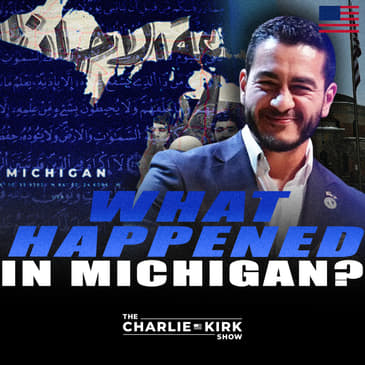
Abdul El-Sayed is the Democrats' Senate nominee — but the race was far closer than any poll indicated after landslide mail vote from Detroit. Mark Mitchell helps ask the question: Just what happened here? Did the Democrat establishment try to stuff ballots against their own left-wing insurgents? And does El-Sayed's win give Mike Rogers a strong chance in the Great Lakes State? Plus, Sara Kleiner explains why permanent Standard Time is superior to permanent DST. Tommy Tuberville joins to talk about centrist GOP cluelessness about the SAVE Act.
Watch every episode ad-free on members.charliekirk.com!
Get new merch at charliekirkstore.com!
Support the show: http://www.charliekirk.com/support
See omnystudio.com/listener for privacy information.
00:00:03
Speaker 1: My name is Charlie Kirk.
00:00:05
Speaker 2: I run the largest pro American student organization in the country, fighting for the future of our republic. My call is to fight evil and to proclaim truth. If the most important thing for you is just feeling good, you're gonna end up miserable. But if the most important thing is doing good, you'll end up purposeful. College is a scam, everybody. You got to stop sending your kids to college. You should get married as young as possible and have as many kids as possible. Go start attorney point, you would say, college chapter. Go start attorny point, you say high school chapter. Go find out how your church can get involved.
00:00:37
Speaker 1: Sign up and become an activist.
00:00:38
Speaker 2: I gave my life to the Lord in fifth grade, most important decision I ever made in my life, and I encourage you to do the same. Here I am Lord, Use me. Buckle up, everybody, here we go. Noble Gold Investments is the gold sponsor of the Charliekirk Show, a company that specializes in gold iras and physical delivery of precious metals. Learn how you could protect your wealth with Noble Gold Investments at noblegoldinvestments dot Com. That is noblegoldinvestments dot com. It's where I buy all of my gold. Go to noblegoldinvestments dot com.
00:01:24
Speaker 3: All right, welcome to the Charlie Kirk Show. It's August fifth, and it would be a Wednesday, which means last night we had the Michigan Primary and everybody was watching for the hotly contested Democrat side of the Ledger Mike Rodgers was uncontested on the Republican side. But it looks like it was a lot closer than we anticipated it. But Abdul Elseiah did, I believe pull it off, barring any surprises. But that's the race has been called by the New York Times and others. He won forty eight point foury eight percent to forty seven point five to one percent, a difference really of about I mean, it's it's razor thin. I mean, it's what is that fourteen fifteen thousand votes separating them. The polling had this thing at like maybe ten right, it was going to be a ten point fifteen points, maybe fifteen. And so because there was so much irregularities, I wanted to bring on an actual polster right at the jump. Here, Mark Mitchell. He's a head polster at the honest polling company. Mark, good to have you back, my friend. There's so many irregularities here. And I want to get into this Trump tweet because he and me talked before the show. I think I misinterpreted it, but directionally we're kind of getting the same thing. But maybe it's slightly a different conclusion here. I'm going to read it and then you have I'm going to have you react to it. So Wayne County Detroit in Michigan is one of the most corrupt voting areas in the United States, if not the world. It is strictly third World. No arguments yet, right, Mark, we're all in agreement with the boss about all that. Yeah, miracles happened in Wayne County, including more votes being gassed than there are voters by a lot. Therefore, the communist who has not liked in Detroit is potentially in vote counter trouble. The radical left socialist has a real shot, And don't discount all of those fake mail in ballots that will surprisingly show up at the last moment. Get ready for another rigged election in November. We must vote for Mike Rogers and make Michigan too big to rig. So I interpreted this as there was funniness afoot in Michigan. There was the establishment Dems came out. They did not want Abdul l Sied to win. They wanted Hailey Stevens to win, and they tried to rig it, and they tried to rig it in some weird ways. Because some of this stuff just doesn't make any sense, Mark, And I'm not sure what the president means then, but you tell me what you think he means and why he's got it a little bit wrong here.
00:03:52
Speaker 1: Well, so we got a break down. We'll go with the end. First, he says, vote Mike Rogers, Okay, are good there? Vote for the Republican. The Democrats shouldn't win in Michigan. But he's tweeting because he's upset with the response of what happened last night? Well, what's he upset about? Syed won and it seems like he would have preferred Stevens to win, which is why he's objecting to what happens with the electioneering, right, And that's wild and totally in congruos because, like what you said, the polling overwhelmingly said that Syed was going to win. The prediction markets both had him at like ninety nine to one. The fact that it was a one point race is actually kind of Nutso it would be one of the biggest polling like misses of the industry that I can recall off the top of my head. And this isn't like New Jersey where you know, hey, it's a special election and it's just after twenty four and there weren't that many people that pulled it, and so of course we were surprised. No, this is like a lot of people were interested in this race, and good pollsters. You guys said fifteen percent. Emerson is a good and you know they missed. Sometimes it's hard. It's getting harder and harder with all of this money, with all the electioneering, with the machine problems that we haven't fixed, with the increase in mail in ballots, And so I look at that race and I say, well, what do we know so far? There was a huge turnout, There was a really big mail interurnout, and Syed massively underperformed the polling. And so what I'm looking at then is why did Syed underperform the polling? Well, he was out competed. Stevens had a ton of money. They were probably doing the things that Democrats do and Democrat states to get their establishment candidate to win because she is the establishment candidate, which was probably handing out packs of cigarettes in the inner city and driving mail in ballots around to the like nursing homes, like all of the things that we know about happen. I think that's what happened. And so I mean Trump's upset that the establishment Democrat won because now you're going to have a DSA candidate, let's be real, the establishment Republican. And that will be really the first time we see a race like that in a statewide race in a purple state. So I think the twenty sixth race for Michigan Senate and all of a sudden got really interested.
00:06:14
Speaker 3: Yeah, And I mean, this is what's interesting. So you talk about electioneering, we know the Democrats do this stuff. We know they play games, They packed you know, these mail ins and these all of this stuff. So he lost early city vote by fifty points, like that doesn't make any sense. Usually the more progressive candidate wins it. This tells me that establishment Dems, especially in some of these black urban cores, they didn't like Elsi ed and they were working against him, doing all the Shenanigans that we are now so accustomed to. Mark, am I wrong here?
00:06:45
Speaker 1: No, you're one hundred percent right. And again like there's an aspect of this that we'll just never know. Looking for instance, at the Emerson crossed tabs and polling's not perfect, and the the sub samples excuse my dog for black vote is probably small in his big margins, Bear, but their poll had Stevens winning by forty among black voters. And then you look at inner city, you know, districts in Detroit, and it's like, okay, they're coming in fifty, they're coming in higher than that in some places. Probably you have Cliburne that was shilling for the establishment candidate probably out there, Like knows how some of these electioneering rackets work. I'm not accusing anybody anything. So I think it's pretty clear like what probably happened. And we're seeing these kinds of things in other races too, where a lot of money gets poured in to help shore up an establishment candidate or ensure that they win. Yeah, and again, like you know, Sayad's crazy, Like yes, we should not defund the police, right, Like obviously he's crazy. But the problem that the Republicans have to wrestle with is that he's going to moderate and he's not going to run on that stuff, and he's going to run like mom Donnie, which is just like, hey, let me give you a big economic hub. I'm here to help save you and fix things. And it's bad for the youth. That's going to appeal to people.
00:08:05
Speaker 4: Well, I want to ask a speculative question mark, which is there was also there weren't super competitive Republican races, so their turnout was lower. But they had a primary for District eight, that's the Flint area, and there was a candidate who dropped out, had stopped campaigning, Thomas Smith, and he actually defeated pretty easily, like seventeen points here Amir Hassan, who was the endorsed candidate by President Trump. And so I guess it's worth asking do you think this is some sort of name factor where people are getting spooked by these more Islamic sounding names and could that end up playing a role in the general election where we have Mike Rogers super generic, you know, English sounding name versus Abdul Al said, So.
00:08:52
Speaker 1: I'm going to try and provide what I think are like the core you know, logic that applies to all all these races when we look at them is that you have your firm, straight ticket Republican base voter and you have your firm straight ticket Republican Democrat voter. They're kind of two different people. The Democrat just wants to win. They don't really care so much about the candidate. The Republican would like to see the Republican do something. And because of that, and because traditionally Republicans don't do as much, there are less of those people. There are less of the core. We know this, like we saw this nationwide electorally. But what there are is this surge volume of people who are a lot more malleable and less ideological, and they don't care about things as much like the muslimsky. It's going to turn them off. So if you're going with those people, you have to have a strategy.
00:09:45
Speaker 3: All right, Mark, I want to get into two things now, and that is the c SPAN caller is this This clip is just gold and I have to play it because I think there's lessons for the Republican side on this as well. And then I want to talk about how brutal this primary was. And you already got Hassan Piker saying we're not gonna mend fences. These guys were calling him a terrorist and all this stuff. So there's I think some opportunity to exploit that. Let's go ahead and start with this. Sod eleven. This is c SPAN College's nineteen years old call her named Brooks. Play eleven Brooks.
00:10:17
Speaker 5: Did you vote today?
00:10:18
Speaker 6: Yes?
00:10:18
Speaker 7: I voted today. I voted for Abdul Alsai. I like a lot of his policies, Medicare for all. But what really convinced me is I've seen Hailey Stevens talk far more passionately about her support for Israel than anything she has for Michigan. So I feel voting for her would leave blood on my hands and I can't do that.
00:10:41
Speaker 1: And how old are you, Brooks?
00:10:43
Speaker 7: I'm nineteen. It was my first election, very excited to vote for abdul al said.
00:10:49
Speaker 3: So, I guess the question is Mark, and I know that you and Rich and some others have basically been saying, hey, this a pac money has become toxic. Whether it's right or wrong, whether it's justified or not. You know a lot of people think of it, think of it as lobbying, for a foreign country. We have to correct the record that these are Jewish Americans, right, But they are interested in Israel. So it's maybe it's a distinction without a difference on some levels. But how prevalent is this when you're polling, especially gen Z, anybody under forty or maybe even fifty, And how much does this bleed into how Mike Rogers should message on this topic.
00:11:27
Speaker 1: Well, that's a lot to answer. First off, you're not going to see people put foreign policy very high on their list of interests when they go to vote. It's just not It's like six seventh or eighth whenever you stack rank these things. But Israel is an issue, and I would really bring up two issues. There's capitalism versus socialism and Israel. And the reason that these young people are going towards you know, candidates like this is because they think that older people are too focused on Israel, and they think that people aren't focused on their economic lively and that's the big one. So overwhelmingly, economy's the number one issue the young voters. I could just rattle off a ton of polling about how they think the entire system is cooked against them, and what's really wild is that most under forty voters, including Trump voters, people that voted for Trump, overwhelmingly support things that sound really socialist, like nationalizing industries or confiscating excess wealth. These are people who call themselves conservatives. I think it was over fifty percent of under forty Trump voters in one of our polls said that they would actually vote for a socialist candidate. So the problem is an optics and messaging problem for the right, okay, And things, in my opinion that aren't going to work are putting is real first, or accusing other people of being a socialist. Young people don't really aren't scared by that. And even I don't think the xenophobia stuff like we talked about before the break is going to be very effective because I think these people want to be put first and are expecting authenticity and quite frankly, the maturity to get into government and sort of like deliver on what you promised and what that needs to be if you want to capture the under Really, it's the under fifty voter now, in my opinion, is national economic populism. And I said this message to Trump last fall, and I wish there had been more listening and maybe now it's too late. I don't know. But what you need to give these people is something to vote for a reason that Republicans long term will fix the problems that are structurally affecting young people in America. And that means providing some kind of meaningful alternative to socialism. And it ain't just more of the same, like Granddaddy's capitalism is not going to win. It might win for a little longer, as long as you keep dumping advertising into the boomer linear television slots. But there's going to be a tipping point, and the young people aren't going to be fighting the same right left battle that the older, more ideological generations are. It's going to be over putting themselves first and getting what they want. And unfortunately for Israel, they made themselves a pretty big whipping boy over this. And I tried to say this was going to be a problem. But and my advice for Trump wasn't like, don't do the Iran strike. It's make sure that you show people that you're still putting their economic situation first despite whatever else you do. And they would let him get away with whatever. I mean, nobody really cared about Venezuela. We were in and out and we were still focused on, you know, the economy and the domestic policy agenda.
00:14:25
Speaker 3: Yeah, and listen, I think this what everything you're saying, I basically, you know, I think there's really well articulated there, and none of this should be interpreted as anti Israel or anti Semitic. No, I think we you know it bears repeating. We think that stuff is brain rot and it's garbage from the pit of hell. But when we're talking about pure politics, it's important to understand what young people are hearing, how they're interpreting it, and what they're voting on. And your message here, I totally agree, is economy, economy, economy, What are my felt realities? And we could tell people they have to cook their own burritos and they need to cook from home all they want, But at the end of the day, things are expensive, and that's not necessarily Trump's fault. I think he deserves a lot of credit for bringing inflation back down, especially when you're navigating the complexities of the Iran war. But the felt, the felt situation for many young people especially is that we just are not getting what we hoped we would get. And maybe those expectations were unrealistic, but that is a lived experience and that has political ramifications. So we just need a message on it. We need we need big national messaging pr battles on this front about what we're doing to address the problems domestically. Okay, I've only got I've only got a few seconds here, so I want to hit this last point. There is carnage after this primary mark on the Democrat side, and I think we need to take a note of it. Here's a Hassan Piker talking about mending bridges. He doesn't like it. It's not six like everyone being like Abdullah's a ton of work to do mending bridges. Here's the take nuke for you.
00:15:58
Speaker 6: Okay, you are.
00:15:59
Speaker 3: All unbelievably islamophobic pieces. Okay, so we're not getting conciliatory messaging from the chief LSI ED pusher, Hassan Piker. Here, what can Republicans do to exploit this mark one minute?
00:16:16
Speaker 1: No, I think they can learn from the situation that what you're seeing is playing out on both the right and the left right now. There are people, intractable people in both sides who are fighting over basically Israel and the economy. And when I say the economy, it's not just prices, it's the idea that the entire economic system is cooked against the younger people. This happened before binding inflation. Remember Bernie Sanders is doing very well with young people long before the inflation was a problem. So what we have is an issue where the workers aren't being represented. There's too much globalism, financialization and rent seeking have ruined everything. And right now again, I think that's the biggest opportunity because it was a natural extension of Trump's platform, which is to realize we have to change the way the economy works for people in this country. You can laugh at his ham piker. I don't know how like effective it's going to be, but we have the same people that are trying to purify through subtraction, which is a term me and Rich both came up with. It's not an effective strategy to build a coalition.
00:17:11
Speaker 3: Mark Mitchell, great stuff, head polster at the Honest Polling Company. Thank you, my friend. I've talked to you soon. Gentlemen, let's get real for a second. Are you frustrated with today's woke dating scene? The apps, the games, the endless swiping it's a waste of time finding a woman who shares your values faith, family, patriotism. If it feels nearly impossible, it doesn't have to. Selective Search, America's leading matchmaking firm, is changing the game. They connect strong, successful men like you, men who love God, love America. Want a family with women who share your values. These are intelligent, faith driven women who put family first and still believe in traditional values. Imagine that. If you're a single conservative man in his late thirties to early fifties in southern California, listen up Eelective Search has an exclusive network of women ready for the real thing. Here's the best part. Their candidate program is one hundred percent free and confidential. Some of our closest friends the show have used Selective Search, and let me tell you, they're meeting great, great women, high quality. This is your chance. This isn't an app, it's your answer. The perfect conservative woman is out there waiting for you. Visit selective search dot com slash California today. Let the professionals introduce you to women already looking for someone like you in Southern California. Don't wait for the perfect match. Take action now. Go to selective search dot com, slash California and start building the future you deserve. We have Coach Tubberville, the great senator from the state of Alabamaho's going to be the next governor of that state, and we're sad to lose them from the Senate, but given how crazy the Senate is getting, I can imagine that selfishly, you are probably looking forward to a change of pace their senator, So we got to talk about it. You are, mister Sharia, you are fighting it at every turn. We now have an Abdul lsa Ed who is the Democrat primary winner in Michigan. He's a man of Egyptian descent. He spent his summers in Egypt. He talked about that last night, and he's a radical communist and he's gonna be the Democrat standard bar in that state up against Mike Rogers.
00:19:22
Speaker 8: Your take, sir, The enemy is inside the gate and they're coming hard. And unfortunately, our education system has pushed a lot of our younger kids. And then of course we have Democrats that are actually democrats, but there are followers, they're not leaders, and they're following this socialist communists agenda to a t and we're fighting it every day here, but we don't have enough fighters on our side, on the Republican side, you know, we we think everything's gonna run on autopilot and it's gonna be okay. If we don't straighten out this country's voting, if we don't straighten out this country's immigration system, we're not gonna make it. It's gonna be over with. And as you said, I'm gonna go back to Alabia. Hey, we might build a thirty foot wall around our state because I know what's coming. I can see it coming, I can hear it coming. I can you know, you can just smell it out there that they want to take this country over and they're not. You know, they're a lot more aggressive than we are as Americans.
00:20:18
Speaker 3: Yeah, I think that's right. So this is this is Abdul lsa Ed talking about his American experience SOT four.
00:20:28
Speaker 9: I know what America gave me.
00:20:30
Speaker 3: I spend summers in Egypt.
00:20:32
Speaker 10: I got my medical education paid for by the NIH and at the same time, growing up just fifteen minutes away from me, children whose families had been here far longer than mine, who never got those same opportunities.
00:20:50
Speaker 3: So he's talking about economics, he's talking about medicare for all, he's talking about making things more affordable. This is their messaging, but it's all going to lead to disaster. It's been tried time and time again. But there's a couple issues. Senator. We have economic illiteracy with so many young people. It's just a fact. I mean, I've talked to them. These are good kids, they're good patriots, they love their country. They just don't they don't understand. I'll never forget. We were doing a round table for our chapter leadership summit, and one of the girls around the table, Senator said that maybe a solution was increasing the minimum wage, as if that would have any practical impact on anything other than making things more expensive. But this is a problem because this message is rosy, and I'm worried that we are not, as Republicans countering it with a positive vision of how our ideas are actually the ones that are going to work. And I'm worried we're not focused enough on that. Your tech, Yeah, well, we don't have a game plan.
00:21:51
Speaker 8: I mean, there's no plan intact up here from the federal government that takes this back to our kids all over the country and explains to them the difference between socialism, communism, and being a capitalist country. They don't realize how good we have it here now. I can understand a lot of them going to these universities and getting a degree in sociology and spending one hundred and fifty thousand dollars or barring one hundred and fifty thousand dollars and getting out and they can't get a job at Walmart because they didn't get a degree that actually you can get a job. Our universities have become a business instead of an educational institution. They want to make money. They enable all these woke professors that have been there for years that are on tenure to preach whatever they want to preach, and they're not controlled. So we got a lot of problems. And President Trump wants to take education out of the federal government. He's exactly right. We have to do that. If we don't, that's going to be a continuation of just indoctrinating these kids in this woke ideology. But again that and then immigration, of letting these people come here from country to agree that that have no clue. This guy says, we deserve nine to eleven. What it's what's been twenty five years? It hadn't been that long ago. What are you talking about? And when I got my degree because of NIH? Who you think paid for your degree? Capitalists in this country paid money, tax money, and NIH has stolen it for years and given it to people all over the world. It is we've got a broken system. The federal gunment's broken. President Trump's trying to put it back together, but unfortunately he's been fought from both sides, from Republicans and Democrats.
00:23:34
Speaker 4: Coach Turberville, I think it's We had a writer on Helen Andrews yesterday and she talked about what should really frighten us is how easy these figures like Hassan Piker, like Elsaiaed, these guys who their parents weren't born here, maybe they themselves weren't born here, but how adept they are at using this lingo of white supremacy of America as a racist country as America because the nation that needs to atone and pay reparations, especially to people like themselves or their parents or their kids who only recently arrived here. And we were also discussing this in context. We still have Republicans on Capitol Hill who say we need more guest workers, more migration from the Third World. We're basically sticking our head into a noose here of let's bring in people who are adopting this rhetoric of let's destroy America, and we're just.
00:24:30
Speaker 9: Feeding it to them.
00:24:30
Speaker 4: And it's so easy for them to build their entire lives and now win elections around it.
00:24:34
Speaker 9: Like who are they fooling?
00:24:37
Speaker 8: Yeah, we're walking into a war zone without a gun, and there's nobody fighting back.
00:24:43
Speaker 6: Everybody, let me tell you what happens up here.
00:24:46
Speaker 8: We're more worried right now about going out and campaigning and trying to keep a majority than we are doing what we should do. How about we take care of the American people. Don't worry about getting elected. I mean, we don't try to play to win up here. All we try to do is and that has gotten us in trouble. We should be passing everything in the world, bust to filibuster, because folks, it is coming when they get control, and it's not gonna be too far down the road with the people we have elected now up here in the Senate and the House. By the way, that we're going to be controlled by these communists, and it's gonna be game, set match.
00:25:21
Speaker 6: I mean, we are we're on the last leg.
00:25:23
Speaker 8: I mean, this is not where this could happen thirty forty fifty years from now. It's gonna happen a year or two now if we don't understand what is happening. But again, we got too many people that love power. We got too many people that are greedy. We have too many people that really don't understand anything other than I just want to come back up here. I want to I want to have my name as a or a senator.
00:25:49
Speaker 3: Yeah, I mean, and that's true. They want they want the title, but we can't even get Republicans to stay in DC during the August recess. Now throw up one eighty two. You are proudly one of these people. And by the way, if you weren't, anybody who's not calling to cancel the August Recess is not allowed on this show right now, I mean probably ever. But throw the image up here. That's a good chunk of the GOP in the Senate. And yet we can't get a leader soon to get behind this effort and get the Save America Act pass. Let's play cut thirteen.
00:26:23
Speaker 11: First is there are no Democrats we're going to vote for this. All forty seven voted against the Save Act five times. So let's make this an issue in the campaign. How about we go out and turn our fire on Democrats and make it about them opposing the Save Act. So we're not that's the point. So we're not getting any Democrats. The second thing is we are not getting rid of the legislator philibusterer. The votes aren't there to do that. I've made it abundantly clear, many many times, and it seems to me some days that I'm the only one here can count to fifty in this town.
00:26:56
Speaker 3: I mean, I just hear that, and I just hear it, just get my blood boiling. I'm gonna be honest. We have had a trifecta of Republican control in the House, Senate and the White House five times in the last century, five times most of the time. It's two years since, and he wants to use it for the next election. Has he not looked at the polling we've got like time is short. I cannot, for the life of me wrap my head around what the hell he's talking about. Cancel the August recess. And I'm sorry to get worked up, but this is just I've been This has been building up in me for so long. Senator, I know you got to keep things collegial because it's what you senators kind of have to do. But what is going on? Why can we not cancel the stink in August recess?
00:27:39
Speaker 8: Well, first of all, there's a lot of Trump derangement syndrome up here. They want the country to stay the way it was. They don't understand how how it's changing underneath us as we speak. I mean, there's a war going on out there. This is not the America that we knew just five, six, seven years ago. This is totally changed. And the president he sees it, he sees it. Okay, you know things have to change here. You got to bust to philibuster. The only way we're going to keep majority is bust to philibuster. Pass everything we possibly can at fifty one, get the country back on track because when and if they do eventually they went, they're going to bust to philibuster. The only way, Yeah, the only way we can get reelected up here is do something for the American people. Let me tell you something. People are going to fight their tails off. If we go on recess at the end of this week, we will not come back until the middle of September. Then we'll go two weeks and then we're going again for another month, and then we have the mid terms. It's gonna be game, set match. You know they're looking at us, going, we gave the majority and you're not doing anything.
00:28:42
Speaker 3: Was of course again, yeah, and why exactly Listen. I am of the perspective that the Democrats are unacceptable. Okay, this country cannot absorb another three to five million illegals every year under the Democrat rule. Okay, we can't. We can't, so that that is out of the option list. Okay, they have lost their minds. The are a bunch of communists. Obviously that's unacceptable. But for the love Republicans, if you don't do your job, people in the middle normies, people that are not clued in, are not gonna come out and vote for you if you don't deliver. If you want to get elected again, deliver for the people. We're out here screaming and hollering, begging these people in the DC to listen to us, and I got like you and Mike Lee I just I cannot wrap my head around at Centater. It's so frustrating. I know you're not done railing against the Save America Act, the fact that we can't get this done, so the floor is your, sir.
00:29:38
Speaker 8: Yeah, Well, it's mind boggling to me how we even have Republicans are against this one set as draconian.
00:29:47
Speaker 6: Let me explain it this way.
00:29:49
Speaker 8: Since I've been here, there's about twelve to fourteen states in this country we will never win as conservative to Christians, constitutionalists, we're not gonna win. They cheat the heck out of us. They're all rigged, and there's over a dozen of them. And so those states will never get a congressman, will never get up a senator obviously, won't get a governor. But the end of the day, if you look at this, it's growing a couple two, three, possibly a year.
00:30:17
Speaker 6: We're gonna get to a.
00:30:18
Speaker 8: Point we're not gonna have any majorities in this country. So we're gonna get run over. So that's a reason we have to And in the past she probably didn't need federal oversight of these elections, but you do now because these people are bound determined to cheat at every turn, and so that's the reason we need.
00:30:35
Speaker 6: To Save America Act.
00:30:36
Speaker 8: Now we're gonna have one shot at it, I think possibly this weekend, and we're gonna do a reconciliation of trying to get a supplemental for the military, which they need about sixty billion dollars, and we're gonna try to connect it with that. Now, somehow, someway, we'll have to word it where the parliamentarian will keep it in there. Now, this parliamentary is a Democrat. She should have been fired when we took over, but we didn't do it. It was a I think a Harry Reid appointment. But we can fire the parliamentarian and if she doesn't go along with this, our leader gon Thune needs to fire immediately because that's what happened. Trent Lott fired a parliamentarian when she didn't agree with or he didn't agree with him years ago and got something across the finish line, we better start playing hardball here, because we're playing softball. We're playing Oh, we're mister nice guy. The hell with that. We have to start playing hardball and get to save America across the line. It will not make a lot of difference in this election. Coming up, but the years to come, if we don't, we're going to lose more and more of these states that are going to figure this out and how to cheat, how to change balance, do the things they need to do.
00:31:47
Speaker 6: And this country will be gone.
00:31:50
Speaker 4: I actually would disagree with you on this election, Coach Tubervelt, for one very important reason which I think Andrew you'd agree. We've been hearing about this all year, the Save of America Act. President Trump has been touting it. We've heard Republican senators, some of the ones who are now slow playing it or saying we can't pass it.
00:32:07
Speaker 9: We're making noise. Oh yeah, we're gonna we're working on this.
00:32:10
Speaker 4: We think we can find a way to get it through. And they've just done these delay tactics, delay tactics, delay tactics all year. And if they get all the way to election day and it's not passed, and everyone decides they were lying to us this whole year, it's going to murder our turnout. They you practically at this point, I think, have an obligation to pass it or the entire base is.
00:32:29
Speaker 9: Going to feel like they were cheated.
00:32:30
Speaker 3: And I say, Coach, you know, you go back to that Thoon clip. He's saying, am I the only one in Washington who can count to fifty? No, sir, that is an idiotic thing to say in a microphone. Okay, first of all, Second of all, just do the dang vote. Just do it. Go out on the floor and do the talking filibuster likes Senator Lee has been proposing, and put names on the board so we know who to primary next. If you're going to vote against this, and then I want to know. Okay, that's and by the way, the American people deserve that, they deserve the transparency. Go show that you actually are willing to let the process play out even if you don't have the votes. Stop covering for these cowards and make them put their name on the line.
00:33:12
Speaker 6: I totally agree with you. Now.
00:33:13
Speaker 8: The last time we put it for a vote was in reconciliation back in June. I think Lindsey Graham had it as an amendment, and we got forty nine votes. We made progress, We made progress, We got forty nine. We can add more. But again, at the end of the day, it's either got to be a fifty one vote. We can't get sixty because none of these idiots on the Democrat side are ever going to vote for it. But we can get to fifty one through reconciliation. If we just press people and let them know how important it is. They'll start hearing from people back home. But if you don't vote, vote on it, like you said, then your constituents don't know who's against it. And so this weekend will be a big test. It'll be a big, big, big days a country, I would say Friday or Saturday. And Ron Johnson wants a reconciliation. He's the new budget chair, taken over for Lindsey Graham. He said he'll run the floor, he'll do it the right way, and I think we'd have a great chance.
00:34:09
Speaker 6: Again. We got to have a leader stand up and say enough so enough of this.
00:34:13
Speaker 3: Yeah, you know, coach, this is the problem, I think. And I'm just being cards on the table. I've called for him to be removed now and I think he's earned every bit of that. And but here's the deal. If you don't actually call the vote, if you don't do the things, then you're just a coward that's covering up for other cowards. Okay, I don't care if you don't have the votes, we want the vote to happen, and we want to see who's voting against the interests of the base. We want to see who is betraying conservatives. Because you're right, time is short. People don't understand what we're up against, the demographic landslide that we're facing as a country, the fact that we've got distractions in the Middle East instead of focusing domestically. This is serious business. So we got we got one last last shot at this and we got to get it done. Failure is not an option. Final minute to you.
00:35:00
Speaker 8: Well, exactly right. We've got a lot of problems in this country, a lot of them, and we're stopping a lot of the fraud. You know, we lose one hundred million dollars an hour, three hundred and sixty five days to money that we lose to fraud and theft in this country.
00:35:13
Speaker 6: One hundred million. How stupid is that?
00:35:16
Speaker 8: And that's the reason that we need thase we needed President Trump to come in. We got to cut back on these day bureaucrats or are stealing this blind the American people need to wake up and get out and vote. My god, folks, this is this is this is past serious. Uh, we only had twenty percent of the people vote in Alabama in the primary, twenty percent. We better get upwards of fifty sixty seventy percent in some of these states or we're gonna get whitewashed. People are gonna run right over the top of us, and especially these states that are going to jam the ballot boxes with all these fake ballots. So folks, we got to go vote. We got to go vote and take our country back.
00:35:55
Speaker 3: And you saw that last night in Michigan. By the way they're stuff in ballot boxes. I mean, some of these returns didn't make any sense. The establishment Dems were doing all their electioneering shenanigans to try and rig it for Stevens. It wasn't enough, but it was darn near enough. I think the margin's fourteen k right now. I mean nothing else IAD's gonna win, but they tried like heck to steal it. So we have to vote. You're absolutely right. The only thing that can overcome it is being too big to rig in these states because we haven't fixed crap.
00:36:22
Speaker 6: Rorist. He's a terrorist.
00:36:24
Speaker 3: Thank him back to that. I agree with you. God bless you, sir, You're one of the good ones. If you're struggling with cravings, bloating, and stubborn weight gain, your gut health is probably playing a bigger role than you think. A damaged microbiome can affect everything from inflammation and digestion to cravings and weight gain, and with today's process foods and environmental toxin, a lot of people's digestive health is taking a big, major hit, which is why taking care of your gut health may be more important now than ever before. That's where a fermented food called kimchi can make a real different It's kimchi is naturally rich in over nine hundred probiotic strains that help support gut bacteria. Because when your gut bacteria are properly supported, your body is better able to process food efficiently, regulate cravings, and support digestion even maintain a healthier metabolism. Overall, studies show that eating kimchi can reduce your body fat by thirty one point eight percent, but supporting your gut microbiome takes consistency, and most people aren't eating kimchi every day because of the taste, of the smell, the hassle that comes with getting it. That's why bright Core created Kimchi one, delivering the benefits of fermented kimchi in a convenient capsule form to help restore your gut's natural balance every day, because when your body is functioning properly from the inside out, everything else becomes easier. Today, you can get an exclusive offer by clicking on the link below for twenty five percent off your entire order, or for an even better deal, call our friends over at bright Core for up to fifty percent off your order and free shipping. Give them a call right now. Eight eight eight three one seven nine two five eight. Kim Chi one from bright Court Health starts in the gut. Get twenty five percent off. Use code Charlie at bright cored dot com slash Charlie. That's bright cored dot com slash Charlie. Or you can call eight eight eight three one seven nine two five eight for up to fifty percent off. That's eight eight eight three one seven nine two five eight for up to fifty percent off your order and free shipping. I'm very excited about this next conversation because everything is about the economy right now on social media, the whole debate. I've accidentally sparked another one about burritos. Blake's been weighing in. He he likes cheap burritos, but that's fine.
00:38:42
Speaker 9: Don't I don't know the last time I've actually had just a burrito. We're gonna do.
00:38:46
Speaker 3: You're gonna have one this week. It's gonna be a whole thing. But here to help us discuss is David Blize. He's the pastor and director of Patriot Mobile Faith. You can find him on Exit Faith Mobilized. He does a lot of great content and he's got a just a really important perspective on this whole debate. So, Pastor, welcome to the show. It's great to have you. And I'm excited to get into this because the clip that started this whole kind of debate actually was one with our friend Jack Posobic. It was actually a back and forth. I mean, people are losing this, you know that didn't like what Jack had to say, Like you know, we had Mikey McCoy arguing with him on the clip. But anyways, we'll play the clip and then we'll get your reaction on the other side. Top fifteen.
00:39:29
Speaker 4: He should we are capitalists, like we are fundamentally pro somebody spending their wealth how they want.
00:39:35
Speaker 9: To spend their wealth.
00:39:36
Speaker 6: I don't.
00:39:36
Speaker 9: I don't think we should.
00:39:37
Speaker 4: I don't think we should center our our country around capital.
00:39:41
Speaker 9: I think that's I think that's not Christian.
00:39:43
Speaker 3: All right, pastor your reaction to that now infamous clip.
00:39:48
Speaker 12: Yeah, and then I want to talk about the burritos because that's crucial as well.
00:39:52
Speaker 9: Yes it is.
00:39:53
Speaker 12: But yeah, so I saw this clip, and you know, the first thought that I had, you know, labeling I'm not a capitalist, I don't know what that means. You know, maybe it's because we're saying I'm a Christian first, you know, I can understand it. And then he said, I don't think we should center our country around capitalism. And again, I like to give grace first. I'm a pastor. I need grace to we all need grace. Maybe he's saying I want to center the country around biblical values and morality. Hey, that's great too. I agree with that. We don't want to center around a system. We don't want to center it around democracy, we don't want to center it around capitalism. We want to center it on the biblical morality, the biblical foundation that we're endowed by our creator, our rights are given by God. The government only helps enforce those rights, protect those rights, not give those rights.
00:40:45
Speaker 5: However, I think this plays into.
00:40:48
Speaker 12: Just this idea that we see on social media about capitalism and socialism, and capitalism is sometimes just portrayed as greed. But here's how I always see really the value statement. Capitalism values freedom, and that is why it is not a perfect system. It's the best system that we've found economically because it values liberty, it values self determination. It values that you get to spend your own money, and you get to be generous if you choose so, because generosity has to be a choice. The other option is socialism, which values fairness, and the government wants to take you know, sees your capital and then they give it out. That's not generosity because you can't be generous with someone else's finances, with someone else's money. And so we have to be aware of what the foundation should be Biblical morality, because that provides the guard rails for capitalism to succeed. Why would capitalism succeed because you have biblical guard rails? Then you know, the Conservative party historically is way more generous. Why because they have the freedom to be generous. The downside of capitalism is if left unchecked, it will develop greed, it will develop selfishness, a love for money.
00:42:08
Speaker 5: The Bible has a lot to say about that.
00:42:10
Speaker 12: But the answer to that is not, well, then let's just get rid of capitalism, because what you're saying is let's get rid of the freedom, let's get rid of the choice.
00:42:17
Speaker 5: Well, God didn't do that.
00:42:18
Speaker 12: God didn't say, hey, Adam and Eve, you're done making choices robots now, No, he said. Essentially, God says, I am going to risk what is on the other side of giving freedom, which is they could use that freedom to be generous or to be selfish.
00:42:35
Speaker 5: But that's the risk.
00:42:36
Speaker 12: So capitalism is the most biblical economic system that we have because it values freedom and choice, which is something the Bible has a lot to say about, and stewardship and generosity. It's not the perfect system. It reminds me of the quote about democracy. Democracy is the worst form of government except for all.
00:42:54
Speaker 5: The other forms.
00:42:55
Speaker 12: So we're not looking for a perfect system. We're looking for the most biblical system to run economics in a nation. And historically speaking and biblically speaking, it's been capitalism. It doesn't mean it's perfect. Of course, it can lead to greed and selfishness.
00:43:10
Speaker 5: But that's the.
00:43:11
Speaker 3: That's the the totally you know.
00:43:13
Speaker 5: The risk of freedom.
00:43:16
Speaker 4: I think that's that's so correct, and I think you want to take the long view here. You mentioned that capitalism has given America the wealth to be generous, and I think it's worth reminding people how unusual America is in that regard that we are a nation of givers in our own communities and around the world. Basically there are almost entire countries that are reliant on the charitable giving of Americans. That America is the country that produces missionary far more missionaries than any other country come out of America to go around the world. And I think that's directly linked to our free market system, even our way of our very energetic church environment, the way that there is so many different competing Protestant churches Catholic churches that there were very on the ball religiously, and I think that's actually a side effect of having this capitalist worldview that if you don't like the way something works, you can.
00:44:10
Speaker 9: Go and make your own version of it.
00:44:12
Speaker 4: Well, and what we see in socialist countries is everyone instead they lose the capacity to do that. It's always the state should come in and bail me out. The state should decide this. I don't have the ability to decide for myself, and I eventually you don't want to decide for yourself anymore.
00:44:27
Speaker 3: To the extent that it needs clarification because I think there was some consternation about that clip, like what is TPUSA stand for? No, no, no, We are pure capitalists, like in the sense that we are very pro capitalism with guardrails, with biblical guard rails. We're not pro greed, we're not pro materialism, we're not pro worshiping at the altar of you know, having billions of dollars or anything like that. You know, Charlie would often say that capitalism is the most proven, moral and effective economic system in the world. And you know, you said it's the most we've ft, the best we found. Well, it's kind of actually inverted that it found us. In many ways, it's kind of a natural outflow of the human spirit of the way we are wired to freely exchange goods and services and and so so there's no hopefully there's no lack of clarity on that front. And so, but I love the what what you're bringing in what so much of our The solution to our problems in this country is not more government. It's we need to be better people. We need to we need to cry out to the Lord to make our country great. From a character standpoint, from a faith standpoint, that's the answer to so many of our problems. And when we invite government in it usually, you know, in Reagan's famous words, I'm not a huge uh Reagan quota all the time, but you know, the the was the scariest words in the English language is I'm I'm from the government and I'm here to help. Final minute in this segment to you.
00:45:53
Speaker 5: Yeah, no, I think it's I think it's really important.
00:45:56
Speaker 12: And I think when we understand that the number one value of these two systems capitalism values freedom, it values liberty, and that makes sense why America has has been a capitalist nation is because what was the founding principle life, liberty and the pursuit of happiness or John Locke life, liberty and property.
00:46:19
Speaker 5: So it's what it's saying is that's a value statement.
00:46:22
Speaker 12: Number one thing is life, and then the other two are my personal happiness, my self determination, and my liberty.
00:46:29
Speaker 5: The government can't take those away from me. And they didn't give them to me.
00:46:32
Speaker 12: And you ask any you know person that values socialism, they value fairness. Hey that's great. My kids love fairness too. But you know when they realize fairness is not the greatest value is when you go to a school and you say, hey, equal opportunity, right, that fair? Yeah, it's fair, equal opportunity in equal you know what is it called a outcome? And they're like, yeah, yeah, it sounds good, sounds right, and the UK okay, uh so here's your test scores. You got an A, you gotta B, you gotta C, you gotta D, you got an F. Let's just everyone's gonna C minus sound good. Fair, that's fair And students like.
00:47:12
Speaker 3: Whoa, whoa, whoa. Yeah, socialism is not fair to the producers and the people who work their tails off and yeah, sacrifice sleep and all this stuff. So you are your pastor and director of Patriot Mobile Faith. We love Patriot Mobile, by the way, great capitalist company, great success story, all American success story. I want to talk about this distinction because I have talked to Jack about what he meant by that, and I'm assuming we're going to get to it in Thought Crime this week, as well, which is our Thursday streaming show.
00:47:39
Speaker 1: You know.
00:47:39
Speaker 3: So for him, he was saying, yeah, I'm a national populist, which incorporates capitalism, right, But it's sort of a way of saying, we're going to apply certain sensible regulations to make sure that we're directing and incentivizing capital in the country in ways that benefit the nation, right. So as opposed to offshoring and hollowing out our industrial base and shipping all the jobs off to China in exchange for rubber trinkets that's going to end up in the trash some day, We're actually going to incentivize through tax code regulation, that companies invest here, that they hire American, that they do things that are good for the American population. So, you know, Jack wrote a whole book hitting communism and attacking communism by no means. I think it would be a very unfair interpretation of his comments to say that he was somehow against capitalism. But I do think that this is a worthwhile debate to have, and I think we're going to be having it ahead of twenty twenty eight about the right way to talk about capitalism. And my concern and then the floralill be yours is that if we don't do this, young people are so inundated by this pro socialism message that they're going to say, well, I don't want the old way as it's been, and this is a way to sort of filter that message and thread the needle and say, hey, we're hearing your concerns that the middle class work class is getting hammered in some ways, especially when it comes to burritos and affordability, but we're not ditching capitalism. Your thoughts.
00:49:09
Speaker 12: Yeah, I think when it gets down into the nitty gritty, which is one of the reasons why you know, clipping up something can be so destructive because you take something out of context.
00:49:19
Speaker 5: Well, we do that with scripture too.
00:49:20
Speaker 12: We take one verse out of context and we can make it say whatever we want. And so I think what we have to constantly go back to, unfortunately, is defining terms. What do you mean when you say capitalists? And if someone says, oh, you know, I'm.
00:49:36
Speaker 5: Greedy, you know, money hungry, You're like, Okay, that's not what I mean by capitalism.
00:49:40
Speaker 12: I mean when capitalism I mean the economic structure in which we value freedom of exchange, freedom of movement, you know, generosity, all those things liberty, and so we have to we have to define those terms and then juxtaposed to the other options. When when you're talking about you know, populism, then now we're like you said, threading a needle. Okay, what do we mean by that? It's not anti capitalism, but we're wanting to benefit our nation first. Well that's great, and the America First movement has then taken that to me and okay, America first, And now we have to define do we mean America first or America only? Because if we have this biblical foundation that we're talking about, the Bible has a lot to say about the Church caring for orphans and widows, the good Samaritan caring for your neighbor, and so as long as we mean America first, like the analogy often given of the oxygen mask coming down on the airplane and putting yours on first, because if I'm incapacitated, I can't help my neighbor, I totally agree with that. But if we're saying America only, that we shouldn't be involved anywhere outside of our own borders, well that's taking away the biblical principle of generosity and kindness and loving your neighbor. So that's I kind of always find myself having to go back to redefining terms that have been outlandishly used in the in personified to mean one small definition capitalism means greed or whatever it is.
00:51:14
Speaker 3: Yeah, and David, I have a perfect example of this that, you know, pure unfettered capitalism. It can lead to excesses, it can lead to bubbles, it can lead to monopolies. This is why conservatives are re examining the legacy of somebody like Teddy Roosevelt, right, the famous trustbuster. He believed that the monopolies that had developed during the Gilded Age has basically resulted in uh, you know, I guess, excessive prices for consumers, excessive influence among a very elite oligarchy that had developed, whether that be economic influence or political influence. And so he broke up some of those companies and there, you know, there are benefits that could be had from those types of things. Now, another limit that we put on capital is immigration. Right, Big businesses would love to flood the nation with unfettered mass migration of Third worlders and cheap slave labor, and we have rejected that at the ballot box when we elected President Trump. Now that doesn't mean that you have to be an absolutist on any of those things, but it does mean that obviously there are sensible things that you can do to regulate or incentivize the movement of capital to best suit your national interests.
00:52:22
Speaker 4: And I think I think it's actually worth emphasizing that point that a friend of mine pointed out. I've been talking to him about this, and he says, one of the better ways if you want to defend capitalism is just really defend against all the other stuff they want. Because so many of the people who are complaining about capitalism, they're actually totally in league with them on let's bring in the entire third world here, So they'll actually concede them that point and say, oh, actually, yeah, let's give big business.
00:52:48
Speaker 9: What they want.
00:52:49
Speaker 4: Endless migrant labor, endless slave labor, endless like literally illegal immigrants. They actually just want to crash America, blow it up, and we should be pointing that out and fighting against that. And you really just get I think I think you get capitalism almost as a side effect of it. You don't need to say we're shilling for business. You just say we're rejecting all of these ideas that are clearly motivated by people who hate America and want to burn it down.
00:53:14
Speaker 12: I just think we're, as believers, were called to hold the tension between oftentimes two incredibly unhealthy extremes, and media often wants to push to the extremes. And we find Jesus often holding at tension between compassion and truth and not having to sacrifice one for the other. And I think we can do that with almost every debate. What's the tension here because we're not going to go to these extremes. It's actually more nuanced. But as a comedian said, the new N word is nuanced. We don't want to talk about it, and it's like, no, we need to talk.
00:53:44
Speaker 3: About a pastor Ecclesiastes seven eighteen. Whoever fears God will avoid all extremes. God bless you. We'll talk to you soon. Hi, folks, Andrew Colvett here, I'd like to tell you about my friends over at why REFI probably been hearing me talk about y REFI for some time now. We are all in with these guys. If you or someone you know is struggling with private student loan debt, take my advice and give them a call. Maybe you're behind on your payments, maybe you're even in default. You don't have to live in this nightmare anymore. Why ref I will provide you a custom payment based on your ability to pay. They tailor each loan individually. They can save you thousands of dollars and you can get your life back. We go to campuses all over America and we see student after student who's drowning in private student loan debt. Many of them don't even know how much they owe. Why ref I can help. Just go to y refi dot com. That's the letter, why then refi dot com. And remember y Refi doesn't care what your credit score is. Just go to yrefi dot com and tell them your friend Andrews sent you. Gonna talk about daylight saving time or standard time. We're gonna have that debate. It's about to not a debate. Standard time is superior. This is what this is the problem with this debate. Everybody's so dug into their ideological trenches.
00:55:06
Speaker 9: Yeah, but my trench is correct.
00:55:08
Speaker 3: So without further ado, I'm I'm so excited about this. So we have Sarah Kleiner joining us Welcome to the show, Sarah. I'm gonna give you a little bio here. You're the creator of the my Circadian app. You're board certified and applied quantum biology by the American Naturopathic Medical Board. You've spent over fifteen years of working one on one with clients to optimize nutrition, lifestyle, and mindset. Your goal is to shift the way we think about circadian rhythms, health, nutrition, and light so we can better integrate those into our life. And doesn't matter what stage of life or anything like that. So we're honored to have you. You come very highly recommended by Alex Clark, who's our official MAHA expert around here. So it's great to have you.
00:55:51
Speaker 13: Thank you so much for having me.
00:55:52
Speaker 3: Yes, absolutely so. Trump. President Trump wants permanent daylight saving time. Blake wants permanent standard time. What is the right answer?
00:56:03
Speaker 14: I mean, the American Academy of Sleep Medicine and every single circadian scientist that I have ever spoken with is on the time of permanent standard time. That's the one that aligns with our biological clock. We have mountains of evidence to show how important it is for anxiety, depression, obesity.
00:56:23
Speaker 13: Heart health.
00:56:23
Speaker 14: I mean we have the research available and I have I saw the I guess it was a statement Trump put out yesterday that Riley was kind of enough to send me and kind of have looked through a lot of that, and I have a lot of thoughts on some of the things he said. There's there's some half truths in there. But I'm definitely on team permanent standard time.
00:56:45
Speaker 3: You and Blake are on the same team. So that that means God's time man out and I have to go a devil's advocate. I have to play at devil's advocate here. So this is the quote from Trump. For many years, the vast majority of Americans have asked to make daylight savings time permanent, but no administration has been able to get it done till now. I'm proud to announce the House of Representatives has passed the bill and it has now gone to the Senate for final approval. People are sick and tired of having to change their clocks twice a year. This we agree with, right.
00:57:11
Speaker 13: That the whole change the clocks, We agree with that.
00:57:14
Speaker 3: Yeah, it's he says, it's foolish, inconvenient in some cases, very costly for cities and states, with watch towers and hard to reach places. It costs millions of dollars. A recent case was made that it is also bad for your health and the anxiety it creates. Leading medical, crime, and economic studies have shown that ceasing the bi annual time change, giving us one extra hour of natural sunlight in the evenings, will help decrease robbery and murder rates, reduce car accidents, et cetera, et cetera. So, okay, Devil's advocate here. So Danny on our team grew up in the Upper Midwest. He says that on Standard time in the winter, I believe I'm getting this right. Standard time in the winter, it was basically it's like dark all all morning long. Or is that? Am I getting that right?
00:57:57
Speaker 4: This is what's so confusing about So it's because you're in the Upper Midwest, the days are shorter, and when you're on Standard time, the sun is also going down earlier in the evening.
00:58:05
Speaker 3: Yeah, he basically does, he doesn't want more dark at a certain time. I'm going to find his note here, but he was he's very very open to this permanent daylight saving We're on.
00:58:15
Speaker 4: Permanent daylight saving time. The sun is going to rise very late and very late. Yes, right, so this okay, So here here's a let me, let me reboot. There is a robbery issue.
00:58:28
Speaker 3: So when you have it light later at night, there is data to indicate that robberies decrease potentially as much as like twenty five percent. So have you seen any of that data and do you agree or disagree.
00:58:41
Speaker 13: I've seen the data.
00:58:42
Speaker 14: It's anywhere from seven percent to twenty seven percent. So I'm definitely not going to refute that data. I don't want to have anyone.
00:58:49
Speaker 13: Fact check me. That's that's data. However, this is.
00:58:52
Speaker 14: Basically going from November to February, and it's from the hours of five pm to eight pm, and it's a it's a real trade off. What we do have is we tried this in nineteen seventy four and within about two months, the approval rate went from seventy nine percent down to forty two percent because there were children being killed at bus stops and people hated it so much.
00:59:17
Speaker 13: They hated the dark mornings.
00:59:18
Speaker 14: They thought they wanted it because it's kind of the same thing happening again. Everyone, we're going to have this extra hour and we're not really getting anything extra we still have to deal with winter, which is a shorter photo period.
00:59:30
Speaker 13: You know, it's that's not being talked about.
00:59:32
Speaker 14: And so what we're taking off the table is the ability for millions of people to actually get the morning light signal, which, as I've said, has robust data around it that they need in order to avoid a lot of health problems.
00:59:47
Speaker 3: This is okay, So I did have it backwards, so on standard time, if you do permanent standard time, it will get light earlier during those winter months. Right, Yes, it'll say how it's been.
00:59:58
Speaker 14: It'll just be how it's been because what we are in right now is DST right. And then if the clocks change, if we just continue with current the way things are, then we'll do that falling back thing, and then in the spring will spring forward. And it's when Trump is saying there's health issues associated with the time change, He's correct, But that is because we strip away that hour and spring that's where we see the increase in heart attack and stroke, cardiac events, mental health episodes, car accidents, all of those things. So that is correct, but that is because we're changing the time and taking an hour from people.
01:00:34
Speaker 3: Right, So if we just kept one or the other we'd probably deal with some of these issues.
01:00:39
Speaker 13: But we would love to just keep one right, just right.
01:00:42
Speaker 3: But just your argument is that that morning sun is really really important for health outcomes. So if you go to same time, it gets like a little bit earlier. So explain why that's so important. So you go, I've heard people tell me that when it in the morning, you got it sort of expose your body to natural sunlight to sort of kick your body into gear.
01:01:04
Speaker 14: What is that about, Well, you have a master clock in your brain that is essentially primarily signaled by light.
01:01:11
Speaker 13: It's called the super chismatic nucleus. And when the eyes.
01:01:15
Speaker 14: Get this signal from light, it signals every single sell and organ system in your body, which also runs on a circadian clock. Which is why in my practice I have people reversing autoimmune conditions getting pregnant after failed fertility treatments.
01:01:29
Speaker 13: I'm going to have a huge.
01:01:31
Speaker 14: Bank of people who have reversed health issues by simply doing this practice of going outside in the morning. So we, like I said that the circadian research is robust here and the argument I get because I've spoken out on this a little bit on social media and gotten this is one topic.
01:01:48
Speaker 13: Whenever I talk about it online, people get so angry.
01:01:51
Speaker 3: Oh, it's amazing, it's amazing. Correct camps. The camps are firmly entrenched. You're right, you're waiting into to perilous waters.
01:02:02
Speaker 13: Well, when you mess.
01:02:03
Speaker 14: With people's time, you're messing with their life. It's very personal to them. I just think that we're they don't really understand how this works, because it's like I've heard this old Indian proverb that says you're taking a blanket and chopping, you know, tearing off the top part of it and trying to sew it onto the bottom and say, acting like it's better.
01:02:23
Speaker 13: It's not.
01:02:24
Speaker 14: Because if you don't get that signal in your eyes in the morning, if you don't get enough brightness, you're not clearing residual melotone in you are not resetting those circadian clocks that influence your appetite, regulation, mood, all of those things need that bright morning signal. So you might get this extra hour, but guess what, you're going to feel kind of depressed and be it risk for obesity lethargy because you never got that proper wake up signal that Again, the circadian science is pretty robust around this topic.
01:02:55
Speaker 3: I'm looking at the sunrise.
01:02:57
Speaker 4: I just I'm plugging in sunrise in different city on January first, right now, and then add an hour.
01:03:02
Speaker 9: If we were.
01:03:03
Speaker 4: Imagining permanent daylight savings time, it would be you wouldn't have the sun come up in like Minneapolis until about nine am if we were on permanent daylight savings time. On this is January first, so one of the shorter days of the year. It's about nine in Detroit. I check to Bismarck, North Dakota, so that's at the far western edge.
01:03:21
Speaker 9: Of hunchy time. Nine to thirty a nine to thirty sunrise there.
01:03:24
Speaker 4: If we had permanent daylight savings time right now, it's happening in the eight o'clock.
01:03:27
Speaker 3: Out so people are already at work and there's no sun and it's so bad.
01:03:31
Speaker 9: One of the things that really makes this extreme.
01:03:33
Speaker 4: School starts so early because they want to make it so parents can take their kids to school and then go in. So you'll have elementary kids getting up two three hours before sunrise in these places so they can go to school.
01:03:46
Speaker 3: Yeah, it'll be dark at reschool at eight o'clock eight thirty. The sun doesn't rise for another hour and a half. That's that is wild to think about. That's on day permanent daylight savings. Yes, yeah, what does that do for children?
01:03:58
Speaker 14: It's terrible for children. I mean, children need the sunlight signal. It's so incredibly important for their hormones, for their brain. The number one treatment for anxiety and depression is bright light therapy upon waking. So that is very established research. And so we already have a depression and anxiety and mental health crisis going on with our children due to so many factors. I'm sure we would agree on. I've got two kids myself, and now we're going to strip away the ability for them to get that bright light signal, which could potentially offset some of the negative impact of what they're already up against as a as a generation.
01:04:38
Speaker 3: Wow. Yeah, I mean, it just feels like we're making the right choice in the sense that we're trying to get rid of this pesky clock change, which seems I mean, it seems like everybody's basically against that. And I would love to hear your thoughts out in the audience. Send us an email Freedom at Charliekirk dot com if you have any questions as well. What do you think you'd prefer permanent daylight saving time or permanent standard time, A little lighter in the morning or a little lighter at night, that's the question. Sounds like we need that let light signal early in the morning, which is something I've heard about and I actually have tried it and just stood out there and tried to get sun in the morning, and you do kind of feel it. You feel revived in an awake a little bit faster. What do you tell us about your my circadian app, Sarah.
01:05:21
Speaker 14: Yeah, I've been coaching people in this circadian health space for the last number of years after actually having my own miracle baby in my mid forties and he's three now, so I'm really passionate about this. Yeah, thank you awesome little boy, and circadian lifestyle helped make that possible. And so I wanted an app that helped people understand when sunrise happened for them. When UVA, which we were talking a little bit about this morning light UVA is when you're making serotonin, dopamine, beta endorphin, these appetite hormones all come online, and I wanted them to understand when that was as well as when they could make vitamin D because you can't make it year round, and then measure lux.
01:06:02
Speaker 13: Which is this most well studied measurement of light. The app has a lux meter in it.
01:06:08
Speaker 14: You want to get a ten thousand lux threshold in the morning, and you want to keep your lux below ten at night the three hours leading up to bed and zero in your bedroom, so you can measure that and that's going to really help you keep your circadian rhythms dialed in. And you kind of have it there in your pocket.
01:06:23
Speaker 3: Oh that's great. So why would it affect fertility?
01:06:27
Speaker 14: I'm just curious, oh man, Because, like I said, every single cell and organ system in your body is impacted by the signal of light. Your hormones run on a circadian rhythm, and that morning sunlight signal is incredibly important for.
01:06:39
Speaker 13: What we call the HPA axis, which is.
01:06:42
Speaker 14: Going to signal your master hormone pregnant alone to talk to the other sex hormones. So if you're not making these hormones, especially in the morning, you're going to deal with fertility issues.
01:06:52
Speaker 13: And then we have the issue at night. It was women used to actually cycle with the moon.
01:06:57
Speaker 14: We have some really interesting data that came out in around twenty ten that showed women stopped cycling. Actually that the research came out in twenty twenty two. It was done in twenty ten that showed women cycled with the moon up until that time. What happened in twenty ten we all got smartphones and so women fell out of sync. Their menstrual cycles became irregular in twenty ten because of this artificial light at night issue that we all have now.
01:07:24
Speaker 3: So wait, wait, wait, wait, hold on, So smartphones broke women's menstrual cycles.
01:07:31
Speaker 13: It's a thing.
01:07:32
Speaker 14: It's a thing.
01:07:34
Speaker 13: There's been books written on this topic.
01:07:36
Speaker 3: Kidding. Wait, So just because women are like scrolling Instagram at night that broke their cycles.
01:07:42
Speaker 14: I have women reverse hot flashes when I get them to get off the dang phone at night.
01:07:48
Speaker 9: Women.
01:07:50
Speaker 3: If a woman wants to get pregnant and she just wants to make sure everything's you know, her circadian rhythms are right, what time do you recommend stop you know, stopping this rolling.
01:08:01
Speaker 14: I mean the science is ten lucks and below the three hours leading up to bedtime.
01:08:06
Speaker 3: So you've got ten lucks off your cell phone screen, even if you turn it all the way dark.
01:08:12
Speaker 14: And you get the blue light. Yeah, you get blue light, you get that lux I mean, and that is enough to keep the brain making cortisol and restart kickstart that sex steroid hormone pathway at night, which is the opposite of what we want. We want malatona to come in because melatonin is actually a very reproductive, powerful reproductive hormone. It's actually a very powerful hormone for cancer prevention. I mean so many things that if you look at the data with artificial light at night.
01:08:40
Speaker 13: And cancer, you will be astounded. I mean, it is.
01:08:43
Speaker 4: Robust and a way a lot of people have tried to deal with a certainly on large computers, they'll get blue light filters so that you know, it basically makes their screen orange at night.
01:08:54
Speaker 9: I know, I definitely have.
01:08:55
Speaker 3: Seen women they'll get.
01:08:56
Speaker 9: I think they get kind of.
01:08:57
Speaker 4: These spectacles that are supposed to filter.
01:08:59
Speaker 9: Out blue light whatever. They're not glad, I don't know.
01:09:01
Speaker 4: They're not for vision correction like me or even And I imagine you can probably get a similar app for your phone. Does that do enough or is that just sort of putting a band aid over it that doesn't do that much and you're better just not using it at all.
01:09:16
Speaker 13: It helps.
01:09:17
Speaker 14: It absolutely helps, And that's why I have that luxmeter within the app, because you can have to use your partner's phone to measure what's coming off your phone. Keep it below ten, turn your blue light filter on where you're blue blockers.
01:09:28
Speaker 13: That's going to help.
01:09:29
Speaker 14: But the other thing that can keep your brain making cortisol is the brain waves that you're going to essentially make from being on your phone. You're going to stay in a high beta state, which can also block melotone in. So there's a fine line you have to walk with it. When I want people to be compliant, I'm going to say, get the blue blockers, turn the dimness down on your phone, measure it good red.
01:09:52
Speaker 13: Light bulbs in your home. That's going to help tremendously.
01:09:54
Speaker 14: But at the end of the day, I want you powered down and sleeping so you can make all that melatone at night and reap those health benefitts.
01:10:02
Speaker 3: So what about so I know everybody's I know you're gonna tell me I'm doing it wrong, and that's probably fair. I watch TV at night before I go to bed, or I read a book, so it's one or the two, and I try and do more reading it admitted like, for years I was like not reading, I was watching TV, and now I'm about seventy percent of the time, I'm reading a book before I go to bed, but the wife and I will watch a show together or something, you know, put the kids down. How bad is that? I tend to just like calk out like it doesn't seem to affect me. But how bad is that? And am I doing it wrong?
01:10:37
Speaker 13: Yeah?
01:10:38
Speaker 14: Well, the great thing I love about the app is that you can take your blue blockers, put them over the lens and measure at eye level. Because I like to watch a show every Sunday night right now this on, I like one show a week. I let myself do that. So I'll sit from where I'm at on my couch, measure the lux I'll have my blue blockers on, and I can typically get even my TV down to about six lucks without doing anything.
01:11:02
Speaker 13: So we're the blue blockers.
01:11:04
Speaker 14: Watch your show every now and then stick to your seventy percent reading, and you're going to be ahead of most people.
01:11:11
Speaker 3: So, but you said the brain waves though, even aren't you still having some of those brain waves that are keeping you up with reading?
01:11:17
Speaker 14: Yeah, it's a it's a trade off. I mean it depends on what you're reading, right.
01:11:23
Speaker 3: Reading about English history, I mean, is it better to read really trashy novels or something that are like low brain effort versus I don't know, philosophy.
01:11:34
Speaker 13: I mean it's really dependent on the person.
01:11:36
Speaker 14: I think you'd probably be fine with philosophy or history rather than you know, murder mysteries or some of the trashy novels people like to read that might get you upset or emotional.
01:11:46
Speaker 13: You're probably safe with what you're reading in my opinion.
01:11:49
Speaker 3: And yeah, you know, we're just not thinking about light. I mean, because you think about ancient man, right, like not even ancient man, just pre electricity man, it was like you know, you had you had candles or you had little oil lamps. I mean that was essentially your light at night and it kind of forced you to go to bed with the rhythm of the sun. So your whole body is oriented around this. It's just we don't observe it anymore because we have electricity, we have artificial light. How much I mean, how much of our modern health because I know there's so many areas of health, but how much of our modern health do you think is actually tied in our problems are tied to this light issue.
01:12:31
Speaker 14: Oh so much. Look into doctor Glenn Jeffery. Look at his research on the mitochondria. Since you guys are talking to mitochondria, look at how red light and near infrared impacts mitochondria positive and blue light specifically impacts mitochondria negative. And our indoor environments are completely devoid of red and infrared light since we got rid of the incandescent bold and we are in these blue rich heavy environments that are actually slowing down mitochondria, slowing down our metabolism, and it's created He's likened it to asbestos.
01:13:03
Speaker 3: What what lightbulbs do you recommend we get at.
01:13:06
Speaker 13: Home infrared if you can get him, incandescent are always.
01:13:10
Speaker 9: Going to be the best.
01:13:11
Speaker 3: That was a really fascinating conversation. I loved it. Hopefully you guys get it home too. Thanks or time forever. Yes, yeah, t see you guys tomorrow.
01:13:27
Speaker 1: For more on many of these stories and news you can trust, go to Charliekirk dot com