
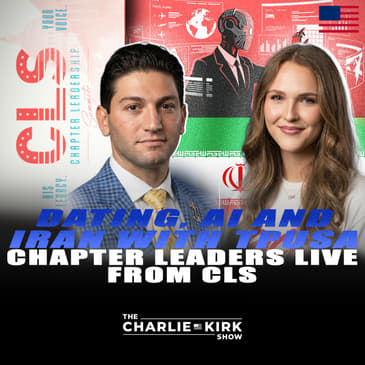
Turning Point’s annual Chapter Leadership Summit was more important than ever this year. Students who care about Charlie’s vision for Gen Z and for the country came together to discuss prominent issues, and Andrew and Blake had the opportunity to ask them questions directly. In this first installment of roundtables, a group of college chapter leaders explain the Iran war’s impact on youth politics, dating as a young conservative, and more.
Watch every episode ad-free on members.charliekirk.com!
Get new merch at charliekirkstore.com!
Support the show: http://www.charliekirk.com/support
See omnystudio.com/listener for privacy information.
00:00:03
Speaker 1: My name is Charlie kirk I run the largest pro American student organization in the country, fighting for the future of our republic.
00:00:11
Speaker 2: My call is to fight evil and to proclaim truth.
00:00:14
Speaker 1: If the most important thing for you is just feeling good, you're gonna end up miserable. But if the most important thing is doing good, you'll end up purposeful. College is a scam, everybody. You got to stop sending your kids to college. You should get married as young as possible and have as many kids as possible.
00:00:31
Speaker 2: Go start at turning point. You would say college chapter.
00:00:33
Speaker 1: Go start at turning point, yould say high school chapter. Go find out how your church can get involved.
00:00:37
Speaker 2: Sign up and become an activist.
00:00:39
Speaker 1: I gave my life to the Lord in fifth grade, most important decision I ever made in my life, and I encourage you to do the same. Here I am Lord, Use me.
00:00:48
Speaker 2: Buckle up, everybody, Here we go.
00:00:56
Speaker 1: Noble Gold Investments is the official gold sponsor of the Charlie Kirkshaw SO, a company that specializes in gold iras and physical delivery of precious metals. Learn how you could protect your wealth with Noble Gold Investments at Noblegoldinvestments dot Com. That is Noblegoldinvestments dot Com.
00:01:17
Speaker 3: All right, welcome everybody.
00:01:18
Speaker 4: We are at Chapter Leadership Summit twenty twenty six in Washington, d C, our nation's capital. We have over twenty five hundred of our top student leaders from Turning Point USA gathered together doing training workshops, hearing from amazing speakers, and we wanted to get their views and opinions on what's going on in the world.
00:01:36
Speaker 3: There's a lot going on.
00:01:37
Speaker 4: There's a lot of opinions that we think the older generations and a lot of people in power really need to hear from younger Americans, people that are voting, that actually have real opinions that might diverge from the more establishment view, the more Washington d C. Centric view, or from an older generations view, and they are critically important to understand where the country is going and what's going to happen next.
00:01:58
Speaker 3: So, gathered around this table are some of our.
00:02:00
Speaker 4: Amazing student leaders at Turning Point USA, and we're going to have them introduce themselves to you.
00:02:05
Speaker 5: Hi, I'm my name is Sepora Cramone and I'm a senior at the University of Miami.
00:02:10
Speaker 2: My name is Jacob York. I am going to be a junior at this fall. I'm the president of the Turning Point chapter at all of the Nazaren.
00:02:16
Speaker 6: University Barny, guys, I'm a Ryan mucial. I am a junior at Clinton University.
00:02:20
Speaker 3: Awesome. I'm Andrew Colevett. This is late.
00:02:23
Speaker 7: I have no I do.
00:02:24
Speaker 2: I was the previous president at Lafe College and now I'll be attending Salve Recina.
00:02:29
Speaker 8: I'm Kennedy Wetzel and I have been the president at Liberty University for the last year and a half.
00:02:34
Speaker 9: I'm Michael Janino, and I'm the founder and president of Turning Point USA at Brew College in the heart of New York City.
00:02:41
Speaker 3: You don't seem like you're from New York. So okay, guys.
00:02:47
Speaker 4: So there is so much going on both internationally domestically, but I think we'd probably find broad agreement in this group that we want to focus more domestically.
00:02:59
Speaker 3: Right there's a lot of issues that we need to address.
00:03:02
Speaker 4: Right here at home, but there are nagging things abroad, and there's been a lot of news lately coming out of Iran. We were trying to get the MoU.
00:03:10
Speaker 2: Across the finish line.
00:03:12
Speaker 4: It looks like there's been some issues, some complications we started striking Iran. Again, let's go back to the whole Iran topic, and anybody can go first.
00:03:23
Speaker 3: But were you guys supportive of.
00:03:25
Speaker 4: The initial strikes against Iran. I'm not talking about Midnight Hammer. I'm talking about the second wave that started earlier this year. It was very controversial with young people. We know that was there. Who was here, was supportive?
00:03:39
Speaker 3: Who was not?
00:03:41
Speaker 4: And if it's if it's great, if it's a gray area, that's mine too. You were supportive.
00:03:44
Speaker 6: Well, that's kind of the thing.
00:03:45
Speaker 8: It's always going to be a little bit of a gray area because there's there's so many different layers to everything. I'm never going to be one hundred percent yes, other than for America one hundred sex.
00:03:53
Speaker 6: For America, and then all of the other decisions there's going to be there's going to be wiggle row.
00:03:56
Speaker 3: Why were you a supporter?
00:03:57
Speaker 6: I think it was absolutely a necessity.
00:03:59
Speaker 8: I think I think part of why, like people who are anti it, they don't irritate me, but I guess the ideas behind it do a little bit. The people who are complaining about it a lot of it. It's not about what if we lose It's not about what if we lose all these people?
00:04:15
Speaker 6: What if we It's about how.
00:04:16
Speaker 8: Long is this going to inconvenience me? As an American? I think that is so insane. There's this isolation there's this huge isolationist way that's coming across America right now, and I personally, as an American, I do find it to be really damaging. I don't consider myself an isolationist. I think we have a lot of issues in America right now that we do need to focus on absolutely, But that doesn't mean that we need to avoid all.
00:04:36
Speaker 6: Going overseas, because there's so many issues.
00:04:38
Speaker 8: Happen all the time that happen all the time overseas that do affect us.
00:04:43
Speaker 4: Here who maybe had the opposite opinion of it.
00:04:47
Speaker 2: I kind of have a gray area of view.
00:04:49
Speaker 9: I feel like depending on how I view the situation and certain circumstances as well, change my opinion of the situation. And this isn't a criticized Trump or anything. I just think joja from the rest of my peers and how they feel maybe it's not exactly what they voted for, you know, like Trump very much ran on America first, and no new wars and I think a lot of people just felt maybe misled when this originally happened. With that being said, I'm very much of the belief that Iran shouldn't have access to a nuclear weapon.
00:05:19
Speaker 2: Let's expand on this.
00:05:21
Speaker 10: When you say your peers, people you know don't agree with this, are these generally people who voted for President Trump?
00:05:27
Speaker 2: And what do they say? They do?
00:05:29
Speaker 10: They say, I'm out, I'm disappointed. What's the range of opinions you're running into.
00:05:35
Speaker 9: I just saw a lot of division within the Republican Party.
00:05:37
Speaker 2: As a whole.
00:05:38
Speaker 3: You've done it locally on campus, Well, no.
00:05:42
Speaker 7: There's not many of us.
00:05:45
Speaker 9: Locally in Staten Island, New York, the only red part of New York City.
00:05:49
Speaker 3: And what were the range of opinions?
00:05:52
Speaker 9: I had a lot of people that felt like Trump was a fraud. I had a lot of people that praised Trump for it. And the the positions range so widely, and we saw a clear division within the party. And when the party can't unite behind main issues, I think, you know, especially in a place like New York where we're so overly dominated by Democrats, to have that division amongst the Republicans is really detrimental.
00:06:19
Speaker 2: And to follow up. So we have the division when it launched.
00:06:22
Speaker 10: Since then, we've settled into this sometimes on, sometimes off, relatively low intensity conflict. Do you see the division healing at all where some people have said it's not as bad as I thought it was going to be, or it's out of the headlines a bit more, or is it getting worse because the conflict is still going on.
00:06:41
Speaker 2: How do you see the trend in how people are feeling.
00:06:43
Speaker 9: I think generally, especially with our younger generation, people have the tendency to forget about things rather quickly and move on to the next, you know, headline. But with that being said, I think a lot of people still feel misled because originally Trump said that I forgot out exactly how many days he said it was going to last. But he gave assurance that this wasn't going to be an ongoing thing, and that's not quite what we've seen. But you know, if Iran is not willing to work with us, then I could defend it in some way. I mean, like I said before, I ran should not have access to a nuclear weapon, and we've been seeing now you know that they're making threats against the.
00:07:22
Speaker 2: US and against the president specifically.
00:07:24
Speaker 4: Exactly, very very over the top threats, We're going to kill Trump.
00:07:28
Speaker 3: Yeah, big signs.
00:07:29
Speaker 10: Any of you from slightly redder areas than New York City, same concept?
00:07:35
Speaker 2: How do you see? How did it start off? How has it been evolving over time? My area specifically I go to so I'm on a Christian college campus. I'd say the general amount of students is conservative. And I think what's interesting is the conservatives who aren't jumping ship their championship because Frum said no new wars and stuff like that. And I always ask them, so, if there was a major crisis, are we not allowed to go now and we do jump ship? Then I think that's what's interesting right now. And I think that's what Charlie was so good is he was so good at uniting people and getting people on the same page and be like, hey, maybe we disagree here, but we're still behind the same team. I feel like, right now you're seeing that, hey, I don't agree with this one thing, I'm out like I don't want to be a part of it, and stuff like that, and I think that's really dangerous. I think also it's just a terrible understanding of politics. In general, because it's always going to be two steps forward, one step back in some sense.
00:08:21
Speaker 3: Anybody else I'll add on it a little bit.
00:08:25
Speaker 2: I guess as far as like a Christian perspective goes. I mean, I'm a Catholic, but we have a lot of Christians that are kind of lukewarm in their faith. But there's like this conflict that's going on between those who are like, it's the Holy Land, we need to protect them. And then well, why are we going to war in the first place. But if you're living in America and you want to protect the liberty that we live in Basis country on, then as a Christian, you need to know how this Western civilization built America and that it was founded on those rights. So's it's interesting because there's Christians that are also against each other as far as Republicans go.
00:09:00
Speaker 4: But so you specifically are connecting the Iran conflict with protecting the Holy Land and.
00:09:09
Speaker 2: Yes, defending those values abroad. Correct. I've heard a lot of people say that I support Israel because we're defending the Holy Land from Christians.
00:09:17
Speaker 3: You've heard that perspective from Christian Yes, okarect go ahead?
00:09:21
Speaker 5: If I could just add on the yes. Regarding the religious aspect of it. At the University of Miami, I know there is a revival per se in Christianity, but that's not the case at my campus. And I think it's really important and something that is lacking is the education and conveying to students actually why we need to protect America from Ibran getting nuclear weapons, and that's not being prioritized. I think we really need to prioritize the education aspect of it because students at what I have been experiencing at my campus, they.
00:09:58
Speaker 6: Don't want violence.
00:09:59
Speaker 5: They don't want the bombings to happen overall, and they think.
00:10:04
Speaker 6: The Republicans are conservatives rather want this to happen. We don't want this to happen.
00:10:08
Speaker 5: Nobody wounts to bomb innocent people or I know there's casualties, but they think that we're just out to get them because they're Islamuth. I think it's important to recognize that though America is welcoming of all religions, it was built on Christian foundations, and Islam the religion itself, not Muslims, the Islamic religion itself cannot really assimilate well.
00:10:37
Speaker 6: With American ideals.
00:10:39
Speaker 5: And so if you know they're saying let's kill President Trump, this isn't the first time we're hearing that. But if you really take a step back and really educate their students who are thinking in this mindset that conservatives just want to take a certain religion out, like wipe them out completely, they would start to understand or, in my perfect little world, hopefully understand that we just don't want them to get nuclear weapons and kill America because if they get nuclear weapons, they will use them.
00:11:15
Speaker 10: Since you're out Miami, this is probably a place that would stand out. How did people feel about the incursion we had with Venezuela last year and the pending matter potentially with Cuba.
00:11:27
Speaker 2: What do they say about it?
00:11:29
Speaker 5: So the Venezuelans on campus and the Cubans on campus, they have a lot of them, actually, Okay, so you Miami itself, I would say not as many as you would.
00:11:42
Speaker 6: Think, but Miami as a whole.
00:11:44
Speaker 5: And I've talked to people like outside of campus, and this is what I'm also attesting to.
00:11:50
Speaker 2: There.
00:11:51
Speaker 5: They love President Trump. They think what he's doing is fantastic. And the students it's ironic because the people are the students who are not Venezuelan, who are not are the ones saying you're out of your mind? Why do you support these people who were you to say their parents, their grandparents flood communism in Cuba.
00:12:09
Speaker 6: I mean, it is just absurd.
00:12:11
Speaker 5: How you have the audacity to speak to somebody like that who family went through that. Well, if I could touch on that, please, There's this really interesting thing that's happening, and it's been happening for years, like this is this is part of being in such a blessed country.
00:12:25
Speaker 6: We're afraid of things.
00:12:26
Speaker 8: We as in a generation, we're afraid of things, and we don't want to talk about things that put like an achy taste in our mouth, Like I don't really like that he said that because it sounded me or I don't like that we did this because it's not good for pr And I think we're able.
00:12:39
Speaker 7: To do that.
00:12:39
Speaker 8: We're able to kind of turn the other like not turn the other cheek, but turn away from things that feel icky because we're so privileged in this country. Like what you're talking about with the Western civilization, Western world, it is at threats.
00:12:50
Speaker 6: There's this huge threat.
00:12:51
Speaker 8: And it's these two major civilizations fighting against each other, but we don't feel it because we live in America and we're so blessed to live here.
00:12:58
Speaker 6: But with that also.
00:13:00
Speaker 8: Comes the responsibility to understand the threats that are happening. Like as far as with the Venezuela thing like that was an incredibly I don't think we understood what we do, but that was such an incredible mission.
00:13:11
Speaker 6: The way that we did that was at forty five minutes in and out.
00:13:14
Speaker 4: I don't know the exact time, but we had zero casualties with.
00:13:17
Speaker 8: Wells and the macarena was playing like it was insane and it was incredible, but it's felt.
00:13:22
Speaker 6: Icky from a PR stamp.
00:13:23
Speaker 4: Do you guys feel there's a difference between sort of Western hemisphere actions, especially military actions, whether it be potential Cuba mission whatever that could entail in Venezuela versus Iran, which is obviously not in our hemisphere.
00:13:41
Speaker 2: I don't think so. I honestly think most of the problem that you have when talking to people about this is that it's any conflict whatsoever that makes somebody scratch their head, or any type of violence. I think you saw that with Ice as well, where there was some type of violence and people are like pushback, Oh, I can't, I can't be a part of it anymore, which is so funny to me because so many people gave Trump their vote based off of how his foreign policy was in his first term. So kind of I think that's what's going on in the conservative space right now, is you don't have like one voice, and you have a lot of people leave it to me, and you have a lot of people it is my wife. You have a lot of people looking for who to trust, like who do I trust? Who do I listen to? And so then when one person does maybe one thing they don't agree with, they're all in or all out. And it's that type of situation, which I just think it's funny because so many people trusted Trump with how Grady was in foreign policy in his first term versus now one thing or two things happen here and they're all out. But I think also along with that, it's just interesting because I don't think it's like a left versus right too. I think the right is so scattered as well in this issue.
00:14:46
Speaker 4: No, I mean, there is no more divisive issue on the right than foreign policy. Yeah, it's just the way it is, and That's why I'm sort of wondering where the threshold is because I didn't see nearly as much pushback on Venezuela, for example. And there is a concept in American foreign policy western hemispheric dominance, right, we don't want the old world powers to come into our hemisphere. We want to project strength and control of the Western hemisphere. And for me, that was sort of a key distinction between the Iran conflict and the Venezuelan mission. So I you mentioned you want you think people aren't educated about the Iran topic specifically, So what would what kind of pieces of information do you think more young people need to know about that?
00:15:33
Speaker 5: So that's tricky because and again I'm speaking from my experience on my campus, but there are a lot of students who are not Christian. They don't have that direction, they don't have that moral compass like we at this.
00:15:47
Speaker 6: Table, or I'm assuming do.
00:15:51
Speaker 5: They don't believe in religion, and so they don't take the time to educate themselves on the Christian values that really drive part of the mission to defend our nation from my brand, achieving that new room.
00:16:03
Speaker 3: Okay, but you just said defend America from Iran.
00:16:06
Speaker 4: Yes, So one of the bigger controversies with the Iran strike is that a lot of people feel that we were dog dog dog walked into a war.
00:16:14
Speaker 3: That's the expression you'll see online.
00:16:16
Speaker 4: A lot dog walked into a war with Iran because Israel wanted us to fight that war.
00:16:21
Speaker 3: Right.
00:16:21
Speaker 4: I don't particularly agree with that, but they have a more direct geographical interest in ensuring that Iran does not have a nuclear weapon or ballistic missiles that could strike Jerusalem or tell.
00:16:32
Speaker 3: Abeed, for example.
00:16:34
Speaker 4: But should that interest extend to the United States, meaning it, what's the education that you would like more people to understand of why that's in America's best interest to get involved in that conflict.
00:16:49
Speaker 6: Yes, And it goes back to this idea that I said that.
00:16:53
Speaker 5: Islam does not assimilate well in our country, and I truely that's an immigration question, correct, Yes, But it goes back to again this idea that if i Ran achieved a nuclear weapon, they would use.
00:17:05
Speaker 11: It just American Okay, see, Okay, I don't know that they have the capability of launching a strike on the United States, but they certainly could on Europe or they could on Israel.
00:17:18
Speaker 3: Right, that's usually the dirty bombs, dirty bombs.
00:17:21
Speaker 4: Yeah, certainly, And I would agree with you on the immigration perspective because I don't I agree that I want to hear from your perspective.
00:17:29
Speaker 2: It's less about mind. But yeah, Charlie believed this.
00:17:32
Speaker 4: I believe this that Islam taken on the macro is not compatible with Western values.
00:17:38
Speaker 3: Right.
00:17:38
Speaker 4: You can meet really really sweet and nice Muslims on the micro, but as a whole and as a collective, it is a conquering religious ideology and political ideology. This is why they prayed to Mecca. Even if they are in America, They're praying to a foreign place, to a foreign seat of authority for them, a religious authority. All right, I'm so excited to share with you guys. C fifteen from Fatty fifteen, the first emerging essential fatty acid to be discovered in more than ninety years. It's an incredible scientific breakthrough to support our long term health and wellness and you guessed it healthy aging. Fatty fifteen co founder doctor Stephanie Van Watson discovered the benefits of C fifteen while working with the US Navy to continually improve the health and welfare of older dolphins. Believe it or not, Based on over one hundred studies, we now know that C fifteen strengthens our cells and is a foundational healthy aging nutrient which helps to slow aging at the cellular level. In fact, when our cells don't have enough C fifteen, they can become fragile in age faster, and when our cells age, our bodies age two. This eventually led to studies finding the first new nutritional deficiency to emerge in seventy five years, called cellular fragility syndrome, caused by a lack of the C fifteen. As many as one in three people worldwide may have low C fifteen levels and fragile cells. To help support and optimize healthy aging, a team of doctors funded by the US Navy spent over a decade to develop the pure science backed and bioavailable C fifteen zero ingredient in fatty fifteen. Thankfully, fatty fifteen repairs age related damage to cells, protects them from breakdown, and activates pathways in the body that help regulate our sleep, our cognitive health, and metabolism. This functionality leads to so many other exciting benefits now and as you get older. In fact, seventy percent of fatty fifteen customers report seeing or feeling benefits within sixteen weeks, including deeper sleep, calmer moods, better energy, and overall improved health. Now that's essential. We're all aging, which means that healthy aging starts from birth. Studies have shown that C fifteen is a foundational nutrient that supports healthy growth and development and children, and supports our long term health as adults. Fatty fifteen has three times more cellular benefits than EPA and OMEGA three. By replenishing ourselves with the crucial CEA fifteen nutrient, Fatty fifteen effective li repairs cells, reversus aging related damage and at the cellular level, and restores our long term health and wellness. Fatty fifteen was developed in support of healthy aging for all, from kids to parents to grandparents. That's why award winning Fatty fifteen is now available as pure capsules, Delicious Apple Mint gummies for teens and adults and Barry Blast gummies for kids. Fatty fifteen is on a mission to support healthy aging for all, including all ages and stages of life. You can get an additional fifteen percent off their ninety day subscription starter kit by going to Fatty fifteen dot com, slash kirk and using code kirk at checkout.
00:20:39
Speaker 10: Kind of think just even on so we're talking about making the case. I think you and I even before the strikes happened, we talked about it seems that we're building up in around and they might strike it and they're not laying the groundwork of why is this.
00:20:51
Speaker 3: That wasteak we had?
00:20:53
Speaker 10: And so what I would ask we talk about how could they sell it? But for those of you who do interact with people who are are perhaps Trump voters who feel betrayed, field misled, feel angry about this, is there a case that could be made that would.
00:21:08
Speaker 2: Win them over?
00:21:09
Speaker 10: Failing that, would they be won over if the conflict ended? Or do you feel the damage is more enduring in some capacity?
00:21:17
Speaker 6: I think it may have been a little better.
00:21:20
Speaker 9: At least for unity standpoint, if there was no boots on the ground in the initial which there well there.
00:21:27
Speaker 2: Still haven't been in not nature in Iran at least.
00:21:31
Speaker 8: Well about what would win someone over, that's a personal thing, like I can't speak to what I speak to a lot of people who feel, as you would say, misled out the trade by the promptses Trump made in his campaign, and to a certain extent in an individual sense, I understand how they feel that way, but what would win them over.
00:21:46
Speaker 6: It's individualized as far as like if if the conflict ended, would they be one over? I think you mentioned Venezuela.
00:21:53
Speaker 8: I think part of why you saw less pushback on that is because it was two seconds and no one knew about it until after it was done, you know, so.
00:22:00
Speaker 6: Of course it's like and it was really success, right, how are you gonna be mad about that? It happens?
00:22:05
Speaker 8: But this is it is more ongoing and there's so much, you know, focus on it in the media right now. I don't think we shouldn't be hiding it, but there is a lot more attension on it, and it is going on for longer than we would have liked.
00:22:14
Speaker 6: But I think part of why.
00:22:16
Speaker 8: Maybe there's an ideological like disconnect between Trump is the terms that he used. I don't think he was being dishonest. I don't feel personally mispled. I understand what people do, but America first, I guess for a lot of people, a lot of people that I talk to has kind of been translated to kind of a cut and dry if this inconvenience is America even in the slightest then we can't do it. Or if this isn't a linear progress for America, then we can't do it. Or if prices go up slightly, then we can't do it. And that's just not what America first, in my opinion, or and I think how Trump described it is about America first is a philosophy. And like you said, politics is often one step four, we're two steps back. And I think it's less about winning someone over on a specific issue and more about kind of how you said, an education of how all these things actually work. And it can't be I don't I don't want to fight anymore. Andrew, let's not. It's just that's not how it works well.
00:23:06
Speaker 4: And sure, and Trump, to his credit, has been critical of Iran since.
00:23:10
Speaker 3: You can go back to the nineteen eighties.
00:23:11
Speaker 4: He's got clips where he's pretty upset about the way that that foreign policy had been pursued. And then you know, within the last decade, maybe even two, he's talked about how Iran should not have a nuclear weapon. So people, I do think there is a truth to the fact that people became convinced of an image of Trump that wasn't actually real or reflected in his campaign.
00:23:31
Speaker 3: But for thee less voted for that voted for no new wars.
00:23:35
Speaker 4: Right, you heard this no new wars and they specifically I think with Iran got it it got even more controversial because there was an impression, rightly or wrongly, and I would believe, I believe wrongly that we did that war or we started this conflict with Iran at the behest of Israel BB net and Yahoo right.
00:23:53
Speaker 3: And so while Trump.
00:23:55
Speaker 4: Has been consistent on it and he wanted to take care of this problem, there.
00:23:59
Speaker 2: Is a perception, perceived reality.
00:24:01
Speaker 4: That Trump did this for for Israel, right, not for America's right. So you've you've made the connection in your head that you believe that this wasn't America's best interest, whether or not the larger public, especially young people, has become convinced of that question is the.
00:24:17
Speaker 3: Question, right, Let's slightly move to the MoU. Right the MoU.
00:24:23
Speaker 4: You guys know what I'm referring to. With that, right, jd Vance has been pursuing this MoU.
00:24:27
Speaker 2: It felt like understanding.
00:24:29
Speaker 4: Yes, yeah, it was basically a ceasefire agreement to pursue a longer term piece with Iran. Now that has hit some roadblocks, but we're not at this point of this recording, it's still something that's approximately being pursued.
00:24:43
Speaker 3: Trump has said.
00:24:45
Speaker 4: It's basically over, but I think there's certain people like JD.
00:24:48
Speaker 3: Vance is certainly still pursuing it.
00:24:50
Speaker 4: So do you guys support that without sort of a regime change? Like, do you are you glad that we're trying to pursue peace? Do you have any faith that we can achieve it? Anybody can go no, we haven't heard from you.
00:25:02
Speaker 2: Yeah, I have faith that we can achieve peace. It's definitely wishy wash. I mean, like we said, there have been roadblocks along the way there. But I think, honestly, kind of touching on what our last point was, I think we live in a soft generation.
00:25:17
Speaker 7: Our generation hasn't really seen a war.
00:25:20
Speaker 2: You know, we haven't fought in a huge wars as far as like I mean, my brothers and sisters in christ they haven't gone and had boots on the grounds in other countries. Because of my age, and I think a lot of people are blind to the fact, like how was Western civilization built? You see a lot of gen Z pop culture people saying, oh, We're built America's on stolen land.
00:25:40
Speaker 7: Like, that's not how it happened.
00:25:42
Speaker 2: That is not how it happened, sir, you know, And I think I have faith that sometimes war is good and that's for the protection of my people and my brothers and sisters in Christ. But obviously, I mean this is coming from someone who doesn't even believe in the death penalty, who's a Christian, And I still think there.
00:25:59
Speaker 7: Is peace is hopeful, but other people need to surrender to Christ and also America first.
00:26:06
Speaker 4: Okay, anyone else on the same question, but their pursuit of peace, though, do you see that you think that needs to be our posture here? Do you sell faith that we can achieve peace with Iran, which has been notorious at telling you one thing and then doing something different. Like a lot of people feel that you can't go into a good faith negotiation with Iran because they basically will just lie to us.
00:26:28
Speaker 8: Well, this is where I think conversations maybe we're and dry a little bit, because what does peace mean?
00:26:32
Speaker 6: What do we mean by that?
00:26:33
Speaker 8: Like I give us five years and we're not going to disagree until like authority changes.
00:26:38
Speaker 6: And then we read back to it.
00:26:40
Speaker 8: Peace means one thing, and I don't think that that definition of peace piece is and like actual agreement and kindness that will last between two individuals or two nations or two families or whatever you want to say. I don't think that concept of peace, which is what I consider to be the definition of peace, is possible with Iran, not because know there's a specific issue that we can't agree on, but because it's an ideological civilizational difference and they're diametrically opposed, and especially in the terms of religion, we're diametrically opposed. So I don't think peace as we're talking about it is is a possibility. What you're describing I think is possible.
00:27:16
Speaker 2: Do you call it submission then, submission from pop the submission submission? I think you're deliberately right, Yes, submission.
00:27:25
Speaker 7: To America specifically, well, I.
00:27:27
Speaker 8: Think with the agreement that Jade Vance is working on, I wouldn't call that submission to America.
00:27:32
Speaker 7: I wouldn't.
00:27:32
Speaker 6: I wouldn't call it that. I think it's kind of kicking the kicking the rock down. So you are you not supportive of I'm supportive.
00:27:38
Speaker 2: Of that type of deal, that type of frame work.
00:27:40
Speaker 8: I'm supportive of us working toward that type of framework. But I think in reality, if we look at in the context of history and human nature and religious tendencies and just everything that's kind of right in front of us, I don't think that's a long term solution. But then you mentioned regime change, and we've seen the last time America helped out that world with the change and it didn't go You know, Charlie Kirk touched on that a lot.
00:28:03
Speaker 3: Yeah, he did.
00:28:03
Speaker 4: He was vehemently opposed to it as a matter of fact, because the issue being, and you could apply this to Iran if you did have a regime change, we don't really know what the next domino to fall would be, right because you could have sectarian strife, civil war, you could have a masty asper of Iranians all throughout the region the world.
00:28:23
Speaker 10: Every regime change we've pursued has had dramatic effects, and they were not the effects predicted.
00:28:29
Speaker 2: Before we launched it.
00:28:30
Speaker 10: I would I want to pose potentially a challenging question here, which is some people say the Iran thing has gone on long enough, we should unilaterally disengage, say we blew up enough stuff that they're not going to get a nuclear weapons soon, let's just leave and if they want to close the Straight that's it affects others more than us. Some people say the number one thing is Iran can't have a nuclear weapon. They're not playing ball with peace. We need to escalate, possibly including boots on the ground. Some people say, you put to thousand guys on carg Island and that will be enough.
00:29:03
Speaker 2: Some people say they want more.
00:29:05
Speaker 10: If the choice, if let's say Iran walks away from the table completely says we're just blockading the straight deal with it, would you prefer unilateral disengagement.
00:29:15
Speaker 2: Or as boots on the ground. I think it's a difficult question, but I for one have faith that we can negotiate a peace deal because I think people know not to mess around with Trump. I think that's been proven through both terms at this point. But also I think what happens is people don't necessarily see the timeline. They see short term action, and they don't see the end immediately, so they're just like, oh, we got to pull out, we got to be done. Or I think Trump and all these different scenarios, you see short term action to prevent long term problems. And I think that's what you kind of have to trust a little bit, especially if you are somebody who trusted Trump with your vote. That people know not to mess around with him, and so I believe that if anybody could figure out a piece deal with Iran, it would be Trump because people know not to mess around with him.
00:29:59
Speaker 6: I agree.
00:29:59
Speaker 8: I mean, I don't trust a rand but I trust Trump and I trust his administration to put America First, as they have said, and do all that they can to achieve a piece deal. And if that's not enough, I trust them to make the decision whether to put bits on the ground or not.
00:30:11
Speaker 4: I have a different way of phrasing this, maybe it's the simplest. Do you believe that the actions taken in Iran is consistent with America First?
00:30:20
Speaker 6: Yes? Yes, yeah, absolutely, yes, I would say mostly.
00:30:26
Speaker 4: Yeah, yes, wow, agreement, Okay, would I putting them on the I was, I think broadly less supportive of striking Iran. As we often say, you can determine when you want to start a war, but you can't necessarily determine when you want to end a war. Right that being said, try I acknowledge a couple of truths that a lot of the isolationists.
00:30:52
Speaker 3: I'm not a strict isolationist. I'm a mostly isolationist, but.
00:30:56
Speaker 4: I believe the world is a very dark place if America power is not projected in the world. In international affairs, we are the most morally upright nation. We have the most power and have abused it less than anybody any other nations throughout history, and so our presence and our willingness to peace through strength, I think is a really important dynamic that other bad actors need to acknowledge before doing bad things. That being said, I trusted that the President probably had intel I did not, And as Charlie would often say, this is why we work so hard to get him elected, right, is because we trust him with the hard decisions. He's the man for the hour, so I give him a lot of leeway. And I'm very supportive of jd Vance pursuing peace, some framework of peace, because I think ultimately we have problems that we need to address here a hum So that's my basic framework. But I think is there anything on the international stage right? We've talked a lot about iron now, and I want to get back to domestic affairs. But I just wanted to address that because it's in the news first, But is there anything internationally that we haven't talked about that you think is a larger concern, that's something that you are concerned about or that you're hearing from your peers.
00:32:05
Speaker 3: People talk about Is it China?
00:32:07
Speaker 6: China a lot?
00:32:08
Speaker 2: Yeah, in what context? Just them kind of their economy, their economy being like the number one economy in what they're capable of in the future. I mean, I think, well, we.
00:32:21
Speaker 3: Are the number one.
00:32:21
Speaker 10: Do they view this as a do they do they see this as maybe just an amorphous threat. There's a country that could become bigger or richer than us. Do they see specific things? Do they worry about China doing something to America, whether it's correct physically attacking us or imposing censorship on us, or like dominating us in some way?
00:32:42
Speaker 2: Do they ever get more specific? Yeah, a little bit. It's more like, oh, like we kind of got to be careful of China.
00:32:49
Speaker 7: Obviously they're not the number one economy, but they are growing.
00:32:52
Speaker 3: They're the number two. Yeah, I mean they're yeah.
00:32:55
Speaker 4: Well, they just landed a rocket all US space X where they the rocket return and they caught in a platform, which was noteworthy.
00:33:04
Speaker 7: Yeah, no doubt.
00:33:06
Speaker 2: But I mean, like, I even have Chinese friends at school there. I mean, I'm fine with them. They're just more like we get along, but I don't I'm not too fearful of them attacking us. It's more like if we get messed around with one of their allies.
00:33:21
Speaker 4: Well, the taiwan ist you right, Taiwan is this the China believes that Taiwan belongs to China. Taiwan has the best chip manufacturing abilities in the world right now, China is reliant upon second generation chips or chips that we provide them. Then there's ongoing negotiations about that. So chips in Taiwan specifically, when you talk about the technological battle, is really where I think the next conflict is.
00:33:50
Speaker 3: We'll see.
00:33:50
Speaker 4: But and then China has pursued its Button road initiatives, buying up resources ports.
00:33:55
Speaker 3: That's why the Panama Canal fight early on and Trump two.
00:33:58
Speaker 2: Point zero was a big but big topic.
00:34:01
Speaker 3: Why don't we want so? China was the main other country that people.
00:34:04
Speaker 9: Are looking at, so ahead, if I may, I think what might be an even greater threat than that is the spread of radical Islam in the West. I think it's something we're not taking strongly enough. I think people are taking it very lightly. Everybody wants to be accepting with everybody in America, but quite frankly, Islam is incompatible with Western values. And we've seen the examples of this all across Europe, where cities are practically being taken over by radical.
00:34:33
Speaker 7: Islamis and the cities are turning.
00:34:36
Speaker 9: Cities that were once really great, rich in history and culture are now being outrun by tyranny.
00:34:42
Speaker 3: And New York, yes, well you are.
00:34:45
Speaker 9: You know, I call New York New York is stan. I mean you have you have Times Square filled with you know, Muslims called a prayer and the entire square is filled with them.
00:34:55
Speaker 10: And I mean it sounds it sounds like you can say it sounds trail. But it's Birmingham, second largest city in Britain. They are It's not merely that a lot of Muslims live there, it's that now their elections are won by independent Islamist candidates. There are explicitly Islamist political parties that are getting seats in European parliaments. We're having a Senate candidate in Michigan who might win, who will have offer condolences because the Iatola died and that was traumatic to people.
00:35:25
Speaker 2: But he's also attacking his primary.
00:35:27
Speaker 10: Opponent for voting for I believe a resolution honoring Charlie.
00:35:31
Speaker 3: When he died.
00:35:32
Speaker 10: And this sneaks up on you over time because people aren't good at tracking demographic change and how quickly two percent can go to four percent and go to twenty percent and what effect that has.
00:35:45
Speaker 3: Yeah, I'm sorry.
00:35:47
Speaker 2: If I may just add one more point.
00:35:49
Speaker 9: I mean it was incredible to me to see how quickly things had changed in New York with the elected mayor zo On Mamdani. I work in the New York City Council, and within one week of him in office, I saw changes in the New York City Council stated meetings, how they started opening with Aslama Lakam, and I thought.
00:36:10
Speaker 6: That was ridiculous. In America, I will say, I do agree with you.
00:36:15
Speaker 8: I think that's one of the most talked about international issues that we have on college campuses. But at least with my friends as well and people that I disagree with on every other issue, we agree on that. But I think that has to do with there's a tangibility there for Americans that there isn't for like the Iran issue, for the China issue yet it'll come. But right now we're really feeling that, and we're looking over at our European brothers and sisters, and in my opinion, I think most of Europe has fallen to redical Islam. And that breaks my heart because that's, you know, so much of the core Western civilization is there in Spain and France, and I see it really is heartbreaking. But there's a tangibility there from a domestic perspective because we see that.
00:36:52
Speaker 6: As America and we're hoorrah America.
00:36:55
Speaker 8: And we see what's happening in Europe at how fast it happened, and domestically we're like, we we can't do that.
00:37:02
Speaker 6: So there is a united So what what.
00:37:03
Speaker 4: Do you think the solution should be? What do you guys want to see happen on that issue? Should we just ban all Muslims coming in the in the country?
00:37:13
Speaker 3: Should what? I mean, seriously what.
00:37:14
Speaker 5: Some people do think that, But I I don't think that is the American way. I mean, I think it's.
00:37:24
Speaker 6: Important to recognize and educate.
00:37:27
Speaker 5: It always comes back to education, which our education system is failing us.
00:37:32
Speaker 6: But to educate ourselves.
00:37:34
Speaker 5: On why it's not compatible and why it cannot ultimately be the overlapping religion that Americans have to.
00:37:44
Speaker 6: Put up with every day.
00:37:48
Speaker 8: Unfortunately, unfortunately, a lot of it does have to do with illegal immigration. We don't even know how many scenarios we have America, well.
00:37:55
Speaker 3: Most of most of the US.
00:37:57
Speaker 2: Most of the Muslim immigrations in the United States is legal.
00:38:00
Speaker 8: I don't know if that's true, Like up in you guys all, who's Nick Shirley, He's here right, baffle situation.
00:38:06
Speaker 6: I don't know that a lot of those were there are some.
00:38:08
Speaker 2: Lot of them are criminals, but yeah, there was.
00:38:13
Speaker 4: There was a lot of people from all kinds of countries coming through the southern border and some through the northern border when Joe Biden was president, and I think we've we've dealt with most of that. So there are some illegals, but the vast majority of immigration from Muslim countries into the United States has been straight up through legal immigration. Are you guys aware, for example, that we have one point two million green cards, those are legal green cards issued every year. One point two million. That's the population of more than Montana. That's the population of Arkansas every three years. That we're just adding from all over the world all the time. And so when Blake talks about the demographic ships, how quickly it happens, that's why.
00:38:51
Speaker 3: And then they are the birth rates are much higher among ye was going to be another point.
00:38:56
Speaker 10: I was going to bring in one refugee Somalian who gets the green card.
00:38:59
Speaker 2: They can then.
00:39:00
Speaker 10: Sponsor spouses, children, parents. They can have three to seven to ten children with their spouse.
00:39:08
Speaker 3: Yeah, spouses.
00:39:09
Speaker 4: I've had three uber rides since I've been in DC for this event, three and all three were Muslim drivers, and two of the three got just diversity vis a green cards. So we're just bringing We're just it's diversity. They want a diversity lari. Hi, folks, Andrew Colvett here, I'd like to tell you about my friends over at why Refi. You've probably been hearing me talk about y Refi for some time now. We are all in with these guys. If you or someone you know is struggling with private student loan debt, take my advice and give them a call. Maybe you're behind on your payments, maybe you're even in default. You don't have to live in this nightmare anymore. Why refy will provide you a custom payment based on your ability to pay. They tailor each loan individually. They can save you thousands of and you can get your life back. We go to campuses all over America and we see student after student who's drowning in private student loan debt. Many of them don't even know how much they owe. Why REFI can help. Just go to y refi dot com. That's the letter. Why then refi dot com And remember why Refi doesn't care what your credit score is. Just go to yrefi dot com and tell them your friend Andrews sent you.
00:40:27
Speaker 6: Well you were STU. What should we do?
00:40:29
Speaker 8: Should we put them on a boat and center houn or I don't necessarily think that. But like there's a word assimilation, and I think that's very very important now when we talk about that, we've grown up it in a nation where Christian values are the foundation of our nation, right, and we understand that because we've grown up that you have secular people here, you have atheists, you have Jewish people here, all of these things, but we understand that we've grown up in these values.
00:40:55
Speaker 6: These are the morals that we've grown up in it.
00:40:56
Speaker 8: What happens when that stops being the foundation that we have, When that stops being the majority of value, I personally think we should be there is how I put this. I don't agree with the idea that diversity is a strike. I'm pro diversity. I like diversity of thought. I like diversity of ideas. I think these are really great ideas. But diversity of values is a totally separate thing, and I think they get convoluted a lot.
00:41:20
Speaker 6: Diversity is important.
00:41:21
Speaker 8: I'm a Puerto Rican, Dominican, Irish Scott, I'm the American melthing pot. I think it's important, and I think it's beautiful in a lot of ways. But I'm pro America. I'm pro American values. I'm America first.
00:41:31
Speaker 6: And that's where I think we kind of disconnect it. When people say, oh, we shouldn't.
00:41:35
Speaker 8: Have diversity, you get labeled as a racist really quickly. But there's nothing wrong with wanting homogeneity.
00:41:40
Speaker 6: There's nothing wrong with wanting to look over at your.
00:41:42
Speaker 8: Neighbor and understand, hey, we both believe these morals and we can rely on that. So what to do about it? I think we should be stricter if who were letting in not like whether or not they want to support the country, But why are they supporting the country?
00:41:55
Speaker 6: What are they wanting to put into us?
00:41:57
Speaker 8: What are they wanting to rebuild?
00:42:00
Speaker 7: The nuclear family?
00:42:01
Speaker 6: Right? Part of it is also the birth rate for Americans.
00:42:05
Speaker 9: I'm sorry before we move on, I just you mentioned one word that really resonates with me.
00:42:10
Speaker 7: Assimilation.
00:42:12
Speaker 9: My grandparents came here from Italy through Ellis Island, and they became citizens. They assimilated into our culture. They were proud to be Americans, and they reminded me of that every day that they were alive. While my grandfather was on his deathbed back in twenty twenty, he was so proud to be able to send in a mail in ballot for President Trump. And you know, in the end, that was almost one of his only reasons for wanting to live, was to be able to re elect Trump and you know, leave this place with some hope, you know, when he unites with Christ in heaven. But they were proud to be Americans, and they reminded me every day how proud I should be to be an American. And they weren't fleeing some communist country. They were fleeing Italy, beautiful and they came here and told me how how much better America was and how much opportunity that they had here that they didn't have over there. So, you know, seeing how they integrated into our culture and assimilated and became citizens, learned English, were proud to be Americans, I think, well, that's a unique example.
00:43:19
Speaker 3: Yeah, that's a beautiful story and I love that.
00:43:22
Speaker 4: And you're right, we've had America had a long tradition of successful assimilation a lot if you look at the story though, the Anglo Americans, right, the English Anglos that were the predominant group here. Originally, they didn't want the eighteen eighty to nineteen twenties immigration waves. They were very concerned about that because you were taking in a lot of Eastern Europeans, Southern Europeans. It was it was a it stressed out the country a lot, actually, and then we had the Great Depression of World War two that brought a lot of people together.
00:43:51
Speaker 2: And we should also note.
00:43:52
Speaker 10: That we say assimilation, and it is that your grandparents became dramatically more American, but it is also the case that America.
00:44:00
Speaker 2: Became a little bit more Italian as a result. And like even here, you know, we can still tell you're an Italian guy from New York.
00:44:07
Speaker 10: We don't go like, oh, I thought you were this Englishman, because there still is those visible differences exist even if someone is very assimilated.
00:44:17
Speaker 3: And there is difference that there's distance between cultures.
00:44:20
Speaker 4: And this is I think another point that you guys are kind of approximately approximately making. It's one thing to assimilate an Italian Catholic into a Christian Protestant nation. It's a whole other thing to then but you know they're both Christians. It's another thing entirely to bring a Somalian that has grown up in a failed state government that's mostly corruption and you know, there's really no infrastructure involved, right and bringing them in And so when you see the Somalian uh, you know, fraud schemes in Minneapolis, you shouldn't be surprised because that's actually the culture that they're bringing into the country good.
00:44:57
Speaker 9: And this is what I don't understand is that these people are fleeing their country's origin in search of a better life just to come here and try to replicate what felled over there. I can't, for the life of me, understand why.
00:45:09
Speaker 3: They would do that. You come to the United.
00:45:12
Speaker 9: States for a better life treated as such, you know, you have the right to pursue life, liberty, and happiness.
00:45:17
Speaker 2: Here locustly for a better life too.
00:45:20
Speaker 8: Right, if we're getting their opinions, what you're asking about, Andrew, you're keep asking for the solution.
00:45:27
Speaker 6: You're getting into a lot of really hot button issues.
00:45:30
Speaker 8: And I'm not scared of a hot button issue, but there is, you know, there's a humanitarian issue that.
00:45:34
Speaker 6: You have to work with. Like when you ask about what the solutions to an economic issue, I'm.
00:45:39
Speaker 4: Asking, I'm asking what I'm really What I'm getting at is it is a very challenging topic.
00:45:44
Speaker 3: So we have the Islamification of the West.
00:45:46
Speaker 4: That's the topic, which is also an immigration question, which is also an assimilation and domestic question because they're already here at least some are right right now that I would say the issue is more on the manageable side, but it's becoming in New York and Michigan in places, it's starting to become much more front and center. So if the question is, hey, you guys are young people, gen Z, you're in college, what do you have a stomach for the types of solutions that it would require to actually fix it or does it sound too drastic? That's really what I'm getting at. The Other thing is I'm curious what all of your friends and tears.
00:46:25
Speaker 3: Feel about this topic.
00:46:26
Speaker 2: Are they ready to actually address this topic?
00:46:29
Speaker 4: Yeah?
00:46:29
Speaker 2: I think a large part of it is it's an identity issue. If you ask fifty people on the street what does it mean to be an American citizen, I think you're going to get fifty different answers, and none of them are remotely close to one another. Along with that, I mean like, if we just go back to American history, look at the Founding Fathers, John Adams said, our Constitution was written for a moral and religious nation. How many people would consider America a moral and religious nation. I'm not too sure. And I think that's an important thing. And so you can obviously you have a religon just freedom in America, and that's a beautiful thing. However, if your religious freedom ends up not morally aligning with the Constitution and America, then I think that's.
00:47:10
Speaker 4: A valid question to ask, Well, do you guys understand that in the Founding generation they had professions of faith in order to serve right so and they weren't If you had a Muslim profession of faith that I don't think you would have had a snowball's chance in hell to get in and serve in the government of your state. So their idea of religious freedom is much different than our modern concept of it. Their idea was, well, you can be Anglican, you can be Quaker, you can be a Christian of different denominational.
00:47:39
Speaker 2: Background and variety. A Protestant, yeah, yeah, most states.
00:47:44
Speaker 4: Yeah, you couldn't even be a Catholic at that point. So our conceptions of this have changed over the years.
00:47:50
Speaker 8: Right, Well, you were asking do you think that people around us are just our generation is ready for what could be like an extreme.
00:47:57
Speaker 3: Do they care about this topic enough?
00:47:59
Speaker 8: I would say yes first, But also part of it is is a lot of it is happening subliminate, subliminally, to where unless you have like a pulse for what's happening, a lot of it, you just feel it. Kind of Generally, people will describe I have a lot of friends who don't contit themselves political. I have a lot of friends who consider themselves opposite to where I am. But there is a general sense in our generation of we're not really united, Like none of us are really together. What you were talking about with identity one of the things that kind of showed us what it kind of looked like back in your ears and day with the dinosaurs, for what it looks like to be a little bit more united. You know, the nixt game that was happening, like that was crazy.
00:48:33
Speaker 6: He's like, America, this is awesome. And we had a taste of like, oh, this is what it feels like to be hoorah. We're all in line for this thing. You know, this is great.
00:48:40
Speaker 8: We see it a lot when the Olympics happened, like no one's warm, proud to be an American and renimits.
00:48:45
Speaker 6: Yeah, but there is a world. Yeah yeah, we took them.
00:48:50
Speaker 3: Yeah, showed up for that one.
00:48:53
Speaker 6: Yeah yeah.
00:48:53
Speaker 8: But a lot of it has to do with the kind of the stuff that I was talking about at the beginning of this conversation, stuff that leaves a sour taste in your mouth because of the con but not because it's morally a bad idea establishment of what it means to be an American, And it doesn't have to be hard fast. You have to look this way, you have to believe this thing, but there are certain ways that you have to act in certain ways that you can't act if you want to that I join it.
00:49:13
Speaker 10: Well, so I was thinking, so just spanning on that, even do they have a stomach of things?
00:49:17
Speaker 2: What do people say about immigration?
00:49:19
Speaker 10: Do they feel they grow up in an era that is one hundred percent high immigration the whole time? Do young people do they talk about that? Do they say I want less of it? Do they say I want less of it from specific countries?
00:49:32
Speaker 2: What do they say? People don't understand it. I mean, I've heard liberals tell me, oh, why is Trump supporting ice and deporting all these people?
00:49:41
Speaker 7: Do you know what happened during the Obama administration? Like what are we doing?
00:49:45
Speaker 6: You know?
00:49:45
Speaker 2: And I fully one support ice because one the safety you see statistics of people. There's just a UMass soccer star who passed away from like a Uzbekistan wherever made up country You got hit by a car on Star warstrics but yeah, yeah, the singing Aliens. But he just got hit by a car and got killed by an illegal immigrant.
00:50:08
Speaker 7: And that's just like part of it.
00:50:10
Speaker 2: But people are blind to the fact at least and as as far as the other party goes to what we're doing in America now, And to kind of touch back on what you said is like people are talking about but I think they're ill informed and I think there is some propaganda in America that we're unfortunately subject to in schools.
00:50:28
Speaker 3: This is a great question just brought yes or no. You and your.
00:50:34
Speaker 4: Friend group, so it's not your opinion, but just your wider campus community.
00:50:39
Speaker 3: Are they supportive advice or not?
00:50:41
Speaker 2: Campus?
00:50:41
Speaker 3: No friends?
00:50:42
Speaker 2: Yes?
00:50:43
Speaker 3: Both, Yes, both are supportive. Where are you at again, Liberty?
00:50:46
Speaker 2: Oh, I don't want to speak for the campus, but as far as the reception, yeah, oh yeah, definitely against ice against no.
00:50:58
Speaker 6: What's your campus against clenchivers against Ice?
00:51:03
Speaker 2: It's just split about I'd say sadly no, especially from a Christian college.
00:51:07
Speaker 5: Is sadly a small majority support ICE, but I think a larger majority would if the media portrayed them differently and their most I would agree with under Christino.
00:51:19
Speaker 4: Yeah, yeah, And I think Minneapolis was just as far as a public perception. I mean, I have a lot of very aggressive thoughts about what happened in Minneapolis because they were basically like comic we call them Kama Kazi Karens.
00:51:33
Speaker 3: They were just like going in.
00:51:34
Speaker 4: There trying to cause a problem and then uh, you know, they played stupid games and won stupid prizes.
00:51:40
Speaker 2: That being said, I can't.
00:51:42
Speaker 4: Deny that from a pr standpoint, it was a bad moment for Ice, right.
00:51:45
Speaker 3: It turned a lot of people like, what are we doing? Is so aggressive?
00:51:48
Speaker 4: You see Joe Rogan you know, kind of turned on everything at that point too.
00:51:52
Speaker 3: So there was not too much stomach for the scenes that played out in Minneapolis.
00:51:56
Speaker 4: So they think they've been pursuing a calmer more behind the scenes, trying to work with local prisons. Immigration, though, is a so if I said to the said to you guys, I propose an immigration mora torum and net zero immigration more torm let's explain what that is. Every year, about two hundred thousand people leave the country to go live somewhere else. You know, maybe you know a lot people don't realize this. When the eighteen eighties nineteen twenties big immigration wave happened, I think it was about was it half ended up going about a third went home. There wasn't the social safety nets, there wasn't government programs. There wasn't NGOs applying you a lawyer to argue your case, and none of that existed. So if you couldn't cut, it, couldn't hack, it got too hard, you went back home to your family, went back home to Italy or wherever Poland. So nowadays we have about two hundred thousand people that just leave. Right if you said net zero immigration more torn would be like if somebody leaves, that makes a spot for somebody else to come. Other than that, there is no place. Let's do it for ten years. Does that sound too aggressive? Does that sound just right? Would you be supportive of it? How does that make you feel? And we can start over here and.
00:53:07
Speaker 3: Go this way?
00:53:08
Speaker 6: We're being quite friend.
00:53:09
Speaker 5: I don't know.
00:53:10
Speaker 3: Okay, that's fun.
00:53:12
Speaker 2: I think immigration is one of those topics. And I think immigration oftentimes kills Western culture civilizations, and I think that would be an okay thing. But once again, I think your standard for who's coming in the country you have to set in stone. What does it You're only going to get really great people.
00:53:28
Speaker 3: Let's just assume for this, say.
00:53:29
Speaker 2: Got some bold really great people.
00:53:33
Speaker 4: All right, Well tell me we don't even have to do a net zero could just be a flat out.
00:53:36
Speaker 3: No new people. Like I'm just saying I want to get where you're how that makes you feel, like, what would you be supportive or not?
00:53:43
Speaker 2: I would be supportive if our birth rate and replacement rate was better because I think abortion plays significantly into that as well well. So, but it is what it is right now.
00:53:55
Speaker 4: So you would rather have the current status quote one point two million new people coming in the country legally every year.
00:54:03
Speaker 2: Yeah, I would agree, yes, for the most part, with it.
00:54:05
Speaker 3: Because so you're worried about a declining population, don't.
00:54:08
Speaker 2: Okay, correct, I.
00:54:09
Speaker 8: Would support what you're describing, but I don't think you could get it past system to the American people, Okay.
00:54:16
Speaker 2: I support it, And also I don't think they'd ever be able to do it as far as like, are we into deep kind of.
00:54:22
Speaker 3: We you know, if people probably need to.
00:54:26
Speaker 4: So there was a Heart Seller Act in the sixties, and then in nineteen ninety we took it from basically a half million a year. I was actually in some cases like three seventy five a year to the current levels. So pre nineteen ninety we had let's just say, half of the numbers.
00:54:41
Speaker 3: Of green cards were currently issued.
00:54:42
Speaker 2: Just so you're aware of it.
00:54:43
Speaker 8: And I think it's a really hard thing, and I don't think it could be done, especially with our.
00:54:47
Speaker 2: So you feel like the political will would not be there, it.
00:54:50
Speaker 3: Wouldn't be agree especially with gen Z.
00:54:52
Speaker 6: There's so there's so much about.
00:54:53
Speaker 3: Ankle will can change.
00:54:54
Speaker 2: Do you like the idea?
00:54:55
Speaker 6: I think it's a hard thing to do, but.
00:54:57
Speaker 8: I think it is a good idea and it could be done if I am I need to be done.
00:55:02
Speaker 2: I think it's a great question.
00:55:03
Speaker 9: It's one i've never actually heard proposed before, I believe it or not. But where I actually stand on it, and I'm not one hundred percent sure at this moment.
00:55:12
Speaker 7: I think it could be.
00:55:13
Speaker 9: It could definitely segue into a longer discussion, which I don't want to rail the roundtable with.
00:55:17
Speaker 2: But that's fine.
00:55:18
Speaker 3: So so okay.
00:55:20
Speaker 4: In general, do you wish there was less immigration and do you think you think that would be supportive?
00:55:27
Speaker 2: Yeah?
00:55:27
Speaker 6: I wish. I don't think less is the right word.
00:55:29
Speaker 8: I wish there were more tactical immigration getting higher quality and getting higher quality.
00:55:34
Speaker 7: Yes, and yeah, of certain people, I.
00:55:37
Speaker 6: Think a little less in what on what she professes?
00:55:39
Speaker 9: Well, Ken, if you come here for a better life and you assimblate and assimilate into our culture and genuinely appreciate America America for the opportunity it's giving you.
00:55:49
Speaker 2: Then I don't have an issue with you being here. I also think it's funny because in her proposition, where if you're more tactical about it, I also think if you were more tax call, you would.
00:55:57
Speaker 3: Have I actually, he's not the same thing before.
00:56:01
Speaker 4: I'm like, so, you're telling me that all the things our government can't do very well, that we are completely just great at bringing in one point too, they're vetting one point two million people every year. We like really like checking all their social media making sure they didn't say death to America. Yeah, it's a it's a farce to even imagine. For nearly three thousand years, Homer's the Odyssey has shaped Western imagination. It tells the story of Odysseus as he faces monsters, shipwrecks, false comforts, and impossible choices on his long journey home. As one of the foundational works of Western literature, Homer's epic is more than a mythology. It explores permanent questions about courage, duty, loyalty, family leadership, temptation, and the search for home. In one of the epics defining moments, Odysseus rejects the offer of immortality from the goddess Calypso, choosing instead the long and difficult journey home. His decision reveals one of the central themes of the Odyssey, that a life of duty, family, and home is greater than a life devoted to comfort or glory. Achilles chose glory, Odysseus chose home. That's why Hillsdale College has released its newest free online course, The Odyssey, tought by Professor Benedict Whalen. The course reveals why Homer's masterpiece remains one of the greatest works of Western literature. Find this free course at Charlie for Hillsdale dot com. It's Charlie for Hillsdale dot Com. Read the classics, study the West, the Odyssey from Hillsdale College. Go to Charlie for Hillsdale dot com. Big Big topics. These are great, which this has been really fun. Let's get more personal the well, there's I want to get into affordability, housing, jobs, all that stuff. But I've been waiting for this topics. I'm just gonna get into it. Relationships.
00:57:54
Speaker 3: Dating, Yeah, the.
00:57:58
Speaker 4: Conflict that I've heard so much about between guys and girls in gen Z.
00:58:03
Speaker 3: Is it real?
00:58:03
Speaker 6: He said you were waiting for this topic.
00:58:05
Speaker 8: Did you think we were going to segue from Iran and radical Islam to dating and America?
00:58:09
Speaker 6: It's actually going to happen.
00:58:11
Speaker 3: From immigration to dating.
00:58:12
Speaker 2: Yeah, it's better.
00:58:14
Speaker 3: So you're being very so is the is the what's it like dating out there?
00:58:23
Speaker 4: Do you feel like the men and women are at each other's next little bit here?
00:58:28
Speaker 6: Or I think it could go.
00:58:31
Speaker 5: The fault goes on both genders quite frankly, I think.
00:58:35
Speaker 2: But do you you acknowledge that it's a problem?
00:58:38
Speaker 3: Okay?
00:58:39
Speaker 2: Do you think generally speaking, the dating pool is not very good?
00:58:42
Speaker 6: Yes?
00:58:42
Speaker 3: Okay, what about you?
00:58:43
Speaker 6: Dating's rough right now? Man? It's bad here?
00:58:46
Speaker 3: You what are the so?
00:58:53
Speaker 2: Not good? Not good? I mean it's hard to find a Christian woman out there that's nice, so maybe not a disable, but as far as outside of it.
00:59:03
Speaker 6: I mean, I mean, I would agree it is rough. I'm at a point where I'm like, Okay, I'm gonna focus on me.
00:59:08
Speaker 8: I'm going to focus on my career, on schooling, and if God brings me a man, then he'll put them in my path.
00:59:12
Speaker 6: And that's what it's going to be.
00:59:13
Speaker 8: I'm not going to go out looking because I've failed at that for sure.
00:59:16
Speaker 9: It's funny you put it that way, because the second I said that to myself is when I found my beautiful girlfriend, who I'm very grateful to have met.
00:59:25
Speaker 2: It's like finding a diamond in the rough, in a in a needle, in a terrible Yeah.
00:59:29
Speaker 6: Yeah, yeah, but I think, sorry, we're going to say them. Where you going to say something next year?
00:59:34
Speaker 8: I think an issue that we're seeing a lot of it. You keep mentioning education, and I agree with you. I think the way that we have grown up, we've we've heard these words like dating to Mary and like courting and all the things, and whether or not you're Christian. There's a lot of you would call it like dating intentionally or dating with purpose, and we're saying these words. And I don't think it's necessarily sad.
00:59:55
Speaker 6: There's faults on both genders. I would agree with that, but I don't think we're.
00:59:59
Speaker 8: In the as genders as a generation. I think that's too vast to say that.
01:00:03
Speaker 6: I think we're all.
01:00:04
Speaker 8: Very confused, and I think we all have not gotten proper guidance. A lot of that has to do with the gender ideology insanity that started. It's been going on for a long time, but really picked up at twenty thirteen. We've in this generation, we've grown up with the idea that we don't know who men are, we don't know who women are. So it's less like we're all just unsavable, vapid creatures who can't find husbands and wives.
01:00:27
Speaker 6: I think it's more like we're all really.
01:00:28
Speaker 8: Confused and scared, and men can't ask women out without being me too, and women can't do anything without I.
01:00:35
Speaker 4: Have a question for the men on that topic, and then I'll help Blake correct the sexes and genders think the six gender is actually invented.
01:00:44
Speaker 2: Oh, we don't need to talk.
01:00:46
Speaker 3: We have two sexes to sexiest.
01:00:48
Speaker 4: That's what it is, all right, So, men, do you feel concerned, nervous, scared, fearful that you might be me too?
01:00:57
Speaker 3: As she said, when.
01:00:58
Speaker 4: You ask a woman out or when you try and you know with them or them in some way.
01:01:04
Speaker 2: I've been through it already, so it doesn't scare me. See. Okay, that's interesting.
01:01:09
Speaker 4: Yeah, yeah, for another podcast.
01:01:17
Speaker 2: What what do I mean by that?
01:01:18
Speaker 4: Is just it could mean anything, but it essentially if you approach a woman, are you worried that you could be accused of being a toxically masculine, aggressive mil.
01:01:31
Speaker 9: But I am approaching one of those, So we're doing that the department.
01:01:34
Speaker 10: I think the bigger picture is if we're saying both sides of college, it's very difficult, what are the substantive drivers of that difficulty?
01:01:42
Speaker 2: So actually, I think social I think social media is really bad too.
01:01:47
Speaker 3: Yeah, I said social media is well.
01:01:49
Speaker 2: I said hookup culture. And in colleges especially, I mean it. I mean even that where I go to school, it's that's like what happens like people you get their freshman year and it's like, oh, the hook culture. People passing on from those that are you look up to, either on a sports team or you're sorety or frat. It's like normalized in a way. And if you don't go to like Liberty University, I'm sure where it's more like Christian base, you're dating intentionally that's very detrimental to just like these people don't want families, at least that I've run into, and I've had to come out of relationships with people who don't want a family, or.
01:02:25
Speaker 4: Maybe they're under the impression that this is the time to have fun and I'll do the family thing later.
01:02:31
Speaker 2: Yeah, I will say, I will say, I do go to a small Christian university, and you would be shocked about how much of a bad dating culture and look culture that.
01:02:39
Speaker 9: Yeah.
01:02:40
Speaker 2: I think it's interesting because I really like what you brought up saying that, like, oh, you're young, have fun. I've had this conversation with multiple people. You're twenty, like you're not that young. Actually, by the way, it sneaks up on you real quick.
01:02:50
Speaker 3: Yeah, you know, it really does.
01:02:52
Speaker 4: Like when you're twenty five, you will be thirty in like a blink, and you're younger.
01:02:58
Speaker 3: So it happens very, very quick.
01:03:01
Speaker 4: And I think there is a lack of appreciation just for how fast time goes, right, we know in scriptures says you know, life is fleeting, right, and so I don't think young people are good at acknowledging things. And I know it's a dirty were or dirty expression, but the biological clock is real, right, it is for everybody. But yeah, I think the question is, you know, hookup culture, social media, Christian university. Would you agree that the some of this is even happening at some of it.
01:03:31
Speaker 3: Yeah, of course, right.
01:03:32
Speaker 2: I mean it's no disrespect to Liberty.
01:03:34
Speaker 3: It just happens.
01:03:35
Speaker 8: We have furries too, you know, at Liberty University.
01:03:40
Speaker 6: It's kind of bonkers.
01:03:41
Speaker 8: Yeah, for you three, you mentioned you have a girlfriend, and you've also mentioned that you've been me too and whatever.
01:03:47
Speaker 9: Yeah, so if you want to know more about that, I'm definitely opening.
01:03:52
Speaker 2: So where are you going?
01:03:52
Speaker 6: Are you guys looking for a relationship with people? Are you guys like actively yeah.
01:03:57
Speaker 7: Looking for today in Teshlo.
01:03:59
Speaker 6: So what do you think it.
01:04:00
Speaker 8: Has been the biggest I'm asking you three because you're men obviously, what do you think has been the biggest separation between the looking for it and the receiving it, like actually getting that.
01:04:09
Speaker 2: I think also part of the problem is men are so scared that she'll just say no because of cancel culture, because of social media, and because it's this big deal to be rejected now, which that's okay, Like there's a reason that the term is the worst that she can say is no. Like that's true. Like if you go up and approach a woman who's you know, a woman of God, she has everything you like, you ask ground and she says no, Like, oh, I'm interested in this or not looking for relationship. Great, so what you gained experience, you were confident and you made a good choice and it just didn't work out. If you think in life every single situation is going to work out that you try to go for, you're not probably going to get.
01:04:42
Speaker 6: Very far to cure fun of your person.
01:04:44
Speaker 2: Yeah, exactly, And you learn and also you learn how to deal with that and realize that not every single time it's your problem, but also if it is something that you did learn from that and become a better human being through that.
01:04:57
Speaker 4: You said you think one of the main drivers for men not being confident asking women out because girls would you say that that's a problem Guys don't ask. They're not they're not being leaders in that way, they're not being okay, so that's a frustration, Yeah, making mental men.
01:05:17
Speaker 6: I have never been asked out ever once. Oh wow, Yeah, it doesn't have that Okay, So this is like and there are other women. I'm not just saying to you, but like.
01:05:30
Speaker 4: Yeah, perhaps, yeah, perhaps when I was in college, what it was probably trending down, but it was not this bad.
01:05:36
Speaker 2: Okay.
01:05:38
Speaker 3: The you said people are scared of rejection.
01:05:40
Speaker 4: Men are scared of rejection because that's become a really big thing.
01:05:44
Speaker 3: What did you mean by that? Like it? I mean men have been.
01:05:47
Speaker 4: Probably scared of rejection from you know, time immemorial here, but you're thinking right now because of social media or because Okay, so because if you say, if you get rejected, then it's going to be on social media every he's gonna be talking about it.
01:05:59
Speaker 2: Is a big Let me ask you through your question. Kay, you said you've never been asked out formally on a date.
01:06:04
Speaker 3: Have you?
01:06:04
Speaker 2: I'm guessing you've talked and Florida than had guys who are interested though in some capacity in high school. Okay, great, I would say probably for all three, I would almost guarantee you've had an encounter like that where it wasn't face to face and it was all over the falls.
01:06:18
Speaker 7: Yeah.
01:06:19
Speaker 2: Yeah, I think that's because you have a screen to hide behind, and men are so scared of just putting themselves out there and having a face to face human conversation, which is I mean scared though because of the rejection, and I think it's as people are saw.
01:06:31
Speaker 8: So I'm very curious. I want you to unpack this mare. I usually when i'm talking about that with my friends, I usually attribute that to them being scared that I described as getting me too. But the woman is going to post that and say that she made her feel uncomfortable and scared of almost the more legal ramifications. Is it more the embarrassment and rejection aspect of it?
01:06:51
Speaker 2: Well, I think in our generation specifically, gossip is a huge issue, especially on college camp sensu.
01:06:57
Speaker 3: Yeah, cancel court, and then's social media now social.
01:07:00
Speaker 2: Media through friend groups and whatnot. Like, for example, I asked this girl out, she says no, I guarantee you within hours and maybe minutes. Every single girl that she's close to knows back home, family all knows about the situation. He can't do anything sure directly, And I think, like that's the that's like the hard part about it is like if I ask the girl out and she says no, why is that such a bad thing? And why do you have to demean the other person so much?
01:07:22
Speaker 7: From that?
01:07:22
Speaker 2: You should feel honored in some sense, in some sense should be able to be like, oh, have a little bit of respect that the man was able to put himself out there and be willing to be rejected. That's part of the risk is you have to be willing to be rejected.
01:07:33
Speaker 9: Yes, And people can say anything about anybody and it doesn't necessarily have to be true for your name to be defamed and for people to change their view about you, especially with social media.
01:07:43
Speaker 2: It's not like I'm telling this, but it's.
01:07:47
Speaker 9: Not like I'm talking to the sixth of you, Like I can make one post on social media and reach thousands, maybe even millions, depending on what my platform is. So you know, that threat is real and it's something that I personally experienced for things that I needed to do.
01:08:02
Speaker 7: I was the one rejecting the person.
01:08:04
Speaker 9: And they took it very poorly and resorted to social media to defame me because they couldn't handle being rejected.
01:08:09
Speaker 7: It's it's ridiculous.
01:08:10
Speaker 6: No, do you agree with what they're saying or do.
01:08:12
Speaker 2: You have a different I would say, well, I'm glad you asked me because I'm I'm more of like the kind of buck that would go out and be like, hey, would you go on a date with me. I think there's a lot of athletes on my team that are Oh, I've seen some guys that are very open for going up to a woman, and especially I mean, are you looking in the right spot, and like the difficulty finding I think is more challenging for me finding someone that I want.
01:08:36
Speaker 3: Asking, you know.
01:08:37
Speaker 2: And I think I was watching a video of Charlie two summers ago and it was the best advice I've ever had a dating and it's sell on your phone, which kind of sucks, but he was like, you got a date someone that has the same ideals as you. And I remember that video vividly because I'm like, oh, shoot, like that's probably why I haven't had a girlfriend. And I've had relationships with people, but it's like it never got to that point because I'm like, oh, like she believes this. She doesn't really like going to church, she's an atheist. And I'm like, oh, like there's something there where I'm like, why would I pursue something that I can't see raising my children?
01:09:13
Speaker 4: This is this is great intel because I think Blake and I probably would like we've internalized these kind of principles like.
01:09:20
Speaker 3: Of course you need to date a Christian. Are you a Christian?
01:09:22
Speaker 4: You need to date a Christian? And by the way, what kind of Christian do they believe?
01:09:25
Speaker 3: The Bible?
01:09:26
Speaker 6: They are?
01:09:26
Speaker 3: Are they praying?
01:09:27
Speaker 4: Are they going to church, like, yeah, absolutely, you need to fish where they are and you need to make sure that you're getting high quality candidates, right, But I think it's interesting for the women here to So you've never been asked out, you've you're complaining that it's a problem. I don't know if you've been asked out, If you've been asked out, what do you want to see from the men of your generation?
01:09:47
Speaker 3: More?
01:09:47
Speaker 4: And you can talk personally or talk like maybe you and your girlfriends have complained.
01:09:51
Speaker 3: What are you complaining about right now?
01:09:54
Speaker 6: To your point, I think more courage.
01:09:57
Speaker 5: I don't think there's anything wrong in being shibo riffs, but it goes back to being me too.
01:10:06
Speaker 6: If men are scared, and not that I'm.
01:10:10
Speaker 4: Like not some of us, but you think they're scared, I don't.
01:10:18
Speaker 6: It's all very complicated, and to be honest with you, I think if we do.
01:10:21
Speaker 3: You want to the young men of your.
01:10:23
Speaker 6: Generation, I think church date, Yes, definitely, a very a lot of guys.
01:10:30
Speaker 8: Most men right now, most young men in our generation, they just they don't know what they're doing.
01:10:35
Speaker 6: And that's not in dating.
01:10:35
Speaker 8: That's everywhere because no one's showing them like it's you're in trouble for being born as a man these days, I don't blame you for being scared to learn how to be a good man.
01:10:46
Speaker 6: So I'm going to answer your specific question and not going a soapbox.
01:10:50
Speaker 8: I would agree courage is a big thing. I would say intentionality Individually. A woman is going to respond very well to a man who says I'm going to college for this, this is what I'm gonna do, this is my plan, this is my passion, this is my conviction, this.
01:11:03
Speaker 6: Is where I want to be. And it doesn't have to be all spelled out.
01:11:05
Speaker 8: But legends will be talking to someone and they might be very charismatic and great, I've been asked out before.
01:11:09
Speaker 6: But when they're talking, it's like, yeah, you know, I'm doing grab the communication with this hanger, you know.
01:11:17
Speaker 4: And it's intentional, aamlessness of what about you?
01:11:21
Speaker 3: What would you?
01:11:21
Speaker 6: I mean?
01:11:22
Speaker 8: I think just be bold, like honestly, like girl, pair be a man, okay, And if you do get rejected, then again, don't go on social media and like whine about it or whatever and bash that person. And if you do, like we get our security through Christ, right not and what other people think about us?
01:11:34
Speaker 6: And then they reject us or not. So if you're a real man and you.
01:11:37
Speaker 8: Get rejected, you find your security in Christ and you're gonna be fine.
01:11:40
Speaker 2: Yeah. What can I add one that? Actually, I want to ask something you said, because you said, you know a lot of guys, and obviously we play on the baseball team, so obviously they're most of respectful men.
01:11:47
Speaker 4: But you know you don't have Yeah, I want to I want to make a statement about baseball fans, wherever they come from, whatever culture they are.
01:11:57
Speaker 3: The Dodgers are annoying, they are good people. Nine times out of ten, baseball.
01:12:04
Speaker 2: Is good. Yeah.
01:12:05
Speaker 3: No, even if they liked it, I'm telling you you've.
01:12:07
Speaker 2: Got it, are you Yankees fan?
01:12:08
Speaker 5: Yeah?
01:12:09
Speaker 7: Look at you?
01:12:10
Speaker 6: I had.
01:12:12
Speaker 3: I had again with him last night already.
01:12:13
Speaker 2: I don't know get going the Mets the news for data the other day.
01:12:16
Speaker 10: Yeah, their Mets announcer was talking about his bloodline being extinguished because his children.
01:12:23
Speaker 2: Wh's funny because you brought up like chivalry and then you said, like a lot of your teammates are either Yeah, I have some guys who like just do the social media route. But I have some guys who are really aggressive and they're not afraid of anything. I think there's a you've got to be in the middle somewhere, right, There's a way to be courageous and bold but also respectable, and that's what attracts a woman of God. I think you can't go up to someone at the bar and be back and also being like, is that this going to be something that want to be with?
01:12:49
Speaker 5: Yeah?
01:12:49
Speaker 2: Is that boldness?
01:12:50
Speaker 5: For sure?
01:12:50
Speaker 2: Is that the right tie correct? And any saying that can be used for good could also be turned in use for evil at the same time, where you can have this good oldness and good passion, you can get.
01:13:00
Speaker 3: Off on the wrong. But I have a really important follow up question, but sorry.
01:13:03
Speaker 2: You had more.
01:13:04
Speaker 10: Well, it was interesting that you said the guys don't know what to do, and I feel like this actually might be speaking to an even bigger crisis, which is I think nobody knows what to do.
01:13:15
Speaker 2: About anything, which is dating careers.
01:13:18
Speaker 10: It's I've often heard the phrase from people, oh, they'll eventually figure it out, and you hear it from older people where figuring it out was in a much narrower band of options for what to do. There was much more explicit guidance, and that certainly applies to dating as an example, where I think if someone was getting married in nineteen fifty, there was a big.
01:13:39
Speaker 2: Superstructure of what it actually was socially expectator for you to do.
01:13:44
Speaker 10: There was a narrower range, and everyone knew what these things were, so the unwritten rules were actually known, whereas today it's not merely that people don't know what they are. They often are in total conflict with each other. I ran to this myself, where you're in a culture and like out a church for example, and what actually does the woman consider an unwritten rule for how a man is supposed to behave totally different This is in DC, so they came from different places and as a result, you truly have no idea what to do. It is luck based almost Yeah, And I think Charlie spoke to that because Charlie, for example, presented such an explicit vision for how men should behave as an example, and I think that also is the appeal you guys might agree with this. If someone like even Andrew Taate, is that someone who stands up and says this is what you should do on all these different things, he is going to create appeal because they offer.
01:14:31
Speaker 2: Because the picture is lacking so much structure.
01:14:36
Speaker 4: Hi, folks, Andrew Colvett here, I'd like to tell you about my friends over at why Refi. You've probably been hearing me talk about why Refi for some time now. We are all in with these guys. If you or someone you know is struggling with private student loan debt, take my advice and give them a call. Maybe you're behind on your payments, maybe you're even in default. You don't have to live in this nightmare anymore. Why ref I will provide you a custom payment based on your ability to pay. They tailor each loan individually. They can save you thousands of dollars and you can get your life back. We go to campuses all over America and we see student after student who's drowning in private student loan debt. Many of them don't even know how much they owe. Y Refi can help. Just go to y refi dot com. That's the letter why then refi dot com. And remember y Refi doesn't care what your credit score is. Just go to yrefi dot com and tell them your friend Andrews sent you.
01:15:35
Speaker 3: I want to follow up.
01:15:36
Speaker 4: That's a really good point. The women you're saying to the men, be more sure of yourself, have an idea of who you are, be aggressive if you want, I mean not you know what I mean by that, Be confident?
01:15:49
Speaker 3: Right?
01:15:50
Speaker 4: What is your women? I'm looking at you, guys, what is your advice for other women? What is what are women currently doing that is getting in their own way?
01:15:59
Speaker 7: Be nice?
01:16:00
Speaker 6: MANI they're yeah, brute all against the guy. I feel for the guys like, no excuse, but these women are brutal.
01:16:11
Speaker 2: If they ask him how they talk crap about him on social media.
01:16:15
Speaker 6: That they'll laugh at people's faces. I mean, and it's totally mean girl men.
01:16:21
Speaker 3: It's the mean girl culture.
01:16:23
Speaker 2: No, yeah, I have never explained it's only gotten worse.
01:16:27
Speaker 3: So so they're just brutal. Basically be nicer.
01:16:29
Speaker 8: Well, I think also a lot of people have you know, an RBF or whatever. They are really hard to go up to. Men and women you know and then are.
01:16:38
Speaker 6: But I think, you know, honestly, people need to be more aware.
01:16:40
Speaker 8: Of that, like in any situation, because if I'm sitting here like, no one's gonna call up the talk to me, right, and if like when we're tabling for turning point, I talked to the chapters about this, like, if you're tabling, have a smell on your face, be approachable.
01:16:51
Speaker 6: Okay, So if if a.
01:16:53
Speaker 8: Guy is standing across the room and he looks mean, I'm not gonna go talk to him, saying with a girl, And so I think if us ladies look mean and just pickable, then they're not going to come up and talk to us anyway.
01:17:02
Speaker 6: So we had to be approachable and be kind as well.
01:17:04
Speaker 7: I'm definitely not approachable.
01:17:06
Speaker 6: It's funny.
01:17:07
Speaker 2: What made me approach my girlf you and I look in the night that I met her was her smile.
01:17:10
Speaker 3: So it's it's a good point she feelt approachable.
01:17:12
Speaker 6: We're really just in a culture that's against men right now.
01:17:15
Speaker 8: So there's a lot of mini issues, but a lot of it comes down to how you men and how they really can't do anything right a lot of ways. And a lot of women that I talk to my age, most of the most of my friends who are women aren't Christian and aren't really looking to get married right now.
01:17:31
Speaker 6: So I have a good pulse of how they're talking about men, how they treat men. It's just awful. It's I mean, you guys know it's so bad and you talked about.
01:17:40
Speaker 8: You know, the fear of rejection and the fear of embarrassment when asking someone out. It takes a lot as a guy to like, Okay, I just wanted to ask, can I not be awkward about it? It takes a lot, and women kind of take advantage of that a lot. I think a lot of it has sumed social media, you know, over or realization of things, but it doesn't really register like this guy really had to go out of his way to be okay with embarrassing and understand that more than likely she should probably say.
01:18:03
Speaker 2: No, yeah, you know, can I actually add on that. Another thing that I see in women a lot is like, if you do go that step, ask a girl out, send that message whatever is, You're not only dating the girl, you're also dating all of her friends of the same.
01:18:15
Speaker 1: She will not respond.
01:18:16
Speaker 2: She will not respond until she consults all eighteen of her friends.
01:18:19
Speaker 8: Very Here's the other thing, though, is women as a culture, men as a culture of being told one thing. Women as a culture and I'm not talking about Christian culture, and I'm definitely not talking about the culture that Charlie Kirk cultivated. I'm talking about mainstream Yes, the mainstream post you know feminism.
01:18:35
Speaker 6: When you get married, when you have kids, your life is over and you don't have a place in society anymore. So in the same way that I don't blame men for being scared.
01:18:41
Speaker 3: Of saying that's the perception, that's the message, that's that's how.
01:18:45
Speaker 6: What's being baked into our bones.
01:18:46
Speaker 8: You lose power when you join a relationship, you lose you know, you lose things more than you gain.
01:18:50
Speaker 6: And that's what we freedom.
01:18:52
Speaker 2: You're not are oh I undred percent agree. I think the idea that children are blessing has completely a bad proser So in the same way that.
01:18:58
Speaker 8: I don't blame men for being scared to reach out because of how culture is painting them, I don't blame women for being scared to lock themselves down because of how cultures pay.
01:19:07
Speaker 2: Can I ask the woman a question on the table, where do you think a man should meet a woman? Not at a bar? Okay? Yeah?
01:19:14
Speaker 5: No, yeah for sure?
01:19:16
Speaker 2: And then I mean excluding church because I think some guys are like I mean, for me, at least some focus on Jesus when I'm at church or maybe a church group. Well that's interesting, is church an unacceptable place to go for it.
01:19:27
Speaker 3: There's been create about that.
01:19:28
Speaker 2: I may also have eighty like it's just Grandma's there present what I'm looking for.
01:19:34
Speaker 8: I well, you ask a good question, and that also poses a different issue that I think women are probably dealing with. I don't as far as an online sphere, I have kind of strict standards for that. I don't really go out with a guy if you ask me online, I don't really do that.
01:19:50
Speaker 6: I don't go with texting. You can, I'll smile when you're here July someone you don't know too, right, Yeah, yeah, exactly, bring you up another state. So there's a kick first. But then what you're pointing to.
01:20:02
Speaker 8: A lot of it in at least in my opinion, the other issue that stops women a lot is the low standards.
01:20:09
Speaker 6: It's it's really really really bad.
01:20:13
Speaker 8: Men lower flow standards for men, like it's it really breaks all of my uh non creg because when you're when you're a woman in the church, in a good church, you know, I haven't talked about the ideal situation. You're being told you know your God's your God's daughter, and there's there's a certain joy and standard that you get from that expectation that you have when you don't grow up in that sphere and a sphere that says women are should be protected, you just have this really, really really negative thing like women. I actually said this to Charlie on the last on the panel.
01:20:42
Speaker 6: That was with him.
01:20:43
Speaker 8: He was talking about why hookup culture is such a big thing, and the thing that I mentioned was women have sex for to receive love. That's that's why women do it. Men do it for a different reason. I think biologically it's different women of men. And this is more in a secular situation. Men give sex to receive or men give love to receive sex, and women give sex to receive love. And I have so many friends where I'm just I'm like, if you if you held fast to not giving up that you would be happier members.
01:21:16
Speaker 2: So I understand what I mean. You're saying they're dating. Yes, yeah, I actually think it's I actually think it's funny you said that because you've made a joke and you were like, oh, I'm below that bar. I think it's actually the opposite that. Yeah, I think it's your so far above that bar that women don't even want to try because that's actually more work to be righteous.
01:21:30
Speaker 6: It's way hard when you're scared of them. Yes, that's yes, No, I one hundred percent would. It's intimidating.
01:21:38
Speaker 8: And it only takes one bad boyfriend to absolutely wreck a woman, especially shows never a father figure destly wreck a woman's perception of herself in what she deserves. And it's just heartbreaking because they just keep getting battered down and beaten down.
01:21:51
Speaker 6: And it's a confirmation biased thing and a self feeling prophecy thing.
01:21:54
Speaker 8: But they think ben are bad, they think ben are evil and will use them, and then they only talk to men who will be bad and evil and abuse them.
01:22:00
Speaker 3: It's a continent by it.
01:22:01
Speaker 4: Ultimately, what you're saying is on some level the wider cultures infected with what you just described absolutely rebuild the nuclearic and so yeah, well no, And by the way, Charlie said, if you ever got into politics is like directly in an elected sense, that was going to be his number one missions to restore the American family. Yeah, because it's that central and critical to everything.
01:22:21
Speaker 6: Right.
01:22:23
Speaker 3: Uh, feminism, you brought up feminism. Do you think.
01:22:27
Speaker 4: Conservative women are also sort of infected with some aspects of feminism and maybe don't even realize it. I would say so, and men, do you feel that as well?
01:22:38
Speaker 3: So the question could be so you said you think so, she's not so convinced over it here and beyond that, what would that mean?
01:22:45
Speaker 2: What specific feminist norms that you think artist?
01:22:48
Speaker 8: Well, I know, I just went on a whole thing about how women don't have high enough standards, but now I'm taking the other side of it. A lot of what feminism says is you're as a woman, you don't have to do any thing to receive the best from men like you. There's nothing that you should offer because you're you're you're the queen here. So a lot of like really fem and this is in the conservative movement as well. Women a lot of times don't really think that they need to put anything to be put in anything to be in a good relationship, like I don't do this, I don't do this, I won't accept this, And a lot of times it's okay, but are what are what are you putting in as a woman? As a woman, like they expect their man to be a traditional man and then they don't want to be a traditional woman. That's very extreme in the more secular feminist areas, But you mentioned I would say that's that affects everyone as well, so you're not convinced.
01:23:38
Speaker 6: I am, but it varies.
01:23:40
Speaker 5: But to your point, I think even this effects conservative woman too. I think their priorities are in the wrong places. I know several conservative girls on campus who will thump a guy because they don't pay for their ubers out or they don't pay for their meals, or there any petties sacord.
01:23:58
Speaker 7: And it's that's we broke out here.
01:24:04
Speaker 3: What are you supposed to be doing? Do you feel that way that even the conservative women?
01:24:08
Speaker 8: And again it's too I mean, if you have conserved women who are not Christian and considerable women who.
01:24:12
Speaker 6: Are Christian, I think there's a big difference there.
01:24:14
Speaker 2: Okay, what about it?
01:24:16
Speaker 6: I think it a liberty. I don't think so.
01:24:19
Speaker 3: You think people are are embracing traditional.
01:24:23
Speaker 6: Yeah, well, I guess we know where we're going exactly.
01:24:29
Speaker 7: We're screwing.
01:24:33
Speaker 8: Kennedy.
01:24:33
Speaker 9: You mentioned before that you know you had never been asked out in person, and then you made a comment like be a man. Now where where I'm like, you know, a little concerned, is where's the line between being a man and uh engaging in toxic masculinity as as a lot of people might say, Well, I think it's.
01:24:51
Speaker 8: Easy to tell when somebody comes up to whether they're coming up to in good faith or not, whether it's whether it's just a regular conversation, whether it's a man trying to approach you for a date, like, it's very easy to tell their attentions.
01:25:01
Speaker 2: Well.
01:25:01
Speaker 3: Also, so I'm picking up so much stuff here.
01:25:05
Speaker 4: It sounds like there's a crisis of confidence with the men and the women are just really brutal and cruel and mean and have weird expectations.
01:25:14
Speaker 3: But you know, there are some like and and candidly, I feel like the men need to get a little game too. I hope that comes off the right way.
01:25:21
Speaker 4: But it's like, if you find a girl you like, why can't you like, you know, if it's a church, like churches, do activities like hang out, do something casual to see if she's welcoming you in her general proximity, hang out with her some more, and then be like, Hey, we're going to this thing, do you want to come? Like? I mean, there's there's ways to do this more in a casual way where you don't need to like, you know, like you know, slap yourself in the mirror, go you can do this, and then like will you go out with me?
01:25:50
Speaker 3: You know, Like I just it feels like, you know, there's a whole bunch.
01:25:54
Speaker 4: Of different things going on here that I find really really fascinating. But you know, do you said people don't know what they're doing anymore. There's like a lack of basic expectations.
01:26:06
Speaker 6: A lot of what you're talking about, it has to come down to moderation.
01:26:10
Speaker 8: Like I know, on one hand, I'm saying women don't have high enough standards, and on the other I'm saying you have two high standards. It's moderation because on one side, a lot of it is the radicalization that.
01:26:19
Speaker 6: Came from social media. You can't just be a man anymore.
01:26:22
Speaker 8: It's either tosking masculinity or betam ount like there's no in between. And you can't just be a woman anymore. It's either a strong woman, have got a trad wife or a feminist you a woke like there's no middle ground, and all of the beauty often exists in the middle. God made a very balanced system that we operate within because we're supposed to operate within so like what you're.
01:26:39
Speaker 6: Talking about men in a little game like yeah, you don't have to.
01:26:43
Speaker 8: There's this if you go too far into the like courting and dating to marry, there's this really aggressive like, hey man, we just talked for three weeks and it didn't work out.
01:26:51
Speaker 6: It's okay, I promise you'll move on. It's okay.
01:26:54
Speaker 8: And then on the other hand, there's you talk for five seconds and then you have a one night stand and then you never talk to each other again. It's there's just a lot of it between the genders and just as a generation, we're so you know, not moderated, and I think with Benjamin Franklin said everything a moderation, but that's like we've lost that ideal.
01:27:09
Speaker 2: Yeah, I think that's interesting. I love that you brought up a Charlie cliparlier because Trolie also said if you're serious about someone, go on a sizeable road trip with them, which I think is hilarious because there's so many little things in that. First of all, I think on the woman's side, do you think most women would either make the man start every conversation or they would lead every conversation.
01:27:29
Speaker 6: If they expect the man to start every single conversation. That's particular correct.
01:27:33
Speaker 2: I think most people you could group into one of those two a lot a lot of time.
01:27:37
Speaker 3: Okay, I think that, Yes, let the men start every conversation.
01:27:40
Speaker 2: Like I think, either you have too contrasting and I know you got I saw you not. You have two contrasting elements as you have the girl either hyper focused and they want to almost lead the scene and not let the man even showing of his game, or it's the opposite of that and the man has to use every ounce of energy and do the entire thing, which I think is interesting. I think that's where maybe the women's sign up for the dating pool could get better the man side. Kay, throw another hypothetical into the situation. Let's say you got a flat fire. How many men of your friends do you think could fix a flat tire?
01:28:12
Speaker 8: Me?
01:28:12
Speaker 2: Yeah, I'm blu car so not specifically, but of your friends, would say, of the guys at Latte College, you could probably pick like one exactly. Okay, So then you said, like, have things figured out? I think for sure, career college mission all that's great, But I think it's also like basic stuff, and I think our generation specifically misses out on just asking their parents, their mentors, people at their church, basic life questions and just learning. Last summer I worked at my high school and I did maintenance. I learned more in one summer of not opening a single book regarding that and skill wise, and I can apply to the rest of my life.
01:28:47
Speaker 8: Now.
01:28:48
Speaker 2: I will have so much fun in the garage when I'm married and older and what not building things for my wife. And I think that's a great thing. How many men in our generation think you have that opportunity? Nobody?
01:28:55
Speaker 4: So there was that I'm I'm excited that I get to share this actually because I remember going through it with Charlie right before he died.
01:29:05
Speaker 3: It was that NBC.
01:29:07
Speaker 4: Pole that came out and it listed the priorities of male and female gen zs and it was the men. The top priorities was you know, get a job, to have a family, find a wife. Literally it was like that women. It was like, I think having kids and getting married was like number eleven on the list or something that you remember that bowl and top of it was like, you know, be financially independent.
01:29:30
Speaker 6: And like, well that's what big push.
01:29:32
Speaker 4: Yeah, okay, so where is this coming from? Who are the sources pushing this? Where are young women getting this? And yeah, why do they believe that?
01:29:40
Speaker 5: And I think Terren's influencers and professors at universities push that. I know there's a big push. I mean even at my friends on universities, the professors always make sure to single out the females and emphasize how important it is for females to be financially independent. And to an extent, I I agree with that because of how bad the dating pool and the marriage pool and normalizing divorce is now, you need to be financially independent, But I don't think that should prioritize having a family, making that connection with somebody.
01:30:15
Speaker 6: But I think those are great places.
01:30:17
Speaker 8: I agree with you a lot of what started with specifically with women, because for historically women didn't have a lot of the rights that we have now. So what started out as empowerment, there's a whole bunch of conspiracy theory about, like if it really.
01:30:28
Speaker 6: Was in environment whatever, what started out as in theory of power conspiracy theory, So we're running out of time.
01:30:35
Speaker 8: What started out as empowerment for women has really very quickly turned into a shaming aspect. Like I don't know if you guys agree with this. Tell me if you disagree or if this is just me being a crazy person. A lot of it and this is between from other women. I don't think women are men are pressuring women to be the career women. It's it's all from other women. But it's from your grandmother, your mother, your friends, your professor's.
01:30:55
Speaker 2: Did your parents give you more advice about what career to pursue or how to find the husband? Didn't have a family.
01:31:01
Speaker 8: I had gangster parents, so they were awesome. Like my mom, she's to stay at home mom, and my dad served in the military, so they were very much like, do what you want, but being a mom is the greatest gift that you can received.
01:31:14
Speaker 2: So a lot of it was in can I add something to the professor part you brought up?
01:31:17
Speaker 3: Well, you were just about to you were saying that most of this is coming thank you got it.
01:31:24
Speaker 6: A lot of it comes from and it's the shaming aspect.
01:31:26
Speaker 8: If you're not thinking about what business you're going to start and what book you're going to write, and what government policy you're going to institute, and how many people you're going to save, before you even thinking about it before you've been thinking about being a mom. You're a failure to the feminist cause. And there's so much shame that happens there. And whereas before, like if you look at in the Victorian era, you wouldn't be considered a part of society as a woman until you were married. But now there's this major shift where it's like the ant si Victorian era where when you're married you don't have a place here anymore, and when you have a child you are the scum of the earth to society, like, don't want up plans and planes, don't come on our buses, don't be in a public area because it's baby cries.
01:32:04
Speaker 6: Then it's your fault.
01:32:05
Speaker 2: Yeah, it's like your life ends once you have kids, which I feel like it's so funny that everybody I talk to who has kids, it says the exact opposites. And I like, learn so much and I have.
01:32:13
Speaker 4: Three kids, and I'll tell you it's the best, most important, most gratifying one thing in life.
01:32:18
Speaker 2: Everything else pales and compares.
01:32:20
Speaker 8: Now to the women, Do you guys agree with what I'm saying. Do you think there is that shame aspect where there's a pressure there I do.
01:32:25
Speaker 6: Yeah, I do. I'm going to see both sides too.
01:32:27
Speaker 8: I mean what you're saying about financial indefence, I don't think there's anything wrong with waiting until after college she get married. I think there's a lot of pressure to get married in college, especially at Liberty is ring by spring.
01:32:37
Speaker 6: Everybody's married by for a year.
01:32:39
Speaker 3: I'm like, okayrs degree.
01:32:41
Speaker 8: Yeah, But honestly, like from my perspective, I think it's best, especially just for me personally. And if you can say, if you agree or not, but to graduate college, get a job, be financially stable. I would want my husband or my boyfriend to do the same thing and then then get married. Then we're financially stable and we have started our our own careers and we have future success lined up. Right. But also, you know, if something were to happen, because in these days, like you said, I mean, divorce is a much higher rates. Something were to happen and I were to get divorced, God forbid, you know, I would have these skills that because I had a job, I would have these skills where I could go back to work if I wasn't stay at home mom or I have you know, my own savings and my own ability to make my own money.
01:33:24
Speaker 2: Yeah, I think that's I think that's valid. At the same time, I think that's like culturally, that's the problem with our view as marriage is that you have to have a safety in at all the time. Like I think marriages you're supposed to like date and figure it out, right, Like you're never going to know in ten years from now you're like, oh, I thought I had that figured out and I had no idea, And.
01:33:41
Speaker 10: I'm Charlie pointing out nothing will actually drive a man to establish that career and that security Mike actually having a wife so direct.
01:33:49
Speaker 2: And I think like having that safety net all the time, Like, yeah, I don't think that's a bad thing to you know, want all those things. But also if God brought you the right person, would you.
01:33:56
Speaker 3: Abandoned all that No?
01:33:57
Speaker 6: Absolutely not.
01:33:58
Speaker 2: Well no, why I'm saying, like, would you commit to that now for being able to settle for all those safety net situations? I think that's a good question to ask yourselves.
01:34:04
Speaker 3: Well, and Jacob, I agree with you a lot.
01:34:09
Speaker 4: But you know, we could talk about no fault divorce and the fact that there is has been a hollowing out of the sanctity of marriage, and that even somebody like yourself, and I'm not judging you, I'm just saying that is at Liberty University has to think through safety nets because you're sort of in the back of your head going, oh, this.
01:34:24
Speaker 3: Might not work, you know. I think that's a huge indictment just on the culture in general.
01:34:32
Speaker 4: Gosh, we have so many more things we could get into, guys, including you talk about jobs, AI and all the stuff. We're gonna have to leave a lot on the table because we have run out of time. But this was really really fascinating, and yeah, man, I learned a tons I'm sure I really did. So thank you guys for joining Sephorah, Jacob Ryan, Noah the guy who likes to ask women on dates, so cls look out, Kennedy and Michael, Thank you guys so much.
01:35:01
Speaker 7: Thank you here so much.
01:35:02
Speaker 3: This is fun.
01:35:07
Speaker 6: For more on many of these stories and news you can trust, go to Charliekirk dot com.