
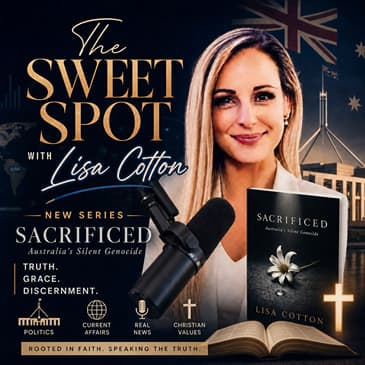
[00:00:09] Welcome back to The Sweet Spot. I'm your host, Lisa Cotton. The Sweet Spot is about finding the balance between church and state and discovering God's perfect will for your life. In this episode, we ask a question that goes to the very heart of who we are. What does it mean to be created in the image of God? For Christians, the defence of our most vulnerable, the unborn, is not about politics alone.
[00:00:37] It is about where we come from and why every human life matters. And if every life matters to God, how should His Church respond to the unborn child, to the mother in crisis and to those who carry the pain of a past abortion? Join me as we explore the biblical view and the Christian response as we continue to look through the preview chapters of my book, Sacrificed, Australia's Silent Genocide. Let's begin.
[00:01:07] In previous episodes, we have examined the motives behind abortion, the humanity of the unborn child and Australia's position in the global debate. But for Christians, the defence of unborn life is not based on politics alone. It is rooted in a belief about who we are, where we come from and why every human life matters. The Christian response must be more than a public opinion or a political position.
[00:01:33] It must be lived through truth, compassion, courage, sacrifice and love. Before we begin, let us pause and consider the responsibility of the Church. If we believe that every human being is created in the image of God, then that belief must shape how we respond to mothers in crisis, fathers who feel overwhelmed, children who are vulnerable, and those who carry the pain of a past abortion. The Church must never respond with condemnation alone.
[00:02:04] It must be a place of truth and refuge, a community where people can find grace, practical help, forgiveness, healing and hope. With that in mind, let us turn to Chapter 7. Chapter 7. The Biblical View and the Christian Response The moral foundation that underpins the defence of the unborn is not merely a philosophical construct. For millions of Australians, it is rooted in a profound theological conviction.
[00:02:32] The biblical view of human life begins with a transformative truth. Imago Dei. The belief that humanity is created in the image and likeness of God. The sanctity of life in Scripture. Scripture does not describe the unborn merely as potential life. It presents the unborn as known, formed and valued by God. In Psalm 139, the psalmist declares, For you created my inmost being.
[00:03:02] You knit me together in my mother's womb. Your eyes saw my unformed body. All the days ordained for me were written in your book before one of them came to be. Similarly, in Jeremiah 1.5, God says, Before I formed you in the womb, I knew you. Before you were born, I set you apart. These passages reveal a creator who is intimately involved in human life from its earliest stages.
[00:03:32] From this perspective, the unborn child possesses inherent dignity and worth, not because of viability, independence, health, ability, or whether they are wanted by society, but because they bear the divine image. Human value is not earned. It is given by God. This means that the life of the unborn cannot be measured only by circumstances, convenience, development or public opinion. Every human life is sacred
[00:04:01] because every human being is created by God and for a purpose. Throughout history, the Christian Church has often stood against the devaluation of human life. In the early centuries of the Roman Empire, the exposure and abandonment of infants occurred in some communities. Christians responded by rescuing vulnerable children and caring for those whom society had rejected.
[00:04:31] This radical countercultural commitment to life became an important expression of the early Christian faith. Christianity proclaimed that the poor, the weak, the sick, the abandoned and the unwanted were not disposable. They were neighbours to be loved and protected. The same principle applies to the unborn child today. If the value of a human being depends on strength, independence, ability or acceptance,
[00:04:59] then every vulnerable person is placed at risk. But if human value is grounded in the image of God, then the smallest and most dependent life must be protected. The modern church's response The modern church in Australia faces a critical juncture. Although the theological conviction remains, the practical response has sometimes been muted. Fear of public criticism, a desire for cultural acceptance
[00:05:28] or an incomplete understanding of pastoral care can lead congregations into silence. Yet true pastoral care does not require compromising the truth. The Christian response must be twofold, an unwavering defence of unborn life and a radical, sacrificial love for mothers and fathers facing crisis. The church is called to be a sanctuary, a place where women facing unexpected pregnancies find not condemnation,
[00:05:58] but tangible support, trustworthy guidance, practical resources and community. The church must be willing to walk with families through pregnancy, birth, parenting, adoption, financial hardship, relationship breakdown, grief, disability and trauma. It must also offer grace and healing to those who carry the deep wounds of a past abortion. Many women and men live with regret, grief, guilt or unresolved pain.
[00:06:27] They need to know that repentance is possible, forgiveness is available and restoration can be found in Christ. The church should never celebrate the destruction of life, but neither should it abandon those who have been involved in abortion. The message of the gospel is that no one is beyond the reach of God's mercy. A whole life ethic The biblical view demands more than a political stance.
[00:06:54] It calls believers to embrace a whole life ethic. This means protecting the unborn while also caring for the mother. It means opposing violence while supporting victims. It means defending truth while speaking with humility. It means standing for justice while extending mercy. The Christian response cannot end with voting, protesting or making public statements. It must be demonstrated through service.
[00:07:23] Are we willing to provide a meal, a safe place to stay, transport to a medical appointment, financial assistance, counselling, childcare or long-term friendship? Are we willing to support families raising children with disabilities? Are we willing to assist women who have been abandoned by the child's father? Are we willing to welcome those who feel ashamed, isolated or afraid? The church is called to stand in the gap,
[00:07:53] to be a voice for the voiceless and to embody the love of Christ in a culture that too often chooses convenience over compassion. If the church will not speak for the unborn, who will? As we reflect on this chapter, we are reminded that the Christian defence of life must never become an excuse for cruelty. We can speak firmly about the dignity of the unborn while remaining gentle toward women and families
[00:08:21] facing difficult circumstances. Truth without love can wound. Love without truth can mislead. But biblical compassion brings truth and mercy together. Every unborn child bears the image of God. Every mother deserves support. Every father has a responsibility. Every church has an opportunity to serve. The answer to abortion is not condemnation. It is a culture of life, one that welcomes children,
[00:08:51] strengthens families, protects women, confronts violence, provides practical support, and points people toward the healing power of Jesus Christ. If you or someone you know is considering ending the life of an unborn child, regardless of the circumstances, please get in touch with us on free call 1-800-363-228 so we can help you find the support you need. And to the listeners of this episode who may have been challenged or changed
[00:09:21] in some way, let this be the moment we make the choice to consider a better way, a higher way with Christ as our inspiration who made the ultimate sacrifice. For it was his body and his choice to give himself so that we may live free from sin and shame and be empowered to love others as he selflessly loved us. Thank you for listening and for letting God's truth shape the way we love. If this conversation
[00:09:50] about the image of God and the Church's response has stirred your heart, please subscribe to The Sweet Spot so you don't miss an episode as we continue this journey together. Next week, we look again at Chapter 8 and ask, what defines a civilised society? Exploring how a society that provides for the strong but discards the weak has lost its moral compass and importantly, how we can find our way back. So for now,
[00:10:20] may the Lord bless you, keep you and give you his peace this week. Join me next week as we continue our journey. Visit sacrificed.com.au to get involved in the movement to abolish abortion and visit prayer at parliament.org to pray for the nation and our political leaders in what is clearly spiritual warfare. End Abortion Australia. Get in touch and get on board as we rise to fight to end Australia's silent genocide.
[00:10:50] It is time to speak. It is time to act. It is time to choose life. I'm Lisa Cotton for The Sweet Spot. Until next time.