
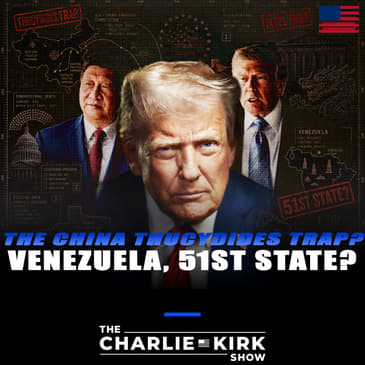
President Trump is in China, and Chinese leaders are talking about...ancient Greece? Blake explains the "Thucydides Trap" and why China considers it so important in its negotiations with President Trump. Rep. Chip Roy talks about the struggle to arrest the Islamization of Texas. Ryan James Girdusky analyzes Trump's desire to acquire Venezuela as a state and the current House odds as weak state Republicans back off on taking as many seats as they can. Rich Baris stops in.
Watch every episode ad-free on members.charliekirk.com!
Get new merch at charliekirkstore.com!
Support the show: http://www.charliekirk.com/support
See omnystudio.com/listener for privacy information.
00:00:03
Speaker 1: My name is Charlie kirk I run the largest pro American student organization in the country, fighting for the future of our republic. My call is to fight evil and to proclaim truth. If the most important thing for you is just feeling good, you're gonna end up miserable. But if the most important thing is doing good, you'll end up purposeful.
00:00:24
Speaker 2: College is a scam, everybody. You got to stop sending your kids to college.
00:00:27
Speaker 1: You should get married as young as possible and have as many kids as possible.
00:00:31
Speaker 2: Go start at turning point.
00:00:32
Speaker 1: You would say college chapter. Go start at turning point, yould say high school chapter. Go find out how your church can get involved. Sign up and become an activist.
00:00:39
Speaker 2: I gave my.
00:00:39
Speaker 1: Life to the Lord in fifth grade, most important decision I ever made in my life, and I encourage you to do the same. Here I am Lord, Use me. Buckle up, everybody, Here we go. Noble Gold Investments is the official gold sponsor of the Charlie Kirkshaw, a company that specializes in gold I rays and physical delivery of precious metals. Learn how you could protect your wealth with Noble Gold Investments at noblegoldinvestments dot Com. That is Noblegoldinvestments dot Com.
00:01:17
Speaker 3: Welcome to the Charlie Kirk Show. It is Thursday, May fourteenth. We are here at the y Refi Studios in Phoenix, Arizona.
00:01:25
Speaker 4: Welcome Blake. Hello. How are we doing this morning? We're doing splendid, wonderful.
00:01:29
Speaker 1: Well.
00:01:29
Speaker 3: We've got a lot of things going on internationally today. Of course, President Trump is in China on a much celebrated trip to meet with President g He was greeted with a red carpet.
00:01:41
Speaker 4: We talked about it yesterday.
00:01:44
Speaker 3: More and more pomp, more circumstance, more celebrations, lots of I would say, shows of welcoming. However, underneath the surface, it appears that the fault lines between these two nations are becoming more and more clear. There was a lot of before this trip to China. What would be the central fissures or fractures between the two countries. We understood that there's the Iranian war. US wants to lean on China to pressure Iran to open the strait, to give up its uranium. But what would the Chinese expect in return? Obviously, there's also they're calling this, by the way, the Boeing the it's the three bees, the Boeing, the beans, and the I'm forgetting one of the other big wigs. Yeah, probably something like that, oh, beef, Boeing, beef and beans. Anyways, So there's a lot of trade issues that need to be iron out. Tariffs, there's the fentanyl precursors that are flowing from China to parts of the world where they make fentanyl and try and pour it into our borders. President Trump has done a great job limiting the incoming fentanyl to the United States, but it still remains an ongoing issue. So what are the big fault lines. Well, it's becoming more clear that turns out Taiwan is top of mind for the CCP, and she is offering a warning on Taiwan as he and President Trump strike a positive note, but underlying this it's very negative. Now, what is the through cicities through thucities? I almost got it through trapped. It's an ancient reference to the Polypnesian Wars in ancient Greece, and Blake, being our resident historian, is going to break it down. But it was a term coined by Erbart academ Yeah Graham Allison in about twenty eleven.
00:03:31
Speaker 5: But it's a lot older than that.
00:03:32
Speaker 3: It's a lot older than that. But here's what's interesting. China has been referencing it Blake since its early as twenty fourteen.
00:03:39
Speaker 5: Yes, well so China at least, China at least does read the Western history, Western thought. A lot of their leaders are certainly more educated in our history than most of us are in Chinese history.
00:03:54
Speaker 4: Which is common around the world COmON around the world.
00:03:56
Speaker 5: But it is revealing China has we should frank China is authoritarian, but it does mean most people who rise to the top are are very smart in a way that doesn't always happen in the US, with US appointing people to things and all of that. But thucidities trap. So that's a reference to ancient Greek historian Thucydides. If you've heard of him at all, you maybe picked him up in a college course about political science. He wrote, he wrote, not the first historical text, but probably the first one. That's the first one on that's really scholarly, that reads like an academic history you might read today. And he wrote about the Peloponnesian War. It's a war between ancient Greece, the city of Athens and Sparta. If you've seen the movie three hundred, it's those guys, and they fought a war for dominance of Greece. And the reason we have a thing called the thu Thucidities trap. In his history, Thucydides theorizes that the cause of the war was that Athens was becoming more and more powerful. It was becoming the most powerful city in Greece, and so Sparta feared this, and so they declared war to stop Athens before they became too powerful, and they were successful. They actually won that war. Now, the idea is that this recurs throughout history, and our biggest, most cataclysmic wars are between a rising power and then the power that they are threatening to supplant, which is threatened of them, the ruling power that is frightened into acting before it is too late. And so if you want a classic example of this, the one people point to is World War One. World War one was Germany as leader of the Central Powers, and they fought against France, Russia, and most notably Britain. Britain was the most powerful country in the world. They had the biggest empire. And the idea is Britain was afraid of Germany because Germany was getting colonies. Germany had was getting a bigger economy, Germany was building a giant navy that could threaten the Royal Navy, and so in Germany and Britain at this time they actually had a big fear of One of the most popular genres of literature was invasion literature, where Germany or a country that resembles Germany but won't be called Germany, they invade Britain. They were this is this is like the romantic chick lit of the days that they were all reading these books about Germany invading Britain. They were afraid of them, and so they ended up getting dragged into a war with Germany and tens of over ten million people died. Similarly, the idea is when we fought Japan in World War Two, part of this was motivated that Japan was becoming more and more powerful, so FDR and the US were taking steps to contain Japan. Don't let them take over China, don't let them spread in other places. Japan feels that we're holding them down, so they attack Pearl Harbor. We get that war, and there's others examples throughout history. That we don't investor.
00:06:46
Speaker 3: Allison identified sixteen times in history that a rising power threatened to displace a ruling one, and according to his tally, which is subjective, twelve of the sixteen rivalries end in kinetic conflict war. In two thousand and fifty teen, President g did say there is no such thing as the so called you just say thucidity through cities trap in the world, said mister g in twenty fifteen before an audience that included former Secretary of State Henry Kissinger, it was on his mind again. I'm reading from the New York Times on Thursday, speaking before mister Trump in the Great Hall of the People, mister she said the world had reached a new crossroads. Can China and the United States overcome this trap and established a new paradigm for relations between great powers? Now, I think it's more interesting that China keeps referencing this as opposed to the United States. Well, guaranteed the United States actors here are very aware of this dynamic, but it's a it's a a soft flex because they're basically saying that we are now on par or in.
00:07:52
Speaker 5: Routes being China's one hundred percent when they say this and can we avoid it? They are saying, China's rising and is poised to if you overtake the United States. Can we allow this to happen peacefully without the United States declaring war on us? That is what China is saying when they say that.
00:08:10
Speaker 3: Now, to be clear, there is leverage points on the United States side here that China is very reliant in many ways on energy flowing through the Strait of Horn moves. Now they're the biggest buyer of Iran's energy, So you could say Iran is more reliant on China than China is on Iran. I certainly think that's true. But after you take Venezuela and Iran's energy off the board, it does put pressures on China. Now, China also has weak domestic demand. When you think about their economy, they are an export driven economy. If you make energy and production of goods more expensive for China in general, it will drive up costs, it will hurt their economy, and they seem to be probably in the midst of a sluggish I think you could safely say a sluggish economic situation right now. There's differing accounts of how sluggish that is how endangered their economy is. But they do seem to be putting specific pressure on Taiwan. They want to exert maximal influence and control over Taiwan. As you said before the show, they believe that Taiwan is theirs by right.
00:09:21
Speaker 5: They think it is on par as if someone had joinked Maine or Washington or Hawaii off of us and they want it back.
00:09:30
Speaker 3: So a little history lesson on Taiwan. So in China used Taiwan, as we've mentioned before, an inseparable part of their territory. It's it calls it reunification, so nationally, that is the term that they use. Even though Taiwan does not ascribed to this China and she they see it as reunifying Taiwan to the nation of China.
00:09:54
Speaker 5: Well, Taiwan does ascribe to the You know what Taiwan's actual official name is, right, Yes, they do actually Republic of China. Their claim is they are the one God, yes, all China. Inact, they claim more territory than the People's Republic does. I think I think the Republic of China may have I might be wrong here, but I believe they've never recognized the independence of Mongolia. So they still claim Mongolia as part of Super China, which it was part of China way back in the day.
00:10:20
Speaker 3: Well, Beijing has never ruled Taiwan, so that's the first thing we need to say.
00:10:25
Speaker 4: They claim it people break Awa.
00:10:27
Speaker 3: They claim it as a breakaway province since the Chinese Civil War ended in nineteen forty nine when the Nationalist government retreated there. So that's kind of the point you're making. So that Nationalist government retreated to Taiwan, they set up shop in Taiwan. That's why they claim to be the legitimate power over the mainland of China. And I guess, to your point, even more territory than the CCP claims for itself. But nevertheless, there's a lot of things that are going on there. It's obviously historical and ideological. It's military. It's a strategic military out post because it sits as the first island chain. It would allow China to project its strength out into the Pacific, which would complicate matters for the US obviously in some of our allies like the Philippines and Japan. It would secure China's eastern flank, if you will, out into the Pacific. But there's also what we talked about economic and technological matters to be considered as well. Taiwan is the global leader in semiconductors. TSMC produces approximately ninety percent of the world's advanced most advanced chips.
00:11:33
Speaker 5: It's really a huge complicator because we've supported Taiwan for eighty years at this point. We've backed up their government against China, but it was most for most of that time. A lot of that period, Taiwan was not that wealthy, or at least it was just wealthy in the same way Japan was, and so we supported them for sentimental reasons, for anti communist reasons. But now now, over the past thirty forty years, they have become the most important choke point of the world's most important technology, which when we say semiconductors, that is microchips. That is the stuff that goes into the chips that you put in your computer, that you put in it's driving ai it's driving It's the stuff you put in missiles to make sure they work correctly. It is the most important technology in the world, and the most advanced fabricators that make the best chips the fastest are in Taiwan and China would love to have them, but they'd also love to have Taiwan for the reasons we mentioned. It was a part of China back when they were an imperial monarchy. They lost it as part of the Civil War. They it is hard for us to ask how psychologically important it is to the Chinese. You grow up learning about this as the rightful Chinese province that was snatched away by these ponds of the West, and they want to keep aspart' that's the narrative they're told, and there's self interested reasons for them to push that, but that doesn't mean they don't really believe it.
00:13:01
Speaker 3: It's safe to say that Taiwan from a tech talent standpoint, and obviously this TSMC, which produces ninety percent of the world's most advanced chips, makes Taiwan a incredibly important chess piece on the board of geopolitics. And I think it's also important to understand that what makes Taiwan so powerful in this respect. Yeah, and you'll see there there's US clears h two hundred chip sales to ten China firms, and this is a big part of the storyline here in videos. Chief CEO Jensen is they picked him up in Alaska on en route to China, so they picked him up there and he's flying with them. He's looking to secure these big deals. I don't love this candidly because President Trump is surrounding himself with people that have self interests in expanding the market in China. President Trump is acting as their chief salesman and trying to open up markets for the US firms. Obviously that's important because we opened up the US market to China for twenty five years and got absolutely ravaged by it. Okay, we got our industrial base hollowed out. What did we get for? We got a bunch of cheap goods, plastic rubber crap that ends up in the in the trash, in the wastebind So don't we got to open up China, for sure, But there's so many strings attached that I don't love it, And one of them is that you've got people like in video CEO, who has self interest in China. Now, the H two hundred is the second gen. It's an older chip that also might be a slightly degraded version of it. So you get them hooked on our chips so that they don't produce their own or don't get more incentivized to invade Taiwan and take it over. Now the the you know, we have a TSMC production facility, a chip making facility here in Arizona that was built, this massive, massive thing. If you drive out to Lake Pleasant, you'll see it out in the distance. But what I've been told by people in the space is that, yeah, we can build the facilit here, but we don't have the tech talent, We don't have the same type of people. There's something unique about Taiwanese people that seem to be uniquely gifted at making these chips. They don't have social lives, they don't take time off, you know, they just make chips all day long. And it's hard to replicate that type of technology and that production capacity domestically here in the United States. So while we do have some chip making abilities in the United States, it doesn't match Taiwan's. Taiwan's has the top top chips. Okay, so now it complicates everything, which now it makes a lot of sense why China is putting maximal pressure on this particular fault line. So here's the big stakes. We'll boil it down for you. Just like this, China is probably willing to help us with Iran if we're willing to change our diplomatic posture to Taiwan, and I don't think we're willing or ready to do that just yet. Charlie used to talk a lot about Angel Studios and what they were building, and as you know, I've been a longtime fan of it for the same reason. So I want to share some of my favorite films and shows on Angel, and I put them all into one easy to use watch list. This is content that's actually worth your time, not just noise or recycled talking points, but stories that go a level deeper and ask better questions. That's what stands out about Angel to me. They're willing to put out films and documentaries that don't just follow the usual script, especially when it comes to politics, culture, and the bigger conversations you and I should be having. So on my watch list you'll find picks that lean into those topics, but there are also solid options for family or just something meaningful to watch at the end of a stressful day. If you want to check it out, go to Angel dot com slash Charlie and take a look at the watch list I put together.
00:16:44
Speaker 4: Joining us now is.
00:16:45
Speaker 3: Rich Barris Big data poll and he's the author of a new book, by the way, called burn It Down. What the polls say young Americans really want. Welcome back to the show, Rich.
00:16:57
Speaker 6: Oh of a book.
00:16:59
Speaker 7: Shout out brother, Thanks for that of course, man, thanks.
00:17:02
Speaker 6: For having me.
00:17:02
Speaker 7: As always, people definitely should go out and buy that book.
00:17:05
Speaker 4: Andrew.
00:17:06
Speaker 3: I you know I was inspired to, you know, promo your book, Rich, because I just saw your tweet where you're you're talking about books on China and war and conflict that people should be reviewing. It almost looked like you were attacking me. But I know better than that.
00:17:20
Speaker 4: Rich.
00:17:21
Speaker 3: No, you're not to have you on the show. I knew you fired it off quickly, but you're absolutely right. People need to get educated on the history of war. I'm going to play this clip because I haven't. This is a g on the Thucydides Trap nineteen.
00:17:36
Speaker 8: The whole world is watching our meeting. Currently, transformation not seen in a century is accelerating across the globe, and the international situation is fluid and turbulent. The world has come to a new crossroads. Can China and the United States overcome the Thucidities trap and create a new paradigm of major country relations. Can we meet global challenges together and provide more stability for the world?
00:18:14
Speaker 3: All right, so, Rich, before we get onto this CIA story that I got to cover, what's your take on what you're watching?
00:18:22
Speaker 7: Well, I about fell out when I heard that. That's not good to hear that. And for people who don't know what it is, Graham Allison popularized the term the Thucydides trap. I actually on that tweet that you were just referencing, I actually told people to read the Origins of the Origins of Major War by Dale Copeland, who wrote before Graham did. But the bottom line is it speaks to an emerging power, the situation in the international system when an emerging power rises to replace and displace the existing hedgemon, and Graham looked at sixteen case studies. Copeland looks at more modern liberals nation state, which is interesting as well, but it usually leads to great power conflict. And for Shijing pink to say that out loud is bad, it's not good because for many, many years, the Chinese have always tried to tell the United States, We're actually not going to do that, We're not interested in that and this time what he said is this is on you. You know, the current situation that we're in right now. He said, can the US avoid the trap?
00:19:32
Speaker 6: Guys? It's a reference to the Peloponnesian War.
00:19:34
Speaker 7: This is just it's exactly if you're an international relations theorist, it's exactly what you have not wanted to hear from many many years. Meerscheimer's written about it. Eh Car is another one I told people to go read. I mean, I'm over here pitching other books except for my own, right, But it's true. You have to get you have to understand why what just came out of his mouth is so important. For many, many years, Americans and the foreign policy blob have tried to tackle an international system that's in their mind and.
00:20:06
Speaker 6: Lets you say, this is the way it works, the world works.
00:20:09
Speaker 7: And then you have liberal internationalists and neo cons who have been arguing, no, we're in a post history era and this is something new, and we're going to somehow be exempt from the laws of nature. We're going to be exempt from the the laws of the international system.
00:20:24
Speaker 6: And realists who have.
00:20:25
Speaker 7: Been right for the last twenty five thirty years more since the end of history, you know, they're taking victory laps, you know, one after the other recently. So to hear she's and ping say this is bad, it's very bad.
00:20:40
Speaker 3: Well, and he did bring it up as early as twenty fourteen, and in twenty fifteen he said, there is no such thing. But I think what you're getting at here is China is asserting themselves as our equal. He's they're asserting themselves as as our equal. That's what you're saying, man, And he's basically saying, don't come on our front poor and bully us around, because you know there's the two of us now and you got to deal with the reality.
00:21:07
Speaker 5: He has a point. I mean, it's for a lot. As you said, for a long time it was China is rising. But don't worry about it. We're not trying to take your stuff. We just want to be rich and powerful. And now yeah, they are more equal. We should we should be frank about this. We should not be in denial about this. If go look around your house at the things that are in it, chances are a lot of them were made in China. Especially. Look at anything advanced. Look at your computers, look at the parts in them. They're made in China significantly. They can if you're worried about military stuff. They can make missiles faster than we can. They can make ships faster than we can.
00:21:43
Speaker 4: At one point whatever billion people.
00:21:45
Speaker 5: Yeah, yeah, they have four times our population.
00:21:49
Speaker 3: They are an aging population. They do have domestic economic concerns, they.
00:21:53
Speaker 4: Have energy concerns.
00:21:54
Speaker 3: And by the way, we have we have successfully under the Trump administration, I would say, uh, blunted their rare earth mineral dominance.
00:22:03
Speaker 4: It still exists.
00:22:04
Speaker 3: We're not all the way there, but we have made strides in that where they can't choke us off from rars like they could. Still got to make more gains there. So it's both and I think President Trump is a realist. I think we need to be frank about it. What we want out of this is we want them to buy our soybeans like they said they were going to. We want them to fill some of these trade obligations for so the farmers are looking at this. We want them to buy Boeing planes. We want them to help get us the uranium out of Iran and then help us open up the straight of horror moves. All these things are doable. But if the price of admission for all those things is you gotta let us take over Taiwan. That ain't gonna happen currently, so we might be at a stalemate. And by the way, I just want to make one final point here before we move on to the CIA story.
00:22:46
Speaker 4: Ridge.
00:22:46
Speaker 3: This is the first of about three meetings, so don't expect this huge cords to be reached at this meeting. This is sort of an opening act, all right, everybody just hold their horses, let this process play out. Let me just play this clip because this happened last night and I actually tweeted it, and you know I've all that, Yeah, so here we go.
00:23:07
Speaker 4: I'll play it.
00:23:07
Speaker 3: This is a it was a breaking news story last night on Jesse waters He since the leaded its NOTT twenty just in John.
00:23:15
Speaker 9: The CIA just raided Tulsi Gabbard's office. Agents hauled out dozens of boxes files on the JFK assassination and mk Ultra, the CIA mind control operation, which she was in the process of declassifying.
00:23:30
Speaker 3: All right, so this was obviously, I mean the tweet when I tweeted it, I'm not trying to you know, mention my Twitter or something here, but it went viral.
00:23:39
Speaker 4: Really quickly.
00:23:41
Speaker 3: It's since been community noted, but I got contacted by friends. They were like, hey, here's a new statement from d and I spokesman. Spokeswoman Olivia Coleman said this is false. The CIA did not raid DNA's office. And then essentially a lot of this originated with Congresswoman on a Place Luna, who was scheduled to come on this show today but then had to cancel because she is actually at the CIS. I guess she's meeting with the CIA currently. She's tweeted that out that's public. So the point is she had gone on with Katie Pavlich on News Nation talking about this not raid now that we're told, and actually it sounds like the CIA took these boxes a while ago.
00:24:23
Speaker 4: It was not a raid.
00:24:24
Speaker 3: The DNI sort of oversees all the intel agencies, so that it none of it made sense actually when you kind of break it, since.
00:24:30
Speaker 5: She could just tell them to not do that.
00:24:32
Speaker 3: In theory, she could just yeah, Tolci Gabbert should have just been able to say you can't take these boxes. So something else obviously was going on. I'm being told this didn't happen the way that it was originally reported, and as I mentioned, Jesse Waters has taken down his shows tweet and I think he just got out over a skis. This does seem related to some of the testimony that we heard yesterday regarding Anthony Fauci. I think the CIA is not happy about this unquote whistleblower. There's a lot of disagreement about the nature of this person who testified.
00:25:05
Speaker 4: Rich tell us what you know.
00:25:07
Speaker 7: Look, here's what I know, all right, outside of what you just said, which is the same thing I'm hearing.
00:25:12
Speaker 6: However, and you know what bothers me.
00:25:15
Speaker 7: You know, he's just like with the CIA, there's always this like little caveat in the back of my mind because there have been these identical stories and they have played out very similar in the past, only to later find out that everybody kind of circled the wagons and came together and said.
00:25:32
Speaker 6: Oh, well, it's not really like that. But then it was right. So I you know, I'm.
00:25:37
Speaker 3: Always you know something, I have something going with you, something's going on. They went and took these MK ultra boxes and the JFK assassination files.
00:25:47
Speaker 4: Should all just be released. It should release.
00:25:50
Speaker 3: President Trump has ordered it to be released, So what is the delay? I completely agree, but there's obviously some sort of disagreement, and everybody's saying, who wa, whoa, woa whoa. Let's not blow this up into some huge, major national news story. It's a little too late for that, because I agree with you, Rich, something weird is happening in.
00:26:09
Speaker 5: Your country is secret for more than sixty years and they can't release it. You don't live in a normal democracy.
00:26:14
Speaker 3: Just to put a final point on the CIA story, Rich, so uh. Rep Anna Polina Luna says, heading to the CIA with Rep. Burlison Eric Burlson to see the files in question taken from ODN I so again, apparently these files were taken a while ago. They she was tweeting last night that they were saying, you have to preserve these documents. They've been ordered released and declassified. And to her credit, she never said that there was a raid. If you watched the clip back the original clip in questions from Katie Pavlich, she said that they were taken and it made it seem like they were taking you know that, you know, yesterday and it was a big, big to do. Apparently this was a more orderly situation she's contesting that people are misrepresenting what she said. So I just I just want to make a final point on that. It sounds like something weird's going on. But to be fair to Congresswoman Anna Polina Luna, she didn't say there was a raid.
00:27:11
Speaker 7: Yeah, I just wanted a couple of things. One is, let's see AA has done this before. They didn't kick in Diane Feinstein's office door either, but we found out later that they did break in and take a bunch of stuff that was related to her investigation into torture or enhanced interrogation. Right, And so we've seen this. I'm sure they weren't taken last night. I'm sure they were taking the moment Donald Trump signed that order, they got whin that he was going to sign that order. I mean, this is what I suspect, Like in the back of my mind, I suspect. And here I often say that the Republican.
00:27:42
Speaker 6: Women in Congress have the bigger you know than Republican men.
00:27:46
Speaker 7: They have the they have spine, they fight, and I'll be honest, I trust Representative Luna.
00:27:51
Speaker 4: I do.
00:27:52
Speaker 7: I also trust de and I gab I do. But the problem is Luna's a representative. Gabbard is the head of an intelligence and you know it's no secret the people's pundent loves him some Gabbard, all right. So I'm not saying that she's like covering for anything here, but there is a bit of a song and dance.
00:28:08
Speaker 3: Well, she has to play within the system that she exists, right yeah, And if she's coming through like knocking the CIA, that's not going to be taken well and she's not going to be long for the DC world. So she's got to play the game. We understand that. But something's going on here. And just one other point on the mk ultra files, most of these were destroyed. There's an estimated fifteen percent of those files that are still exist in existence. This is what she DNI Gabbard is tasked with declassifying. And obviously MK Ultra was a brainwashing tactics that were experimented on by the Intel community in San Francisco, in villages in Europe, you know where they laced the bakery with LSD. I mean, it's all kinds of crazy stuff. And you know, the American people do deserve to get clarity on what are Intel operatives were actually doing. So we want to see these things get declassified and released, so we support Congresswoman Luna's efforts there to to get them released. Rich, I want to I want to pivot here a little bit and go to this Massy race in Kentucky that is coming down to the final stretches primary. Uh, there's been polls release that show Massy down.
00:29:25
Speaker 4: There's on at.
00:29:27
Speaker 3: Even What are you seeing in your polling and what what do you expect to take place here?
00:29:33
Speaker 7: Well, you know, I don't want to blow the markets up here, you know, like we saw happen with the Pole the other day, and I think the market's corrected because I'm going to defend him.
00:29:42
Speaker 6: Look, this is a difficult race to poll.
00:29:44
Speaker 7: A lot of people when they get into these GOP primary races, they they wait boomers so much, Andrew, and this is a great race that underscores burn it down. What I'm when I'm arguing with Joshua and burn it down, which is that the GOP is real danger here. They're governing they were not elected by a coalition of boomers, and they're governing for a certain kind of boomer and even silent gen when in ten years, I mean the first boomers turned.
00:30:09
Speaker 6: Eighty this year.
00:30:10
Speaker 7: Guys, this electorate is going to dramatically change. One thing we have over China is a robust millennial gen block that they do not have. They will be the dominant voting group in the not too distant future.
00:30:23
Speaker 6: And to just ignore their wishes the way.
00:30:25
Speaker 7: We have has been stupidity. I'm sorry, but Massi's race is a great example of this. Millennials are going for Massy three to one, not two to one, not two and a half to one, three to one.
00:30:36
Speaker 6: And so when you're.
00:30:37
Speaker 7: Deciding as a polster, do I trust randomization here?
00:30:40
Speaker 6: Am I underscore?
00:30:41
Speaker 7: Am I underestimating how much younger voting cohorts will make up of the electorate?
00:30:47
Speaker 6: Or do I not? And in the case of that one poll, he didn't know.
00:30:50
Speaker 7: The problem is, and I've tried to warn other pollsters, Kentucky, for is not a boomer district. It's traditionally they're about thirty six thirty eight percent of a competitive primary electorate. That's it, and typically eighteen to twenty nine. They could be eight ten percent. In our last poll, we only had them at six and Massy.
00:31:09
Speaker 6: Was still ahead.
00:31:11
Speaker 7: What will be key is what the forty five to sixty four do I mean, I gonna want to give away too much yet, But Massy has a slight lead with them, Gallrin leads with sixty five plus and it really will come down to how much of the forty four and under show. Here's why again, I would caution people be careful of what you're looking at. There is no registration growth whatsoever in the sixty five plus category.
00:31:34
Speaker 6: In fact, it's been net negative.
00:31:36
Speaker 7: Forty five to sixty four is a little bit, so their potential for elasticity when you're modeling the electorate, it's there, it's not huge. All of the elasticity and uncertainty comes from forty four below.
00:31:47
Speaker 6: And the reason is is.
00:31:48
Speaker 7: Because literally that's where all of the new registration growth is, particularly among those.
00:31:53
Speaker 6: Who are thirty to forty four and have families. And that what does that mean? Why does that matter? Because when you have families, you're probably marry.
00:32:00
Speaker 7: Vote history becomes more robust than it was before you had a family.
00:32:03
Speaker 6: It's really interesting. So I just caution some of the other posters out.
00:32:07
Speaker 7: There be careful because what what's gonna happen is you may not have given these people enough time. It's literally that they're just they didn't have enough time to build that robust vote history. So when you're deciding who you want to model in your poll, if you wait them out, you're gonna end up like polsters in twenty sixteen who waited out Trump's.
00:32:23
Speaker 3: So I don't know what you think of quantas just good. Yeah, it's very close. Quantus nine eight respondents forty eight point three percent for Gallren, for forty three percent for Massy, eight percent undecided. The sixty nine respondents who are undecided, fifty two point two percent of them back Gallern and twenty point three percent. Uh, because we would go for MASSI. So that that's what that's just came out minutes ago from the Hill. So it's a title.
00:32:56
Speaker 7: It was done, it was done the days ago. This is what I want to try to explain to people. And we actually did see a period where there was a little bit of a response bias going on with younger, younger cohorts.
00:33:08
Speaker 6: So if your only Andrew, if.
00:33:10
Speaker 7: You have to wait up because you didn't talk to enough of them, it creates more uncertainty in your in your polling.
00:33:16
Speaker 3: Call it rich, colle Rich, who do you think is gonna pull out the primary.
00:33:19
Speaker 7: Well, the poll will be out tomorrow and then we'll do two updates when the early vote comes in to show them. Listen, I think, Matt, if I say it, I'm literally gonna move things before I should.
00:33:29
Speaker 4: So I'm just I already heard it.
00:33:31
Speaker 3: There was an m there, Rich here, it is very close.
00:33:36
Speaker 4: It's very close. All right, we're gonna see what happens.
00:33:38
Speaker 3: Okay, we got thirty seconds left, Rich Cornyn Paxton, Texas?
00:33:43
Speaker 4: What are you seeing? Thirty seconds quick?
00:33:44
Speaker 7: If Republicans nominate Cornyn, they risk huge depression in November. There's like thirty twenty eight percent of their GOP primary electorate is telling us they won't even bother to show up.
00:33:54
Speaker 6: If John Cornyn is nominated, he has a cap.
00:33:57
Speaker 7: He has more consistent mail in vote that back him.
00:34:01
Speaker 6: But he does have a cap.
00:34:02
Speaker 7: And we've even pulled this, like what if Trump endorsed corn In and you know what happens. He goes from forty six to forty seven. The guy's got a cap. So the only way Paxton loses is if his voters don't show up.
00:34:13
Speaker 4: Pax is gonna win. That, wouldn't you say?
00:34:15
Speaker 6: I think he's got the ad Yes, absolutely.
00:34:17
Speaker 3: Rich Barris burn it down. Check out his book What Young Voters Really Want? Rich Barris, thank you, my friend. We'll see again soon.
00:34:24
Speaker 5: All the best, brother, Hey Erod, We're excited to tell you about Charlie's favorite supplement. If you experience brain fog, low energy, frequent illnesses, or if you just wake up stiff and achy every day, you've got to try strong cell. Charlie took it every single day. He frequently talked about it on the show, and he even traveled around the country bringing it with him. For Charlie, strong cell helped keep his mind sharp and focused for all the debates he was engaged in. Strong cell gives clean, natural energy without jitters, weird spikes, or afternoon crashes. It makes you feel like a younger version of yourself. People would often ask Charlie what is strong cell exactly.
00:35:00
Speaker 1: Strong cell uses a proprietary delivery of ANYDH to make sure it goes straight to your cells to help your mitochondria. And since there are cells in every air of your body, then healthier cells equals a healthier you.
00:35:13
Speaker 5: Strong cell is a nutritional supplement that leverages a remarkable enzyme called na d H. Think of it as the power source for every single cell in your body. With over thirty trillion cells working for you, imagine how great you could feel when they're all functioning at their very best. Unfortunately, as we age our bodies, NADH levels naturally decline, leading to all kinds of ailments and health issues linked with poor cellular health. Unlike many supplements that simply nix ingredients and hope for the best, Strong Cell has a proprietary delivery system designed to ensure that those ingredients effectively get into your bloodstream where they can truly make a difference. This is crucial as many supplements on the market are just pretty packaging with no real benefits. Here's the exciting part. You can give strong Cell a try completely risk free. Thanks to Strong cells ninety DS money back guarantee, you can experience this revolutionary product with no worries and no hassles. If it's not for you, no problem, They'll refund your money. With nearly two million units sold, it's no wonder that NADH has become a highly sought after remedy. Remember what you put in your body matters, and you truly get what you pay for. Strong sell doesn't cut corners. They use the finest ingredients and they adhere to the highest manufacturing standards. So if you're tired of feeling tired, battling brain fog, or just not feeling like yourself, check out strong Sell today. Visit strongsell dot com and use the code Charlie for twenty percent off your order. Charlie always recommended giving strong Cell six to eight weeks to experience its full benefits, So do yourself a favor. Get strong Cell today and give it the time it needs to work its magic.
00:36:44
Speaker 1: That Strongsell dot com forward slash Charlie, and don't forget to use special discount code Charlie at checkout to get a special twenty percent off just for Kirk listeners. Strong Sell dot Com forward slash Charlie. Check it out right now.
00:37:01
Speaker 3: Another story that is making massive headlines is about Sharia a lah, the Islamification of the United States of America. There was a big hearing in DC yesterday that the clips were everywhere. I don't know if you guys saw. It was the Sharia Free America. Why political Islam and shri a la are incompatible with the US Constitution. This was part two of these hearings. That was held yesterday and Chip Roy was leading the charge. He joins us, now, Congressman, welcome back to the show.
00:37:31
Speaker 2: Great to be with you guys. Hope you're well.
00:37:32
Speaker 4: Doing great, sir so.
00:37:34
Speaker 3: I saw these clips everywhere, Congressman, and there was just so much going on. You were there, you were making some great points. Brandon Gill was there, this great young kid, Hunter Lopez, who then gets lectured by Jamie Raskin. I want to get into that in a second. There was the Texas Public Policy Foundations, Aim and Blair, Rare Foundations USA founder and Amy Meckelberg. You pulled out all the stops here at Congressman, tell us what you guys were doing and why it was so important.
00:38:07
Speaker 10: Well, this goes back to and again I don't like doing this, except you guys appreciate it that the last conversation I have with Charlie was about Islam, and Charlie was one of the few people willing to say what needed to be said, which is that Islam is incompatible with Western civilization. So the purpose of these hearings is not just to sit there in the minutia of the law, which is important obviously.
00:38:31
Speaker 2: As someone who wants to be the Attorney General of Texas.
00:38:33
Speaker 10: I'm dramatically concerned about Sharia law and what it means for young women, what it means for equal protection under the fourteenth Amendment of the Constitution, what it means with the arbitration agreements that end run our laws and undermine our civilization for people that are subjugated under Islam. But importantly, it's to elevate this and to highlight the truth. We've imported about five and a half million people from majority Muslim country since nine to eleven. That does not count the millions of Muslims that we've imported from non majority countries. It doesn't count the additional people that came in as family members. It does not count the children that have been born in the United States to people that came here, were naturalized, or have visis. So we have an exploding population of people who have no desire to assimilate or join the melting pot, but instead and in fact called, as Amy testified to and as Amon Blair testified to, that are called to wage jihad against the West. And then you pointed out Marco who did a fantastic job. Hunter Lopez, the sixteen year old student in Wiley High School north of Dallas who basically schooled Jamie Raskin on the issues involving the questions. And I think by the way that Marco was quoting Charlie, he didn't say it because I remember when Charlie gave a great answer to one of these questions about where God is in the Constitution, and he said, well, God has four times mentioned in the decoration. Charlie made the point that our state constitutions, before we created the federal government, all had references to our Christian faith, and Marco was quoting that directly in arguing with Jamie Raskin, a constitutional law professor that was arguably being schooled by Marco. I was proud to share the hearing I called the hearing you got. I got to tell you it takes a lot of work to get people here in Washington and want to take on Islam because they're afraid of being called Islamophobic.
00:40:26
Speaker 2: I'm afraid of losing America.
00:40:28
Speaker 3: Yeah, well, it was such an important hearing. I want to play this clip. I posted it as well and got great feedback on it. This is Rare Foundation USA founder Amy Mecklberg talking about the brutal truths that, as you said, too many are afraid to mention out loud.
00:40:46
Speaker 4: Clip three.
00:40:47
Speaker 11: Islam is a hostile, totalitarian political ideology using our freedoms to destroy us. To every non Muslim, it offers three choices convert, submit or die. It does not stop until every court, every school, and every government on earth is under Sharia. These networks operate more than eight thousand Islamic nonprofits across America, including six hundred and fifty in Texas alone. They build a parallel infrastructures mosque, seminary, school, Sharia bank, Sharia court, Sharia clinics, charities, media, and political networks. They have no plans of insimilating.
00:41:24
Speaker 5: Now a congressman a thing that we are hearing about this all the time from our listeners. We get a ton of emails about it, we get a ton of calls about it. It obviously fills a lot of people with dread. But we're also aware we bump up against a core part of America's identity. The First Amendment does guarantee free exercise. How do we both legally and I think rhetorically negotiate that dilemma that we're aware we do have freedom of religion. We're obviously very wary of curtailing that because we know how the left would love to attack Christian churches. But we're also aware this is not a suicide pack. This is not an amendment that makes us just turn our country into a part of the caliphate. How do you how do you negotiate that problem?
00:42:10
Speaker 10: Number One, the federal government has to stop importing millions of people from countries where we know they adhere to this ideology, and it is a political ideology and we need to stop doing it. Let's freeze the immigration broadly, like I suggested under my Pause Act. Let's reform our entire system from top to bottom. That's number one. Number two, we've got to have smart lawyers, and obviously I'm running the attorney jungle of Texas, who will go into court and win cases and make the point that this is in fact a political ideology with political goals and motives. Their own moms say it. We've got plenty of video, plenty of evidence. We have memoranda from the Muslim Brotherhood. We have an entire plan laid out by individuals and organizations, the hundreds of organizations that are well funded to drive this agenda to politically undermine the United States.
00:43:02
Speaker 2: We have to call that out for what it is.
00:43:05
Speaker 10: And thirdly, you've got to be able to continue to fight and win on grounds that are I think more legalistic about how these things are being developed, except to Trade Practices Act and so forth, like Epic City and so forth. But the biggest thing we have to do is to acknowledge that we are in fact a Christian nation dot Judeo Christian principles, and that while we are very defensive and we should be and must be of the First Amendment, we all believe that that the government can't come in and tell you got to be in church on Sunday, or you've got to pay this tax, or you got to believe this thing.
00:43:36
Speaker 2: None of us would want that.
00:43:38
Speaker 10: But we are in fact a nation that was bound together by a set of ideals, and at the core of it all was our Christian faith. And if we don't acknowledge that, we don't remember that it says in God we trust above the speaker's share in the House chamber, that Moses is on the backside of the House chamber looking over us, that we've got the ten on the front of the United States Supreme Court that we absolutely had references to our creator and to God four times in the Declaration of Independence, and that our founding was built on that. You know, our founders were very, very open about how much our faith was necessary for this country to work. It is the glue that holds us together. And the reason our country is fraying is because we're moving away from our boundary faith. And number two, we're throwing federalism out the door. You cannot have four hundred and thirty million people peacefully coexisting when you have conflicting values and faith, and when you don't allow local people to make decisions that are best for them under the constitution. So these are the things I'm trying to fight to do up here.
00:44:44
Speaker 3: I want to play this clip from Charlie Congressman and future Attorney General UH twenty three.
00:44:50
Speaker 1: The spiritual battle is coming to the West, and the enemies are Wocism or Marxism combining with Islamism to go after what we call the American way of life. And the American way of life is very simple.
00:45:03
Speaker 2: I want to be able to get married, buy a home.
00:45:06
Speaker 1: Have kids, allow them to ride their bike till the sun goes down, send them to a good school, have a low crime neighborhood. Not to have my kid be taught the lesbian, gay, transgender garbage in their school, while also while also not having them have to hear the Muslim call to prayer five times a day.
00:45:30
Speaker 4: That's important.
00:45:33
Speaker 1: We want the American way of life, which is, by the way, Christendom.
00:45:38
Speaker 4: Amen. I never did.
00:45:40
Speaker 5: I never did get him to get Christendom rights.
00:45:44
Speaker 4: It was so clear, so morally clear.
00:45:46
Speaker 3: And so Congressman, you're running for attorney general in Texas. I've heard from a variety of sources that say that the ads going back and forth, it's like, well, I'm more pro this guy's more pro Islam, and that guy's pro It's so it's become very central to what's happening in the primaries right now in Texas.
00:46:05
Speaker 4: Why do you think that is?
00:46:06
Speaker 3: I mean, is it just a visceral reaction that Texans are experiencing walking their neighborhoods. There's just a very visible increase in mosques in the Muslim population.
00:46:17
Speaker 4: What's going on here?
00:46:18
Speaker 2: Well, it's an important question.
00:46:20
Speaker 10: And I really appreciate that quote from Charlie or that clip, because he says it with such moral clarity, like you said, And what we're seeing in Texas is three hundred and thirty mosques, more mosques being built in Texas than every day than any other state in the Union. We've seen in a massive explosion in the Dallas Forth Metroplex in particular, all by design by the Muslim Brotherhood, and it's all shoots in its various organizations. And I have to tell you guys that you know, there are a number of reasons that I'm running for Attorney General, not the least which is my family and the ability to be a husband and father back in Texas rather than traveling back and forth the DC. But the biggest professional reason is my commitment to what Arlie just said and why this issue of stopping the March of Islam is critical to preserving Texas, the crown jewel in the American Republic. If we lose Texas, we lose the nation. And right now we're on a path where Texas is in trouble and we've got to stand up and protect that American way of life that Charlie just said it. And so I'm talking about it, but I'm not just talking about it I'm doing something about it. I'm holding hearings where I declare affirmatively that Islam is incompatible with the West, and it's not going unnoticed by care and a bunch of those that have concerns. But importantly, my opponent has never practiced law, and I'm not going to get into it too much.
00:47:40
Speaker 2: I don't like to get personal. But you have to know what you're doing.
00:47:44
Speaker 10: I've run the Attorney General's office, I've been a federal prosecutor, I've been a constitutional lawyer. I've been the chairman of the Constitutions Subcommittee in Washington and Congress.
00:47:53
Speaker 2: You have to know what you're doing.
00:47:54
Speaker 10: My opponent introduced legislation last year in the name of religious liberty that would have made it easier for mo to create Epic City and to create these massive housing enclaves and communities that are Sharia compliant and Islam centric.
00:48:08
Speaker 2: You've got to be ready for the battle.
00:48:11
Speaker 10: We are at a point in our history where we're at war, and you have to acknowledge the war if you want to win it. So those of us who have been in there taking the arrows, fighting the good fight every day, that's who you want leadership. Positions like the attorney general. The most important legal job in the nation for conservatives is Attorney General of Texas. Particularly if we don't have control of the administration. You've got to have someone there who can fight. And this issue of Islam is front and center. There are other things securing the border, dealing with criminals on the streets. Charlie just rattled off in that clip, the Marxists, the woke brigade that are all out trying to target our state. All of those things are attacking Texas.
00:48:50
Speaker 2: Move got to deal with those.
00:48:51
Speaker 10: And one last point are the corporatists who are trying to come in and they buy up our land and they put data centers in every corner. They want to say, oh, don't have state stands on the AI. We'll have one big federal standard and we'll brempt states. No, we're going to allow the people to be able to defend our kids from the march of the corporatus as well as the Islamis, as well as the Marxist.
00:49:13
Speaker 3: Yeah, it kind of what it scores Blake's earlier point that we're up against this religious liberty concept that is central to the American value system. We Obviously, our founders created that thinking about you know, Presbyterian and Anglican and Quakers.
00:49:28
Speaker 4: They weren't thinking.
00:49:29
Speaker 5: How do we overcome these fundamental religious exactly.
00:49:32
Speaker 3: And so you've got it to your point, if you're going to fight this an illegal front, Congressman, you have to understand the law. You have to be able to be creative, you have to find workarounds. You have to be able to exert influence power politically, socially, culturally in ways that don't undermine our system, but that preserve it. And so you have to understand the technicalities of the law, what you can win on, what you can bring suits on, and so to your point that that is so critical to be able to being able to fight this fight. And I, by the way, you mentioned the corporatus last time, I think maybe I mentioned this to you that I flew into Dallas. I actually drove three hours up to Oklahoma, and it was like one farm after the other after the other getting just like demolished and just like it was. It candidly was really gross to me because it's just all these like crappy homes that are being put up in this beautiful farmland. I'm not anti growth. But man, there are forces at Texas that are like ripping out the heart and soul of the people that made Texas Texas. And there's got to be a balance here somewhere, because it's just happening so rapidly.
00:50:40
Speaker 10: Well one hundred percent, And I'll bring up a point that's directly related. There's a pack in California that ran a million dollars of ads against me in the first primary, and now they're running hundreds of thousands more now with the stated objective of killing my political career, which, by the way, my life isn't going to be defined winning or losing an election, is defied in my faith in Christ and my family and serving my country wherever God puts me. I'm putting myself out there to be Attorney General because I think I'm the best man for the job. But this pack wants to take me out because I was successful in delivering for President Trump repeal of half of the great new scamsums that he's a year ago. I had to threaten taking down the big beautiful Bill for a few days to get it, but we got it done. And so now they want to take me out. Now, why does that matter? Because all of these corporate cronies that are taking government money, they're using it to buy up land, to put up solar panels and win farms. They want to use similar kinds of things to go put the data centers in place, all without regard to the homes that people built over centuries in this country, who built communities, who built up farms, and I get I'm with you. I'll say it the same way as you did. I'm not saying I don't want growth. I'm not saying I don't want affordable houses. I'm not saying you can't sell a farm that's in close to Dallas that you can then go build houses on. What I'm saying is what you're saying. We need to protect this great nation, this great state. We need to be thought full about how we're doing it. We've got to be mindful about having good technologies and good input from local government and citizens so they don't have a bright light in their night sky in a small Texas town and their water isn't getting sucked out and their grid isn't getting drained while the price.
00:52:13
Speaker 2: Of electricity goes up.
00:52:15
Speaker 10: Also, corporations can make a lot of money with a quick sale of private equity in New York.
00:52:19
Speaker 2: Yeah, there has to be a balance here.
00:52:22
Speaker 4: Yeah.
00:52:22
Speaker 3: And by the way, I actually, I actually love the idea of taking dilapidated land or old malls and using that land.
00:52:29
Speaker 4: You know.
00:52:30
Speaker 3: Yeah, we use some of the underserved, underutilized land that we already have. Support Chip Roy for Attorney General. He's the man for the job. Congressman, it's great to see you. We'll have you on again soon. God bless you.
00:52:42
Speaker 2: Thanks guys, God bless you guys.
00:52:46
Speaker 3: This Mother's Day month, you can help make motherhood possible if you've ever joined us providing ultrasounds and saving babies with preborn Thank you. There are babies alive today and mothers celebrating this year because of the gift of an ultrasound that helped turn the truth of the baby that was growing inside of her. Today, you can help another young woman choose life for just twenty eight bucks. And that is just the beginning, the start of a two year long mentorship that includes services like free maternity clothes, baby clothes, diapers, strollers, cribs.
00:53:17
Speaker 4: Formula, and so much more.
00:53:18
Speaker 3: And it all begins with that ultrasound you provide today because preborn separately fundraises for administrative and overhead costs. One hundred percent of your gift goes directly to providing ultrasounds. So call or click right now and join us in saving babies and moms so that next year there's even more to celebrate. Call eight three three eight five zero baby that's eight three three eight five zero two two two nine, or click on the preborn banner at Charliekirk dot com. All right, Uh, our next guest is a guy that we just had on recently, but he was so good breaking down the numbers when it came down to comes up with our midterms that I wanted to have him on again because there's been a lot of news that's been going on with the redistricting fight after the Supreme Court ruling relative to the state of Louisiana and Hollywood impact.
00:54:12
Speaker 4: All the rest of the states.
00:54:13
Speaker 5: Annoying news, annoying news.
00:54:15
Speaker 3: Ryan James Gerdski joins us. Now he's got his bios too long. I'm not even gonna get into it. I'm not this time. Maybe on the other side of the break.
00:54:24
Speaker 4: It's just too much.
00:54:25
Speaker 2: It's too much.
00:54:25
Speaker 3: Yeah, it's fine. He hosts a show he's got multiple packs. He's got a sub stack. Ryan, give us the latest news on the redistricting fights, because it was looking like we were going to run the table here and we've had some setbacks.
00:54:40
Speaker 12: Well, I actually did a whole episode of this for my podcast, A Numbers Game on iHeartRadio. The Here's what happened. So in South Carolina, five Republican state senators joined all the Democrats to block the redistricting effort in South Carolina. So right now, Tom Clayburn, Jim sorry, Jim clavern seat is safe for him. The governor said he's going to bring into his special session which would redistrict that one seat in South Carolina. The governors over in Louisiana and Alabama, however, are leaving Democrats with one seat each As of now. K Ivy has been very adamant behind the scenes. I've been hearing that she wants to protect one of the Democratic seats, the black majority seat in Alabama. Seven Over in Louisiana, the governor Louisiana is seemingly to he's seemingly trying to settle political scores because certain people who he's not very friendly with are not getting the seat are not creating a seat that they could possibly run in, So that's over in Louisiana, so that'd be still a net positive of two seats. Florida obviously they just changed four seats, but it's in the middle of a heated legal battle. Tennessee did redistrict their one seat. It is also in illegal battle, but that's likely to be in favor of Republicans. And Maryland has said they're going to open the our door to redistrict the one Republican seat in Maryland and Andy Howers' seat, So Republicans really kind of drop the ball over in Alabam.
00:56:00
Speaker 2: In Louisiana.
00:56:00
Speaker 12: Oh, when I FORGT. Mississippi, they announced that they are not redistricing this year. They're going to redistrict next year, so that'd be for twenty twenty eight, that's the lone Democrat seat there for Benny Thomas. Governor Brian Kemp surprise everybody saying he will redistrict. I'm gonna bet that's probably also me another one seat, but that's also in twenty twenty eight. So for as twenty twenty six goes, you have one seat in Tennessee, a possibility in South Carolina and chew out of Louisiana and Alabama. But it's a net positive three instead of many, many more than people expected.
00:56:30
Speaker 4: What's a little unfortunate.
00:56:35
Speaker 3: I gotta say it's frustrating to be a part of a political movement that you have to share with a bunch of like Southern country Club Republicans that don't understand what's at stake here. Give us the overall math here, Ryan, where do you see the numbers? So if you had to go Republican strong seats, Democrats strong seats, and toss ups, where does this leave us now?
00:56:59
Speaker 12: I think Republicans probably have a two. If South Carolina does get their redistricting dumb, which I think they will. The governor seems pretty strong about it, they'll probably be about two hundred and ten Republican likely seats and about a two hundred and maybe seven or eight Democratic seats, and then maybe a twenty nineteen in leaning independence seat, not independent but toss up seats. It depends on what you classify as a toss up. Definitely, the seat in Florida probably is more of a toss up. The wut Watsman and Schultz seat, even though it's now leaning Republican. The seat over in North Carolina where the incumbent congressman has had those allegations of misconduct with a staffer. That could be a toss up eventually. Main second is a very big one in New York's third congressional district, which is the one that's the sleeper race. That's the Trump plus five seat out of Long Island, the former George Santos seat. A guy named Michael Petri's running. They are a very strong campaign against Tom Swazi. The Marcie capture seats very important over in Ohio. So overall, Republicans need to probably win half of all the toss of seats to maintain the House majority, which is much better position they were in even just a few months ago.
00:58:07
Speaker 3: So how many on one final question with to Blake, how many seats are we leaving on the board here that because of the inaction or the failure to act of the Southern States.
00:58:19
Speaker 4: How many do we live?
00:58:20
Speaker 12: At least at least three that's off my head. One Mississippi, which will come oh sorry, sorry more than that, five, two in Georgia, one in Mississippi, one in Louisiana, one Alabama. The Louisiana Alabama ones are the most egregious ones because it's said that the courts just gave them the light to get the game. The Okay, Mississippi is hard. They already had their primary, so that's why they're saying, we don't know. Brian Camp is Brian Camp. He's kind of you know, he does his own thing. But the ones in the Louisiana and in Alabama, especially Alabama seventh and the one in New Orleans for New for Louisiana, that is egregious. The Republicans really should have redistricted both those seats being the Republican seats.
00:58:59
Speaker 5: So I guess how much how likely do you think it is on the basics situation, We're talking a couple of seats, where a seat here, a seat there. What are the odds this ends up proving decisive for the House itself? This fall like, what sort of majority are we looking either way? Do you think it's likely to come down to two seats either way? Or do you think this matter is much more going forward? After the selection.
00:59:26
Speaker 12: Let's say Democrats run the table. Let's say gas prices stay high, the economy doesn't pick up, people are still mad about AI and a bunch of other things.
00:59:33
Speaker 11: In the war.
00:59:35
Speaker 12: Hakeem Jeffries will probably have a seven to eight seat majority, so he's basically in the same kind of hell Kevin McCarthy was in, not only just two years ago. We're very looking at done AOC is very empowered. The squad's a very empowered. That's kind of the situation they're in. There's just so few toss up seats. We're not looking at a twenty eighteen style electionalave anymore. There's it's just not the way the math works. If Republican can win half of the seats available to them, they'll probably end up with the same situation there and right now, which is a one to two seat majority. Maybe at most maybe they can win a third, who knows, but there's not a lot. There's really a very little wiggle room either which way unless a party kind of blows it out of the water. And seats that are likely Republican flip Democrat are likely Democrat foot Republican.
01:00:23
Speaker 3: All right, So let's fast forward a little bit. Set our sites on the census twenty thirty. How does how does the population shifts from these blue states into the Sun Belt primarily a few other states.
01:00:37
Speaker 4: How does that change the electoral math, Ryan.
01:00:40
Speaker 12: I mean it basically going from twenty thirty to twenty forty. If a Republicans can just hold Florida, Ohio, Georgia, North Carolina, Texas, Arizona, Arizona, you don't even need Evada. A Republican will win the presidency every time. They no longer need Pennsylvania, Michigan or Wisconsin. They no longer need, you know, they don't need Nevada, they don't need New Hampshire or Minnesota or all the lean Democrat states that are just always got to reach New Mexico. As long as they keep those like six sun Belt states, they can't lose the presidency. George is obviously gonna be very difficult, North Caroline will be very difficult. Those are very small margins that Republicans have won by, so they'll still be important Pennsylvania, Michigan, Wisconsin, all the rest of them, but they're not essential to win. The only states are essential to win are the Sun Belt states plus Ohio.
01:01:28
Speaker 5: And something that comes to mind. Maybe you can correct me if I'm wrong, but this increasing it's called maximalism about House seats where you're seeing states jerry manner to get as many seats as possible. Is that going to make the census more important because I know in the past how the GOP would pick up these seats, but they are often you know, immigrant groups who then you create House seats, and so you might get a Democrat House seat, but a new Republican electoral vote. But now we're just seeing these blue states. Are they're shedding a seat that they were going to jerry mander to make blue no matter what. And we're gaining a seat that will probably jerrymander to make red no matter what. And so the census is becoming an even bigger deal now than it was just with the presidential stakes.
01:02:12
Speaker 12: Yeah, there's obviously some examples where that may not be true. Like if Georgia gets this extra seat, it'll probably in Atlanta that might be a Democratic seat. You know, if Austin is growing very big and Texas gets four seats, one may be a Democratic seat out of Austin. It will also leave pressure out of the Republican seats not to stretch so thin, so not to have a dummy Mander. That could all be possible. But yes, in large part it is essential because of the twelve seats Democratic seats are expected to lose as of right now, I mean maybe ten would be automatic Republican seats, and add ten to two ten they're a number we have right now as a safe or lean Republican and you're at two twenty and you're at the House majority number. So you know, California maybe be able to knock out one more Republican seat, Illinois knock up one more Republican seat in New York obviously not got a bunch, but nonetheless and yet still that makes it more important. And another thing that no one's paying attention to. It makes the state legislative elections super important. Republicans have to keep the state sentence in i say, legislatures in Wisconsin, Michigan, Pennsylvania to keep those Republican seats, make sure they don't go in full Democratic hands, and really start competing in other blue states to try to save some Republican seats.
01:03:23
Speaker 3: Ryan, I'm gonna play a clip for you, and we're just gonna we're gonna deal with this impending reality.
01:03:28
Speaker 4: Top five.
01:03:29
Speaker 13: When I was talking to the President this morning, it was just before the Oval Office event, he kind of surprised me a little bit because he said, John, I just want to tell you I'm very serious about this, so you could talk about this. I'm serious about beginning a process to make Venezuela the fifty first state.
01:03:46
Speaker 5: All right, Ryan, break it down for us, dead serious. How many electoral votes is Venezuela going to have in the twenty eight election? And is it a swing state, a blue state, a red state.
01:03:58
Speaker 12: So Venezuela would get as many electoral college was as Texas. Now I want yourminius link. Even though they even though we would add two US Senate seats, we would not add any House seats to Congress. They would serve four hundred and thirty five House seats, so a lot of red and blue states would all lose congressmen to go to Venezuela. So Venezuela would have thirty eight congressmen, and they would come from all over the country, including out of red state. So that's a big, big caveat how do they vote?
01:04:28
Speaker 2: That's a big question.
01:04:29
Speaker 12: So Venezuela and Dysporia, both in the United States and in Argentina, the two places I looked at were big backers of both President Trump and j Javier Malay over in Argentina, the Libertarian President of Argentina. They are, though the dasporia are tend to be wealthier than those who live in Venezuela. And Venezuela if it were to come a state would have one tenth the GDP per capita of the state of New Hampshire. It would be more than twice poor, twice as impoverished as American Samoa. It would have an average of eight nine hundred dollars per year per person income. So a generous welfare state is going to sound very alluring to those people. They had not had a free election since they voted for a communist. That being said, maybe they've learned their lesson. Who knows. However, there are certainly a very pro communist wing of that country that still exists, so it is not safe to say that they will vote any which way, given that a lot of people who despise communism have already fled the nation.
01:05:29
Speaker 3: I was going to say, so, the big thing you got to think about with Venezuela is that the diaspora, as you said, that we see in Florida or Argentina, that's selective, that's not representatives of the people that remained. The people that remained are the poor less well off. You said, they may have learned their lesson, but they may not have learned their lesson, and that is the difficult thing to gauge here is because we haven't had transparency in Venezuela, we have no idea what that electorate is like.
01:05:57
Speaker 4: We know that there.
01:05:58
Speaker 3: Was accusations with the Maduro's last election that it was rigged, that his opponent actually won that election, and that they rigged the elections in his favor, So maybe they would vote that way. But I mean, do we have any Moduro president?
01:06:13
Speaker 12: Even under the fair election estimates, Maduro still received forty something percent of the election, so it wasn't like it was ninety nine to one like the fake election results. Maduro has a sizeable level of support, maybe one in three people living in Venezuela. I don't know about you, but to get thirty eight new congressmen and have a third be all squad members, that's not a great deal, especially when you're taking congressman from Alabama, from Ohio, from Pennsylvania, from Texas and you're sending them over to Venezuela. Not a really big fan of that idea. Plus also, I mean, we've had a very tough time securing our own border with Mexico that has a river and mountains. Securing the Venezuelan border from the millions who would easily flock through the into that nation to be counted in this election would be uh, would be panemonium.
01:07:06
Speaker 1: Yeah.
01:07:06
Speaker 5: And you know, obviously we're being a little cheeky here, but I think another thing to keep in mind, we have America has annexed formerly independent countries before we did it with Texas. We did it with Hawaii, but Hawaii had tremendous immigration from the United States. Texas was clearly just founded settled by Americans who wanted to join the United States. Throughout that period. We've never we would be annexing a country that is Spanish. Yeah, speak Spanish has a long history of independence, they have an identity as Venezuelans. And so when we're discussing how that would go politically, they wouldn't I don't think they'd be thinking what's best for America because I am now American. They would be thinking, how do I help Venezuela, my country that has perhaps just temporarily attached itself to this country that's decided to be at sugar Daddy. And so for example, in politics, it might just reduce to who's promising us the most money. And I think we all know which party he loves to promise people money for doing nothing the most.
01:08:05
Speaker 12: Yeah, it's important. Remember, Venezuela is poor. The average Venzuela is poorer than the average Western European after.
01:08:10
Speaker 2: World War Two.
01:08:11
Speaker 12: So what we had to do in World War two to build up Western Europe, we would have to do at a larger scale to build up Venezuela while we are, while we are broke, and while Americans really are resenting one foreign policy, you know, adventurism, and two money not being spent within our own country. So that would probably be very very dicey. I don't think Donald Trump needs to do this to make it part of his legacy, to have a wonderful legacy.
01:08:41
Speaker 4: So but what about the oil? Ryan? We could just fund it all with the oil, what say you?
01:08:46
Speaker 12: Yeah, allegedly, but the oil would then be owned by private companies. So we're going to increase taxes on oil? Is that what Trump's gonna do? I mean, we're just gonna increase taxes.
01:08:54
Speaker 2: Left and right.
01:08:55
Speaker 12: We can increase taxes on AI and spend a lot and pay for a lot of things, but we don't you that either. Like they're not gonna want to. If Trump has a good friend purchase oil at an oil company in Venezuela, he's not going to push for higher taxes out of Venezuela. It's just not like there's just no way that that's gonna happen. So no, it's gonna come out of the American tax lot. We're gonna borrow from China to spend in Venezuela at the increase of the lowering purchasing power of the American dollar for people in red states throughout the country. It's it's not necessarily's.
01:09:27
Speaker 4: My most important question.
01:09:29
Speaker 3: So we already have one Spanish speaking uh, you know, territory in Puerto Rico. How many more bad bunnies could we get out of Venezuela. That's really that is really the question that needs to be asked. It's a cultural question, it's a rhetorical one. Ryan James Gordoski, you have so many things here. I want to make sure I get it. You have the home pack, hold on home my lad.
01:09:53
Speaker 12: Pack for immigration restriction check it out, and a numbers game podcast in my podcast, those are the two all plug everything out you can.
01:10:00
Speaker 3: Nap Substack, National Pop Yah yes okay, Ryan, great analysis.
01:10:06
Speaker 4: Thank you, my friend. We'll talk to you soon.
01:10:07
Speaker 2: Thank you.
01:10:12
Speaker 4: For more on many of these stories and news you can trust, go to Charliekirk dot com