
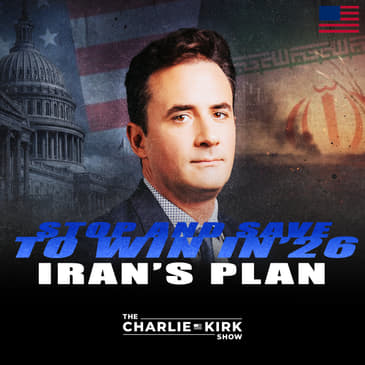
The massive fortunes amassed by almost any person who serves a stint in Congress have scandalized the public. Will Republicans finally go and ban it — and can we get the SAVE Act too? The show discusses how this will decide the GOP's fate in November. Then, Tom Sauer explains Iran's strategy for winning a war with America as Trump plots a potential return to major bombing. Auron MacIntyre explains what's true and what's fake about the new NDAA and Israel, and Alex Marlow reacts to Sophie Cunningham's showdown with woke scolds in the WNBA.
Watch every episode ad-free on members.charliekirk.com!
Get new merch at charliekirkstore.com!
Support the show: http://www.charliekirk.com/support
See omnystudio.com/listener for privacy information.
00:00:03
Speaker 1: My name is Charlie kirk I run the largest pro American student organization in the country, fighting for the future of our republic. My call is to fight evil and to proclaim truth. If the most important thing for you is just feeling good, you're gonna end up miserable. But if the most important thing is doing good, you'll end up purposeful. College is a scam, everybody. You got to stop sending your kids to college. You should get married as young as possible and have as many kids as possible. Go start at turning point, you would say college chapter. Go start aturning point youould say high school chapter. Go find out how your church can get involved. Sign up and become an activist. I gave my life to the Lord in fifth grade, most important decision I ever made in my life, and I encourage you to do the same. Here I am.
00:00:46
Speaker 2: Lord, Use me.
00:00:48
Speaker 1: Buckle up, everybody, Here we go. Noble Gold Investments is the official gold sponsor of the Charlie Kirkshaw, a company that specializes in gold I rays and physical delivery of precious metals. Learn how you could protect your wealth with Noble Gold Investments at noblegold investments dot Com. That is Noblegoldinvestments dot Com.
00:01:17
Speaker 2: All right, welcome to the Charlie Kirk Show. It is July twenty third, twenty twenty six. I'm at the remote y Refic Studios. Blake is holding it down in Phoenix. That were doing, Blake, I'm doing great because I'm at.
00:01:29
Speaker 3: The real y Refic studio with.
00:01:32
Speaker 2: You got my mic flag? You got my mic flag? It's no, no, listen, it's on my microphone. Well, let's not quibble over the details here, Blake. We actually got things pasted in the House yesterday. But of course, because it's DC, because this is America, I can't be without controversy. And I am, of course referencing the new bill, the Stop Insider Trading Act. Now, this was something that President Trump had floated at the State of Union. Massive applause, massive populist energy behind things like this. It is very clear the American people do not want Congress trading based on insider info, based on where the government's going to be spending money, where regulations are going, what's coming out of committee. We do not want them using that information to then enrich themselves. And a lot of people all eyes were on Nancy Pelosi of course she voted against this. But the controversy here, Blake, is that House Republicans attached aspects of the Save America Act requiring voter ID on federal elections to this. So critics are calling this a trojan horse, they're calling it a partisan sham. My question is, why wouldn't you just vote for both because both are very common sense pieces of legislation. Nevertheless, it does pass, and I think this is a positive step in the right direction. Is it everything I want bill to be? No? I actually think there were stronger versions of this bill, but first reaction to it getting passed. Then we'll go through some of the specifics here, Blake, Well.
00:03:09
Speaker 4: I just what I would say is I've been around the block on this and I don't think Republicans are going to get any kudos if they can't get a Senate to pass these things, and if they can pass a ban on stock trading, if they can pass pieces of the Save Act, both things they can do if they get rid of the filibuster to do it. You know, you could call it. You call it stop and save. It sounds like a gas station, so you have you pass stop, you pass save, you lower gas prices, and that would be a pretty good message for the midterms. But they've got to actually pass it, and I'm worried.
00:03:41
Speaker 3: I am worried. The critics are.
00:03:43
Speaker 4: Right that they attached the Save Act stuff so they can make the bill sound more good for red meat conservatives, and then they also know it will not pass out of the Senate.
00:03:52
Speaker 3: And it weans me to say that.
00:03:54
Speaker 4: Only because we've been around the block all year on this, and I guess here's my reaction. Yeah, My warning two Republicans is this that if they managed to talk about the Save Act all year, all of twenty twenty six and then not pass it, they're gonna get whacked in the midterms. And they'll deserve to get whacked in the midterms.
00:04:12
Speaker 2: I don't disagree. I don't disagree, but here's so there is a difference of opinion here. I've been texting and calling all of my contacts in the Senate. It feels very divided. There are glass half foles guys that are saying this will pass the bird bath, which is again the parliamentary rules of the Senate how you can pass certain things through you know, a fifty vote threshold, as opposed to a sixty vote threshold. Reconciliation is the process that that's called. So we'll see some think it won't, some think it will. I'm hearing both sides of that. So I choose to be an optimist today, Blake, because they actually moved something through that is common sense that the American people want. Will. I was in the room, Blake during the State of the Union when President Trump first floated this idea, and I tell you that the energy and the exuberance and the clapping, the applause for that moment was huge. Then we got all distracted with Iran and people forget about that moment. But coming off the State of the Union was a huge, huge, populous, domestic, wonderful vibe shift that we desperately needed in this country. And this was one of the key pillars. Why do I say that because we have populist energy, You got to give the people some of these things in order to get excited to come out for the midterms. Okay, this is one of them. Let's talk about what the bill does and what it doesn't do. The bill bans purchasing covered investments, so that would be stocks of publicly traded companies and comparable derivatives, so it bans the purchase. It does not ban selling investments, so you can sell it, right, you can sell it if you're already holding it. It requires seven to fourteen days public notice before a sale. Okay, that's a good thing, right. I think this is actually a common sense compromise. Applies to members, spouses, and dependent children, so you can't just like give the stocks to your kids and then have them do your bidding. But no, no, no, that doesn't work. It imposes fees for violations force sale of improperly purchased stock, so if you do it wrong, they're gonna make you sell it. Okay, So you don't get to have all those and they're gonna impose certain fees. It excludes certain funds, so you can still trade mutual funds, all of those types of things, ETFs that just basically follow the larger indexes it. So all of those things I think are really good. These are common sense measures that we've all sort of been wondering. Why haven't they been in place since now Again, I'll just say there was certain acts in the past, Blake. There was the Ethics Acts or the Honest Act, which aim for full bands on holding trading individual stocks with the divestment requirements and coverage, so that doesn't happen, but it does build on the twenty twelve Stock Act. So these are positive steps in the right direction. But you're absolutely one accurate here. The proof is in the pudding. The rubber meets the road. In the US Senate, the question then becomes can we get this through the parliamentarian? That is the question. Trump is called to fire the parliamentarian. It's a Democrat, at least that's what they said. I actually think that that's not the right, proper, proper course ahead. What we need to do is we need to do with Senate Senator Mike Lee has been proposing, which is the talking filibuster. Make these people stay in DC, no August recess, none of this garbage. Do the work of the American people. Make them outlast. You make them put their name on the record say yeah or nay to this stuff, because I think if they say if they vote know, then the egg is on their face and that can only help. That just needs to be needs.
00:07:52
Speaker 4: To be the Republican approach on a lot of things. Every bill we get up seems to be an omnib us bill on everything, and so they don't make Democrats vote up or down on things that could conceivably be unpopular for Democrats to vote against.
00:08:10
Speaker 3: I think about that a lot.
00:08:11
Speaker 4: On the border, there's so many aspects of border security of immigration that would are basically insane, And so you could introduce a single subject bill to roll that back. You can ram it through faster to force them to get votes on it. And I just don't know why Congress fails to do these things. And you could do it on this Stock Act too. Just more people want to see a Congress that feels like it's doing things. And the way they feel like Congress is doing things is not by holding hearings, it's not by holding press conferences. The way they feel like Congress is doing things is that they are voting on and passing stuff. And I just often wonder what's going on with these guys. They aren't even confirming Trump nominees as quickly as they could. Here's the plan. If you want to win as a Republican, the plan you should have is zero vacancies. You should get to election day, midterm day with zero vacancies on any position that Trump can make an appointment to all of those people should be confirmed. Yeah, if you do that, if you have go like I said, the Stop and Save gas station, if you have Stop Act passed, so that they can say we're doing something populist. We're not enriching ourselves on insider trading, which is illegal for you, but it's been legal for us for ages. If you ban that, and if you pass the Save Act, and you know, if gas prices get lower because of Iran, we'll talk about that up ahead.
00:09:31
Speaker 3: You have a good message, you can win the election.
00:09:35
Speaker 2: Yeah, and I totally agree. And again, one of the issues in this election is going to be the economy affordability. If you pass this, it's a huge symbolic victory that the elites, the oligarchs, they don't get to enrich themselves and put themselves ahead of the American people. That's why I think this is so important. It's an important scalp to win heading into the midterms. All Right, I'm so decided to share with you guys. C fifteen from fatty fifteen, the first emerging essential fatty acid to be discovered in more than ninety years. It's an incredible scientific breakthrough to support our long term health and wellness, and you guessed it, healthy aging. Fatty fifteen co founder doctor Stephanie Van Watson discovered the benefits of C fifteen while working with the US Navy to continually improve the health and welfare of older dolphins. Believe it or not. Based on over one hundred studies, we now know that C fifteen strengthens our cells and is a foundational healthy aging nutrient which helps to slow aging at the cellular level. In fact, when our cells don't have enough C fifteen, they can become fragile in age faster, and when our cells age, our bodies age two. This eventually led to studies finding the first new nutritional deficiency to emerge in seventy five years, called cellular fragility syndrome, caused by a lack of the C fifteen. As many as one in three people worldwide may have low C fifteen level and fragile cells. To help support and optimize healthy aging, a team of doctors funded by the US Navy spent over a decade to develop the pure, science backed and bioavailable C fifteen zero ingredient in Fatty fifteen. Thankfully, Fatty fifteen repairs age related damage to cells, protects them from breakdown, and activates pathways in the body that help regulate our sleep, our cognitive health, and metabolism. This functionality leads to so many other exciting benefits now and as you get older. In fact, seventy percent of Fatty fifteen customers report seeing or feeling benefits within sixteen weeks, including deeper sleep, calmer moods, better energy, and overall improved health. Now that's essential. We're all aging, which means that healthy aging starts from birth. Studies have shown that C fifteen is a foundational nutrient that supports healthy growth and development in children and supports our long term health as adults. Fatty fifteen has three times more cellular benefits than EPA and OMEGA three. By replenishing our cells with the crucial CE fifteen nutrient, Fatty fifth teen effectively repairs cells, reversus aging related damage and at the cellular level, and restores our long term health and wellness. Fatty fifteen was developed in support of healthy aging for all, from kids to parents to grandparents. That's why award winning Fatty fifteen is now available as pure capsules delicious apple mintgummies for teens and adults and Barry Blast gummies for kids. Fatty fifteen is on a mission to support healthy aging for all, including all ages and stages of life. You can get an additional fifteen percent off their ninety day subscription starter kit by going to fatty fifteen dot com, slash kirk and using code Kirk at checkout. I just saw this video. It's kind of related. It's not related to anything, but if I saw it now, you guys have to see it. Blake, I know you're a lifter. You're a weightlifter. There's a lot of female sports news going on. Oh is this Paris twenty twenty four? I had no idea. I've never seen.
00:12:58
Speaker 4: I think it's I think it's the It is the Paralympics at least, so they're probably a little more easy going. But you see the argument in the notes, you know, just.
00:13:07
Speaker 2: Make me feel bad. You just I didn't know all this. When I was laughing so hard about this in the break, somebody said me this. We're gonna play it because I think it's the perfect example of the Senate GOP. This is a living embodiment of the Senate GOP. And then they kick off for vacation. You'll see what I mean. Top fifteen.
00:13:27
Speaker 5: She's getting for one hundred and forty five kilas on this occasion.
00:13:33
Speaker 3: To solidify that position on the alloah.
00:13:41
Speaker 6: Start.
00:13:53
Speaker 2: I didn't know as the Paralympics, just to be just to be clear.
00:13:55
Speaker 4: All right, it's all right, there's there's Like I said, they're debating in the notes other athletes at the Paralympics, we're completing more full reps. For those of you who couldn't see it, that was a woman out of powerlifting competition and I'm not even sure her elbows. She's doing the bench press and I think I think the bar literally moves about one inch and it counts as a rep.
00:14:16
Speaker 3: That definitely stands for me, that.
00:14:18
Speaker 2: Is the GOP. Yeah, that is the GOP. In the Senate, they think they get a whole month off if they just you know, don't bend their elbows and then they scream like they've done something great. Okay, I just we just had to go over that. Here's what's really going on here, though, And I want to get into this because this now is becoming another front in this battle for the Save America Act, which we all agree is super important. But let's just hear the Democrats in their own words. Okay. A journalist went and approached Pocahontas Senator Elizabeth Warren and asked about the fact that we now have prooved I mean, there's definitely far far. This is the tiniest tip of the iceberg. But now we have proof out of New Jersey with the scandal unfolding where we found out there is six six hundred non citizens who are found on their voter rules. That number is actually higher now it's five x higher that we've confirmed. But Senator Elizabeth Warren is now asked about it because there's proof some of them voted top fourteen.
00:15:18
Speaker 7: Oh hi, just a quick question for you.
00:15:19
Speaker 8: I know you're vehemently a post in Save America, but does the recent revelation in New Jersey with the aliens who are actually registered to vote change your opinion on getting that legislation power.
00:15:27
Speaker 9: It is already illegal for someone who's not an American citizen to vote, period.
00:15:32
Speaker 10: That's at least four hundred aliens that did that.
00:15:35
Speaker 9: There are already laws to prevent that. People have violated the law and they should be prosecuted.
00:15:41
Speaker 10: Do you see anything's actually going to happen.
00:15:42
Speaker 3: I thought Democrats always said that there's no evidence of that.
00:15:45
Speaker 9: I don't understand why you want laws that are already there.
00:15:48
Speaker 3: That makes me no sense.
00:15:49
Speaker 2: But that's a complete straw man argument. It's the honor system. And by the way, in nineteen States, did you know, Blake, In nineteen States, they have the automatic DMV voter roll right, the motor voter rule. And in those nineteen states, illegal aliens and non citizens get driver's license, so you basically have to go in and do an extra step to make sure you don't get put on the voter roles. It's it's that big of an issue, and it's all on the honor code because the law says you cannot check the ID during voter rege. Such a huge issue. Jake Tapper is dropping just pearls of wisdom here on CNN St. Nine.
00:16:30
Speaker 7: You're in the country illegally and you get a letter saying that you can vote, and you know you're not supposed to Not only you're not supposed to vote, you're not supposed to be there.
00:16:39
Speaker 3: Why do you vote?
00:16:40
Speaker 1: Like?
00:16:40
Speaker 3: I mean, you could register for a party, some of that.
00:16:43
Speaker 7: I mean, but I just like wonder, like that's some stupid business.
00:16:48
Speaker 4: I mean, it gets it gets out what we've talked about, which is it's about the decentralization of everything. Is that I think part of what's going on the Democrats, they love the idea make it super automatic that these people will register. That a lot of these people could you could practically accidentally register to vote and end up I don't want to say accidentally voting, but you can imagine these people getting rushed along voting for something not really maybe grasping the full consequences of it. And they make it so easy throughout the process that it's not like you even need to send an operative to illegally solicit their vote. You just make it so they're automatically registered. You tell people to vote, you offer to drive them to the polls, you offer to provide an interpreter. And if people illegally vote along the way without having to be told to, oh, that's so much the better. They're going to vote the way we want them to. And a few dozen votes there, a few hundred votes here that can get you extra wins along the way, and it's just like mailing all the ballots to everybody. You make it a decentralized process that nobody has to go to jail for, even if it's super illegal, super flagrant what they're doing.
00:17:53
Speaker 2: Yeah, it just imagine just the logic that these people are using. They've heard the details now, and Trump did that whole press conference, a primetime address where we found out there's over a quarter of a million in just a handful of states they're on the voter rules. In New Jersey we find out it's over thirty five thousand actually, and many of them did vote, so the numbers higher than six thousand, six hundred. We have that Trump truth that confirms at and they don't care. They laugh at it because they say nobody's gonna do this. Well, actually, we have proof that people do it what we already have. It's already illegal. Yeah, well it's on the honor system. Yeah, but it's going to make it harder for Democrats to vote. So how if you say they aren't doing it well because you know black people and you know married women, that doesn't make any sense. Oh, you're a racist. That's how this debate is going. Fine, if they want to go with that line of reasoning, make them do it from the Senate floor and put their name on it. Colorado is at it again, trying to silence free speech because that's what they do. In Colorado, a state law forces big businesses to refer to some customers with inaccurate pronouns, even if using them would violate the business owners religious beliefs or conscience. That's a violation of free speech. But as Colorado has proved time and again, it has little concern for the First Amendment. At Alliance Defending Freedom, they're challenging the law on behalf of a Christian bookstore and a sports apparel company. But a court recently ruled against them, which is a huge, huge problem. With eightf's help, they've appealed and they'll continue fighting to ensure Colorado doesn't get away with this attempt to skirt the First Amendment. Your gift today helps protect free speech in cases like this all over the country, and for a limited time. Your gift to the ADF, the Alliance Defending Freedom, great lawyers, great team. It's going to be doubled by a special matching grant while funds last. So text Charlie to eight three eight four eight. That's Charlie to eight three eight four eight, or you can visit them online at JOINADF dot com slash Charlie to have your gift doubled one more time, text Charlie to eight three eight four eight, or go to JOINADF dot com slash Charlie to have your gift doubled.
00:20:09
Speaker 4: Alrighty, well, it's been a few weeks since we've talked about Iran. But the Iran conflict has continued to stop and start and stop and start and have.
00:20:18
Speaker 3: Ceasefires and then not have ceasefires, and.
00:20:20
Speaker 4: It looks like we're grinding back towards the direction of a showdown with the Islamic Republic. So we have a new guest on to talk about that. He's a former Navy EO D officer that is explosive ordinance disposal, highly relevant to this conflict in the Strait of Hormuz. Tom Sour, former Navy lieutenant commander. He's joining us now, Tom, give us the big picture here, what is the current strategic situation with the US versus Iran. I'll be honest as a it's weird to say casual observer, but it feels like we've been in this status point. This is like the same thing has been had happening for months on end. Have things been changing in the background.
00:21:03
Speaker 11: Yeah, hey, and thanks for having me, guys, huge honour to be on here.
00:21:06
Speaker 3: Yeah.
00:21:07
Speaker 11: I got to say that I can understand why a lot of people feel like this is meant to be you know, we're just in this stalemate. But I really don't think that's the case.
00:21:14
Speaker 2: If you consider the.
00:21:15
Speaker 11: Fact that Iran now has virtually zero power projection right now outside towards its neighbors, aside from perhaps molesting shipping traffic in the Strait of Hormuz, which is continuing to be less and less in being diminished day by day. You're now also seeing the strangulation again of the blockcade against Iran, which is gonna you know, that's not meant to just squeeze if I'm gonna squeeze the people per se, it's also meant to squee to squeeze the infrastructure, the actual power structure of the Iranian leadership. So you know, look, a lot of people are very anxious about this in terms of like, does this mean we're going to go take carg Island. I think that there are options on the table out there that do not involve any sort of a forever war or something like Iraq or Vietnam. I'm not seeing anything like that. But also I think it's important to point out that Iran's strategy here. If I were the Iranians, I would probably follow the following strategy. And frankly, I hate to be the one to say it, but it's the same strategy that the Democrats have. And what I mean by that is that Iran wants to play this out, drag.
00:22:28
Speaker 2: It out as long as possible.
00:22:30
Speaker 11: Shoot stop say you know, they'll get get beat up a little bit more, they'll say they want to talk. Then they're going to say that we can't control some of the military commanders in our provinces. They're going to lash out again, go back and forth, and with their goal is to drive up prices, right, you know, particularly of oil, which you know, as we all know, translates to prices everywhere else going up. Their goal is to keep those prices up, keep this dragging out, which obviously won't necessary politically bode well for President Trump in the midterm elections.
00:23:05
Speaker 10: And their goal is to have you.
00:23:08
Speaker 11: Know, a loss of the House and or the Senate in November, and then once the and then you know, once the Democrats were to take power in Congress, their goal is that the funding would get cut and we would be forced with some situation where we have to start leaving around alone. So that's what I mean when I say that the IRGC, the UH you know Hamas, Hezbollah who are funded and supported by them, and the Democrat Party all have the same goal right now.
00:23:39
Speaker 10: And I know that sounds a.
00:23:40
Speaker 11: Little overly partisan, but it's just objectively true.
00:23:43
Speaker 2: Yeah, and I think that's actually right. I think we've all gathered that their ability to project strong military power at this point is greatly diminished. I sort of was curious, how, you know, the remains tom a bunch of these military sites yet to hit, because that's what we're hearing. We're hitting their radar, we're hitting their missiles, we're hitting their drones. I was under the impression that we had destroyed more of those, so I'm surprised that there are still so many targets left to hit. Nevertheless, that's we're doing. I want to play some clips here from Marco Rubio, who's kind of going viral this morning, and then I'm hoping you can take us inside the decision making structure, inside the White House. Who are the players and what are they What kind of positioning do they want? Right? Is JD still advancing the piece? Is Rubio somewhere in the middle? Does heg seth want to go really hard? We'll play this really quick, sot to.
00:24:36
Speaker 6: I saw you know, guys, I saw a Rachi, their foreign minister, who the other day say or something about their policies, and I for an eye. The president's policy is ahead for an eye. I mean, honestly, that's what it's going to be. I mean, they will pay a very heavy price for the things they're doing. They're already paying a very heavy price. You guys don't know it because you don't cover it. You're not in Iran, you're not in the street. They don't have a free media. But they're going to continue to pay a very heavy price.
00:25:00
Speaker 2: Goes on. And this is something called that I've been texting with a bunch of people the last week, and I've heard this phrase come up a number of times. Is shia bravado. That's what they call it, Shia bravado. He kind of references it here at tot seven.
00:25:11
Speaker 6: And these people do a deal, they either break it or after they make it. They want to change the deal, So they're probably not ready to do a deal yet, but they will be soon because the price they're paying is very high. Despite their tough talk and their flowery language and their stupid lego videos they put out. I've never seen them, but they put these things out on social media. Despite all that bravado, they are suffering tremendously and they're going to suffer more until they come to their senses. They're not there yet, unfortunately.
00:25:35
Speaker 10: Yeah.
00:25:35
Speaker 11: I think there's a lot to that, right there is. Well, yeah, just the reaction I would say is, yeah, there is a lot of that, like a bravado as you as you talk about because you know so much of it. It's like a lot of other cultures, of non Western cultures. It's a very like face saving type of a culture and remaining defiant.
00:25:54
Speaker 10: Now, one thing.
00:25:56
Speaker 11: I'd say that when you mentioned earlier is a lot of their targets hadn't been hit yet. One thing that I think is really interesting to point out is Uranians were at least smart enough because look, a lot of people think these people are just you know, dominant educated. That's far from it. Uh, they are, you know, their leadership is quite fanatical. But one of the things that that you guys and the viewers shouldn't realize is that they knew that if they got into a real conflict with the United States as they have, that most of their conventional forces, their conventional navy would go away. They knew that right like they lost their ships, they lost their you know, their what few submarines they have. They now granted they've got conventional ground troops, but that's you know, that's not really a threat to the region. So what they did, and they knew that was going to go away. But what they did invest a lot of time and effort and money into is a lot of these you know, hidden missile sites, launch sites, storage facilities. They're the so called uh, you know, mosquito fleet, which what we call fast inshore attack craft fact fayak, you know a lot of that and so and also keep in mind the coastline of Iran is about roughly the same length as California. It's a lot of real estate and it's also pretty craggy mountainous along most of that coastline, so you can hide a lot of things in there. And one thing is, while I think it's safe to say that the Iranian coastline along the Persian Gulf and you know, and along the Strait of Hormuz is probably some of the most heavily surveilled in the world right now. So we are watching at all times, and I think you're going to start seeing that the future attacks are going to get fewer and further between, because every time they make a move, we see it and will most likely hit it or be able to hit it. So that's one of the things that I think between that and addition the blockade, and also I've been told with not I haven't given any of the details, but there are other options on the table for the president to force a deal or and it may be a deal that's not a great one for them, but they have no other choice to accept. But all that said is the Iranians pursued what they called their Mosaic Plan. And I'm not sure if you or your viewers are familiar with this, but in two thousand and three, when they saw Iraq get absolutely pummeled and the Saddam Hussein's government taken over in a matter of weeks, you know, like, say what you want about the occupation of Iraq. That was obviously a mess. I participated in that, but we did take out their convention, their government, and their conventional military very quickly because we did decapitation strikes, destroyed all of their command and control communications, and you know, they were blind very quickly and it got over. It is over soon. So Iran saw that and they said, oh crap, we need to be able to plan against something like that. So what they did with their mosaic plan is Iran has thirty one provinces and each province is essentially its own command and control see right where they have their standing orders. They know what they're supposed to do in case they get into a big shooting war with America or whomever else, but in this case America, and they have their own I guess you could say, self contained military fighting force. And so what we're doing now to counter that is you've seen some of the infrastructure we've been hitting is to cut off and isolate. There's three providence provinces boushir Conzas and I can't remember the name of the other one, I apologize, that are along the coast there and basically cutting them off in terms of power, rail bridges, roadways to make sure that they are completely isolated, because those are the biggest threats to American shipping. And even though the actual firepower power projection capability against merchant traffic is relatively low, the issue though, is that insurance companies don't want to underwrite it or they make the premiums too expensive.
00:29:55
Speaker 2: Now, I think that's all really really smart analysis. I think the question and then becomes, you know, because I keep hearing you know, Trump wants this done, which leads me to believe that he wants a really, really forceful strike. It kind of makes me think back to you know, Isis where he unshackled the military to defeat ISIS and they got it done really quick. I mean, I think that's kind of where his thinking is at. So, Tom, your analysis is amazing. I think it's really helpful. Just breaking. By the way, on at Axios, I guess he gave an exclusive interview. President Trump says he is close to making a decision, including strikes that would be bigger than the ones carried out during Operation Epic Fury. So he's seriously considering restarting major combat operations in Iran and even bigger strikes. Right, So, even though we've continued hitting them. Apparently he's got plans that he's very very seriously considering that could go even further. Explain, as I said before, inside the room, which voices are pushing for this, which voices maybe want to see a different route, and what would this larger plan entail in your estimation.
00:31:07
Speaker 11: Well, despite the fact that I've got a lot of friends at the White House of Pentagon and i'm there often, nobody's sharing too much strategy with me. But I think it's a fair estimate right now that it's pretty consistent. What we're seeing here with this breaking news is pretty consistent with what I was just speaking about on an earlier segment that I would suspect that these massive attacks would most likely be focused on, you know, the coastal provinces where most of the attacks on shipping or it's more like molesting attacks on shipping that really threaten and makes you know, the shipping too expensive to underwrite, that slows down the flow of resources through the strait. I think it's we're going to see isolating isolation of those provinces, like cutting off everything or you know, turn the way out, cutting off rail bridges, highways, any sort of communication so that those provinces.
00:32:08
Speaker 2: There are no longer a.
00:32:10
Speaker 10: Threat to shipping traffic right now.
00:32:13
Speaker 11: So keep in mind that we've got our two biggest objectives in this whole thing. Is one, first and foremost is deny Around's ability to build a nuclear weapon. Now, obviously, reasonable people can argue whether or not the fact that any in your enriched uranium that's buried beneath a mountain now in full of rubble and all that is completely inaccessible or what. And so we can just check that box off, and you know, just just keep an eye on things and assume that they're not going to try to rebuild. And if we have to come back and mow the lawn, we will. Okay, that might be part of that, but denying them access to nuclear weapons. And then next is ensuring the Strait of Hormuz, which is in international strait, is free for you know, it's complete freedom navigation.
00:33:03
Speaker 2: So those are those two objectives.
00:33:05
Speaker 11: And keep in mind, like I mentioned, with that mosaic plan that they are executing right now, is you know, in my estimation, you know, we could wipe Tehran off the map and very likely it wouldn't change the tactical situation on the ground along the Strait of Hormuz. So in addition, I think to probably taking out more leadership, just as whoever is comes next in the seat decides, hey maybe I like this position, and also, hey, I don't want to have a bomb dropped on my head. They those people might be more inclined to make a deal. However, even if Tehran leadership does make a deal, it's not a guarantee that some of these provinces and local IGC commanders, IRGC commanders you know, on the ground are gonna listen because they've got their standing ords. It's part of that mosaic plan. Say, hey, if commanded control is knocked out, don't anything anyone else says, carry out this mission. So I think it really comes down less about you know, neutralizing the head of the snake, and then really it's like ta neutering their ability to project any sort of power, even minimal power, such as you know, firing a few rockets are drones at shipping traffic. Does that all make sense to.
00:34:19
Speaker 2: You, guys, Yeah, it makes perfect sense. And it seems like I mean, I'm just reading the tea leaves here that the basic prevailing sentiment within this administration right now and probably the War Department, is that they need more pain. That they're getting asked to make a deal. But basically they're not working working forward in good faith and therefore they need more pain. It seems like this is going to happen, that the escalation is going to happen, and then maybe they'll be willing to make a deal. There's another front on this war, though, that people need to keep their eyes on as we look at energy prices Tom the Houtis are firing at Saudi shipping lanes now as well in the Red Sea. And President Trump is saying we're going to hold Iran responsible because that's a proxy. What can you tell us about that? We have two minutes remaining. What are you what are you looking for there?
00:35:09
Speaker 7: Uh?
00:35:10
Speaker 2: If we're going to hold Iran responsible, I mean, wouldn't we just fire on the hoo thies?
00:35:15
Speaker 11: You know, I'm actually no, that's a that's a fair point. And I'm honestly surprised now because up until now the Houthis, have you noticed, like have kind of stayed quiet, They've stayed out of this fight. I'm actually surprised right now I'm willing to bet that obviously that the Houthies uh do get some support from the Iranians, obviously at least a little bit, if not considerable. So uh, you know, the Houthis, I think for a time were wisely staying out of this fight, as in, like, we don't want that heat right now, and they cannot sustain the type of punishment that Iran has been taking. So when I learned that, you know that they were firing at you know, their mortal enemy, the saudiast or well, I guess mortal enemies really is real. But you know something, the Saudi's and the N's don't get along too well. So when I heard about that, I was rather surprised. I think you could probably see so much it would take us a lot less for us to properly punish the hoo Thies. And a lot of this really just comes down to geography. And you know, I mean, look at you know, our mutual good friend Jack Pasovic often loves to point out the map right like map break, and you've got to keep in mind that geography really matters. So where Iran, especially the areas that we're concerned with, is super mountainous hard to navigate, easy to hide things. You know, yes, there are some mountains in Yemen, but it's a lot flatter, and you know it's they're much more exposed, so their power projection capability is a lot lower. So I'm willing to bet that you know, somebody in Yemen had their arm twisted or worse into doing this, because it's really just a poor decision for them.
00:36:50
Speaker 2: Tom Souer, former Navy EO D Officer, former Navy lieutenant commander. Excellent analysis that you know, matt break, sort of regional break. We haven't covered this as much as maybe our audience would have expected because it's just been this time, it's been a stasis. But you're telling us it's a lot of pieces in motion, and we're going to be keeping a closer eye at the coming days. Tom, thank you so much.
00:37:15
Speaker 11: Thank you gentlemen.
00:37:18
Speaker 2: Good conversation is about respect. It's how we create a space where people are able to share their ideas and be heard. Charlie knew that Turning Point still knows that, and TikTok has always strived to build the kind of place that thrives on respectful connection, where curiosity fuels connection, and we can share what's on our minds and learn from each other. When ideas meet respect, good things happen. On TikTok. You can find a mechanic explaining the why behind a problem most of us wouldn't even know how to name, or a father sharing a lifetime of knowledge with his viewers. Viewers who listen discuss, and then they respond. TikTok turns connection into community through small acts of understanding. You can feel it in the comments and the thank you from a stranger halfway across the world. TikTok is a place where respect opens the door for discussion, and discussion helps us build something real. We've got a great guest in store. His name is Oron McIntyre. You've seen him here before, host of The Oran McIntyre Show. He's a columnist for The Blaze and you can find him on Exit oron McIntyre. Please do check him out. He's a smart guy and a thinker. We're gonna be talking about something else. Congress Scott passed yesterday and that was the NDAA and inside of that, there are some provisions that have caused a lot of controversy, and the one that's getting the most attention is section two nineteen. But there's another section six twenty two that I actually think I have more issues with, and we're gonna unpack that with Orin McIntyre right now, orin welcome back to the show.
00:38:48
Speaker 10: Thanks for having me, guys.
00:38:49
Speaker 2: All right, So why don't you explain to nineteen and six twenty two Orrin, and we will unpack them from there.
00:38:57
Speaker 7: So two nineteen is getting all the attention. That's the one that just past the house, and a lot of people are saying that this is totally integrating the Israeli military and the US military. We're merging both of these forces, and that's not correct. What this is is a way in which we can work with each other on different dynamics when it comes to logistics chains, developing of technologies, a lot of integration when it comes to looking at AI drones, cybersecurity, possibly even things like directed energy weapons. This is an agreement that looks a lot like the kind of things we have, but they are NATO countries. The only problem is we're not actually in a technical alliance with Israel. We don't have any real documents drawn up that ultimately put us in some kind of defense treaty with Israel, and the other half of this is, well, we were kind of trying to get out of NATO, right, We've been talking about how it isn't great that we're integrated with all these other countries that they're relying on us for their defense, and this looks an awful like we're kind of reinstantiating NATO, but only between US and Israel. So it's not anything as hyperbolic as people make it out to be, but it is still I think a step in the wrong direction, especially under the area of cybersecurity, because we do know that Israel does spy on the United States. Some people justify that and say, hey, every nation's going to do that. Some people say, you know, no, that's terrible. But either way, I don't think we should be integrating cybersecurity with a nation that ultimately has a record.
00:40:21
Speaker 10: Of spying on us.
00:40:22
Speaker 7: I also am strongly of the belief that Machiavelli is right about politics and foreign mercenaries and foreign auxiliaries. You never should fight a war with other people's troops, other people's technology, because you are not sovereign over them. You are dependent on something you do not control. And when we are talking about eliminating redundancies like two nineteen does. What we're really saying is we're gonna not make some of these things. We're gonna give the Israelis the opportunity to build them or work on them. Those kind of things integrate them. And so we don't want to be dependent on any Israeli technology, not because there is really, but because we just shouldn't be dependent on anyone else. As we learn from COVID when we didn't produce antibiotics or ventilators, that's not great for us. So I think two nineteen is probably a poor decision, but it's not as distressing as six twenty two. Now, six twenty two is a Senate provision, so it is separate and has not passed yet. Because this has not passed the Senate, it would most likely end up in reconciliation if both of these were going to move forward. And what six point twenty two does is it requires intelligence sharing with Israel unless the President goes to Congress and specifically asks to not have to do that. So what it does is it automates all intelligence sharing with the Israelis, and it removes the article to authority of the president to have control of intelligence. He has to go back to Congress in order to say no, I'm going to stop sharing that intelligence again. I just think that it is bad to have an automatic position where the president does not have control over intelligence agencies and instead there's more power now in the deep state if this passes to control the flow of intelligence unless the president can literally go to Congress and get approval to do his job.
00:42:03
Speaker 2: So yeah, I think that's all really well stated. Go ahead, But that's all well.
00:42:07
Speaker 4: That second part there just limiting the president's ability to make decisions on what seems to me a very core national security matter. There is there an argument in favor of this. Is it one of those things in Congress that sort of got slipped in somewhere along along the way and a lot of people don't know what they're voting for. Are they making the case for why this is so important? I guess is it? Probably? I'm thinking of it up on the fly. Are they basically worried we'll have a DSA president and the future who tries to shut this down and they want to block that preemptively?
00:42:42
Speaker 3: But just how did this come about? What's going on here?
00:42:44
Speaker 2: Well?
00:42:44
Speaker 7: I think the benign argument would be that this simply automates a process that's ongoing anyway. We're already allies with Israel, We're already sharing intelligence on a regular basis, and so this just was out the process. We have five Eyes agreements with other nations, and this would create a similar scenario except for this thing where it inhibits the president from stopping this unless he gets the congressional action.
00:43:06
Speaker 10: I do think that the.
00:43:08
Speaker 7: Motivation for both of these is ultimately to kind of remove the Israeli relationship from the democratic process. As you said, there's a high possibility that Democrats and well, frankly in a decade maybe even the Republicans would not be huge fans of close integration with Israel. And what this does is make that automatic and makes it creates a level of bureaucracy that is hard to overcome in order to stop it. And this is where the deep state comes in. This is where we get the deep states automating all of these processes, removing them from the constitutional authority that's vested in either the Congress or the president, and instead making sure that the bureaucracies automatically carry out these agendas no matter who gets elected. So I do think there's a little bit of hedging here. And this is why I've heard from many people that many people in the White House and the government Pentagon they don't really want this. They're already working with Israel. They don't need any kind of encouragement to so. So it feels like there is the pressure is really coming from the Congress, the legislators who are interested in locking that position away from presidential authority rather than the president or you know, the current Pentagon looking to make this change.
00:44:15
Speaker 2: Yeah, and I think you've made some really tremendous points here or I and I would just say I checked with my sources to your last point there with the Department of War, and basically their position is we don't need this. We're already working very closely with Israel. I think the other so our own Department of War. I mean, I can't underscore that enough doesn't want this deal. Their official position is there against this. The other thing that I think was a really good point to Blake's earlier point was this stripping of article to power from the president to do what he feels his best. Now that might be you know, inconsequential right now with President Trump in the White House. But it does feel like a hedging for potential future Democrat presidents and ensuring that this sort of alliance stays intact. I see it on multiple levels. Multiple things can be true, namely that Israel can be really freaking good at making military tech. I mean, they got lasers that are shooting down drones, and there could be some economies of scale, there could be some advantages there. But what you said was very important. It's essentially an agreement that we will not make certain aspects of our own military tech. That feels like a recipe for disaster potentially down the road, and I don't love that. And then again on the intel sharing, we're already sharing intel, but we can turn it off, turn it on. They do spy on us, we probably spy on them. It feels like the lines need to be very clear. Israel is amazing at fighting its wars. We can learn things from them. We do learn things from them. But here's my last point. We really haven't touched on this yet. Israel needs its own read them obviously from a practical standpoint, but from an optic standpoint, they cannot be perceived as a vassal state of the United States, either domestically or internationally. People cannot see them that way. And I think that's really really critical because this these sections could give the impression, even though we said it's overblown, that that is the case, that they are just a vassal state of the United States. So these for all these reasons and more, I am against the both section two nineteen and six twenty two. But six point twenty two is the real poison pill here, and I just want to reiterate something two things can be true at once. This is not an anti Israel. Position. This is a pro America position. This is a what makes sense position, And six point twenty two strips the president of Article two authorities that that that's kind of insane. The question now becomes does it have a chance of passing in the Senate? And what are you hearing on that.
00:47:03
Speaker 10: It's a difficult question.
00:47:05
Speaker 7: I mean, obviously we know that the House just passed two nineteen and six twenty two is part of the Senate bill, so it would even have to go through the reconciliation process. It might not survive that as well. I do think that it is probably likely to eventually get past but I hope that is not the case. And the problem really is the frame that this sets. As you noted before we went to break, this is bad for America and Israel.
00:47:27
Speaker 10: This is bad for sovereignty across the board.
00:47:29
Speaker 7: And right now AOC is out there yelling about two nineteen saying that it's selling our entire military out to Israel, that it's merging our forces and handing over all our sovereignty. And while that's a really big overstatement, ultimately she gets to make that argument because the Right is making bad decisions. They're making decisions that don't seem to benefit America first. And so while I think her argument is hyperbolic, and those hyperbolic arguments don't help us to understand the nuances of what's actually occurring here, that doesn't mean that we should reflexively just support the thing, because I do think there are very serious problems here. Again, we are working from a point of nationalism, and what I'm hearing more and more from both Israeli nationalists and American nationalists is that it does not benefit either country to be dependent on each other. But we both need our sovereignty, we both need our respect, we both need our authority, and that can happen when we're integrating all of our systems that's set such a close level. That's the opposite of sovereignty. So I think for the sake of both nations, we need to encourage our senators to reject this imposition on the president and his authority. Like I said, I don't think the White House wants this. I don't think the military wants this. I think this is just a move by legislators who have some our ulterior motives, or perhaps they think they're doing the right thing by protecting an ally by removing it from the democratic process. But ultimately this is something that is going to read terribly for both the US and Israel in the pr war and in the idea that we're currently involved in this conflict. I just don't think it's wise at this moment to a shrine a relationship that many people are saying we should probably disentangle and allow for sovereignty on both ends.
00:49:08
Speaker 4: Or I talked about this with Charlie often, and I think we're all aware there's a lot of anti Israel sentiment rising on the right. There's also just a rise of anti Semitism on the right, and what I argued with him, is I think a lot of this just comes from it's not and implicit they're always going to hate them. It's that a lot of young people they've grow up and they just they feel like they've seen story after story where lawmakers are just literally prioritizing a foreign country, or where it feels like like we're basically our country is being a sucker. And I think that if you just dial back that aspect of feeling like we're suckers, they would get over this and they would be fine with having them as an ally in the Middle East.
00:49:51
Speaker 3: But these these kind of weird acts.
00:49:55
Speaker 4: Where they're creating a relationship that doesn't exist with literally any other country, seems it's what creates a lot of the bad blood.
00:50:03
Speaker 10: I agree on one hundred percent.
00:50:05
Speaker 7: I think it's not even often Israeli official saying anything that's the problem. You have politicians, American politicians saying I only went into Congress to fight for Israel. You have people like Tammy Bruce as a spokesman for the United States government saying, actually, I think America is the best country in the world except for Israel.
00:50:21
Speaker 10: Like that's just not healthy.
00:50:23
Speaker 7: That looks bad for everybody, and I don't think anyone in Israel asked Tammy Bruce to say that.
00:50:27
Speaker 10: But when you have people.
00:50:28
Speaker 7: Going out and saying that, you can see why young people look at this and say this is just not a good relationship to be in.
00:50:34
Speaker 10: I agree that ultimately what we have to.
00:50:36
Speaker 7: Do, what must be done, is we must decouple the government of Israel from the idea of all Jewish people. It is not fair to judge all Jewish people by the government Israel, or the government of Israel by Jewish people. These are not one and the same. These are not the same category. And you can have concerns about a relationship with Israel, could have concerns with actions of the Israeli government and be fine with Jewish people in the.
00:51:00
Speaker 10: United States and abroad. This is just not healthy to have this idea.
00:51:03
Speaker 7: If Americans criticize their government, they're not attacking the American people. If someone says, hey, I like Israel, I think it's an ally in many ways. But ultimately there are aspects of this relationship that are unhealthy. That is not anti Semitism, that is not an attack on the American people. And by the way, Charlie was attacked as an anti Semite for voicing exactly this belief. And I think if he has the courage to go out and say the things that he said about that relationship, we should be able to do the same. Charlie loved Israel, he loved the Jewish people, and no one believed except the worst possible actors who were trying to smear him, that some criticism unhealthy aspects of that relationship is an attack on Jewish people in general.
00:51:45
Speaker 10: I think that just has to be the standard going forward.
00:51:47
Speaker 2: Yeah, I completely agree. He actually devoted, to Blake's point, he devoted a ton of energy to making sure there was this sort of third option. You're not either four or against. There's multiple multiple spots in between where you can still be four Israel for the Jewish people, but be able to point out legitimate criticisms or have critiques about the arrangement, right, And I think that's great. I just want to I want to reiterate something here. The Department of War is against this section two nineteen and six twenty two. That should tell you everything you need to know. We already have a very close working relationship. The thing that as I've been sitting here pondering or in yeah, six twenty two, this intel sharing mandating it stripping Article two powers from the president, massive mass and poison pill. But the other part of it, we've just seen this play out so many times. If you give America the option to not develop or manufacture certain aspects, whether it's a chip or it's a piece a component that goes into a missile or a plane, we will stop doing it. What happens when our interests diverged with Israel in the future, because they've diverged with the UK, they've diverged with austral Tell you where we have similar arrangements. Will that be a leverage point to force us into certain actions. I'm not saying it's going to happen. I'm saying you're opening the door for something like that to happen, and then we don't make the peace that we need. Okay. I just this thing is bad optically in it and I think it's in the wrong direction or in McIntyre, thank you for joining us. Always a pleasure, my friend.
00:53:23
Speaker 10: Thanks again, guys.
00:53:27
Speaker 2: I want to talk to you about an issue so many Americans face, and that's health insurance. There's an organization I really really appreciate. Called Christian Healthcare Ministries CHM is a faith based alternative to health insurance. And this is real stuff, Folks like you've gotta listen in. With HM, You're not paying into a company's profit margin. You're investing in a community with less overhead than the competition. You get reliable support through the giving and prayer of fellow members. Members contribute every month to help pay for each other's medical bills, allowing believers to afford the care they need. Because they're not insurance, you get access to your preferred doctor or hospital without network restrictions. You heard that right. If you want to see massive savings in your healthcare budget, CHM has four low cost programs for every stage of life, starting at just one hundred and fifteen dollars a month plus. You can enroll or switch your program at any time. See why so many believers are taking a leap of faith. Start today by visiting chministries dot org. Slash Charlie and use promo code Charlie for a fifty percent credit towards your first month. That's shministries dot org. Slash Charlie and use promo code Charlie. Alex Marlow is our official WNBA resident expert.
00:54:47
Speaker 4: I believe this is true, and I feel like you're a big WNBA enthusiast, Like every time it is a WNBO story, you're really fired up.
00:54:55
Speaker 3: You know what the record of the meur is tell the truth. I genuinely don't.
00:55:02
Speaker 2: I will tell you to be perfectly clear. I always have to think if the name is actually right. Alex, welcome back to the show, my friend. Without further ado, You've been waiting patiently.
00:55:12
Speaker 10: I'm super excited to talk.
00:55:14
Speaker 12: I'm super excited to talk women's sports with you guys.
00:55:18
Speaker 2: Okay, well listen, you are our resident expert on the w NBA. Besides, regardless of what Blake wants you to believe, I know very little. But here's a.
00:55:28
Speaker 12: Huge Brittany Hicks fan. I mean, we're all big Britney Hicks fans over here.
00:55:32
Speaker 10: So with the audience, will okay, hold on there, We'll get it.
00:55:36
Speaker 2: So we have to Yeah, we have to actually get the Shane Gillis moment. I think it was like you got it, you got it, he shouts out the w NBA. Please get that clip that the w NBA star in the in the row. We'll play that as soon as we have it, So Sophie, Sophie Cunningham says, hey, men shouldn't be in women's sports, and it's become like a whole thing because I I don't know, like when we tell you that woke is not dead, it's just paused. It's dormant while President Trump is in office. This is clue number eight hundred and seventy eight thousand. Okay, let's go ahead and play. So she gets asked by this and she had a great answer, Sophie Cunningham. We really like what she's about, what she's doing. Top five.
00:56:16
Speaker 13: On that same vein and that story with ESPN, you talked about wanting to protect young girls who shouldn't have to go against biological men.
00:56:22
Speaker 2: Just can you expand your viewpoint on that?
00:56:23
Speaker 13: I mean, I think I said what I said. I think it's kind of common sense, and I think I'll always believe in that. I think it's really important to protect children, and that's little girls who are also involved in that category. And so I stand on what I said and I always believe that.
00:56:41
Speaker 2: All right, So Alex, the controversy doesn't end there, because you know, we had to get somebody from the view chiming in. In this case it's Meghan Rappano who lost a soccer match to fifteen year old boys. But that's fine, she's got something to say here. Tot six.
00:56:57
Speaker 14: They're going after trans people in sports, and they're using this as a wedge issue because we love sports, and you know, we don't want our little girls to be unsafe in sports.
00:57:05
Speaker 7: And it's like.
00:57:06
Speaker 13: Unsafe from who?
00:57:07
Speaker 14: But okay, but now we're using this as like an overarching thing, when really what we're attacking women. We're saying if you look like this as a woman, you can play.
00:57:18
Speaker 2: Not if you look if you are a woman.
00:57:22
Speaker 10: Wasn't that guy in the Odyssey?
00:57:23
Speaker 12: But wasn't that guy in the Odyssey, by the way, the one you just played, the little guy with the blonde here like the safe saying no the So first of all, I hate all this because I want Sophie Cunningham. Sounds totally rational, very brave of her to stand up and make this point. But this is getting me further away from my ultimate goal, which is I want to see five guys who are former or current NBA players just announce that their women go down the NBA and just run up the score and just see how big of a blowout.
00:57:58
Speaker 2: You we could get.
00:57:59
Speaker 12: Yeah, yeah, exactly, I want to see. I'm an accelerationist in this regard. I will not rest until five guys dominate the WNBA and bring home a championship. And so until I see that, then I'm not going to be satisfied with the woke moment. So I'm pretty upset about this because she sounds totally rational and normal, and we're all gonna have to talk about this because it's a positive for girls. But come on, guys, we could see the biggest blowout in WNBA history if we just take this experiment just one more step further with the appropriation of women's sports by men.
00:58:31
Speaker 2: I totally agree we should do. They don't even have to be like, you know, starters from the NBA. We'll get the back bench.
00:58:38
Speaker 4: I think the freshman all star team of like high school like high school freshmen, I think could probably win the w NBA.
00:58:48
Speaker 10: I would like to, I mean, with Megan, I would like to see that.
00:58:51
Speaker 12: But all in all seriousness, yes, sovietning m it's very brave what she said, and if you listen the full explanation, she says, it's because I'm protecting girls and I think girls should have a place where they do well in sports. And we've always talked about this as a society that we want girls to be able to be treated equally. It doesn't treat them equally if you let men come in and win the sport. And she knows she's going to get hatred for this, and she still went out and said it, and that's awesome. It's actually and here's a hot take for you. I think it's actually cooler than her pointing in a humorous way at another player. But I will back all this up by saying, yet again, we're talking about the WNBA and it has nothing to do with anything that's happening on the court. It only has to do with the political stuff that happens in between plays. It's never about their skill as basketball players. And I do find that amusing.
00:59:41
Speaker 2: Well, the question is you know what skill? Genuinely, I will take it back. Caitlin Clark is the most skilled WNBA player that I've seen. That she plays like a guy, like she can actually compete. I'm blown away. Sopha Cunningham's apparently very good, but there are skilled players I'm being a little harsh, but yeah, your point is apt Like the WNBA still can't get its act together and make money. It exists at the you know, because of the largesse of the NBA.
01:00:11
Speaker 3: Well we should push back on that. We should push back on that a little. I will.
01:00:15
Speaker 4: I will say as much as I dump on the WNBA. I'm not an avid follower like Andrew. What I will say is it is a testament to American greatness and American.
01:00:24
Speaker 3: Enthusiasm and how go get her.
01:00:25
Speaker 4: We are that we made women's college basketball a thing a lot of people follow and care about. I have a friend, his boomer parents are just die hard Yukon women's basketball fans, and he follows them, and I believe the WNBA, like actually has real attendance.
01:00:42
Speaker 3: Now thanks to Caitlin Clark.
01:00:44
Speaker 4: She's on the apparently she's on the cover of the new NBA video game that you can play if you get the deluxe edition. She's the cover athlete. They still call it NBA, but they did put a w on the cover. I just feel like it's an American accomplishment that we're so into sports that we made a somewhat inferior product.
01:01:01
Speaker 3: But aimed at women, an actual thing.
01:01:03
Speaker 4: That is constantly thrown at me when I visit ESPN, and they haven't given up yet.
01:01:08
Speaker 2: Here's the problem, though, this is like now bleeding into the White House press briefing room. This is like, this is getting out of hand, like Top seventeen.
01:01:19
Speaker 4: Sofia Cunningham and.
01:01:20
Speaker 5: The end WNBA has been attacked as a maga barbie for saying it's common sense for men to not be in women's sports and locker rooms.
01:01:28
Speaker 14: Is the President following this story?
01:01:30
Speaker 5: I know he is following the story, as you know. This is something the President feels strongly about as well, and the American people do too, that men should not be playing in women's sports. It's completely ludicrous that anyone could support that. It's even more ludicrous that you do have Sophia Cunningham, a female athlete herself very accomplished in her own right, coming forth and speaking that truth that men shouldn't play in women's sports. We want to protect women and girls, and the backlash she is receiving from Democrats and left wing fingers across the country is astonishing. They are clearly very out of touch with the American public on this issue. Which again is an eighty twenty issue. It's common sense, it's rooted in basic biological fact.
01:02:10
Speaker 2: I don't know. I think Maga Barbie actually has a nice ring to it. Alex.
01:02:14
Speaker 10: Yeah, it's great, it's great.
01:02:15
Speaker 12: It's all good and also is funny how Trump is now just a constant fixture in sports. He got FIFA to change their roles. There was a report that after Bryson Deshambeau got assessed at two shot penalty the British Open over the weekend, he wanted to call Trump and get Trump the way in over a British golf tournament. I mean, it is just he just looms large over everything. That's where we're at, and I'm here for it. The entertainment value just through the roof.
01:02:38
Speaker 2: Well you saw that with the Spain team when they won the World Cup. They wanted President Trump to be out there.
01:02:45
Speaker 3: Trump.
01:02:45
Speaker 2: They were all doing the Trump dance. Yeah, and there was actually what I think the guy who scored the winning goal actually was wearing a Make Spain Great Again hat. Yes, during the parade. So You're so right, he looms so large and you know I'm here for But all that being said, to wrap this up, in a nice bow here, gentlemen, the whole thing is ludicrous. It makes me sad that we are still dealing with this issue that should have been put to bed a while ago. And I just want to reiterate, Evil never sleeps. Woke is not dead. It's just sleeping. It's dormant. I shouldn't say it's sleeping because I just said evil never sleeps. But they are going to mount a comeback and they will try and regain territory here. The fact that Megan Rappino goes on there and says that men, you know, banning men and women's sports is an attack on women. That's how crazy these people are. It's completely ludicrous. But Sophie Cunningham is a national treasure.
01:03:44
Speaker 4: I mean, I'm happy there's finally a WNBA story that I can get excited about.
01:03:51
Speaker 3: As excited as as you are, Andrew.
01:03:53
Speaker 4: All the time, because I know you are deeply you're deeply passionate about it, even if you have to hide it, even if you have to suppress it.
01:03:59
Speaker 3: We know you love it. We know you're super excited.
01:04:01
Speaker 2: Alex. Did you know that that Blake does not have a Do you know that Blake does not own his own girl.
01:04:07
Speaker 3: I have girl.
01:04:09
Speaker 2: I used the girl last night.
01:04:11
Speaker 12: It's the it's I had heard that, which is a disgrace. I might add that that is an absolutely I'm going to fix it for him.
01:04:18
Speaker 10: I don't need to pile a lot.
01:04:19
Speaker 12: I feel like Blake was a conscientious objector to the w NBA segment anyway, so now and I was just really piling on. But I think overall just to recap seriousness aside her argument, Sophie Cunningham's argument, which is that this protects girls to keep guys out of sports.
01:04:36
Speaker 10: Isn't that the logical one?
01:04:37
Speaker 3: Isn't anyone who.
01:04:38
Speaker 10: Refutes that kind of retarded?
01:04:41
Speaker 2: Well said, hi, folks, Andrew Colvett. Here, I'd like to tell you about my friends over at why REFI. You've probably been hearing me talk about y REFI for some time.
01:04:52
Speaker 1: Now.
01:04:53
Speaker 2: We are all in with these guys. If you or someone you know is struggling with private student loan debt, take my advice and give them a call. Maybe you're behind on your payments, maybe you're even in default. You don't have to live in this nightmare anymore. Why REFI will provide you a custom payment based on your ability to pay. They tailor each loan individually. They can save you thousands of dollars and you can get your life back. We go to campuses all over America and we see student after student who's drowning in private student loan debt. Many of them don't even know how much they owe. Why ref I can help. Just go to y refi dot com. That's the letter, why then refi dot com. And remember y Refi doesn't care what your credit score is. Just go to yrefi dot com and tell them your friend Andrews sent you. Alex. I want to tear our attention to the DSA rise because it's something that is causing a lot of stir and I'm pretty amazed. Actually, it's just how popular they are within the grassroots of the Democrat Party. Let's go ahead, play a clip from James Carville to get us into this segment three.
01:06:05
Speaker 15: And these people are paternalistic and it's a bunch of over educated, little white turds who think they know more than other people know.
01:06:14
Speaker 12: They think they know.
01:06:15
Speaker 3: More than you do.
01:06:17
Speaker 15: You should do these people with extreme, extreme skepticism.
01:06:23
Speaker 2: He calls them little white turds. And then you get this interesting clip from a quote from Punch Built Bowld News from Representative James Clyburn of South Carolina, who's obviously a black man. He said, I saw a picture that concerned me coming out of Michigan. And he's of course looking at lsied race there, which is a he's a far left radical Muslim DSA supported candidate for Senate. I saw a picture that concerned me coming out of Michigan. I saw the rally. I didn't see a single person that looks like me. That tells me all I need to know. So you got, we're calling them white turds. Clyburn's worried there's no diversity. It does seem like the rise of DSA is really the rise of entitled white radical progressives.
01:07:11
Speaker 4: It's clear like this is a manifestation of the race obsession on the left. Like a lot of their biggest ideological left wingers, they're really far on the left. They're more open to the socialism, outright communism stuff, yet they've also been marinating in race politics for so long. If you're on the left, you can't really view your movement as fully legitimate unless you have the right number of brown faces to prove that you're a pan ethnic coalition, or you know that you're not white. Basically, they all merining in this, but I do want to pushback.
01:07:45
Speaker 3: It annoys me.
01:07:46
Speaker 4: I don't want us to just say, oh, it's a bunch of spoiled white kids, because then we're practically indulging the same thing. And it also I think it pushes a myth that black Hispanic Asian Democrat voters are not going to vote for this if it becomes the new party orthodoxy. A lot of the time, the people who back this in big cities, they're just they're part of the Democrat patronage apparatus. They make sure that, oh, every time a Democrat wins, we get a new pay raise for public employees for you know, we get all these like union carve outs, like they're all part of this apparatus, and they just don't want someone to mess it up. And that's usually the biggest reason I think they're not getting on board with like really radical DSA stuff. They just they think the current system's great. They don't want to mess it up too much.
01:08:32
Speaker 3: But it is very.
01:08:34
Speaker 4: Revealing of how long the left has been stuck in this race. Cul de sac that when radical ideas pop up, the first thing that comes to mind is are the people pushing it white or not? The best argument against it is the people pushing it are insane and they're going to destroy America. That's how I feel about it.
01:08:51
Speaker 2: Well, and here's my big problem with this. We talk about l SI ed a lot of our audience. Probably this is my fault in Blake's fault, sure, but we don't talk about the Republican candidate enough. And so part of this, you know, I do think you know, people are now saying AOC's probably gonna run for president, and she's got this great chance to win. Part of her notoriety is because she was an easy punching bag for us on the right, because she said all of these obscene things. ELSI da saying it, mom Donnie saying, we're making them more famous. But here's candidate Mike Rogers out of Michigan, who has a real shot of winning, especially if Elsi had wins the primary. Here it's Nott sixteen.
01:09:31
Speaker 8: We think we do better against both. Have to remember, I mean, one is obviously more radical. Abduel Is I think far too radical to be a serious Would he be a better match for you. I think we're going to win on both of them. I'll tell you why. They both support doing away with guest powered cars and making you drive an ev the government man in Michigan. Oh yeah. They both believe that men should be in women's sports. They both believe in high taxes. They both oppose the overtime taxes relief that the President gave us. By the way, we have three million Michigan working families that are benefiting from no tax on overtime. They want to put it back. So those things are the same. We can do very very well because we're making that contrast of the high cost of living, poor education, loss of manufacturing jobs under Democrat leadership in Michigan. We're going to change that.
01:10:22
Speaker 2: We got to get this guy over the finish line in Michigan, and there are headwinds, Alex. This whole thing makes me think of a question for you, and I just want to be very clear. I think the rise of DSA is a terrible development for the country. I think it reveals an underlying rot within the body politic that these ideas that have been tried historically and failed again and again and again and led to despair, destruction, and death and misery. In the twentieth century, they're being re imagined, reinvented. I think it's a terrible thing, but it does provide a political opportunity, at least in the short run, while enough of us still have our senses about us to fight this, and it could get people like Mike Rodgers into the US Senate. Do you agree or disagree?
01:11:06
Speaker 12: I totally agree. It is very high stakes, but it does make it so that it is they're more beatable and we should be historically weak right now, but I don't think we are because their candidates there're not charismatic, and their ideology is not coherent.
01:11:19
Speaker 10: That they're pro super gay, but.
01:11:22
Speaker 12: They're also pro Islamists now, which is random. And they are socialists, but they want of an open border, which is impossible one or the other, but again of both. And this racial stuff that Blake is talking about is really important here because it's really about coalition mobilization. It's not just about making all politics about race in a dei sense. It's about they know in order to move voters, they move blocks of people by race. And Carville is making a claim the Democrat establishment is going to keep those races, those blocks of racial voters. So it's not just about, oh, this sounds very woke. There's more to it than that. This is actual politics that we're talking about here, and it is a big chance for Republicans because I don't I've haven't seen them this disconnected as a movement in my whole life.
01:12:04
Speaker 3: Man.
01:12:04
Speaker 4: I don't think it's I don't think it's incoherent. I'll disagree with you there. They can be pro Islam, Islamist and pro LGBT. They can be pro open borders and pro socialism because both of those things are things that allow you to destroy America, destroy the things that made it successful for so long. It's almost the politics are beside the point. What's really is it's the id, it's the will to destroy. It's this resentment based gut feeling, and they'll seize anything that can.
01:12:32
Speaker 3: Let them tear it down. That's why it's scary.
01:12:34
Speaker 4: But there is an opportunity to get great guys like Mike Rodgers into the Senate.
01:12:39
Speaker 3: Alex, thank you for joining us. We'll see you very soon.
01:12:41
Speaker 4: I'm sure check out your local WNBA team to make Andrew happy.
01:12:45
Speaker 3: We'll see all of you tomorrow.
01:12:51
Speaker 12: For more on many of these stories and news you can trust, go to Charliekirk dot com