
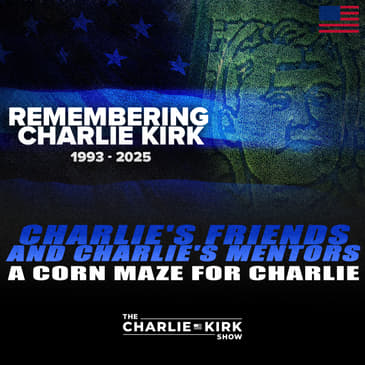
This week will mark the one-year mark of Charlie's death, so the show opens the week by speaking with some of his closest allies. Steve Bannon joins fresh out of War Room, followed by Charlie's academic mentor Larry Arnn. Michael Knowles joins, along with Indiana farmer Jeremy Goebel, who is honoring Charlie with his very own corn maze.
Watch every episode ad-free on members.charliekirk.com!
Get new merch at charliekirkstore.com!
Support the show: http://www.charliekirk.com/support
See omnystudio.com/listener for privacy information.
00:00:03
Speaker 1: My name is Charlie Kirk.
00:00:05
Speaker 2: I run the largest pro-American student organization in the country fighting for the future of our republic. My call is to fight evil and to proclaim truth. If the most important thing for you is just feeling good, you're going to end up miserable. But if the most important thing is doing good, you will end up purposeful.
00:00:24
Speaker 1: College is a scam, everybody.
00:00:26
Speaker 2: You got to stop sending your kids to college.
00:00:27
Speaker 1: You should get married as.
00:00:28
Speaker 2: Young as possible and have as many kids as possible. Go start a Turning Point USA college chapter. Go start a Turning Point USA high school chapter. Go find out how your church can get involved. Sign up and become an activist. I gave my life to the Lord in fifth grade. Most important decision I ever made in my life, and I encourage you to do the same.
00:00:45
Speaker 1: Here I am.
00:00:46
Speaker 3: Lord, use me.
00:00:48
Speaker 1: Buckle up, everybody. Here we go.
00:00:56
Speaker 2: Noble Gold Investments is the official gold sponsor of The Charlie Kirk Show. a company that specializes in gold IRAs and physical delivery of precious metals. Learn how you could protect your wealth with Noble Gold Investments at noblegoldinvestments.com. That is noblegoldinvestments.com.
00:01:17
Speaker 1: All right, welcome everybody. September 8th, 2026. We're here at the YRefi Studios in Phoenix, Arizona. And it's going to be a tough week. It's going to be a really tough week. I still can't believe it's one year. without him, and we miss him profoundly still today. Doesn't feel real. It's never felt real. I think you would agree, Blake. And so we're going to be paying tribute to our friend Charlie, and we're going to be leaning on our friends to help us do it, just like we did a year ago today. And first up out of the box is Steve Bannon, host of War Room. And Steve, welcome to the show. It doesn't feel real, but Having you start the week off with us is very helpful. We're grateful for your time, Steve. By the way, I've got to say, the piece that you did yesterday and you invited us all to be on it, my phone was blowing up. I just want to thank you for doing that and remembering Charlie in that way.
00:02:21
Speaker 4: The introduction to your show is always so powerful.
00:02:23
Speaker 5: I get goosebumps every time I watch it, particularly when you play Scotland the Brave. I always think of Charlie Kirk in the Brave, but Those speeches and everything you see, that's the point of delivery.
00:02:35
Speaker 4: For Charlie to be like that, as you know, it took so.
00:02:39
Speaker 5: Much work every different way, intellectually, to know how to make sure you could control yourself by the discipline he put in in these college campuses when he's just being attacked relentlessly.
00:02:51
Speaker 4: The speeches, all of it.
00:02:52
Speaker 5: And so I thought what would be appropriate is let's just talk about the work of the work ethic of Charlie Kirk.
00:02:59
Speaker 4: Behind the scenes, what it was that made the band.
00:03:01
Speaker 5: That the world saw and the world came to admire and love and do it with people that, and that was so great that we could have you and Tyler and Blake who are different aspects, you know, Tyler more the political operative, you more the media part, and Blake the driving force, you know, of Charlie's kind of getting up to speed intellectually on all these different topics he had to master.
00:03:25
Speaker 4: That's what I thought the power.
00:03:27
Speaker 1: Of it was.
00:03:28
Speaker 4: And I'm glad Real America's Voice helped us pull together. You guys cooperated.
00:03:32
Speaker 5: And I just think it was a great way to start the week off because a lot of people are going to be talking about Charlie at a macro level. To understand Charlie Kirk, you've got to understand Charlie Kirk, really the intellectual and political and spiritual athlete. And to do that is like any athlete. It's all about the reps. And I think that's what the show showed. And I'm so glad that you guys came on because you're kind of the tripartite piece of Charlie Kirk.
00:03:58
Speaker 4: So thank you guys.
00:03:59
Speaker 3: Yeah.
00:04:00
Speaker 6: The reps thing you can attest it's, it's the craziest thing about Charlie is that he wasn't a true workaholic. It was just that he was the most disciplined man in the world about using his time exactly as he meant to, like he didn't have a single moment to waste at any point. And it's like he knew in some special way he knew his time was limited and he shouldn't waste a single second of it and compared to anyone else we've ever met i don't think he did yeah.
00:04:29
Speaker 1: He was the most remarkable man i've ever met genuinely and when you work with somebody that closely for eight years to be able to say that at the end and not have it be you know rose-colored glasses looking back he just truly was that great and steve you got to ask us a bunch of questions um and so i want to ask you that that some of the same questions you asked us What did Charlie mean to you? What did you see in him that maybe others didn't from your unique vantage point?
00:04:55
Speaker 5: You know, what Blake just said there, it's very haunting because one of the things about Charlie was the urgency. He wasn't maybe a workaholic, but the urgency of which he approached everything was pretty remarkable. We had the opportunity to see him from the time he came to Breitbart as a writer. I said in some of the earliest pitches he made for Turning Point, you guys remember at the time, I believe the initial pitches for Turning Point He was going to go after this college campus situation by going after student governments. And I had been student government president or student body president at the school I went to. And then the same on the 26th campaign as Don Jr. 's body man, as the guy that traveled with Don Jr. And then, of course, the podcast and the Real America's Voice and then the Poloka operation and what you guys learned. You know, the 22, not just 2020, but the 22 with Kerry Lake and everything you guys learned. And what I found to be the most inspirational is that every time Charlie started Endeavor, it didn't start off as a home run right away. A lot of people are just particularly younger people think that, hey, if I don't do this and it doesn't explode and it does not absolutely spot on at the beginning, then I'm just going to give it up because the resistance, the house is always five to seven against people being successful kind of the. And Charlie was the exact opposite. Charlie just went back and did the reps. And so everything that he did from Breitbart to to, you know, the college, the turning point to the to the ground game, to the being Trump's advisor at the White House, the podcast, this huge hit show. Everything became great because he grinded it out. And I think that's a huge lesson for people and a huge lesson for our movement. That if it just, it's not going to come easy. And Charlie Kirk made it look effortless. He had this gentleman demeanor, kind of an old school gentleman. But he did it behind the scenes.
00:06:58
Speaker 4: With hard work.
00:06:59
Speaker 5: And to me, that's the lesson, particularly younger people have to understand.
00:07:03
Speaker 4: It's not going to come easy.
00:07:04
Speaker 5: Everything is difficult, particularly when you're trying to make changes on a national and global level. And Charlie was, you know, John Solomon had him on the show today and he said, hey, he had met with or talked with a Charlie two weeks before the assassination, he said, Charlie, the work you've done and what you accomplished in 2024 with the ground game, and particularly in Pennsylvania and Arizona, these other battleground states, really, you've.
00:07:29
Speaker 4: Teed us up to help save the nation.
00:07:31
Speaker 5: And Charlie goes, John, we are going to save the nation, and doing that, my real focus is saving Western civilization. So that shows you the ambition and the scale of what he thought But it all gets back, and particularly Blake, it gets back to those eight or ten briefing books. Because people sit there and go, hey, Charlie just showed up at these campuses and he had this rap. Charlie Kirk would go through these eight or ten briefing books on every topic with subject matter experts, and you guys.
00:07:59
Speaker 4: Would murder board everything. Murder board it.
00:08:02
Speaker 5: They don't understand, and this is why I think people need to understand, the commitment this guy put in on every single aspect of his life.
00:08:10
Speaker 4: And so what you saw and you loved.
00:08:12
Speaker 5: came from just tremendous dedication and tremendous commitment and really personal sacrifice. So that's why he's always, I've always seen this guy as a young man and a kid from the time I think he was 18 years old, 19 years old, and just incredible, incredible work ethic and incredible individual.
00:08:30
Speaker 1: Well, and you did see it up close, Steve, and I remember when we started kind of working together more and when we brought the show on Real America's Voice and just how instantly you got it all. I remember one time you came to HQ and you met with all of us. It was Tyler, me, Charlie, and you just said, this is the real deal. I thought you were going to be skeptical about kind of what we were building out, and you were like, nuh-uh. You saw it instantly, and I give you a lot of credit for that because you could have just scoffed at it, but you didn't.
00:09:04
Speaker 5: Listen, I knew you guys were beyond real just knowing Charlie and what you had gone through, but one of the things that impressed me along the way I think it was in 22. When you did those nightly broadcasts, these things had to be six or eight hours. You were doing the Cary Lake, you know, the stealing of the election. Of course, you did 2020. You were critical in that. Just the commitment and dedication. People don't realize you're live for six, seven hours. And Charlie is always sitting there, hey, what do we got?
00:09:31
Speaker 4: What do we got?
00:09:32
Speaker 5: I said, these guys are beyond real. This turning point thing is not just the wave of the future of how we're going to win elections. It's also that these guys are tremendous carriers of a message of American rejuvenation. And that came, quite frankly, and seeing you guys said, man, this goes, I would come on for 15 minutes, but you guys would be on for hour after hour after hour. and people don't realize how tough that is when you're doing it live and particularly on things that people don't think that's exciting like going through precinct by precinct in Arizona and Maricopa County and showing it and here's the thing the lessons that Tyler and you guys learned where I was so impressed a lot of people would turn on each other argue the lessons you learned in 20 in particular lessons you learned in 22 you learned a.
00:10:20
Speaker 4: From that was not perfect.
00:10:22
Speaker 5: And you set us set up, you set upon, you set out to say, we got to make this perfect.
00:10:28
Speaker 4: This ballot chasing thing is a way we're going to.
00:10:31
Speaker 5: Unite young, bring young people in the movement and win elections, particularly with lower propensity voters. And 24, the comeback of president Trump is predicated upon the work, the ground game of, of turning point in that, in that attitude. And just like, I hope in a couple of weeks, the same thing, but no, Just, uh, to me, it was easy. It was easy to get. It wasn't hard seeing you guys down there. The first time I went to headquarters, I was blown away about the scale of it. It just, what you guys had built and, and not been Charlie, you guys didn't brag about it. So many people take a little thing and they just go on and on and on about how great they are.
00:11:04
Speaker 4: You guys never talked about it.
00:11:06
Speaker 5: So to go down there and see it and see the team that you guys had was just a very impressive.
00:11:11
Speaker 4: And, uh, I know you'll go forward and, and be.
00:11:14
Speaker 5: Just as, uh, just as powerful and just to have just as big an impact as you had now with the legacy of Charlie Kirk and what he means to the country and what he means to people.
00:11:24
Speaker 1: Yeah, it's really amazing. You know, we've been having to do all this press because every single outlet, I'm not kidding, just like every single outlet on planet Earth wants to do a year looking back. And, you know, it's interesting because we've had to kind of tell our own story over the last year. And it's remarkable the legacy that Charlie has left. and the amount of groundswell support from students. We tell people, it's like, we're now at over a million students that are part of Turning Point. And I think that blows people's minds. And it keeps growing. Every single different aspect and vertical, whether it's the ground game on the action side. We got offices now in New Hampshire, Arizona, Nevada. We're putting people out in each of those states. We're light years ahead of where we were in 2024. And the chapter growth, the student growth, the donor growth. And it's such a testament to what Charlie meant to so many in his life and legacy. And I tell people this all the time. The staff around here are heroes. They're my heroes. What they have endured over this last year, whether it's the conspiracies or just losing Charlie to begin with, but just forging forward and growing and building just like Charlie. You know, we laughed, like, in the immediate aftermath. I mean, it was macabre, but it was like, Charlie was like, you guys should be streaming right now. That was how Charlie was. And so people didn't understand why we immediately threw ourselves into the work because we knew Charlie would want that. And that's how he would have done it. Final word to you, Steve. I know your time is short, and you graciously made time for us.
00:13:03
Speaker 4: Just keep grinding.
00:13:04
Speaker 5: I think the other day when we finished with the last, I think, 45 minutes with the three of you, to me, I told my viewers, I said it was perfect. You had Tyler, you know, who grinded it out on the ground game and really perfected that model and even perfected you, Andrew, on the media side and with the show and all the content. And Blake, kind of the intellectual that helped Charlie so much to have a deeper understanding. One thing that's powerful about Charlie as an activist and a guy in the field, you don't see many people that are in Charlie's position have such a depth.
00:13:38
Speaker 4: Of understanding of the different issues. And Blake, you provided that.
00:13:42
Speaker 5: So I just think it's going to be, you know, I don't want to leave on a negative note, but one of the schools I went to and got a degree from, Georgetown, which used to be a Catholic university, you know, they're doing something like mock Charlie Kirk on, you know, let's dress up like Charlie Kirk on Thursday. That shows you the level of depravity of the left. And you have to understand they've come after Charlie Kirk because he is a symbol of America at its best, of what America can produce, and people that not just the best, but someone not just out to make money for himself, not just to go to Hollywood and get fame, not just go to Wall Street and be a hedge fund guy.
00:14:24
Speaker 4: It's all about me, me, me.
00:14:25
Speaker 5: Charlie Kirk is the best of us because it shows you what America can produce when someone dedicates himself to hard work and then rededicated himself to his country and to his countrymen. I mean, Charlie Kirk was a fire-breathing populist nationalist.
00:14:40
Speaker 4: And America first.
00:14:42
Speaker 5: And that's one of the reasons the left hates him so much.
00:14:45
Speaker 4: And they do hate him.
00:14:46
Speaker 5: And I think you're seeing the demonic power of the left coming out. And at a Catholic university run by the Jesuits, they should be more than ashamed of what their.
00:14:56
Speaker 4: Students have tried to work up over this weekend.
00:14:59
Speaker 5: But I think it shows you in high relief the divisions we have in this country. And that, like Charlie Kirk, Charlie Kirk was not going to back down. Charlie Kirk did not need to go do that tour In the fall, Charlie Kirk went and did that because he knew it was his duty, his dharma, his purpose, his task and purpose was continuing not just to be in the White House and helping out, not just doing the Charlie Kirk show and RAV, not just doing the speeches and all that, but was to go back and do the basic work that had really been the key thing that happened to change people's minds from the very beginning, and that is one-on-one communication in a group setting. to change people's attitudes with new information and presented by a true classic American gentleman.
00:15:44
Speaker 4: So a lot of work ahead of us, guys. And hey, the easiest days are behind us.
00:15:49
Speaker 5: Just remember that. All the easy days are behind us. Everything else now in the future, every day is going to be harder.
00:15:54
Speaker 4: Every day is going to be harder.
00:15:56
Speaker 1: Yeah, well said, Steve. And, you know, I'll never forget one of Charlie's first interviews on Fox News. He must have had 10, 15 chapters, and he said, you know, we're not going to– he's still got his Chicago boy accent on it. He said, we're not just going to be some flash in the pan. We're building an institution here that's going to stand the test of time. And, you know, for Charlie, I can tell you all the team, all the staff at every level is dedicated to doing just that. Thank you, Steve, for being one of his champions, and thank you for giving us some of your time. Thank you, guys.
00:16:28
Speaker 5: Always love tossing the show to you every day at 12.
00:16:31
Speaker 1: Thank you, sir.
00:16:32
Speaker 2: Thanks.
00:16:32
Speaker 1: It means a lot. Steve Bannon, War Room. Grateful to him. He had a very packed schedule, and he wedged us in this morning, so God bless him for that. As I said, it's going to be a tough week on many different levels. Marking the one year without Charlie feels surreal. I told somebody else, Blake, I said, it feels like just yesterday. It doesn't feel like a year has gone by, and yet on a whole other level, it feels like I've lived 10 lifetimes this year. And marking this one year is, uh, and that we're going to talk about this. We've got Larry Arn. Um, we've got Jeremy, uh, who the, the, the farmer that made the corn maze, we've got to have that. So we're going to have him at one o'clock Eastern. And then we've got Michael Knowles and I, you know, marking this year is difficult. I don't, there's no roadmap for anything that we've lived through this year.
00:17:28
Speaker 7: There's no roadmap at all.
00:17:30
Speaker 6: And I mean, Bannon, Steve's right that it, only does get tougher because I think for the past year, it's, there's been a lot of us, we're still in the post losing Charlie environment and it's, it's gone on a long time precisely because we've seen what a void he's left in terms of our political environment, our religious environment that we all do miss him tremendously. But, We have, as Charlie would say, onward. We have an obligation to move forward and continue the fight. And it's only going to get more challenging as a result because he's not here to provide that leadership that he was so exceptional at providing.
00:18:16
Speaker 7: And we can look to his example.
00:18:18
Speaker 6: But every day brings new challenges that Charlie himself didn't have to face.
00:18:25
Speaker 7: And we can only.
00:18:28
Speaker 6: do our very best to imitate him, to look to him for inspiration. But the struggle never ends.
00:18:36
Speaker 1: No, it doesn't. And I want to make one quick note, and we're going to bring Dr. Arnon in the next segment, one of Charlie's mentors. I'm going to ask him, what does this week really mean? What does it actually mean for us, for the movement, for you at home watching? And I want to know, your guys' thoughts as well. And we're going to have an opportunity this week. If you want to send us an email, freedom at charliekirk.com. If you want to do a selfie video, we're going to be playing a bunch of selfie videos. We're doing all these montages from our Turning Point students. And so we'll play those on the air this week. I believe we got J.D. Vance is going to call in. Don Jr. Probably do that on Thursday on the one year itself. But I want to hear from you. So, This show belongs to all of you as much as it does to any of us. And so please send us an email. Freedom and Charlie Kirk. Do a selfie video if you want.
00:19:31
Speaker 7: We get so many.
00:19:32
Speaker 6: One we got just a moment ago, literally in the last 10 minutes from Tia, who said, I always wanted to share my testimony to Charlie because he helped convert.
00:19:43
Speaker 7: Me to Christianity from Islam.
00:19:45
Speaker 1: Wow.
00:19:46
Speaker 7: And she sent a drawing of Charlie.
00:19:48
Speaker 6: Says you know quotes the book of corinthians where oh death is your victory where oh death is your sting and and a few other lines.
00:19:56
Speaker 1: Jesus is the son of god i love jesus love liberty and love america let's debate let's debate yeah that's amazing yeah we have that image too we should throw it up there she just sent us a drawing that she did of charlie It's pretty great. This is the kind of stuff that you guys send us. It's amazing. So this week, please flood the inbox. Give Blake too many emails to review. And if you send us a video or selfie, maybe send it in a link or whatever. Or post it on your own social and send us that. But let's flood the airwaves. Let's flood social media with tributes to Charlie and what he meant. Because as Bannon just said, there's a whole move. These leftists, they will not even give us one year. to mourn our friend. They're going to use it as an opportunity to mock Charlie, to mock conservatives, to mock his death. Really sick stuff. And as Bannon said, and I would agree, I do think it's demonic. You know, we are not in a battle against flesh and blood, but against powers and principalities. Never, ever, ever forget that. And their reaction to Charlie's murder is yet more proof that these people are truly sick. They need Jesus, and we've got a country to save, and they're some of the people that need the most help. So I'm going to try my best this week not to give in to anger or rage at them. I'm going to pray for them, and maybe I do get a little righteous anger, but this week is not about them. This week is about remembering a truly great American, a friend, a father, a husband, a a movement leader. I believe Charlie Kirk is a modern-day founding father, and he was the very, very best of us. And Blake and I can attest that even in private, even behind the scenes, he was that good. It wasn't perfect, but man, he was remarkable. Most remarkable man I've ever met. Gentlemen, let's get real for a second. Are you frustrated with today's woke dating scene, the apps, the games, the endless swiping? It's a waste of time. Finding a woman who shares your values, faith, family, patriotism, if it feels nearly impossible, it doesn't have to. Selective Search, America's leading matchmaking firm, is changing the game. They connect strong, successful men like you, men who love God, love America, want a family, with women who share your values. These are intelligent, faith-driven women who put family first and still believe in traditional values. Imagine that. If you're a single conservative man in his late 30s to early 50s in Southern California, listen up. Selective Search has an exclusive network of women ready for the real thing. Here's the best part. Their candidate program is 100% free and confidential. Some of our closest friends of the show have used Selective Search, and let me tell you, they're meeting great, great women, high-quality women. This is your chance. This isn't an app. It's your answer. The perfect conservative woman is out there waiting for you. Visit SelectiveSearch.com slash California today. Let the professionals introduce you to women already looking for someone like you in Southern California. Don't wait for the perfect match. Take action now. Go to SelectiveSearch.com slash California and start building the future you deserve.
00:23:24
Speaker 2: All right.
00:23:25
Speaker 1: Without further ado, Dr. Larry Arnn, Hillsdale College. Welcome to the show, sir. It's so good to have you back, and you honor us by making this a priority. So thank you so much.
00:23:35
Speaker 3: Oh, it's a priority, Andrew. How are you both? Good to see you both.
00:23:39
Speaker 1: It's a weird week.
00:23:40
Speaker 7: As well as we can.
00:23:40
Speaker 1: Yeah, it's a weird week. I woke up this morning feeling like it's hard to make heads or tails of what it means. And so, you know, Peter on your team, he said, what kind of questions do you want to ask Dr. Arnn? And I said, I just want to know what he thinks. thinks this means? What is it supposed to mean? What should this mean?
00:24:01
Speaker 3: Well, Charlie's loss is a tragedy. Tragedy is actually a weird word.
00:24:09
Speaker 8: It comes from a couple of Greek words that oddly combine to mean great song. And we sing great songs about losses. Loss of Charlie is partly just a personal thing, right? Charlie, what he was like. When you met Charlie, what did you think? The first thing is Charlie was fun. Charlie was very lively.
00:24:35
Speaker 3: He was alert.
00:24:36
Speaker 8: He was quick as a cat. He had a lot of joy in him all the time. He absorbed information like a sponge. Well, if you know somebody like that, the loss of them is, you know, you miss them.
00:24:52
Speaker 3: Of course you do.
00:24:53
Speaker 8: Never met anybody. You know, everybody's unique. Charlie is unique in some beautiful ways. And then Charlie was important. He was a voice to a confused generation.
00:25:11
Speaker 3: And the loss of him is felt. You know, I think this assassin, probably they got the guy.
00:25:27
Speaker 8: And what a vapid and pitiable human being. But given his objects, what they appear to be, his act was well chosen because the things that Charlie represented and that he hated have suffered a blow. It's weaker because Charlie is gone. And so we mourn both those things, the personal side, the fun side, the engaging side, the lively side, and we miss the effect of him. And his effect, you know, you don't have to agree with all of Charlie's positions.
00:26:07
Speaker 3: Charlie himself changed his mind about things. Everybody does.
00:26:12
Speaker 8: But the main strains of it, what was he saying? He was saying we should live free and serious lives. We should be serious people. We should give to others. We should found a family. We should serve. We should grow.
00:26:29
Speaker 3: To grow, you have to suffer. I think Charlie might have picked that.
00:26:35
Speaker 8: Up from me because I told him that the first time I ever talked to him.
00:26:38
Speaker 7: You're hitting something very profound, Dr.
00:26:41
Speaker 5: Arnn.
00:26:41
Speaker 6: You mentioned he was very serious. He had a very serious message in terms of, as you said, embrace faith, start a family, fight for your country. and yet, at the same time, he was a very cheerful individual, very upbeat all of the time, and we often think of those as intention. As intention with each other, if you say someone is a very serious person, you think they're very neutral, they don't laugh much, they don't get excited very much. Charlie actually was both those things. Immensely serious in his endeavors, and yet also a cheerful, upbeat, lovable individual, and I think Those two things in harmony go a long way towards explaining why he resonated with so many people.
00:27:27
Speaker 8: Yeah, he was just a good man, right? I've been corrupted by my education and partially helped to corrupt Charlie, who got.
00:27:35
Speaker 3: His own education. I just helped him. But the Greek word for serious is spoudios.
00:27:41
Speaker 8: I've always just loved the way that word sounds.
00:27:45
Speaker 3: It doesn't mean grave. It means getting things right.
00:27:50
Speaker 8: And one of the things you've got to get right is you shouldn't miss the joy of life. Among the things I say sometimes lately when I say my prayers is, remember the joy of life.
00:28:03
Speaker 3: Well, Charlie was a constant reminder of that. He had a lot of fun. He counted his blessings, and he enjoyed them. He didn't live in fear.
00:28:20
Speaker 8: Like, you know, he was married to a beautiful woman, you know, who's your, you know, head of Turning Point now, right? And she's just an awesome woman. And you could spend your time worrying about the loss of her.
00:28:34
Speaker 3: Or you could spend your time serving her and enjoying her. Well, he did that. And that's serious.
00:28:41
Speaker 8: See, that's not, you know, you can be a whiner. You can always fret. I've got this thing. I can't keep it, you know. I'm going to die, ultimately.
00:28:53
Speaker 3: Well, he didn't. He was serious. Serious doesn't mean grave.
00:28:59
Speaker 8: As a matter of fact, people who are down in the mouth all the time are not serious people. What was Winston Churchill like? This afternoon I'm talking to somebody who wants to make a movie about Winston Churchill in a certain plaintive story in his life about a dream he.
00:29:19
Speaker 3: Had about his father. There were a lot of frustrations there.
00:29:22
Speaker 8: One of the things I'm going to tell them is, Winston Churchill was happy. Winston Churchill was hilarious. To be around him, he was always sparking.
00:29:34
Speaker 3: Charlie was like that, too. What does it mean to be engaging?
00:29:39
Speaker 8: It means that people engage with you and you engage with them.
00:29:45
Speaker 3: And people don't like to do that with people who are a drag.
00:29:51
Speaker 8: So yeah, I did this interview, I guess The Guardian is right, in a big article in the British left-wing newspapers, writing a big article about you guys. And so you guys asked me to talk to the guy, so I spent 45 minutes talking to him. And I don't know how the article is going to come out, or I don't even know if it's come out.
00:30:12
Speaker 3: I don't read The Guardian. But the interview was really good.
00:30:17
Speaker 8: Because I just explained Charlie to him, you know, and he wanted me to do that.
00:30:22
Speaker 3: Let me do it. Help me do it. Ask the right questions, right?
00:30:25
Speaker 8: Well, when you get to talking about Charlie, They're just stories, you know? He's just, he was always up to something cool. And he was always excited about it.
00:30:40
Speaker 3: And then if you ever had a suggestion for him, I had a few.
00:30:46
Speaker 8: You know, mostly I talked to Charlie about things he wanted to understand that I happened to have studied a long time. But once in a while, I would have a suggestion for him about his work and he would come there serious in the grave way he would always stop and pay close attention I once told him a tweet he had sent out somebody I knew was affected by it somebody important and complained of it to me and I said I said yeah you should think about whether that was right or not and he goes you know what he said to me Charlie was an important man. I am not an important man at all in the way he was. I don't hang around the ruling people, Donald Trump and J.D.
00:31:42
Speaker 3: Vance and such, hours.
00:31:44
Speaker 8: At a time the way he did. My life doesn't work that way, and I don't really even want it to.
00:31:50
Speaker 3: But he did. And so, of course, I was very respectful of that.
00:31:54
Speaker 8: I didn't try to tell him how to do it. But on this one occasion, I said, you should think about that. And you know what he said? He said, yes, sir, to me. And I thought, that's good. I said, Charlie, you're the one doing this. You've got to figure this out. But maybe it's too early to take side.
00:32:13
Speaker 3: In those issues. Yes, sir, he said. What a respectful, self-disciplined man he was. you know, it just had all the qualities.
00:32:24
Speaker 1: Well, I want to play a clip of you with him here. This was from March, 2025. I will be coming back.
00:32:32
Speaker 8: I'm going to give you an honorary degree.
00:32:35
Speaker 2: Oh, well, that would be quite a, that, that, that would be the honor of my life, but I, I got a lot more learning.
00:32:40
Speaker 4: Yet to do.
00:32:41
Speaker 2: I have to be able to pass your Aristotle course. And I say this, the Hillsdale courses have changed my life. And the more I take, the more I learn and the, it is, as you have taught me, Dr. Arndt, Aristotle wrote that all men seek to know, and I find that when I go to these college campuses, that students deep down, they want to know, and it's time that we teach them something.
00:33:06
Speaker 1: And so, Dr.
00:33:07
Speaker 2: Arndt, God bless you. Thank you for your contribution to this country. Wonderful as always. Everyone should take the online courses.
00:33:13
Speaker 1: By the way, you know, we have a great partnership with Hillsdale, but he would just do that all the time.
00:33:19
Speaker 3: Like, Oh, yeah.
00:33:21
Speaker 1: Because he really believed in what you were doing. And so when he said, yes, sir, it's because he loved you and valued you and knew that you were an important person in so many ways and to so many students.
00:33:33
Speaker 8: He kept doing big favors, you know, all kinds of things. The month didn't go by that I didn't find out Charlie Kirk did some handsome thing. And he never told us about it. And if I brought it up and thanked him, he didn't want to talk about it. You know, he was doing what he thought was right. And, yeah, he just was a golden soul, you know.
00:33:59
Speaker 3: That thing, you know, about learning.
00:34:02
Speaker 8: The reason he could go on college campuses and sit at those tables and the reason he was effective was he respected those people and he had prepared himself to talk with them. through hours of labor, and he could find good things to say in response because he thought about.
00:34:26
Speaker 3: It all the time. And therefore, he was modeling.
00:34:30
Speaker 1: Yeah, you helped him do that in a really important way. And we love sending people to charlieforhillsdale.com because that's where you get to access so much of what Charlie learned from. And when we talk about just the quality of... It's free. It's 100% free. But the quality... It's so tremendous. You get to take actual college courses that will help you be a better citizen, a better family member, a friend, father. So charlieforhillsdale.com. I don't even mind plugging it just all the time, just like him.
00:34:59
Speaker 3: Thank you.
00:35:03
Speaker 1: It's a tough week. It's a tough week. But I go back and forth, and I'm sure some of you guys are feeling this too. Sometimes I'm just thinking about how awful it all is that we still don't have Charlie and that we're never going to have Charlie back and just the permanency of it. And then I think about all the good times as well. And Dr. Arnn, you were mentioning this engaging nature that Charlie had. And sometimes when I hear other people describe Charlie, it reminds me of different aspects of his personality and the way he was.
00:35:34
Speaker 6: Well, I just think we're getting tons of emails throughout this entire show, and I suspect we'll be getting them All of this week. I hope we'll be getting them all this week. We're saving as many as we can. We'll try to read a lot of them when we have the opportunity.
00:35:46
Speaker 1: But, Dr. Aron, you mentioned how engaging he was.
00:35:50
Speaker 6: So many people, there are people who met him maybe once, but they remember it the rest of their lives. Or they never met him at all, but they feel like he spoke to them directly. He just had such a direct line to them. And that's such a rare ability for people to have. Why do you think Charlie... had that it factor?
00:36:10
Speaker 3: Because everybody wants to be good.
00:36:13
Speaker 8: And so when they see an example of it, they want to be it, right? And, you know, what is it to be good? It's to be a good thing of the kind that you are. And it is, you know, there's a list of the virtues, four cardinal and three theological virtues, courage, wisdom, justice, moderation.
00:36:39
Speaker 3: Faith, hope, and charity. Everybody wants those things.
00:36:43
Speaker 8: Those are good things, right? And you're a better person and a happier person if you have those things. But when you see them in somebody, they come together. You know, there's that wonderful thing that Mark is in Julius Caesar, describing Caesar. He was sanguine, and the elements were so mixed up in him that all the world could look at him and see that this is a man. You see, everybody wants to be that. And so when you see him in action, vile spirits want to destroy that. That's what despotism is, right? But ordinary spirits want to emulate that, engage with that, see that.
00:37:35
Speaker 3: What should operate?
00:37:37
Speaker 8: I mean, why did they flock, you know, including to that last event in Utah? Why did they flock there like that? College kids are busy, right? They have plenty of things to do without going to that thing. And they would come in their tens of thousands. And that's because they want to be good, want to.
00:37:59
Speaker 3: Learn how to be.
00:38:00
Speaker 8: So they have an instinct, even if they don't put the arguments together, that in order to be happy, they have to be good, and they have to learn how to do that. It's a striving. So yeah, that's what he was. And he was so determined.
00:38:17
Speaker 3: So I knew him for 12 years. He grew so much.
00:38:32
Speaker 8: Last thing, he gave a speech for Hillsdale College a few months before he was killed. And after it was over, I walked up and I said, okay, boy, you have learned a lot.
00:38:47
Speaker 3: And he said, thank you.
00:38:49
Speaker 1: Dr. Arndt, that's an interesting story about you guys as well. And that's why he said yes, sir, to you. Because you were sort of part of a Mount Rushmore of people that he looked up to. And But when he first encountered you, I don't think you were quite so impressed. You always liked him. But then he grew on you. So in the last three minutes we have here, what did you notice about, because that's the real story of Charlie Kirk, I think, is that he started off with this baggy suit and it's kind of rough around the edges. And then he became something. He did it through sheer will and work. And he so badly wanted to impress you. and you know and a few others of course but he wanted to.
00:39:33
Speaker 8: Win your approval you know so the reason i didn't like him before i met him was because everybody kept coming up to me and saying There's this 18 and 19-year-old boy, and he's the greatest of all the boys ever born. And I don't believe you ought to talk to young people about young people or to them like that. I don't think it's good for them. And I'm in the business of torturing the young. So I did not seek him out, but Foster Freeze, who helped to launch Charlie in.
00:40:07
Speaker 3: Life, he was a very good man.
00:40:09
Speaker 8: Caused him to be sat next to me at a Hillsdale College event in Wyoming. And I'm annoyed when I see that he's sitting beside me.
00:40:19
Speaker 3: So I'd on a list before, and I thought, what's that about? I'd never met him, right?
00:40:24
Speaker 8: And so I pretended I didn't know who he was, and I asked him some hard questions, and he couldn't answer them. And I said, so you're going to fix the world, and you don't know.
00:40:36
Speaker 3: Much about it. He used two words, culture and college. I asked him to define them. He couldn't. You know, he could, but he stumbled around, right?
00:40:47
Speaker 8: And by the time the conversation was over, you know, there were 400 and some people, I think, at that event.
00:40:54
Speaker 3: It was a lunch.
00:40:56
Speaker 8: And I was supposed to be talking to all those people, right? Well, I gave my talk, but apart from that, I didn't talk.
00:41:01
Speaker 3: To anyone else.
00:41:03
Speaker 8: Charlie would not leave me alone. And by the time, I was late for my next appointment, and he was late for his next. And about two-thirds of the way through all that, he had just won me over. I just could see what he was, right? He didn't, he was a show pony. He was becoming an important man. He was admired all over the place by powerful people. And I beat him up, and his reaction to that was exactly right.
00:41:34
Speaker 3: He was a student.
00:41:35
Speaker 1: Right.
00:41:36
Speaker 8: He wanted to know. And so I could see that in him. So it took 30 minutes.
00:41:43
Speaker 3: And I thought this young man something in me. Look at him.
00:41:46
Speaker 7: I feel it.
00:41:47
Speaker 1: So, yeah, so much.
00:41:48
Speaker 6: It speaks so much to what you're saying. You know, so you meet this kid. And he strives for years to learn, learn. And you finally tell him last year, Charlie, I want to give you an honorary degree you've passed. And he just goes, actually, no, I still need to learn.
00:42:01
Speaker 1: So much more.
00:42:03
Speaker 6: That's Charlie in a nutshell, always more, always wanting to improve, always wanting to be better, upwards, onward at all times.
00:42:12
Speaker 3: You've done me two favors.
00:42:13
Speaker 8: One is you reminded me that I had promised him an honorary degree, which I have now given him. And I forgot that I had done that. I would have remembered, but I had forgotten that until you showed that.
00:42:25
Speaker 3: Clip a minute ago. But that's the first thing.
00:42:30
Speaker 8: The second thing is you guys are carrying on good on you both. We have not lost Charlie. He is alive in this conversation right now, and he will live if we live well. And that's what you guys are doing. And I am grateful to you for that and to Erica and to the whole bunch there.
00:42:54
Speaker 3: You guys are a great bunch.
00:42:56
Speaker 1: Dr. Arnn, God bless you. Charlie loved you dearly, and you know that. So thank you for honoring him and us with a little bit of your time on this Tuesday. God bless you, Dr. Arnn. God bless Hillsdale College, too.
00:43:10
Speaker 3: Bless you, too.
00:43:11
Speaker 1: Charlie loved Hillsdale. I had the honor of a lifetime to call Charlie a friend. And what I remember most wasn't just what people saw on stage. It was what was behind the scenes. That was an unwavering commitment to his faith, his love for his family, and his genuine desire to encourage others to live with courage and conviction. Charlie believed that following Christ wasn't something you compartmentalize. He didn't put it in a box. He lived it out loud. It shaped how he lived, how he served. how he treated people every single day. Charlie Kirk, American Martyr, captures that heart. This documentary isn't just simply about remembering Charlie. It's an invitation for each of us to ask what kind of legacy we're building and whether we're willing to stand firm in our own faith when it's tested. I hope that you'll watch it with your family and have those conversations together. Go to angel.com slash Kirk. That's angel.com slash Kirk. Become an Angel Guild member. Watch Charlie Kirk, American Martyr, and help bring more stories of faith, courage, and conviction to audiences around the world. It's going to be a hard week, but it's also kind of going to be great in a sense because so many wonderful people are going to be on this show and around the country and in different places honoring Charlie. And one of the more unique, I guess, demonstrations of people honoring Charlie feeling moved is out of Goble Farms. And there's this corn maze design, which is just remarkable. We're going to throw it up 142. It is such a unique way to do it. I just think it's so beautiful. So when you're flying over, you see this beautiful corn maze. And it's a picture of Charlie, which is remarkable. And we actually have the gentleman because it's so unique and extraordinary. I mean, I don't even know how you do this. I guess you map it out on some, maybe they have software that does this and the tractors help you. I don't know. But it's so remarkable, and I just love it so much. So we have Jeremy Goebel, who is the manager of Goebel's Farms here, to tell us about this story. Jeremy, welcome to The Charlie Kirk Show. Thank you for doing this, for honoring our friend. And how did you come up with this idea? I mean, this is a remarkable thing to do, very unique.
00:45:30
Speaker 9: Well, Charlie was important to me and what he stood for, and I just wanted to honor him whenever he... Past last year, I immediately said that, you know, this is what we're doing next year.
00:45:45
Speaker 1: And mom and dad wholeheartedly agreed. Wow. So you planned this a year ago. And I mean, I want to get into why Charlie meant so much to you. But how do you even do something like this?
00:46:00
Speaker 7: How does one make a corn maze?
00:46:02
Speaker 1: Yeah. How do you do this?
00:46:03
Speaker 9: Well, initially, 25 years ago, we cut it out by hand, and it was a big, painful process. Nowadays, the last 11 years, I've been creating it on the computer and then planting it that way. So you can almost think of the planter.
00:46:21
Speaker 1: As a printer. Got it. Okay. That makes a lot of sense. So you've been watching this grow now for a couple months, many months maybe, and you So how did this story just, I mean, because people didn't see that you were doing this, if it was growing over the course of the year?
00:46:40
Speaker 9: They wouldn't necessarily even know what it is unless they flew over it themselves.
00:46:45
Speaker 1: Got it. Okay. Yeah. I mean, how big is this field, by the way?
00:46:51
Speaker 9: It's not a huge field.
00:46:52
Speaker 1: It's about five acres. I mean, that's big. That's actually pretty big. For us, it's not. Well, fair enough. Does it actually function like a maze? You can actually travel through it?
00:47:05
Speaker 4: Yes.
00:47:06
Speaker 1: Wow.
00:47:07
Speaker 9: And there will be people going through it. Hopefully people don't hurt it because it would be easy to knock over, but yes.
00:47:16
Speaker 6: Well, you can sadly usually count on the left to be as nasty as possible.
00:47:21
Speaker 7: But we can hope rural Indiana doesn't have too many of them.
00:47:24
Speaker 1: And just a note on that. It's like if you do not have enough common decency– and self-respect, not to clown yourself and debase yourself by mocking the dead or by attacking a man that is not here to defend himself. I just, shame on you, first of all, but please don't. This week, would you just, would you just resist the urge if you're a leftist? Don't do it. Don't do it. Fight us on the ideas. Fight us on the policies. do not mock a man that's not here to defend himself. And I just, I want to get that out of the way. Cause we talked about something similar with Georgetown university and our one and Steve Bannon, but you have gotten some, some pushback on this, but you've also got a lot of love. I don't want to focus too much on the pushback, but, but tell us what, what has it been like since this story came onto the fold last week?
00:48:17
Speaker 9: So we posted it on our Facebook page from our website and like immediately people started reacting negatively and, positively too um but the comments got so bad we shut comments off on our website and deleted them and um ended up getting like over 100 one-star reviews before the our profile on google got shut down and then we appealed it and we're actually able to you know get our profile back up but um There's been a whole lot of people reaching out positively, sending emails and Facebook messages and all of the above since the negative stuff happened.
00:49:05
Speaker 1: Well, yeah. I mean, there's a whole corner of the internet that lives to do nothing else but to brigade the comments or downvote things just because they're nasty people and they have nothing better to do with their lives. How do people support... your farm? I'm tremendously honored as somebody that was, Charlie was one of my dear friends, and I'm so touched by what you've done. And by the way, I didn't realize you spent a year doing it, basically plotting this out, planting the seeds that would grow in this pattern. It's amazing. How do people support global farms and you're in Indiana, right? And so how, how do they, can they go on your, your website and buy things and you'll ship it? Or do they have to go there in person? I just want everybody within the sound of my voice. I want them to flood your farm and honor you guys and bless you guys.
00:49:53
Speaker 9: So the primary way would be to come here and either go through the corn maze, take a ride, buy pumpkins, Christmas trees, you know, all of the above. We also offer wholesale, but that's, you know, not very many people are going to be able to do that. But, you know, and we don't have a tremendous capacity. We have decent capacity, but, you know, that can be shipped. But we don't have any products that we can just ship by UPS or anything like that.
00:50:23
Speaker 1: It's Gobel Farms, right? Gobel Farms?
00:50:26
Speaker 6: Yeah, you guys are near Evansville, so I'm checking, and if you guys are in St. Louis, that's a two-and-a-half-hour drive. Nashville, two-and-a-half-hour drive. Louisville, there's a lot of pretty big cities out there that you could make a day trip out to this guy's farm.
00:50:41
Speaker 1: Yeah, make a trek out there, and if you're buying wholesale Christmas trees, pumpkins, things like that, is that what you mean?
00:50:48
Speaker 9: We don't do Christmas trees, but we do do pumpkins.
00:50:51
Speaker 1: Okay. So, hey, we've got Halloween coming up and harvest festivals, which people, you know, pumpkins are great for that.
00:50:58
Speaker 6: Can't celebrate Halloween too much, Charlie Woodfrout.
00:51:00
Speaker 1: It's funny. You know, I grew up celebrating Halloween, but my wife's family didn't. They only did harvest festivals. And Charlie was kind of more of a harvest festival guy. He was more of a harvest guy. So, anyways, the point is, would you please, listening to this, bless Jeremy and his family that have a family-run operation here and they've taken it upon themselves to to get the inundation from the haters online. So let's show globalfarms.com all the love you can. If you are somewhere out there that buys pumpkins for whatever reason... People love pumpkins. There's people that are running stores and running shops that need to sell them. Please bless this family. If you're in the area, go to Global Farms right now. Make a plan to go. Do the corn maze and bless... a family that's standing up for our values. And final minute to you, sir, just on what Charlie meant to you and why was he an inspiration to you and your family?
00:51:56
Speaker 9: So for me personally, I did agree with, you know, pretty much everything that I heard him talk about. I just, I mean, I love the fact that he stood up for the ideas, you know, that he put out there. and he didn't back down that, but he also was wanted open dialogue and he wanted to just talk to people. Um, and so for that, he should never have been killed. And I just think it's, I just, it's hard to wrap my brain around why somebody would kill somebody over that.
00:52:32
Speaker 1: Yeah. You, you and us both. And unfortunately that's, um, A sign of the times, there are a lot of people on the left that think political violence is just fine and they'll mock a dead man that was an innocent man and a great man. But there's also stories like yours that give us all a lot of inspiration, a lot of hope. People that are willing to put their business out there like this. We had a Froyo shop out of Idaho we had on the show that does Charlie's face on their their, their cups. And there's so many stories like that coming in from around the country. And, and I just think that this is one of the cooler ways that somebody has chosen to honor Charlie. And so a big old hat tip to you, sir. And once again, please, if you are in the Indiana area, or if you said, what'd you say? Louisville, Nashville, St.
00:53:25
Speaker 7: Louis, Nashville, they're all like two and a half.
00:53:26
Speaker 1: What in to global farms and bless this family, an all American patriotic family. God bless you, Jeremy. Thank you for making the time.
00:53:34
Speaker 4: Thank you.
00:53:35
Speaker 1: And you know, Don't sweat the haters. That means you're over the target. That means you're doing something good. Before he ever stepped onto a debate stage or behind a microphone, Charlie understood something really important, that if you want to lead, you first have to learn. Charlie believed that ideas shape character, conviction, and courage. That's why he spent years studying the classics, the American founding, and the Bible through Hillsdale College's free online courses. He would rave about these courses all the time. These free online courses are taught by Hillsdale College professors and draw from the same great books and enduring ideas studied on Hillsdale's campus. Hillsdale's newest free online course is the Iliad, where Professor Stephen Smith guides students through Homer's great epic of honor, courage, friendship, leadership, and the pursuit of true greatness. For nearly 3,000 years, the Iliad has shaped the Western imagination. It tells the story of Achilles as he confronts injustice, rage, grief, responsibility, and the terrible costs of war. but Homer's epic is more than a story of ancient battles. It raises enduring questions about courage, duty, leadership, sacrifice, and self-command. Achilles is the greatest warrior among the Greeks, but Homer asks whether strength alone is enough to make a man truly great. In this new free online course, you'll follow Achilles through the defining trials of his life and discover why one of the greatest works of Western literature still speaks to the permanent questions of human life. Charlie understood that learning isn't just about gaining knowledge. It's about forming the mind and character needed to face the challenges of life with wisdom and courage. You can enroll today completely free and take this class or their 40 plus other free online courses. Just visit charlieforhillsdale.com to start learning today. That's charlieforhillsdale.com. Learn deeply, think clearly, lead boldly, and carry it forward just like Charlie. So, okay. Do you want to read an email or do you want to play a Seinfeld clip?
00:55:30
Speaker 7: We've got so many emails.
00:55:31
Speaker 1: We also have Seinfeld.
00:55:32
Speaker 7: How about this?
00:55:33
Speaker 1: I'm going to do the Seinfeld clip. So Charlie loves Seinfeld. As a matter of fact, and then you'll pick the email that you want to read. So when Charlie died, one of the hardest parts for me was just late at night when you're trying to go to bed. So I just started watching Seinfeld from the first episode all the way through. And I would just kind of watch it. I'd fall asleep to it. And I'd find where I left it last night and keep going. And it's been a great joy for me. So we have some of Charlie's favorite Seinfeld episodes. And I think I'm going to start with this one. It's at 12. You want to go with me to NBC?
00:56:10
Speaker 7: Yeah, I think we really got something here.
00:56:12
Speaker 1: What do we got?
00:56:13
Speaker 8: An idea.
00:56:13
Speaker 3: What idea?
00:56:14
Speaker 1: An idea for the show. I still don't know what the idea is. It's about nothing.
00:56:20
Speaker 3: Right. Everybody's doing something. We'll do nothing.
00:56:24
Speaker 1: So we go into NBC, we tell them we got an idea for a show about nothing. Exactly.
00:56:28
Speaker 7: They say, what's your show about? I say nothing.
00:56:30
Speaker 3: There you go.
00:56:32
Speaker 1: I think you may have something here.
00:56:34
Speaker 6: It's so funny that Charlie loved that clip because it occurs to me now that Charlie was one of the biggest something doers of all time.
00:56:41
Speaker 1: He would die if you told him, oh, we're doing nothing. We're going to go somewhere and do nothing.
00:56:45
Speaker 7: He would lose his mind.
00:56:46
Speaker 1: This one's great. Sat 11. What's today?
00:56:50
Speaker 4: It's Thursday.
00:56:52
Speaker 3: Really?
00:56:53
Speaker 4: It feels like Tuesday. Tuesday has no feel.
00:56:58
Speaker 3: Monday has a feel. Friday has a feel. Sunday has a feel.
00:57:03
Speaker 4: I feel Tuesday and Wednesday.
00:57:04
Speaker 2: All right, shut up, the both of you.
00:57:05
Speaker 3: You're making me nervous.
00:57:08
Speaker 1: Tuesday has no feel.
00:57:09
Speaker 7: No feel.
00:57:10
Speaker 1: No feel. Tuesday is kind of the weird day that... I remember an ad once.
00:57:15
Speaker 7: It's the most boring day of the week. It's not even the hump day.
00:57:19
Speaker 1: Tuesday has no feel.
00:57:19
Speaker 7: It's just the slog day.
00:57:21
Speaker 1: All right. And then this is probably the most oft-played clip of Seinfeld on this show. And it's the ribbon. Because it was so prescient about the BLM black squares and all this.
00:57:33
Speaker 6: And he was starting this at peak woke, peak BLM, peak COVID insanity.
00:57:37
Speaker 7: This spoke to Charlie so much.
00:57:38
Speaker 1: This was deep. This was a deep cut. It's not 10.
00:57:42
Speaker 7: You're checked in?
00:57:42
Speaker 1: Thank you.
00:57:43
Speaker 10: Here's your AIDS ribbon.
00:57:44
Speaker 1: No, thanks.
00:57:45
Speaker 10: You don't want to wear an AIDS ribbon?
00:57:46
Speaker 3: No, no.
00:57:47
Speaker 10: But you have to wear an AIDS ribbon.
00:57:48
Speaker 4: I have to?
00:57:50
Speaker 3: Yes.
00:57:50
Speaker 1: Yeah, see, that's why I don't want to.
00:57:52
Speaker 7: But everyone wears the ribbon.
00:57:54
Speaker 10: You must wear the ribbon.
00:57:55
Speaker 3: You know what you are?
00:57:57
Speaker 7: You're a ribbon bully.
00:57:58
Speaker 6: Hey, you, come back here.
00:58:01
Speaker 1: Come back here and put this on.
00:58:02
Speaker 7: Hey, where's your ribbon?
00:58:03
Speaker 3: Oh, I don't wear the ribbon.
00:58:05
Speaker 1: You don't wear the ribbon?
00:58:06
Speaker 3: Who do you think you are?
00:58:07
Speaker 1: Put the ribbon on. Hey, Cedric, Bob, this guy won't wear a ribbon.
00:58:13
Speaker 8: Who? Who doesn't want to wear the ribbon?
00:58:18
Speaker 1: That is the woke insanity in one humorous clip. We got some emails.
00:58:24
Speaker 7: We got so many emails.
00:58:25
Speaker 6: I grabbed this one almost at random, but there's so many, and they're all so good. This is one we got from Taylor, and she sent in a photo she took in 2024 when Charlie came to her church in Albuquerque. I was so excited I got to meet him. I felt like I was meeting a celebrity, but he was so gracious. He took the time to have a quick chat and a picture. He saw me in the crowd and gave me a shout-out because I brought a Trump shirt from his website. I knew he was friends with our pastor. He said he wanted to make it an annual trip to our town and church. We miss him dearly. I also remember Charlie one time responded to some of my emails. He read one on air during the Trump indictment saga, and I got so excited. I'm forever grateful for this memory. I have this photo to hang up in my house forever.
00:59:09
Speaker 7: Prayer.
00:59:10
Speaker 6: To everyone this week. We love Charlie and TPUSA. Thank you for that, Taylor.
00:59:15
Speaker 1: Look how tall he was. A giant. He was a giant. And I was invited to write an op-ed for Fox, and I'm drafting it right now. And I was relating. I was remembering the first time I met Charlie. And that was the first thing I noticed. I was like, man, this guy's tall. And he's 6'5, very tall, but somehow he felt even bigger. It's just because of his presence and the way he carried himself. But yeah, let's keep going.
00:59:40
Speaker 7: Let's see. Sorry, I've got a few things in here.
00:59:47
Speaker 6: This is one of my favorite memories when thinking about the impact Charlie had on his life. I took the screenshot at 1.51 a.m. on November 4th, 2024, while watching the stream of election coverage. My husband and I watched Charlie every day after War Room. We attended TPUSA events. We were always in awe of Charlie's mind, impact, and dedication to God, family, and country.
01:00:08
Speaker 1: He was a unique and fearless individual.
01:00:11
Speaker 6: I mourn his loss every day, but when I feel down, I think of Charlie's smile and his sense of humor, and it brings me peace and a smile to my face. God bless you all. God bless Charlie and his family. That's from Jill. Thank you very much, Jill.
01:00:25
Speaker 1: Love that. And we do have... I told the team... Oh, yeah, that's what, yeah.
01:00:30
Speaker 7: I love this one, Nicole.
01:00:32
Speaker 1: I always wanted to be Charlie's hat thrower. Okay, I tried throwing the hats. It was not nearly as easy as he makes it. He really, like, perfected it.
01:00:41
Speaker 3: Yes.
01:00:42
Speaker 7: Look how far that goes.
01:00:44
Speaker 1: Yeah, no, he got really good at, like, throwing them real far. And the first one, I just, like, you know, because I played baseball. I fancy myself an athlete. And I tried to throw it as far as Charlie, and the thing just, like, tumbled.
01:00:54
Speaker 6: I like it when– it's good when he can throw it far because it means– it shows you're a man of the people, that you want to get to those people who are further back, further deep in the grassroots.
01:01:05
Speaker 7: Get the hat out there.
01:01:05
Speaker 1: He was very proud of how far he could throw those hats. We do have Golden Boy. So how long is it? It's going to be too long. We'll play it at another time. One of Charlie's favorite clips was Golden Boy.
01:01:17
Speaker 6: We should shout out another thing about Charlie that he loved. He loved Oregon football. He would have been very exasperated. He would have been very exasperated this weekend as they won, but it was a close game over Boise State.
01:01:29
Speaker 1: This is actually Coach Lanning with Erica and the team. They went up and met him. Coach Lanning has been a total gentleman. Doesn't let the politics get involved in anything. He didn't know Charlie was a big fan until after the fact, but he's been supportive and very gracious, so You know, begrudgingly, I guess, I'm a UW fan, so it was Charlie and I who always had a bone to pick on this, but, you know, go Ducks. It's Charlie's week. I want to talk to you about an issue so many Americans face, and that's health insurance. There's an organization I really, really appreciate called Christian Healthcare Ministries. CHM is a faith-based alternative to health insurance. And this is real stuff, folks. Like, you've got to listen in. With CHM, you're not paying into a company's profit margin. You're investing in a community with less overhead than the competition. You get reliable support through the giving and prayer of fellow members. Members contribute every month to help pay for each other's medical bills, allowing believers to afford the care they need. Because they're not insurance, you get access to your preferred doctor or hospital without network restrictions. You heard that right. If you want to see massive savings in your healthcare budget, CHM has four low-cost programs for every stage of life, starting at just $ 115 a month. Plus, you can enroll or switch your program at any time. See why so many believers are taking a leap of faith. Start today by visiting chministries.org and use promo code CHARLIE for a 50% credit towards your first month. That's chministries.org and use promo code CHARLIE. Without further ado, I want to bring on Michael Knowles, one of Charlie's dear friends, and a great American himself. Great Catholic. Oh, man, I'm thinking about all of your Catholics.
01:03:23
Speaker 5: There it is.
01:03:23
Speaker 6: I'm really sad we never got just a nice, great, full three-hour throwdown.
01:03:27
Speaker 1: The part two of that. I remember, you know, so the way this would work, so people aren't aware of this, Charlie would... He's running 1,000 miles a minute at our events, and we'd reach out to Michael's team and be like, hey, you want to do a podcast with Charlie in the podcast room at AmFest or whatever? And Knowles would come in, and some of the teams are like, I want to know exactly what topics we're going to be talking about. And Knowles is just like, yeah, wherever it goes, it's fine. Whatever, man. Let me know. Yeah, exactly. And so you just stroll in, and you'd sit down, and Charlie would go like, hey, Michael, probably hasn't thought about what he's going to ask you at all. You know, literally, he gets there, he's running for one thing or the next, probably just got off the phone with President Trump or something, sits down next to you and he goes, so let's talk about Catholics and the Pope. Yeah, was the Pope a communist? It was so funny.
01:04:12
Speaker 10: You know, I remember there was one of these, probably the most recent one that we did before Charlie was murdered. And typically, you know, because Charlie was managing like a thousand things at once, I'm certain he gave absolutely no thought whatsoever to what we were going to talk about.
01:04:25
Speaker 1: I didn't really either.
01:04:26
Speaker 10: And so we go in, and it's this kind of like pep rally. We had just won the election. It was a ton of fun. And so we go in, but I don't know. Charlie was probably just sick and tired of talking about the victory of the election and all the regular politics. So then, you know, of course, Charlie, out of the blue, he goes, hey, why is the Pope a communist? Excuse me? And, you know, it was amazing because, I mean, this is the sort of thing that we're all going to reflect on probably this week. Charlie was the most prominent political activist of our generation. and the most influential, and he scored the most wins, and there's no doubt about it. But the only thing he really wanted to think about was religion. And obviously, politics comes off of that, culture comes off of that, family, like all this other stuff. But he really did bring it back to first principles. And it was very funny. I mean, he and I would razz each other for 10 years or almost about religion. But then, you know, he also had a very deep curiosity to him about it. So it's like, you'd get the jokes in there a lot, but then even as he's kind of making some joke about veneration of the saints or whatever, some aspect of theology, he would also be trying to learn about it and try to figure it out and come up with the arguments against it, maybe move.
01:05:35
Speaker 1: His view a little bit.
01:05:36
Speaker 10: You know, he really was moving like a mile a minute on everything. And, you know, that obviously is just one instance talking to one friend about one subject, but then he would just do that with his 10 billion other friends about 10 billion other subjects too.
01:05:51
Speaker 1: Well, and it was funny because... It really was a compliment to you that he knew he could just trust you, and we didn't have to sweat the small stuff. He could just go wherever you wanted to take the conversation, and it was going to be great content. It was going to be a lot of fun. He was going to be able to enjoy it. And that was the thing. So this is a little behind the scenes. So we have this big speaker list for AmFest, and it would be like, well, Charlie, who do you want to do a podcast with? And he'd go down and like, eh, eh.
01:06:19
Speaker 3: Yep.
01:06:20
Speaker 1: Yep. No. Yep.
01:06:21
Speaker 5: No.
01:06:21
Speaker 1: And like, it was always when he got to Knowles, it was like, oh yeah, yeah, that'll be great. We'll have fun with those. Cause he knew he could have fun with you and it, but it would be serious and substantive. And he knew that you would come kind of with just baked in knowledge about whatever subject he thought it was interesting. So he could learn from you. And it was interesting that the one about the Catholic Protestant debate, it actually got kind of like, you know, you can see him getting kind of like frustrated a couple of times and those clips went really viral because Because people just were like, I always wanted you guys to do a part two of that. I really did. Yeah, we should have done it. It's too bad.
01:06:53
Speaker 10: Because that was really just off the cuff at an event that was political. But I know, I certainly love that stuff. And I know Charlie did too. And it was also, you know, in his development, because Charlie started in politics when he was about three and a half years old at the very highest levels, he really did learn a lot of things on the fly.
01:07:15
Speaker 3: I remember.
01:07:16
Speaker 10: this was now a number of years ago, I was encouraging him to do the Claremont Institute Fellowship. I thought that it would really benefit him because he didn't go to college, famously didn't go to college and thought it was a waste of time. But I knew, he was so smart and he was so curious, I knew he could benefit from like 10 days of reading books in a formal classroom setting. That Charlie could get out of 10 days what most people would get out of undergraduate plus graduate school and maybe into a Ph.D., And so it was amazing because he might be the single person I know who was the most busy and yet was able to develop his ideas the most as well. And I never could figure out when he had time to do it. Because usually if you want to develop your ideas, you actually do have to kind of sit and just either lock yourself in a room or sit in conversation with people privately. And I realized he was working out the ideas on stage. He was working out the ideas on the radio show and on the podcast. He was working out the ideas on the stump at a campaign event or something like that. We actually were able to see publicly Charlie's education. One of the many sad things that came out of his being killed is that was never going to end. He was just constantly getting better, learning more, adapting, honing his arguments, honing his beliefs. And you could have seen that go on until he was 95 years old had he not been struck down.
01:08:47
Speaker 6: Just a tremendously– I think we underappreciate how fearless you have to be because if you're working that stuff out publicly, it means you're accepting the risk.
01:08:55
Speaker 7: You'll have an exchange where you.
01:08:57
Speaker 1: Look like you don't know exactly what you're talking about.
01:09:00
Speaker 6: You might you might look like the loser in an exchange and he had zero fear that that might happen he didn't care he was just a good chance to learn and we've had we had exchanges with the left where it would go viral and with among the left. And we would just think, okay, well, what was good about this? What was bad about this? How do we move on from it?
01:09:21
Speaker 1: And he would get them the next time. Yeah. Get them the next time.
01:09:24
Speaker 5: Right.
01:09:24
Speaker 7: Always planning, always getting ready.
01:09:26
Speaker 6: We were discussing earlier in today's show, his binders, how he would just memorize certain things.
01:09:31
Speaker 7: So they would be ready on recall.
01:09:33
Speaker 6: A number of times I got a message, Blake, give me four things about this because I can memorize those four things.
01:09:38
Speaker 7: Don't give me 50.
01:09:39
Speaker 6: I'm not going to memorize 50, but I can memorize four. And he did that over and over. And after a while, You have 50 memorized things.
01:09:45
Speaker 1: Yeah, and by the way, you mentioned the Claremont Institute. He loved that. That was a big turning point. Sorry, I didn't actually mean to do that. But it was a big turning point for him. It really was. And it gave him a lot of confidence in the Hillsdale learnings. He took those really to heart. So I'm glad you mentioned that because it meant a lot to him.
01:10:07
Speaker 10: Yeah, I knew it would be hard to convince him to do it, because to get him to take 10 days off to do anything was a huge ask. But I knew that if he did it, he would love it, and he would benefit from it, and he would continue on. He actually remained involved with Claremont afterward. And I knew it would really benefit Claremont, because... Charlie was this rock star, and his star was only rising. So I was really glad that he kind of trusted the plan and did that, because I agree. Some people, if you don't go to college, even if you know that's the right thing and you know that so much of what's taught in college is a bunch of nonsense, still you can have this fear. There's a little bit of an intimidation. You say, well, I just don't know. I didn't have this experience. And for Charlie, that was really unnecessary. I mean, he was obviously such a generational talent. But then once you get a little bit of that book learning in there, you say, oh, wait a second. I have nothing to be intimidated about at all. And, you know, it's such a great point on give me four bullet points and I'll memorize those. Don't give me 50. Just give me the ones I can hold on to. Because that was one side of it. And Charlie had his talking points down perfectly. And he had amazing recall. Because that meant he had four bullet points on like 300 topics. You know, he had the four bullet points on really anything you could ask him. at one of these Change My Mind events or anywhere else. But the thing that really separated Charlie from other people who can memorize talking points is he would revisit them. A lot of times you see this in elected politics. The member of Congress or the senator becomes a captive of the class that he gets elected in. So the Tea Party guy, he never changes. He's just always using the Tea Party talking points. The 2016 populist MAGA guy, He's always stuck in that. We're talking about the 90s, whatever. You're always kind of stuck in the one that you most prepared for. You get your script, and you're just going to read it for the rest of your life. And Charlie didn't do that.
01:12:01
Speaker 3: He got his.
01:12:02
Speaker 10: Talking points down, but he was constantly reevaluating. He wasn't afraid. As you point out, he wasn't afraid to look foolish and have a couple knocks in a debate because he was working out an idea on stage. He also wasn't afraid to say, yeah, I used to believe this, but my views have changed a little bit. They haven't completely flipped, but they've become more complicated. He had no problem with that. To change is human, and to change many, many times is basically the definition of sanctity. That's the definition of perfection. He was really able to do that, and what it revealed was not a pride of saying, well, I'm I'm just going to say how it is and whatever I believe today is true. What it reveals is a humility to say, oh, yeah, I didn't have a perfect picture of it a year ago or two years ago.
01:12:51
Speaker 1: Of course I didn't.
01:12:52
Speaker 10: I was like 17 years old. But I have a better picture of it now, and I'm going to explain to you my thought process. I think he really brought a lot of people along the journey with him and showed them not only what they should vote for and what they should believe about issues, but even how they should go about thinking and talking about issues.
01:13:10
Speaker 1: Yeah, that's really well said. It kind of reminds me of when you see your dad is still dressing like he did in the 1990s or something. They get frozen in time. It's like no fashion trends have happened since. Charlie was the exact opposite. When I first met Charlie, the overfitted suits that were too big for him and the shoes that looked like they were supposed to be on a 70-year-old man. And then you fast forward him coming on campus with the athleisure wear, the cool... The cool sneakers and kind of the, he got his swag. I mean, it was cool to watch him just develop all those years. Michael Knowles, you are going to be speaking, Michael. I want to make sure we give a shout out. UVU on Thursday night. You're a total mensch for doing it. Freedom built to last. Throw the graphic up here. And I mean, lots and lots of, please come out to this event. If you were in the Utah area, if you want to, we have a ton of people, by the way, that have emailed and sent us notes or texted and saying, hey, I want to go to this. You've got Glenn Beck, Michael Knowles, Frank Turek. We've got Andrew Seifer, who runs our field program. Caleb Chilcutt, who was our chapter president the day this happened at UVU. It's going to be an amazing, amazing evening. Michael, thank you for doing it. And just a quick word from you on this evening. It's my honor.
01:14:29
Speaker 10: I was really honored to be asked to do it. I'm happy to do it. I think it's really important to go out there. I'm actually very impressed that TPUSA is going to, because it's obviously very painful. We're going to do a memorial for Charlie on the year anniversary of his murder, of course, but to do it on the campus is, of course, very painful, especially to TPUSA. And so the fact that you guys had the guts to do it, I think, is good, and it shows a lot of courage, especially at this moment, looking back after a year. A lot of us are just thinking of it from the personal standpoint. This guy was our friend, and he's a husband and a father, and you just think of the personal injustice in all of it. But of course, the reason that millions and millions of people around the world are paying attention to it is because he was a major political leader as well, and this has major political import. And I'm very sorry to say that looking back after a year, this could have been expected, but the left has not learned any lesson. The left, in many ways, I think, believes that it got away with something here. You're seeing people on TikTok and social media who are celebrating the anniversary of Charlie's murder. You have the intellectual thought leader, as it were, of the left right now, Hassan Piker. He's a guy who's called for the murder of Republican senators, who's called for political violence against conservatives, who's even said rather nasty things about Charlie Kirk before he was killed. That's the guy campaigning with the Democrat Senate candidates. He's the one being promoted in the New York Times. So as a result, Charlie had this amazing ability to help maintain the conservative coalition, score these big wins. And the left killed him for it. A leftist activist killed him for it after many other leftists had tried to attack him and others. And as a result of that, the right is weaker today than it was when Charlie was still alive. And I think the left feels strong, and I don't think they feel very much regret at all. So I think it was a very courageous choice by you guys and TPUSA to hold the memorial at the campus. And if I can help in any way, I'm more than happy to do it. But it shows the kind of guts that we've come to expect from our pal Charlie and TPUSA for many years at this point. And I think it's very urgent to stand up and say, you know, listen, you guys, you think you scored a win. You think that we're going to take this lying down, but we're not going to do it. We're still going to be here standing and We're going to fight for the things that our pal was fighting for.
01:16:56
Speaker 6: I was looking at our emails that have been coming in all this hour, and one of them that came in is that every time the left gloats over Charlie's death, it's actually an admission of defeat. It's an admission that they could never produce a person of his caliber. They could never have their version of Charlie. Every person who's put forward as the left's version of Charlie is just so clearly Morally deficient, leadership deficient, institutionally deficient. He was an exceptional individual, and that's why they have to try to gloat over it.
01:17:33
Speaker 1: I think it was your colleague at the Daily Wire, Matt Walsh, who said, when we die, may our enemies celebrate. Because that means that you did something that they feared you. That you were that effective. If the world hates you. I got to put the URL out there. CharlieKirkLegacy.com. If you guys want to see Michael Knowles, Glenn Beck, Frank Turek, and a bunch of others at UVU, please make the effort. You won't regret it. It's going to be a really special night. A deliberate act. A defiant act of celebrating Charlie's life and legacy. Okay, Knowles. Three minutes left. Three and a half minutes left. There is... All the controversy online, you were right in the middle of it, my friend, is that they're taking this $ 12 billion HHS fund that basically paid for stay-at-home moms, or sorry, paid for working moms to send their kids to daycare.
01:18:21
Speaker 6: Daycare.
01:18:22
Speaker 1: Yeah, and now all of a sudden they're like, hey, if you're a stay-at-home mom and you're doing things the right way and your dad's at work, we want to help you guys out too. Up to $ 9, 000 a year. Everybody's losing their mind. It's socialism. It's terrible. I happen to think it's a great policy. Let's reward the people that are doing it the right way instead of subsidizing the wrong way and kids growing up being taken care of by their– I don't know, some daycare somewhere. You like it. I like it. But it's all the same. controversy. The floor is yours. I think Charlie would have liked it just for what it's worth. You would have loved it.
01:18:54
Speaker 5: Yeah.
01:18:54
Speaker 6: Your take.
01:18:55
Speaker 10: Yeah, I, It's difficult to understand the opposition to this. You had a very good tweet on this, Andrew, which is that it's a policy so good that only the GOP establishment could oppose it.
01:19:05
Speaker 1: And I think that's obviously.
01:19:07
Speaker 10: What's at play here, because they're accusing Vance. I guess Vance is really pushing this in the admin, though it's a Trump administration policy. They're accusing him of socialism because the administration wants to take a program that's existed for 30 years with mandatory spending, and they're trying to reform it in such a way that if we have to spend the money anyway, it's not only going to incentivize single parenthood and subsidize corporate daycares. It might also, like a little bit, help mothers who want to take care of their own kids. That is the fullest extent of this proposal, and you've got some people in the GOP establishment calling this socialism. What's really, really bizarre about the whole thing is that The argument for this reform, for a fund that basically none of these people even knew existed, I don't remember any of them trying to abolish this fund until two days ago, but now because Trump and Vance are doing something about it, they're all upset. The argument for this policy is the exact same argument as school choice. School choice, which is one of the most popular policies on the right, and it's a way broader policy than what we're talking about here with the CCDF. School choice says... We're already paying all these tax dollars to the government. The government's spending it on a bunch of programs.
01:20:22
Speaker 1: Well, you know what?
01:20:23
Speaker 10: Instead of only spending those taxpayer dollars so that you can drop your kid off at a state-run institution, we're going to send some back to parents if they want it so that they can raise their kids the way they see fit. This is exactly the same thing that you're seeing with this HHS reform. And, you know, I think we all basically agree that kids do better when they're being raised by their mother than when they're.
01:20:44
Speaker 1: Being raised by some corporate daycare.
01:20:45
Speaker 3: Of course. Of course.
01:20:46
Speaker 10: By the way, there was a Gallup poll that came out a few years ago, showed that 54% of working mothers wish that they could stay home and spend some time with their kids. So again, this is not a new welfare program. It's not expanding a welfare program. I think a lot of it is they're trying to take shots at J.D. Vance as part of the shadow war.
01:21:04
Speaker 1: It's a proxy 2028 thing, of course.
01:21:07
Speaker 10: You know what's funny about that, though, is that a lot of people are trying to pit Vance against Rubio. That's been a big play for 2028. rubio basically wrote this policy when he was a senator so they actually used the language of rubio i don't to me this is total common sense rubio.
01:21:21
Speaker 1: Has a whole book about basically what you want to if you want to call it common good or whatever you know like capitalism he had a whole book about it like so if you think you're gonna get anyways it's a funny thing well said michael knowles and by the way the years are few when the babies are small and they're growing it's such a precious time don't Don't work at some cubicle when your kids are that young. Spend time with them. And if we can help, we should. Michael Knowles, you're a great friend. Thank you. Thank you for honoring Charlie. God bless you. Good to see you guys. For more on many of these stories and news you can trust, go to charliekirk.com.