
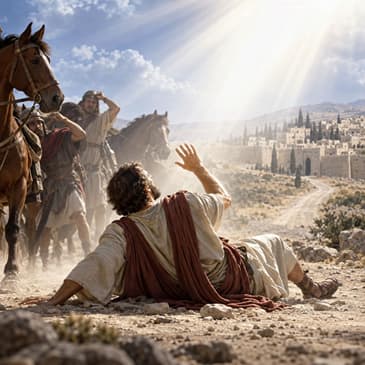
[00:00:00] Hello listeners, welcome to my podcast. We will continue from yesterday. ACTS, a commentary by E. M. Blaiklock. ACTS 9, 3-9b. Paul's Conversion 9, 3-9. There were two roads to Damascus. One was the caravan route from Egypt, which followed the coast of Palestine until it struck east to cross the Jordan north of the Lake of Tiberias.
[00:00:28] To join this road, Saul would have first turned westward to the sea. The other way led through Neapolis, crossed the Jordan south of the Lake of Tiberias, passed through Gadara, and ran northeast to Damascus. Somewhere on one of these two roads, Saul had that vision of Christ which changed his life and altered the course of world history. It was conversion, shattering and sudden, and an act of God.
[00:00:58] Two views of what may be described as the spiritual machinery are held. 1. Sudden Impact Ramsey believes that Saul's whole mind and conduct were based on the certainty that the imposter was dead. If that were not so, the whole foundation crumbled beneath his feet. Then, in the mid-course of his mad career, he saw Jesus so clearly, so unmistakably, that he could not disbelieve.
[00:01:27] He saw, he heard, he knew, and there was no alternative to surrender. Two points may be noted. First, Ramsey seems the only leading authority to hold this position. Second, God does not usually deal thus with men. In his grace, he sometimes reveals truth with special clarity, but not to complete an implacable hostility,
[00:01:53] only to bewilderment, however despairing, and to nascent conviction, however overlaid, repressed, and beaten down. 1. Consummation Few conversions take place out of the blue. S. H. Malone writes,
[00:02:23] Let us observe again the case of that conversion which changed the history of the world. St. Paul had for long been deeply impressed by his experience of the devotion of the Christians whom he persecuted. Perhaps it would not be going too far to say that he had already been a Christian for a long time, but unconsciously, and just for that reason his fanaticism against the Christians increased,
[00:02:47] for in personalities of this type, fanaticism exists as a compensation for, and in conflict with, secret doubts. A. W. F. Blunt agrees. His furious purpose of persecution, he writes, would not be psychologically incompatible with the disquietude of conscience, which a sincere and eager man may feel only the more strongly because he tries to silence it by zealous energy of action.
[00:03:16] So does F. W. Farrar in his venerable study of 1884. If haunting doubts could for a moment thrust themselves into his thoughts, the vehement self-assertion of contempt would sweep them out, and they would be expiated by fresh zeal against the seductive glamour of the heresy, which thus dared to insinuate itself like a serpent into the very hearts of its avengers. The dean continues to describe the week-long journey to Damascus,
[00:03:46] Saul's lonely meditation, alone with memories, the pressure of conscience, the spirit of God, and the challenge of the word. R. B. Rackham may be ranged with the same commentators. He writes, This is a common proverb found in Greek and Latin literature, as well as Hebrew. It is thoroughly in the proverbial style, familiar but incisive, of Jesus of Nazareth.
[00:04:16] And, in fact, it was the best description of what Saul had been doing, trying to stifle the pricks of his inmost heart of conscience, which all the time was asking, Is this righteousness of mine own really joy and peace? What if Stephen and the Nazarenes are right after all? Thanks for listening. We will continue tomorrow.