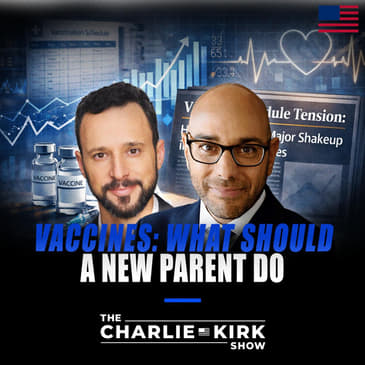
RFK Jr.’s HHS is shaking up healthcare for American children by altering the vaccine schedule and retracting long-existing advisories. What should new parents think about this? Doctor Joel Warsh and lawyer Aaron Siri guide Andrew and Rylee through the current state of vaccines and offer advice to parents unsure about what is safe for their own kids.
Watch every episode ad-free on members.charliekirk.com!
Get new merch at charliekirkstore.com!
Support the show: http://www.charliekirk.com/support
See omnystudio.com/listener for privacy information.
00:00:03
Speaker 1: My name is Charlie Kirk. I run the largest pro American student organization in the country, fighting for the future of our republic. My call is to fight evil and to proclaim truth. If the most important thing for you is just feeling good, you're gonna end up miserable. But if the most important thing is doing good, you'll end up purposeful. College is a scam, everybody. You got to stop sending your kids to college. You should get married as young as possible and have as many kids as possible. Go start at turning point you would say college chapter. Go start attning point youould say high school chapter. Go find out how your church can get involved.
00:00:37
Speaker 2: Sign up and become an activist.
00:00:39
Speaker 1: I gave my life to the Lord in fifth grade, most important decision I ever made in my life, and I encourage you to do the same. Here I am.
00:00:46
Speaker 2: Lord, Use me.
00:00:48
Speaker 1: Buckle up, everybody, Here we go. The Charlie Kirk Show is proudly sponsored by Preserved Gold, leading gold and silver experts and the only precious metals company. I recommend to my family, friends and viewers.
00:01:09
Speaker 2: Hey, everybody, welcome to a very special episode of The Charlie Kirk Show. We're going to have a long form discussion about some changes that are happening at the CDC, conversations that are continuing to evolve when it comes to vaccines and autism, about the hep B shot, and getting deep into questions that we receive here at the Charlie Kirk Show from moms all around the country wanting to know how they should be addressing and thinking about when the issues that come up when they have their own children, when they're pregnant. There's so much here in so much practical discussions that we need to have for you out there in the audience that we wanted to bring in two experts of this area. It's a very dynamic area. There's a lot of confusion about it, and that's what this conversation is designed to do, is to bring clarity in a sea of confusion where there's still a lot of questions and we're to help us navigate this very important topic. Is doctor Joel Gator Walsh is MD and author of a new book, Between a Shot and a Hard Place right here, and you can find him on x and Instagram at doctor Joel Gator. Thank you so much for joining us. I know that Alex Clark has also had you in panels at our events, and it's honored to have you back with us here.
00:02:27
Speaker 3: It's an honor to be here, and I really appreciate you guys having a vaccine talk. I know that that is not something that everyone's willing to do, and I think it's so important.
00:02:34
Speaker 2: Well, there's no way to honor Charlie Kirk, the namesake of the show, than talking about this topic because he was passionate about it. And the second guest that we have here is Aaron Siri. He's also the he's the So let me get all of your titles here, because there's a few. Your civil rights attorney, you're the managing partner of Siri in Gilmstad LLP. Your website is sirilp dot com. And you did the author of this book, Vaccines Amen, which has just come out. And you guys were before we took the show here, you guys were both read each other's stuff. So this is going to be a really fantastic conversation back and forth. And it's not a debate, it really is. There's just so many practical questions that parents and families are having about this topic, and there's been some new changes at the CDC. Obviously, RFK is now head of HHS. There's a lot of controversy about that, a lot of discussion about that. So we want to just try and help bring clarity to a dynamic conversation. So here to help us also bring clarity to this is Riley Marty. She is our resident MAHA expert. And you're just a fan of all things health related. You and Charlie shared that in common, and so thank you for joining as well and for setting this up. So let's get into it. These are there's two things I want to take. The first thing, I think it's a little easier to wrap our brains around, and there's probably fewer questions, but it's very very important, and so that'll be kind of our on ramp into this larger vaccine discussion. So on December fifth, the CDC's Advisory Committee on Immunization, so the ASIP or ACIP, voted eight to three to drop the long standing universal recommendation that every newborn receive hepatitis B vaccines. I will tell you I have three small kids. When they start when you have a baby in the hospital and they just start shooting things into the baby and they're putting you know, You're like, you don't even Many parents are probably like me, especially with our first where you just had no idea that was even gonna happen, and you're wondering, like it must be necessary. They're doing this. So when it comes to HEPB, let's explain the logic originally, maybe first with you, doctor Gator. What was the logic of making it mandatory the CDC was advising it now they are no longer, what was the original rationale for that and why the change?
00:05:00
Speaker 3: So Originally, when the hepatitis B vaccine was brought out, it was more for high risk groups because the main way that you would get it would be like an STD, through sexual contact or through drug use. But there were still tens of thousands of cases every year, and so they decided that they would recommend that to all babies in the first day of life to get the hepatitis B to decrease those cases near down to zero. And the reality is it did work pretty well. I mean, we did see a big decrease in the hepatitis B disease, but that is still mainly coming from individuals who had hepatitis B as mom passing it on to the baby. It was extremely rare. It's still extremely rare for a baby who's born to a hepatitis B negative mother to get hepatitis B. Is it possible, Yes, it is possible that a test could be wrong, that you could get hepatitis B after you do the testing, or somebody could come by and bleed on your baby. But again, that's extremely extremely rare. We're talking like one in a million to one in seven million by best guesses. And so when you're talking about the medical community, a lot of times you only hear about benefits and a lot of doctors saying, well, we want to make sure every single baby gets hepatitis V vaccine so that no babies ever get it. And the reality is, I don't want any baby to get hepatitis B or any infection at all. But you have to weigh the risks versus the benefits. And there are risks to any intervention that we do, any medication and any vaccine, and we're not acknowledging that in the medical community. And I think for something that's so rare, let's say it's one in a million, you have to ask giving this vaccine to three million kids that don't necessarily need it to protect one kid? Is that worth it within the first twenty four hours? Why within the first twenty four hours? And then you're talking about the known risks and the unknown risks and you have to weigh that. And a lot of other countries have looked at that calculation and said, you know what, we're going to only recommend it to high risk babies. And so what we decided, and what ASP decided, was that they are going to go to this high risk group decision where you're not necessarily going to recommend it for baby. If you are in that high risk group, you could you do it. If you want to do it, you can still do it. But now it's a shared clinical decision making versus an explicit recommendation. It was never mandatory per se. It was just a recommendation, and now they're removing that recommendation in place of making it shared clinical decision making.
00:07:16
Speaker 2: So you're saying that basically, this new advisory or this new decision eight three, which remember and you were educating me on this and I remember the story is that you know RFK came in he basically removed the seventeen members of ASIP right I don't know what you would call them, the voting voting members, voting members, and now they haven't replaced all of them yet, but the one there was an eight three vote to drop this universal recommendation. And you're you're I guess you were. We were discussing this before we took on the show here, but you were saying that some of the risks are fever, other other known risks that maybe would be potentially worse than I guess I would say worse. But you have to know the risk, right, This is informed consent idea, right.
00:08:09
Speaker 3: I mean, we know that there's a risk of fever, and in the Hepothetis B trials it was about one to five percent. And if a newborn gets a fever, that's a big deal. They're getting a full work up, they're getting a lumbar puncture, so that's something to keep in mind. We also know that they can have encephalitis and encephalopathy. We know that they can have autimmune conditions like yam Brace syndrome. That's just what we know. And then there's all the things that we don't know because by and large, we haven't really studied it long term. We're not really sure what it does to the immune system long term and if there are long term complications, and that gets controversial, but to be you have to take that into account when you're saying that you're protecting only one out of a million or one out of three million kids for something that you're giving to all of these kids. So I don't think it's unreasonable to have those discussions. That's what they decided when the medical community gets upset. They're looking at just the benefits, just the kids that are protected. But that's not the only thing in the decision tree here, and we have to get back to at risk versus benefit analysis and we just haven't been. I don't know why medicine doesn't want to do that. I don't want understand, but.
00:09:05
Speaker 2: Just to be clear, so for the audience's sake, h doctor Walsh, I mean you prefer gator or what wash it?
00:09:12
Speaker 3: Okay, I don't care.
00:09:13
Speaker 2: Would you describe yourself as anti.
00:09:15
Speaker 3: Vax Absolutely not. I mean you can ask any patient that's been in my office recently that has gotten a vaccine. I believe in informed consent. I believe people should be able to choose what they feel like it's best for them. I have patients in my office that do the regular schedule, some that do a slow schedule, some that don't do it. We have discussions, we talk about what we know and what we don't know, and then they come up with that decision. I've never forced anybody to do anything.
00:09:35
Speaker 2: Got it. I just want to just establishing the record here. So Aaron so your civil rights attorney. I found it interesting, just the little things I'm picking up as the layman here where technically it wasn't mandated to get the het B shot.
00:09:52
Speaker 4: But I don't.
00:09:53
Speaker 2: Feel like and I'm trying to remember back to my own experience. I don't now my baby. My kids were born in in Californi, so maybe it's different. I don't know, but I don't remember feeling like there was much informed consent with HEPBE. It was just kind of done. And is there a civil rights component to this? You were just at ASIP. You literally flew here I think yesterday, you came back yesterday this morning, so you were in and around this whole debate that was ongoing. So give give us the hep BE story from your vantage point, and are there civil rights implications to this?
00:10:30
Speaker 4: Sure? I'll add one data point on the safety side, I've never heard or I'm not aware of a single baby that's ever died from heppy on the first day of life. But I can tell you definitively that babies have died on the first day of life from the HEPTBAVA shot. Okay, So including one that was adjudicated not long ago in something called the Vaccine Inatry Compensation Program, which is the federal program where you can get compensation if you're injured by vaccine, and there was a baby that was adjudicated as having died from they have be show on the first day life. Also another just quick data point I'll go to the civil rights question is the very first hepatitized BV vaccine was in nineteen eighty one. It was based it was actually a maid using the plasma the blood of those who are chronic hepatitis B carriers. There were under three hundred deaths in America of hepatitis B in nineteen eighty We are now well over fifteen hundred deaths a year and hepathetis be Okay, so we haven't actually gotten down immortality, which is an interesting data point.
00:11:28
Speaker 2: Do you know what's causing that increase.
00:11:29
Speaker 4: I'll leave that, okay, But it's interesting because they always talk about, well, you know, we have to reduce. Whenever mortality goes down, they immediately attributed to the vaccine Moore mortality goes up. Nobody wants to look. But let's leave that aside. Let's let's put the data side. On the civil rights side of things, there's absolutely a civil rights component. Number one, we have endless cases where parents have provided written notice to the hospital that they do not want to hepatize V vaccine as part of their birth and program in writing signed and the hospital does it. Anyway, we probably have about over one hundred clients like that at the firm right now. So my firm has over one hundred folks, about over about fifty of them do just vaccine related work. And one of the things we do is this type of these cases where actually we've started taking on these representations. They're supported by a group called eye Can They Information in Action Network because they're not very lucrative, so but a nonprofit has decided they want to put a stop to this practice, and so we've done those cases. There's another component too. We get lots of calls from parents who are in they've just given Birther and happiest moment of their lives, and they've decided they don't want the shot, and the hospital is telling them if they don't get it, they're gonna call CPS on them.
00:12:46
Speaker 2: No kidding, Yep, We've had that happen a few seyss in Red States too. I mean, is it all across the board, because you know, you think about red versus Blue states, but it's actually like a medical establishment that is very very keen on this.
00:12:57
Speaker 4: We'll tell you it's interesting. I don't It really comes down to whoever the attendant is in that moment. Sometimes it's not even the hospital, it's not even the state that matters. It's the attendant. Who is the attending physician in that hospital in that moment. Are they in a good mood, what's going on with them that day? It really can come down to that.
00:13:17
Speaker 3: It could be anybody that got a bad feeling about the situation and then they all for whatever reason.
00:13:21
Speaker 2: Yeah, it just it strikes me that I do not have a clear memory. And now with babies two and three, so I've got three three kids, the second and the third, I remember being very much more like queued in and I was. I was aware of a lot more because I had been through it once before, but especially that on our oldest I can't remember even being given the option. I can't remember at all now. On the third one, I I successfully delayed the have B like a day though. I mean it was like, you know, we don't ease do that right now, and then they they harped on us. So what I gonna throw Riley just really quick here, because you are a mom, you're really in touch with the MAHA community. Like, what are moms saying about the heap Bey stuff.
00:14:09
Speaker 5: It's honestly, it's fifty fifty. A lot of moms are saying, I'm getting stuff from both sides. I don't know, you know, I have The things that I'm reading online are scary. I don't know how to interpret this. If you don't have a science background, you don't do your research on your own. Even if you do research on your own, if you don't understand how to read and interpret a clinical study, you may not know what's right and what's wrong, or what you're being told.
00:14:33
Speaker 3: It's all over the place.
00:14:35
Speaker 5: I know. A lot of the issue is like with birthing plans. I have a one year old, so obviously I was. I had my birth and plan. Did it change by the time the baby was born, but when I walked in, of course that it happens. I made sure that the hospital that I had was one hundred percent agree with my birth plan, that they would accommodate that no matter what. But there are a lot of moms that are they're scared. They go in, they don't know what to expect. If you've never had a baby, you don't know.
00:15:05
Speaker 3: What to expect.
00:15:06
Speaker 5: You're reading all this stuff online, You're overwhelmed. You're already stress because you're about to have a baby, let alone going in and not knowing what you don't know because you don't know what you don't know. One of the things was is making sure that dad is always with baby, because you're doing your own thing. You're having the baby. But if that doctor takes that baby out, there's a lot of parents that are concerned that my birth plan may be this. But I don't one hundred percent trust the establishment. I don't one hundred percent trust the doctors or the hospital that they're not going to give my kids something even though I have it in writing and I've stated that I don't want this.
00:15:41
Speaker 3: Well, I never left my kid's side in that for a second.
00:15:44
Speaker 5: My husband was with our baby from.
00:15:46
Speaker 3: Day on, never for a second. Because they make mistakes and they have their look like you said, that that's the default, right, the default is to do all everything. So and there's always nurse changes and shift changes, and so you have to assume that they just by default will do the things that are on their checklist. So I agree fully.
00:16:03
Speaker 2: So yeah, I mean do you get that a lot? Where have you have you been litigating cases like that where hospitals just can just defy a parent's birthplan.
00:16:10
Speaker 4: Oh? Absolutely, we've settled them where hospitals have to pay the parents. Absolutely we have. Like I said, we have probably about a one hundred clients literally right now as you as we sit here where my law firm is handling their cases right now. So it happens all the time because you know, and that's part of the issue with the routine recommendation from ASIP, because when it's viewed as routine, what does that mean there? That means that they the medical community views it as everybody should get it. And you know, you're right to inform consents sometimes goes out the window, even apparently when you have it in writing.
00:16:44
Speaker 2: So I just for the audience sake, a SIP stands for Advisory Committee on Immunization Practices. Okay, so it's a really powerful committee. Yes, it's within the CDC. And again RFK Junior famously now notoriously whatever you want to got it removed the seventeen sitting members of that and has been replacing them. But you said before we came on the air, So I just want to catch our audience up that he's actually the people that have been appointed to this board are pretty They're across the spectrum ideologically when it comes to this stuff.
00:17:17
Speaker 6: Oh.
00:17:17
Speaker 4: Absolutely, If you watch an asappearing, you will hear quite you will hear a diversity of opinion.
00:17:22
Speaker 2: Well that's great, though, right, I mean it should be.
00:17:24
Speaker 3: Well not everyone thinks that though. I mean have you seen the tweets about him from Senator Cassidy.
00:17:30
Speaker 2: Or about you?
00:17:30
Speaker 3: Yeah, I mean they were sing he shouldn't be there because Bill Cassidy.
00:17:34
Speaker 2: From Louisiana, who famously voted to impeach President Trump.
00:17:38
Speaker 3: I mean there are many people that are saying that he shouldn't be allowed to be there because he sues and makes money off of vaccines a lawsuits and that doesn't make any sense to me as a physician. It just makes no logical sense whatsoever. All the vaccine companies are there, They're always speaking. I mean, everybody has some sort of conflict of interest, and you you want people that know about vaccines, that work on vaccines. You want the companies to be there. I mean you want them to talk, You want to be able to grill them. So why should you not be able to have somebody who is thinking in different ways. It's absurd to say that that's a conflict event just that couldn't be there.
00:18:08
Speaker 4: Well, did you see my response in CNN? They covered the exchange actually for the first week.
00:18:15
Speaker 2: So are you on ACEIP No, I spoke before.
00:18:18
Speaker 4: That's what I thought, okay, And so I was invited to speak about the development of the childhood Schedule and Center. Cassidy tweeted out that I'm you know something about how I shouldn't have been invited because I make my living is what he wrote, suing vaccine makers. So I tweeted back, and I said, it's ironic you write that, because actually I can't make my living swing vaccine makers because they have immunity. Childhood vaccines are the only product in America, literally the only one. As as four of us city are in this room. Look around this room. We're surrounded by thousands of manufactured products. On your way into this room. Okay, for every one of them, you could see the company on the basis that had they made that product safeter, you or your child would not have died or gotten seriously injured. Okay, So for extra penny, they could have made the gas sank in your carnate explode. You could sue them because it could have made it saver. If this wall material could have been made safer, if it didn't cause you cancer, you could sue them. The only conduct you can't see for are vaccine since nineteeny six because it's something called the National Tallet to Vaccine in Duracked nineteen eighty six. So it Senator Cassidy says, I make my living swing vaccine makers.
00:19:26
Speaker 2: It's pretty ironic because it's Congress. We've got it up.
00:19:29
Speaker 4: It's Congress that can you find my response? It's Congress that that you know, eliminated that that right in nineteen eighty six, precisely because of how much harm those vaccines were causing.
00:19:41
Speaker 2: Yeah, I mean, I have like a lot of questions, so the let's get so before we move on. Actually, I just want to make sure we're putting a pin in this whole idea of the het BET. So it's no longer universally recommended. What's that?
00:20:00
Speaker 4: Only at birth?
00:20:01
Speaker 2: At birth? Okay? So that's the question. So the follow up questions are, do you get it on day one? Do you get it on twenty days after you get a month after you get it, two months after? Is there is there a something more comfortable recommending?
00:20:14
Speaker 3: Their recommendation now is two months or later, which generally is what kids were doing anyways. If they didn't get the vaccine at birth, they would get it at two months, four months, and six months or any time after that.
00:20:23
Speaker 2: Okay, And in generally speaking, that is much safer when it comes to fevers, encephalitis or you know.
00:20:31
Speaker 3: I mean, it's definitely safer if you get a fever that you're older. But whether that makes the vaccine safer or not, that's debatable. So that's something that should be studied. But we haven't studied those differences to see whether it is safer.
00:20:42
Speaker 4: And the manufacturer's disclosure about cephalitis and selfalopathy don't distinguish between age.
00:20:47
Speaker 3: And in most of the safety research, I mean the original safety research, which is really interesting and might get us a little off topic, but was four to five days of safety research, which is crazy days.
00:20:56
Speaker 2: Yes, So I want to go back to something you said, doctor. You said you don't mandate for any of your clients. You give them essentially informed consent. You go back and forth. So question might be don't vaccines at some point lose their broader appeal or they're broader I guess upside, if we don't have universal vaccine vaccination of some of these diseases, you have to.
00:21:22
Speaker 3: Go vaccine by vaccine on each of these because for many of the vaccines, and this is something that you don't realize unless you really look into it or think about it, is that most of them don't protect the community. They just protect you. So many of the diseases don't have this community immunity that you're talking about. Some of them do, I mean the measles vaccine certainly something, Yeah, we can talk about that, but there are some more than others. But the polio vaccine protects you. We'll being cough, vaccine protects you. Many of the vaccines just protect you. So it's not really about the community immunity like you're mentioning. So it depends. Each one is a little bit different.
00:21:55
Speaker 2: Anything you want to say about het be that we've missed, because there's a whole bunch of other topics we can get into. But I want to make sure you know, there's so much that I can talk. Okay, what are we missing?
00:22:10
Speaker 4: I mean, I'll just build on what the dude doctor said, which is the clinical trial relied upon to license. There are two standalone hepatized B vaccines. One was licensed in eighty six one eighty nine were COMAVAXHB, Indrux B whe KOMMAVACSHP was licensed based on a clinical trial. And this is what the doctor was talking about. When clinical trial that monitored children for five days for safety after injection. That's it. Five days. There were one hundred and forty seven kids in no control group. That was the whole trial. That's it. Okay, nothing else that is useless to determine the safety of the product.
00:22:42
Speaker 2: Who regulates these control groups in these you know, because there's a lot of this going on right now. Alex Bearenson has been talking about the COVID shots and the clinical trials that were done for that, and he's basically of the position that these companies are very good at at rigging. He didn't use that word, but essentially they're very good at these.
00:23:04
Speaker 4: They're good at making money well, and they're good.
00:23:06
Speaker 2: At these control groups or these clinical trials to make sure they get the outcome they want.
00:23:10
Speaker 4: Yes, for most drugs, okay, they normally have multi year placeble control trials. Why because they're liable for the injuries from drug products after they go to market, So they want to make sure they don't lose money, and that's what they're in business for. There's companies with business make money. You have a retirement account, you got a four to one K. You want the companies in your portfolio make money. So does Wall Street, So does everybody that has stock, right, so do the CEO, so does the board members. In fact, you fire a company, you take matter your portfolio if they weren't making money, right, So that's how they make their decisions. Now. Normally, the interest to make money is aligned with safety because if you put out of product's not safe, you lose money and so. But with vaccines, it's the only one that, as I noted, has that immunity I talked about earlier. So the financial interest has been inverted, okay, which is why for vaccine trials will often see days or weeks of safety review, never a polceible control for any of the routine injected vaccines, and they're often underpowered, meaning not enough kids. So to answer it was a long way to answer a question. But to answer your question, FDA regulates these trials, okay, but it's the companies that conduct them. Why would the FDA accept the trial that short? That's because there's a drug division, there's a vaccine division, and if you've interacted with the vaccine division, they are believers in these products.
00:24:32
Speaker 2: Even during rfk's ten yures. So far, has it changed? Is there more skepticism?
00:24:38
Speaker 4: Vine Prosad, who is the head of ciber the which has the vaccine division at the FDA. You saw that memo he released that was leaked where he talked about the ten kids dying.
00:24:48
Speaker 2: I don't know if you've read it read it, but.
00:24:51
Speaker 4: He is trying to reform. He is facing mass descent and opposition. Look, if you sat an FDA for the last few decks, AIDS anybody in there, and you licensed these vaccines based on these kinds of uh clinical trials that in no way could have confirmed affirmed safety, you must have incredible cognitive dissonance when faced with those without reality. Yeah, they just assume safety.
00:25:16
Speaker 3: And can I just say that I think that your question again, it's so reasonable, and my question is why they would allow that like that? That what doesn't make sense? And that's when when you have sued them and for FOIA request to find out if there are more information, because it doesn't make sense that we would give a vaccine to a newborn unless we had the very best safety data possible. That doesn't make you anti vax. It just means if you're going to put a new vaccine on the schedule, if you're going to give a new vaccine to my baby, I want to know that it's been studied in thousands, maybe hundreds of thousands of kid against an inert placebo, followed forward and looked at to see what the safety profile is. How is that anti anything? That doesn't mean that they shouldn't get it, but we should be sure that it's safe. Before you give to a healthy newborn, it's not the same thing as giving to somebody who's sick.
00:26:05
Speaker 2: My Pillow wants to say a heartfelt thank you to our listeners for your continued support. To show their appreciation, they're offering an incredible after Christmas sale with some of the best prices that they've ever had and all when you use promo code kirk ki RK right now, you can get their luxurious Giza Dream sheets for as low as twenty nine to ninety eight. That's pretty insane. You'll also find cozy blankets, comforters, and duvet covers starting at just twenty five dollars. Six pack towel sets are only thirty nine ninety eight, making it the perfect time to refresh your home. But the savings don't stop there. Everything is on sale, from dog beds and socks to couch pillows and much more. This is the best opportunity of the year to stock up on My Pillow favorites. Take advantage of these unbeatable specials. Don't wait.
00:26:51
Speaker 1: Head to MyPillow dot com Oric eight hundred seventyive zero four two five now and don't forget to use promo code KRK.
00:26:56
Speaker 2: These offers won't last long. Call eight hundred eight seventy five zero four to two five, or visit my pillow today and use promo code kirk. Yeah. So, let me just tell you how I'm hearing this as the layman in this conversation, even more so than Riley. I'm hearing unless you are in a very you know, high risk group, it doesn't sound to me like this is something that I would be inclined or rushing to give my child, at least immediately. Maybe you could talk about two months, six months, first year maybe, but it doesn't. That's basically where I'm landing on this hearing the intel. Now, I just want to make sure that everybody knows we invited doctor Paul Offitt to this discussion, and Riley reached out kindly, and it was I would say, not a welcome invite. Was concerned that we were going to be confusing the audience and you know, maybe causing more vaccine hesitancy or anti VAXX sentiment. But we did want to at his perspective, and he is I would say, much more of an adherent to you know, the medical establishment's view. I think that's safe to say, the wider medical establisher's view about vaccine efficacy and the need for vaccine. So we did want him to be on on this conversation. But regardless, I don't think you would not describe yourself as anti vax would you, like?
00:28:25
Speaker 4: I mean, look, all I can use is a dictionary for the use of words, Okay, sure, And under Webster's dictionary defines anti vaxi as somebody who opposes mandating one or more vaccines or receiving one or more. So under that definition, most of the country is anti VAXs because a majority opposed mandating COVID vaccine, flea shots and some of the other ones and so forth. So you know, I mean, I guess it matters what definition you're using, whether or not somebody's anti vax you oppose them a COVID vaccine mandate, Yes, then you're anti VAXs, quarter Mirriam Webster totally, So there you go. All right.
00:28:55
Speaker 2: So, but but my point, I think the lay person would think of it as you know, you're not against all vaccines.
00:29:03
Speaker 4: I'm not four or against any product. They're just a product. I'm not pro or anti car I'm not I'm not I don't think cars are good or bad. They're just cars. I don't think there's microphone.
00:29:13
Speaker 2: Personally, I'm not pro anti I personally think cars are good. But I do acknowledge the cars that blow up are good. No, so those are bad, those are bad. So some are good, some are bad. Yeah yeah, okay, so but but that's a I get what you're doing. I get what you're where. You know with this, it's I just think of them as products, honest, right, But the products can have benefits here, and if you become convinced the benefit out weighs the cost, you would probably I'll.
00:29:37
Speaker 4: Answer the heart of the question. Okay. The heart of the question is this on hepatitis B. So if you're gonna, for example, really think about hepatitis BE and you're trying to decide whether to take it, here's the way I would do it. Okay, If a baby is born to a non Heppie positive mother, I would say, Okay, how many the needed number needed to treat? How many babies of help non hepatities? You back to many mothers do you need to inject but to prevent one case of chronic can be? Okay, that's where you start that's the benefit. That's the number you need. What is that number depending on where you look, some say millions, some hundreds of thousands, okay, benefit. Now what's the risk?
00:30:15
Speaker 2: How many out of because that's rare. Yeah, so say so that's rare. Say the number is a million, how many are then getting fevers or getting some other or getting.
00:30:25
Speaker 3: Or that's the right question. That's the question that we need answered.
00:30:28
Speaker 4: Well, there are there are data, there are there are there are data that reflect that the risk in that instance might be greater than the benefit. Now, I don't make metal decisions for other I mean every should make their own choices at the end of the day. Really, my goal is just make sure everybody has the right and the ability to do that as a civil individual rights you know, as an attorney, that's my goal. Not to do that mathematical. But when you do do that, when you do do those numbers, you know, that's the way you should go about it.
00:30:59
Speaker 2: Yeah, And I find I do find it interesting. And I think this is a question that a lot of people have, is why this forceful sort of you know, this this mandate culture when it comes to vaccines. And I think Blake on our team who tends to be a little contrarian in almost everything, but it is well made, this sort of community immunity idea that we want to get these these diseases completely out of the population. Where that's polio, which is probably the most famous example. Smallpox we talked about before we started rolling here, and you had some nuance with smallpox. But polio, for example, right, we eradicated polio essentially. Maybe I'm wrong on that currently, but that was that was always what it was sold to us. You know, we started vaccinating for polio and we got it out of the community. You're saying that is only a consideration on certain illnesses, maybe is that what the community immunity?
00:31:54
Speaker 3: So even for polio, the original polio, the oral polio that does protect other people in theory that one that we use today, the inactivity doesn't. It just protects you. The oral polio was giving more people polio than actual polio that we had, So that's why they stopped using it. Because you can what about measles, So measles is a different case. I think measles is probably the most difficult of the vaccines in terms of that kind of discussion, because we know that measles is extremely contagious and kids can get sick. And we also know that vaccine works very well and you do get some community immunity if you vaccinate enough people. So I think that that is all the diseases. Measles is probably the one where that discussion makes the most sense.
00:32:31
Speaker 2: Can I ask a question like, I don't know which questions are dumb here or not? And guys, you are literally in the thick of these discussions, and so I feel, you know, please forget my insecurity about some of this question. But I have to believe if I'm having some of these questions that like our audience is having the same ones. So my mom did like a measles party when she was like where they literally tried to just get everybody sick so that they would have the immunity and they get it done with. And I remember doing chicken pox. It was like there was no there was no chicken pox vaccine when I was a kid. So these kind of things. So, so how dangerous is mes? Are the measles?
00:33:11
Speaker 4: Uh?
00:33:11
Speaker 2: And and do we do you think that the I mean again, I don't want to put you in a position. You know, you're sort of you're open, open handed, like do you recommend them for people the vaccine?
00:33:21
Speaker 7: Do you?
00:33:22
Speaker 2: Or do you think we this old way of doing things was actually better in some ways, like it is a natural, naturally gained immunity better than a vaccine immunity. General questions, your questions are great.
00:33:33
Speaker 3: You should understand that these are the questions we get, or certainly I get, every single day, so they are excellent questions. In terms of measles, it is really important to understand the epidemiology of measles. From way back in the day. People were not afraid of measles a long time ago. The problem with measles, the concern around measles is that it's very contagious. It's one of the most contagious diseases that we have. So if nobody is vaccinated, it's going to go through the community. Everybody's going to get it. Most people in a room, like nine out of ten people are going to get measles. So a few kids will get really sick, and that's something to understand. Back before they were vaccine, some will die, yes, some will die. So before Reckon data, there were about three to five hundred deaths a year. Back before measles, So there are very very few deaths but not zero, And the biggest concern for measles is pneumonia. A lot of kids do go to the hospital. There is about a one to twenty risk for pneumonia and for searus complications. So obviously we don't want any kid to go to the hospital. We don't want any kid to die. These are things that are possible, so that's something that people do need to understand. And the vaccine, if you get both of them, it's about ninety seven percent effective, so that's pretty good effectiveness. The question then becomes, Okay, at what cost?
00:34:42
Speaker 2: Yes, I'm going to throw to this the attorney here, so because you are you litigating now or have measles cases MMR vaccin cases? Sure, okay, so I can give you.
00:34:54
Speaker 4: A sense Yeah, yeah, different. I mean to answer your initial question, which from an I I will build upon what was just said with regards to getting measles versus getting the vaccine. So Joel's correct. They were about three to five hundred deaths a year leading up to nineteen sixty three, when the first measles vaccine was introduced.
00:35:14
Speaker 2: Sixty three sixty three, first meals vaccine.
00:35:16
Speaker 4: Ever, in the United States, between nineteen hundred and nineteen sixty three, measles mortality United States to climb by over ninety eight percent.
00:35:23
Speaker 2: Climbed, declined, declined, interesting, declined.
00:35:27
Speaker 4: So you had over a ninety eight percent decline in mortality for measles in the United States to nineteen hundred nineteen sixty three. That's just the CDC mortality data. You know what didn't cause that decline in mortality? Measles vaccine? Yeah, exactly, couldn't exist.
00:35:40
Speaker 2: It didn't exist, I know, so sometimes people it takes some tracking.
00:35:43
Speaker 4: Okay, so what did cause it? We could probably ascribe it to public health measures, even meane. Public health authorities probably could take credit for a lot of it. They never do they take other than appointing to vaccines. But it's probably better sanitations, better clean water, better nutrition, go down the list.
00:36:02
Speaker 2: Okay, Well, when they get sick, they're probably had more advanced care, all the things.
00:36:07
Speaker 4: Better acute care, absolutely right. Because of the secondary effects. Now, measles vaccine can prevent transmission, so anybody who's got the vaccine is less likely to get clinical measles, and hence they're less likely to get harm from measles, But that's not the end of the story in my opinion, for the following reason. First of all, if we didn't vaccinate with that mortality curve continued to decline, mortality from all of these infectities were declining, other than polia was going up. Was the only one since the nine hundred for the most part, okay. And so when mortality have continued decline, that's first of all, so can we ascribe all of that reduction mortality to measles? Remember musles mortality was going down as the population was climbing from nineteen hundred. Okay, So even as population continue to climb, mortality likely would have continued to going down. So but I assume some of the reduction mortality can be ascribed to the vaccine. Fine, but let me save you the flip side. Those that have had measles. Studies have shown how far less depths from cardiovascular disease, cancers, and other issues. A prospective one hundred thousand person study in Japan meaning forward looking for twenty two years, that tracked one hundred thousand people in Japan for twenty two years found So this was a you know, this was a very serious study by institution, by an institution there and you know, by the government of Japan and major university there. And what have found is that those that had had measles and momps had naturally, naturally naturally got it, naturally got it compared to those who didn't had a twenty percent statistically significant decline immortality from cardiovascal disease.
00:37:45
Speaker 2: So this is a point that I've heard and from a very prominent person. I was just talking to them recently, and they their whole This person would proudly describe themselves as anti vax, like, very proud. And the rationale for this person was that when you get diseases naturally and your body overcomes them, that you have a stronger immunity for everything. And this person's con perspective on it, and I'll probably throw it to you. Either of you can answer this actually was that it was It wasn't just cardiovascular, It wasn't just against that same disease in the future. It was against like things like cancer. This was this person's well that's what I'll study show, Okay, So I'm not speaking out of turn here. This was not completely is there? So for example, COVID, yes, if you got a natural immunity, you got covid, and then your you overcame it.
00:38:34
Speaker 4: Uh.
00:38:34
Speaker 2: It didn't mean that you weren't going to get it in the future, but perhaps your body.
00:38:37
Speaker 4: I mean, I got it.
00:38:38
Speaker 2: I got the og COVID in twenty twenty, and I think I got it one more time. And the first time was rough. Second time was like a piece of cake. But also the virus is getting weaker. But so I don't really know what to make of that, but I will say that their perspective on it was that you should let your body fight these things. Stop injecting our kids with all this stuff like chicken pox vaccine and measles vaccine. Let them get over it. That's that's person's perspective. I just I'm thrown it out there because I bet a lot of people have heard this.
00:39:04
Speaker 3: Yeah, I mean, there are different perspectives on it. I think, you know, one of the main things to consider the point of a vaccine, theoretically would be to protect you from getting the disease, protect you from dying or getting very sick from a disease. So I think we have to keep that in mind because the only people that survive are the ones that can have this protection. Right, So that's the counter argument. You have to survive the disease to have some sort of you know, potential other benefits. Also with measles, there is immune amnesia. That's one of the things that is right.
00:39:30
Speaker 2: It like wipes your your uh, your immunity memory.
00:39:35
Speaker 4: I'll disagree with that.
00:39:36
Speaker 8: I don't.
00:39:36
Speaker 4: I don't think those studies.
00:39:37
Speaker 3: Are sure, but that that is one of the things that is certainly pointed to in the literature as something that people talk to. So it's debated, you know, whether it could be beneficial or not. But those are again the right questions, right, those are the questions where we should be looking this. We shouldn't be hearing, oh, there might be some sort of protective benefits and saying, ah, that's crazy. You know, we need to understand those things. We need to look at the whole picture and weigh those things out to see what the long term benefits. We don't necessarily understand everything about this world and about diseases and what potential benefits, but there might.
00:40:06
Speaker 2: Be It is interesting though, right if you go back to like the there's that famous episode of the Brady Bunch where they all just get measles and it's like a laugh track, you know, And it's just like, culturally, we have gone very far from like, oh the housekeeper gets gets measles and everybody laughs about it and she's you know, she's got red bumps or whatever, to now where like kids are gonna die RFK is and it sounds like it's true three to five hundred a year. I mean, I don't want to make light of that, but it is like a weird and cultural difference. How many kids die of chicken pox? Very few? Right about before the back.
00:40:43
Speaker 4: They estimated about one hundred something a year.
00:40:45
Speaker 3: Yeah, so it's very few.
00:40:46
Speaker 2: I mean, I don't even remember being worried about that. Now there was the Samoa case though, right that the RFK has gotten into some hot water with get blamed for.
00:40:56
Speaker 4: Is not the United States?
00:40:58
Speaker 2: Okay, So you think that that is more or because it's like a dozen kids died or something like that in the South.
00:41:04
Speaker 3: No, it was more than that, was it?
00:41:05
Speaker 2: Okay? So however, many dozens dozens of kids.
00:41:08
Speaker 4: Something about Samoa doesn't make a lot of sense because one in four and fifty thousand Americans died of measles before there was a vaccine. It came out of those infected about one in ten thousand. The numbers in Samoa just don't match any any data from historically. I don't know exactly what happened there, but it doesn't match any of the actual data, real world data that exists in the United States from any time period.
00:41:31
Speaker 2: That's fascinating. You had a thought on this, No, it's fine, Well I did, but.
00:41:41
Speaker 3: I guess I do.
00:41:42
Speaker 5: As far as how often is are the data that is being used for vaccines? How often are the studies done in another country and not in the US, or are they all in the US?
00:41:57
Speaker 3: They're not all in the US.
00:41:59
Speaker 2: The able accept foreign studies.
00:42:01
Speaker 4: Are you talking, well, are you talking about clinical trust a license? You're talking about post licensere safety studies. Post license safe studies.
00:42:08
Speaker 2: Ironically happen host Licensure' sorry, is that what you're saying?
00:42:12
Speaker 4: Post licensure after the vaccine is licensed. They often do studies outside of the US. Actually, Denmark's a place they often do a lot of them, like the recent aluminum study.
00:42:22
Speaker 7: And why is that?
00:42:24
Speaker 2: Uh well, uh, well, be honest, be honest.
00:42:29
Speaker 4: Well, okay, so they often do them in Denmark. They say the reason they I'll tell you what they say, and I'll tell I'll tell you my personal view. So they say they do them in Denmark because Denmark has a centralized medical care system with robust tracking of vaccination and other metrics, and so they say they can do these studies there more readily on vaccines vaccine safety. Uh, I would say the other side of it is, uh, they only have they have a tiny vaccine s edule compared to the US. So there's nine vaccines that are not on their schedule that are on the US schedule. So kind of a better place to study vaccine safety when you're giving nine less I'm not talking shots, I'm talking nine less different vaccines. I can tell you the whole Danish schedule super easy. At three, five and twelve months. You get one hex availed and which is basically dtp hib IPv and and one other I'm trying to do fast two dose MMR detap agan of five years and then HPV. That's it. That's the whole schedule. That's nothing compared to the US.
00:43:34
Speaker 3: But if you're correlating that to.
00:43:37
Speaker 5: Kids here in the US, that is not accurate.
00:43:40
Speaker 4: It's not accurate. But that's what you, like you saw that recent aluminum study they came out with that said aluminum aage evants are safe and they studied them in Denmark. Did you, I don't know if I didn't. It was all over the news. It was used as to punch against Bobby, against our Yeah. Yeah, I mean, but the problem is that they excluded any kids that got more than a certain amount of aluminum maagice. But the problem is that every single kid in America gets that amount if they study, if they follow the CDC schedules.
00:44:06
Speaker 3: And they didn't have an unvaccinated group, which.
00:44:08
Speaker 4: Well they did and then they kicked them out. Yeah they had one initially, right, and then they and then they merged it.
00:44:15
Speaker 2: This is this is a one of the ingredients of a lot of vaccines, right, So so it's American kids presumably would get up much much more of this is far more right, Okay, and it multiple times. Okay, So you said the maybe we'd come back to that, but you said the stated reason is that Denmark has the centralized medical system. They track everything, it's really organized. What's your opinion on why they do it there?
00:44:41
Speaker 4: Oh? I thought I was transparent about my opinion. Okay, well, I could read the line is that which is that THEA which is that they're just so much fewer vaccines.
00:44:52
Speaker 2: Okay, so it doesn't trigger the same yet, Yeah, you know.
00:44:55
Speaker 4: How you know percent of kids get at V vaccine in Denmark by eighteen years of age, basically zero point one. They don't have HEPPY on their schedule. You can't even get your kid a het VY vaccine in Denmark if your mother is not heavy positive or you're not high risk. My understanding is you can't even get it. So you have point like one point zero one percent of kids have hed B vaccine. Do you know what the head be rate amongst kids in Denmark versus the US's effectively the same.
00:45:23
Speaker 2: So that's b And now you we've talked a lot about this, and I think what Children's Defense Fund has made a big thing about this over the years is how I learned about it is the nineteen eighties schedule versus our current vaccine schedule. And you are talking about Denmark. Is there an industrialized country that you look to and say they basically do the childhood vaccine schedule in a way that you look up to that you see as the gold standard.
00:45:55
Speaker 4: I don't know.
00:45:56
Speaker 3: I mean, there are other places that have better health overall, so I think we can at their overall health. But I don't know that you can always compare it exactly to America. So I think it's it's tough. I mean that that's literally what Trump just came out and said that he wants to do. He wants to compare to other nations, look at the differences and have these discussions. But you would have to really do a deep dive into that, and I'm not sure that anyone's ever truly done that before. Maybe maybe I'm wrong.
00:46:21
Speaker 2: I look, I think your say his last name.
00:46:24
Speaker 4: I think he should just I think it should just treat vaccines like a product, which is you want to get him get them. It's freedom, that's America. I'll support anybody's rights to get as many vaccines as they want and wear as many masks they want. I mean it so okay, basic, but but but I don't think the government between the business of basically promoting vaccines. So I think that schedules are problematic to begin with.
00:46:44
Speaker 2: Postkay, okay, they're problematic. I get that. I get your perspective on this, just to find it. Then between nineteen, let's say eighty five, twenty twenty five, how much more vaccines are we getting? I guess we have a graphic o it.
00:46:57
Speaker 4: Here, Yeah, so and so on screen. That's the current schedule. So if you are following the current CDC schedule including COVID vaccine, okay, because still a lot of kids are getting that today. By the first birthday, a child will get twenty nine injections including COVID. So take COVID off three or four doses because maybe the mother gets that includes in euro twenty nine injections. In the nineteen eighty six when that law was passed, a child falling sea schedule get three injections by their first birthday. So you've got on three to twenty five excluding COVID twenty nine including covid okay, three to twenty five or twenty nine. That is a massive difference. And every one of those products was except for one, was developed and licensed by a company knowing they would virtually never have to pay for the kids that they kill or injure with that product.
00:47:48
Speaker 2: What's the one? MMR okay? So let's get into MMR okay. MMR was the the focus of a lot of controversy, maybe rightly or wrongly, but you know, there was films that came out about this, how that it used to be separated into individual shots. It then that got grouped together apparently a long time ago. People are saying that they're you know, making you get it too young. These kids are getting too young. It causes sort of, you know, a shock to the kid's system because of I don't know, some sort of toxins or whatever. What is the truth about MMR And by the way, it was the one of the more the ones that was linked most to autism according to the people that prescribed to that theory, right, so it was the most under siege, if you will, from that community. Yeah, I mean, I'm just I'm trying to ask the question in a neutral way. I'll be honest and say that you know, our family, we tried to delay it as much as we could, and I always wanted it in separate shots.
00:48:53
Speaker 3: Let me start here. So for me, when I was in training and I went to a great program, very Western, the only thing that I was ever taught about vaccines and when it comes to autism was it's been debunked. We have tons of science on this. The science is settled, and that's really all that you're taught, and so unless you go look into it yourself, you really don't know what the research is. And I'm not being hyperbolic, I would say the most shocking thing I've ever seen in my life is when you go look at the research that actually exist on vaccines and autism and you realize what is and isn't there. When I was doing the research for my book, what I thought I was going to do. I was trying to write a balance book as best as possible, and I thought what I was going to find Because I'm in the integrative space, I'm aware of some of the research on maybe not always the best research, but there were studies out there that said, oh, maybe vaccines are related to autism, or there are people that have said that, And so I thought what I was going to find was all this amazing research that said, here are the amazing studies vaccinated versus unvaccinated. We have tons of studies that show vaccines don't cause autism. Here's what it is. And also here are those other studies that people are talking about. Some maybe it's not totally settled, but here's the both sides when you actually go look, all of the research is only on MMR thyma aerosol, which is the mercury component that's not in vaccines anymore. And that's really it. And I could not believe it. I had to go back. I looked at it again. I have a master's in epidemiology, I've done house research, I've done a literature view. I couldn't believe it. I read Paul Offit's book, Peter Hotez's book. They literally separate it by that. And so when you're talking about vaccines and autism, the reality is that question has never totally been asked and answered. It's certainly not debunked. If anything, there are some studies in some research that has come out, not always the best research in the best journals, but it's out there. There are studies on MMR. But even those studies are epidemiologic studies. They're retrospective, so backwards in time, and they're looking at MMR versus no MR in the setting of kids who got their other vaccines. That's not the question that parents have. The question that parents have is if my kid is unvaccinated, do they have a lower risk of autism than if I get them vaccinated. MMR is the only one that we do have some research. So if you were to take the mainstream research, you could say, well, based on what we have, the MMR doesn't seem to increase their risk. But that's not the question. I think it's about all vaccines, and I think that it's yeah, sorry, I'm just saying I think that's where we're talking about what the CDC changed recently. On their website, they basically went back to say, it's not been debunked, it's not settled. We need to do this research.
00:51:26
Speaker 2: So let's.
00:51:29
Speaker 9: This is Lane Schoenberger, chief investment Officer and founding partner of y Refi. It has been an honor and a privilege to partner with Turning Point and for Charlie to endorse us. His endorsement means the world to us, and we look forward to continuing our partnership with Turning Point for years to come. Now hear Charlie, in his own words, tell you about why refy.
00:51:49
Speaker 1: I want to tell you guys about why refy dot com. That is why are ef y dot com. Why refi is incredible private student loan debt in America. Told us about three hundred billion dollars. Why refy is re financing distress or defaulted private student loans. You can finally take control of your student loan situation with a plan that works for your monthly budget. Go to yrefight dot com. That is why refight dot com. Do you have a co borrower, why ref I can get them released from the loan. You're going to skip a payment up the twelve times without penalty. It may not be available in all fifty states. Go to yrefight dot com. That is why are e f y dot com. Let's face it, if you have distress or defaulted student loans, it can be overwhelming because of privacit loan debt, so many people feel stuck. Go to y refight dot com. That is y r e f y dot com private student loan debt relief yrefight dot com.
00:52:38
Speaker 2: On November twentieth of this year, twenty twenty five, the CDC wording changed regarding vaccines and autism, so we have this year. They added this asterix here says pursuant to the data says vaccines do not cause autism, but with an asterisk, so that's a pretty big deal. And then they added that line in yellow vaccines do not cause autism is not an evidence based This is a big old shot across the bow to the medical establishment on this issue. And I'm sure there is massive amounts of debate within your your guys's communities, a medical community, and the legal community on this on this topic, because this is kind of what I guess. You know, some people feared what happen with an rfkah tess right, Why did they make this change? Do you support it? Do you you just you have sort of a different perspective on it altogether. What's your take on it?
00:53:34
Speaker 4: You mean they were scared they would tell the truth?
00:53:37
Speaker 2: Okay, So that's well, Look, that's what I'm trying to do it.
00:53:39
Speaker 4: Look here I'll give you so here on the autism question, Joel's exactly right. They have not ruled out that vaccines and not cause autism in any way. And I'll tell you why. First of all, the very first time that the question of whether vaccines and autism should be studied was in the nineteen eighty six act that Federal Law Congress specifically told ahhs look at whether Pertessa's vaccine causes autism. It was one of only eleven conditions. They asked that the HHS look into HHS being the US Department Health Human Services, that's the department in which cdcfdnh Health loocate us what Bobby's running right now. Okay, So it was nothing to do with MMR. Initially it had to do with Protessa's vaccine. Okay. So that's where it started. Paul Wakefield thing didn't come up until the late nineties. I mean, that was way way later. HHS commissioned the Institute of Medicine to look at this question of whether or not protesta's vaccine and as connected autism. And you know what, They published report in nineteen and one and they said, we can't find any study, zero, none. You never looked at it. Again. They were commissioned by the CDC, the Institute of Medicine and HEARSTL, which is an agency in HHS that fights vaccine injury claims again to study whether is there any science to show protester's vaccines don't cause autism, and again they could not find any study to support that question. When IOM publish its report in twenty and twelve, they found one study. They found one study that showed actually there was an association, but they threw it out because it said didn't have an unvaccinated group and it was based on verir's data, so they threw out the study. Okay, so we're at twenty twelve on behalf of I can that nonprofit I mentioned earlier. I sued the CDC for the studies that rely upon to support that. The vaccine is given in the first six months of life. Five different vaccines, three shots each HEPPI, hib detap IPv, and PCV, so each of those are given three injections ease fifteen injections. Why when you look at parental surveys, forty to seventy percent of parents still blame vaccines as causing their child's autism. And what vaccines do they point to? They point to those vaccines in the first six months of life, and they point to MMR. That's what they point to. So if you're gonna say vaccines on cause autism, you better rule out those vaccines cause autism in the first six months of life because they can diagnose autism before they give the MMR, which doesn't get given until no earlier than twelve months of age, except for if you're traveling abroad. Maybe I'll give it to you earlier, but almost never. Okay, So we said, CDC, give us the studies. We foided them something called the Freedom Information Act. We ended up suing them in federal court Southern District of New York. I didn't even go to Texas, Okay. I went to Southern District of New York, right, not the friendliest territory. And the days before we had our initial conference, I got a call from the Department of Justice and I got a list of studies from them, twenty studies. Now, maybe the CDC thinks we can't read. I don't know, but I read them, and I called back the DOJ attorney and I said, hey, I read your list. I said, are you sure your client, the CDC wants to enter into a settlement saying these are the twenty studies rely upon to claim that the vaccine is given in the first six months on casualtism. I said, because nineteen of these studies have nothing to do with any of those vaccines. They're almost all MMR vaccine studies, which are irrelevant, right, because you're comparing basically kids who get seventeen shots with eighteen shots. That's silly, right, you shoot seventeen shots whiskey and eighteen shots whiskey and you're drunk. That doesn't mean anything both ways. And also they are all the MMR studies have helped user bias because the kids who get injured in the first six months from vaccines, they stopped getting vaccinated. They don't get MMR vaccine. Throws off those studies. Putting that aside, and I said, the twentieth one on your list is the twenty twelve IM report. I just told you about that. I only had that. Said, the Institut of Medicine itself said, we can't find any study showing DETAP does not cause autism, in one that showed an association. I said, so your whole list literally only has one study and it showed an association. They went ahead, They signed it. I signed it. The DOJ signed on behalf of the CDC. I signed him half the I can judge entered as a court order. I mean, I know nowhere else to turn, meaning that if you know, they were held with guns to their head in federal court and they don't have the studies. So the point is, so when that web page is updated, yes, I completely agree that's correct. We shouldn't be saying vaccines do not causultism unless you have the studies to show it, because we don't know that you don't have the studies. Yeah.
00:58:21
Speaker 3: So one of the things that's most interesting in the vaccine space when it comes to autism, and you can hear it when he deposes doctor Edwards, which is one of the most interesting things you can listen to if you want to listen to vaccines and autism, is you realize that basically all doctors are saying that vaccines don't cause autism because it hasn't been proven to cause autism. So it's this weird negative because it hasn't been studied. So therefore, if it hasn't been found to cause or not cause autism, they can say, oh, it's not proven to cause autism. That's where we're sitting.
00:58:51
Speaker 4: He said.
00:58:52
Speaker 3: He's like, oh, so Heppy, do you have a study to show this?
00:58:55
Speaker 8: No?
00:58:55
Speaker 3: I don't.
00:58:56
Speaker 2: That is the question is then why do we not have more studies? And it's because, I mean, I'm looking at you, there is not a financial incentive.
00:59:06
Speaker 4: Who who's got the who? You hit it right in the head. I didn't need to say it exactly I mean, who has the financial incentive to conductive studies are expensive? Who's going to do them?
00:59:15
Speaker 3: But wouldn't you think wouldn't you think that somebody would take the big data bases that we have and study vaccinate vers vaccini kids. Wouldn't you think that would exist? It's not a hard thing to do.
00:59:25
Speaker 2: Well, Yeah, I mean, who is unvaccinated in the United States? Besides, like the Amish, there are kids that are on vaccinated.
00:59:30
Speaker 4: I mean, but according to the CDC data, there's around at least seven hundred, around six hundred and fifty thousand kids in America today that are on vaccine according to CDC's own data.
00:59:39
Speaker 3: So okay, and certainly there are kids that are fully vaccinated versus having fewer vaccines versus no vaccines.
00:59:45
Speaker 2: You can absolutely do that stuff I'm talking about completely.
00:59:47
Speaker 3: That's about one percent there.
00:59:49
Speaker 4: You'd be surprised how many kids are on vaccine. And by the way, the last person to do that study is the federal government because remember I said earlier, you can't see vaccine manufacturers. But if you're injured by vaccine, and I've got over dozen, you know a lot of people from to do this work. You can bring a claim for VACS an injury, you just bring it against the Secretary of HHS. You bring it against the federal government. It's the only and they fight you with DOJ attorneys. It's the only product they know in America where the government defends the interests of the industry against the injured consumer. Think about that. You're injured, your is now and that is because why that's because the nineteen eighty six Act.
01:00:27
Speaker 2: No, but why were they Why was the federals just? Is it just it's big money?
01:00:30
Speaker 7: Is it?
01:00:31
Speaker 4: Why was it's? Why are they not?
01:00:34
Speaker 2: So I brought up I said, well the government should do the study, then we should.
01:00:37
Speaker 4: We under rected. Yeah, so they have a structure of the dynamic. Give the conflict. I'll give you the dynamic. So, for example, the Department of Transportation promotes aviation, more planes in the sky, right, that's a good thing, more airports, more way to get around. But they when you're already working with industry to have them do more, you can't also have them regulating them for safety there because the inhering conflict. So they created the NTSP. It's totally separate. Same thing. Department of Energy promotes more nuclear power plants, but they don't. It's completely separate agencies responsible for the safety of nuclear power plants. It's hard. I could dou say, hey, build another power plant the same time I'm smacking you for safety. It doesn't work so well, Okay, regulate, it's a conflict from a regulatory standpoint, so they separate those functions. When it comes to vaccines, the very same department, the Department of Health uman Services, they're responsible for promoting vaccines, statutorily has to promote them and has to defend them in against any claims of injury right when families bring those claims. So that's one side of their duties. The other one is safety. They're in conflict if they do a study that shows harm, what are the lawyers who represent vaccine injured family is going to do use it against the federal government. So it's the shortcut don't do the study, or don't do the study well, or you know, So it's it's the federal health authorities are completely conflicted.
01:01:54
Speaker 2: Well, and isn't there sort of this idea of institutional capture as well, right where you've got you know, board members from it's just a Pfizer that ends up you know inside there.
01:02:03
Speaker 4: You mean like Julie Gerbering was the head of the CDC for a decade during mrk's most controversial controversies around MMR vaccine and Gardesslo vaccine and some of its other products, and then went to head their vaccine division has made millions of dollars. You mean that, yes, yeah, are.
01:02:17
Speaker 2: There a lot of those instances?
01:02:18
Speaker 3: Yes, yes, okay, But but also vaccines are a religion.
01:02:22
Speaker 2: And he that's amen.
01:02:25
Speaker 4: I was trying to get.
01:02:26
Speaker 2: I was like, what are you driving at It feels like you're you're you know, obviously I'm talking to you now, and I sent, I sent a lot of the skepticism. But you know, vaccines, Amen. I was like, oh, okay, so I got the pro and I got you know, no, so but this this is what you do. You you snuff out these these inconsistencies or you know, let's just say conflicts of interest or this presented as a religion and you're like, this is not a religion. This is a fact based, evidence based area, and we're not we're not dealing with.
01:02:58
Speaker 4: It that way. Look in a religion, and people who know they're in religion when you go to church, to you go to your house of worship. You believe, and you know you're taking leap of faith to answer the unanswerables. Where do we go when we die? You know? Where does where does life come from?
01:03:13
Speaker 7: Right?
01:03:13
Speaker 4: You know you're in religion. These folks who run vaccinology they think they're engauging in science, and what I'm telling you is they're not. So it's it's a perverted religion. But it is a religion because they'll say things like vaccines on causultism, but that's not true. They don't know that. They say things like these are the most robustly trial products ever before they come to market. It's just false. But they The crazy thing is they believe these things. They believe vaccines are safe a priori without any data.
01:03:39
Speaker 2: Yeah. Well, so you were talking about these these clips that we need to show of you deposing different individuals. This is doctor Plakin, who is doctor Plotkin.
01:03:49
Speaker 4: So doctor Stanley Plockin is the world's leading vaccinologist to the medical texts of vaccines is called Plokins vaccines. The gavel at asip is called Plakin's gavel. That's the CDC vaccine can make.
01:04:00
Speaker 2: Where he's named the gavel after this guy.
01:04:02
Speaker 4: They lamed the gavel after Whi because he attended every A meeting for decades and is in their own words, he's probably had more influence on an ASIP than anybody out there. He's probably had more of an influence in developing the current vaccine schedule in any living human being or dead. How old is see by the way, he's pretty old at this nineties. It was in his nineties.
01:04:21
Speaker 2: Okay, So when did you depose him?
01:04:22
Speaker 4: I deposed him in twenty eighteen.
01:04:25
Speaker 2: Okay, So this clip I'm about to yeah, okay, so it's I see it's from January eleven, twenty eighteen. I see it on here. I'm just going to play the clip and then have you. These are longer clips, so we might have cut out some of the context is important. You can fill that in on the on the back side of this play cut.
01:04:40
Speaker 6: One seventy point is that there are no studies showing that it does cause autism except one study by two well known anti vaccination figures Geyer and Geyer, who have no legitimacy whatsoever.
01:04:54
Speaker 2: Well, and it's okay, so and then it goes on. So what they're saying is that that there's no evidence and the important point from my point of view is that there is no positive evidence all right to do a proper study, So that that was.
01:05:09
Speaker 4: The whole that's the wrong clip. I probably maybe I sent the wrong clip, and I it was no.
01:05:14
Speaker 2: It's fine clip. But this is this is what you were kind of talking about before though of the well.
01:05:19
Speaker 4: The clip, if you had the clip, what the clip would show is this. He eventually concedes there are no studies that show DETAP doesn't cause autism. Okay. He also U and he says, well, and I say, but you have done studies and you claim that do support the MMR vaccine doesn't cause autism.
01:05:37
Speaker 2: Right, He goes, yes, I go to the study said that slower. So oh that last part that I.
01:05:41
Speaker 4: Said to him, you believe studies have been done to show that MMR vaccine does not cause autism? And he says yes, And so I said, okay, so studies are possible to rule out that a vaccine cause autism and he said yes.
01:05:56
Speaker 2: I said, great, we should do them.
01:05:58
Speaker 4: But there are no studies that show that DETAP doesn't cause autism. And he said and he had to eventually concede that there are not because the iom said. And so I said to him, I said, doctor Plockin, shouldn't you wait until you do, until you have the studies that show that DETAP doesn't cause autism before you tell a parent that vaccines will cause autism?
01:06:20
Speaker 2: So what did he say to that?
01:06:21
Speaker 4: He said, do I wait? No, because I have to take into account the health of child. And then I said, so for that reason, you're willing to tell a parent that vaccines don't cause autism even though the science isn't there to support it. And he said yes, okay, So what he is saying he has admitted what the CDC webpage now admits, which is we told people vaccines on't cause autism to avoid vaccine hesitancy, even we didn't have that have the studies to support it.
01:06:48
Speaker 2: Okay, So that takes us in some ways to our I mean, you have some more here. We could play them this. You're deposing world leading vaccinologist doctor Catherine Edwards regarding vaccines and autism. So that's another we could play that clip. It's about forty seconds a little longer. Let's go ahead and play it and see where see where it leads us one to seventy one.
01:07:07
Speaker 7: In the expert disclosures for this case, it asserts that, among other things, you.
01:07:12
Speaker 4: Will testify that quote, the issue of whether vaccines cause autism has been thoroughly researched and rejected.
01:07:19
Speaker 7: End quote. It's your testimony that MMR vaccine cannot cause autism. That's correct. It's your testimony that head B vaccine cannot cause autism. That's correct.
01:07:28
Speaker 4: It's your testimony that I PULL cannot cause autism. Yes, it's your testimony that HIT vaccine cannot cause autism. Yes, your testimony that very cell vaccine cannot cause autism.
01:07:38
Speaker 7: Yes.
01:07:39
Speaker 4: It's your testimony that prevnarvaccine cannot cause autism. Yes, it's your testimony DETAP vaccine cannot cause autism. Yes.
01:07:47
Speaker 2: Well, she just goes through the list.
01:07:48
Speaker 4: Well, you're missing, you're missing the important part of the clip.
01:07:51
Speaker 2: But these are very long clips.
01:07:53
Speaker 4: I just want to Then I say to her, do you have any study that shows B vaccine doesn't cause autism? And she says no, do you have any that shows that? Each one?
01:08:02
Speaker 2: You just go, Okay, give me the next thirty seconds, the part you know you got to set this. They're just giving me the clips that's okay. The issues. These are longer clips.
01:08:14
Speaker 4: Anybody can watch it. Yeah.
01:08:15
Speaker 2: But but so that's funny. So she goes through, you go, this is your testimony, these do not cause autism. She goes yes, yes, yes, yes, yes, And then then you go, do you have science to back up this?
01:08:24
Speaker 4: This?
01:08:25
Speaker 1: This, this this.
01:08:25
Speaker 4: She says no, no, no, no, no no, and she has to admit no because she knows me, she answered, And at that point I've already been a few hours of me pounding her. This is infuriating on some level. Now, I don't let me just say. This doesn't make me think that all vaccines are bad. Guy, I don't believe that. I genuinely don't believe that. That's not the way we've done our family.
01:08:45
Speaker 2: I would just say that this is infuriating because there has been so much mud slinging and name calling and like, you're an I have to have I mean, listen, there was a whole era when Charlie was fighting this COVID Matt mandate where he started getting put like Charlie Kirk anti vaxxer, Charlie Kirk like in the media clippings because he was just like, I don't this feels really wrong to me, bodily autonomy, this whole argument, and and so we got smeared as anti vaxxers on this show, which was like not true, first of all, but second of all, you know, we were simply asking a question we'd never asked before. We had never even talked about it as a as a team, as a show. It was just like, hey, they're forcing this thing that you just came up with, Like, I know, you haven't done the long term studies about it, because we just got it right, and so you start asking all these new questions. Up up until that point, I think most people in the country were like, yeah, I'm like pro vaccine, you know, save countless lives, right, right, So all of a sudden, COVID unleashes this new wave of question asking because we saw how we were dealt with and this and then but again, I wasn't even questioning the schedule. I wasn't questioning what I thought was, you know, essentially established science, right. And then to hear lead vaccinologists in the world going like, I mean, we didn't hear it, but you filled me in on the second half of the clip, which is the most important clip. Studio uh. But to hear that the answer was no, no, no, no, no, we don't have science. We don't have science, and then we don't have the studies. It actually to your point. Now, I'm very happy that RFKSHHS and the CDC under him has updated the language saying let me get it, let me get it specifically here, because I want to make sure I have the exact wording right. There's one sixty eight. Vaccines do not cause autism is not an evidence based claim, and it appears unless scientific studies have not ruled out the possibility that infant vaccines contribute to the development of autism. However, let me just keep going. This statement has historically been disseminated by the CDC and other federal health agencies within HHS to prevent vaccine hesitancy.
01:10:53
Speaker 3: Yes, try being a doctor.
01:10:54
Speaker 2: This is okay, this is this is on your federal government's website now, and I'm sure heads are exploding, and I'm sure you're just in the middle of this kind of and you're you. Is it fair to say that that your role in this because you've been suing vaccine makers and I mean you you must be.
01:11:14
Speaker 4: Not sewing vaccine makers. Remember I can't see them. Oh, I would love to see them for the injuries, but I can't.
01:11:18
Speaker 7: So.
01:11:18
Speaker 2: But but you've been litigating these piece of civil rights can right against and so you're probably not very popular amongst some circles within the medical establishment.
01:11:27
Speaker 4: Is that understatement? Right?
01:11:29
Speaker 3: Understatement?
01:11:30
Speaker 4: Yeah?
01:11:30
Speaker 2: Yeah, exactly understatement And okay, so now it's it's I hope it's all coming. But yeah, I will say the focus for you guys at home, because I am starting to see where the lines are drawn and where they're like, where the where the battle lines are at.
01:11:43
Speaker 4: I will tell you it's a mixed bag. Very unpopular in some circles, very popular in others. Oh, I don't doubt that those documents. And I'll tell you, I'll tell you the community of doctor the doctors who actually who actually read the primary sources, like toll right, I think you know Joel doesn't have an emotional reaction to having a discussion with me. He has an intellectual reaction. The doctors who don't know the primary sources, who just repeat mantras, they get worked out pretty bad.
01:12:11
Speaker 2: These doctors did know the primary sources. I'm gonna play the second part of that clip.
01:12:14
Speaker 4: Well, that there are different little Okay, so they are vaccinologists. There are a tiny little group more researchers, if you will, right there, they are vaccine they're vaccinologists. They are like the vaccine experts. When people think of doctors, they think, oh, the doctors, you know, they all know about vaccines, or the pediatricians at least know, or the immunologists know where the infectious.
01:12:34
Speaker 2: These doctors they're taking their cues from these people, the vaccinology.
01:12:37
Speaker 3: Right, we don't That's what people don't get.
01:12:39
Speaker 2: They do not We do not know.
01:12:40
Speaker 3: We did not learn this.
01:12:41
Speaker 4: Okay.
01:12:41
Speaker 3: When we go through our training, we are taught, here are the horrible diseases. Hear how much here are how much lower we have them today. Here's your schedule. Good luck. That's it that you don't really get into the details. You certainly don't get into the ingredients. You don't get into safety. You don't learn why we shouldn't trust pharma one oh one. You just are taught vaccines are good, and so you go do it. And it's not nefarious. It's not that any doctor patrician is giving a vaccine because they think they're harming a kid or they want to harm a kid. They want to protect kids. That is what we are taught. And unless you go learn this yourself, unless you listen to testimony like doctor Edwards, I didn't know any of this. I was in the integrated with space and I still didn't know ninety nine percent of this. You have to have these kinds of conversations and doctors need to hear it. And that is why I don't want to have a contentious conversation with Paul Offitt. I want to ask give me these questions. I want to say, Okay, here's what the research is. Why you think why do you think that that vaccines can't cause? Like I would love to know what they would say if they were questioned. They never get asked those questions because they only go on the things where they get the softball questions where they can say the pre answered questions.
01:13:46
Speaker 4: Well except for deposition, except when a deposition.
01:13:48
Speaker 2: But this is this is what's frustrating though, because I have only my own experience to go off of. But we got looked at like we are crazy people, like, oh, you're those people. We are probably in terms of our audience on the very moderate end of this, And all I wanted to do was delay certain shots as so the kids would get older there would be like less toxicity issues or whatever. I mean. It was basically like, hey, vaccines are still good, but I just want to kind of like space them out more, right, And we got looked at like we were absolute nutcases by so many of these pediatricians, and we were struggling to you know, just get people to work with us, like this is our comfort level. Can you work with us on this? And then on top of that, you have the schools, even private Christian schools in California, they're like bound by the state as well by the state schedule. It's a brand new year and a brand new opportunity to change the world for the better. This is one of our most important partners. It's easier than you might think. You can save babies by providing ultrasounds with preborn together during this Sanctity of Human Life Month, We're going to save babies right here on The Charlie Kirk Show, to show the world that not only do we believe life is precious, but we're going to do something about it. Your gift to preborn will give a girl the truth about what's happening in her body so that she can make the right choice. What better way to start this new year than to join us in saving babies. And twenty eight dollars a month will save a baby a month, all year long. A fifteen thousand and I know there's some of you out there that can do this. A fifteen thousand dollars gift will provide a complete ultrasound machine that will save thousands of babies for years and years to come. And we'll also save moms from a lifetime of regret. So start this year right by being a hero for life. Call eight three three eight five zero two two two nine. That's eight three three eight five zero two two two nine, or click on the preborn banner at Charliekirk dot com today. So you there's no religious exemption, which is one of the things I want to talk to you about. But before we get too far afield, here is the second half of that clip of the deposition one seventy five.
01:15:56
Speaker 4: Let me just finish other any studies one way another test or whether it does or doesn't cause autism part of MMR, but but not as very cell of by itself, no, sir, No studies that say it does or no studies that say it doesn't. Right, there have been studies that have found an association between hepotitis, the vaccine and autism.
01:16:23
Speaker 7: Correct, not studies that I feel are credible. Okay, which study? Which study you are you referring to when you say that, Well, why don't you show me this study and then I'll see whether I agree with it.
01:16:38
Speaker 2: Still missing, part of it, still missing, but we got a little bit of it right there.
01:16:42
Speaker 4: Well. Doctor Edwards is one of the four editors of Plockins vaccine books just considered world leading vaccinologists. Okay, but but there is a difference because the vaccinologists are the ones that are really you know, they're the ones that the CDC everybody else relies upon. You know, when I deposed pediatricians, infectious disease doctors or or immunologists, they don't know almost anything about vaccines in my experience. The ones who know, who know, you know, these kind of are the vaccinologists.
01:17:07
Speaker 7: Right.
01:17:08
Speaker 4: Doctor Warsh knows more about vaccines than virtually than any pediatrici immunologists or efeccies doctor or vaccine that I've that I've encountered. So because he's looked at it, they don't look at it.
01:17:20
Speaker 3: That's a very nice thing to say.
01:17:21
Speaker 2: Well, yeah, and you know, and I want to give you your due here as well. Doctor.
01:17:26
Speaker 4: You're you.
01:17:27
Speaker 2: I'm not hearing from you that you're anti these vaccines. I'm hearing that you're you want to make sure everybody has freedom, which is like a crazy idea. Now, I would be convinced potentially on this community immunity if you could make the case to me, okay, because there is a benefit. One of the main things I've ever heard from you. Know, the benefit of vaccines is that you could immunize a whole population and therefore nobody does right. Okay, that is sort of the idea. But I love that you're saying at least if I because my experience is I got looked at like I was a crazy person. I feel like I wouldn't be looked at like that in your office, and you would give me a strategy and a plan of attack to do it. Yeah, I mean the way I was comfortable.
01:18:10
Speaker 3: If there was some magic pill and you could give that magic pill to your kids and they would never get sick and there would be no consequences. Everybody would line up for that. That's not the reality of the world. The vaccine is not magic. It's a product. We have to weigh the risks versus the benefits, and the question is what are the risks. We have a pretty decent understanding of the benefits. We don't have a full understanding of the risks. And that's the question. And why are we not able to talk about that? Why don't doctors want to know that? I don't understand if they do increase the risk of let's say asthma, Let's say he be increases your risk of asthma by ten times, wouldn't we want to know that? Wouldn't we want to say, hey.
01:18:48
Speaker 2: Well, but this is the question. Why won't prominent vaccine experts debate skeptics openly? It are we suggesting there's a financial incentive to not do so for them personally or institutionally?
01:18:58
Speaker 4: Why won't pull off it?
01:18:59
Speaker 5: It?
01:19:01
Speaker 4: He can't defend it, not now, Paul, If would not sit here and debate me, there's no question. I don't think he couldn't. The primary sir, He's is indefensible in my view. That's why he won't do it.
01:19:12
Speaker 3: I would love to hear his opinion, though I would love to be able to ask him these questions very nicely and say convince me otherwise. I'm happy to give kids a million vaccines if they protect you from everything and don't cause any harm. But I don't ever hear the discussions about the harms. That's what happened with hepatetis B this last week. It was all the things you hear on the news are we're going to kill kids. They are going to be people that are gonna get liver cancer, We're gonna get more hepatitis be. But the question is at what costs? How many kids are being harmed by this vaccine when you're giving it to a one day old newborn. They say none, But they don't have the evidence to back that up, because where are those studies? That was never done before the vaccine hit the market.
01:19:47
Speaker 2: So what can a patient do if their doctor refuses to discuss vaccine options.
01:19:52
Speaker 3: Well, I mean, if they refuse to discuss vaccine options, then you want to talk about it, then you should find a different doctor. I mean that that's the simple answer, agreed.
01:19:58
Speaker 2: What if you find yourself like I was in the hospital room and I'm not given options you're talking about you got to step in right, just say you always refuse.
01:20:08
Speaker 3: Put your foot down and you say no, there are no mandates to get a vaccine. There are there are rules for school.
01:20:13
Speaker 1: Yeah.
01:20:13
Speaker 2: I was gonna say, so go back to California. You're you're in California, right, correct? So sent my kids to a Christian school. Thought we'd have more options explore religious freedoms. There was none. This is I remember being in the shows telling Charlie, tell them to get religious freedom for California. And and you know, even hhs Iss sent well, it's a state based issue. We can't do anything about it. Are you suing California for this kind of stuff? Please tell me?
01:20:34
Speaker 4: I do have a lawsuit in California. We restored the exemption in mississip while they we restored the exempt of Mississippi. Weve got a federal court decision that restored a religious exemption there. We we just we're in the middle of doing it in West Virginia. Please.
01:20:48
Speaker 2: Is that the answer though? And I want to get you in because I know you're you've got something important here, But what is that the answer? Or is there a more wide sweeping answer we need to sue to this issue of medical autonomy, medical freedom.
01:21:05
Speaker 4: You want my a little bit longer answers, yes, please, okay. Here here is my little bit longer answer to that. The answer is that, yes, we should have freedom. You know, this country was founded on the the as a rebellion against the idea that there's some central authority, some central government, a king, a dictator, whatever it was, that should make the decisions for you. It was bounded on the idea that we should all have individual and civil rights so that there was enabled the rights given to us by our maker. And to be sure, freedoms come with dangers. Letting how people have freedom of speech comes with danger, and assemble who they want, and you talk.
01:21:41
Speaker 2: About cars, religion, who they want, freedom to have cars, cars.
01:21:44
Speaker 4: Everything comes with a risk. But we have struck the balance in this country that we should always err on the side of letting individuals make their choice over letting the government make the choice, because the second you say somebody else would choose, it always ends up being the government, and that always creates problems the long run. Always okay, and so and when you also look at the long arc of history, okay, in my opinion, what's caused more harm, devastation to humanity than any pestilence or anything else. It is the idea that that that individuals shouldn't have rights and freedoms, that the government should suppress and do what they want. And what and how do they do that? Typically, how does the government get what they want?
01:22:21
Speaker 2: Coercion mandates exactly.
01:22:23
Speaker 4: It starts slowly, a little bit of coursion, a little more and a little more, and then manage. It's in censorship because when the government has a policy.
01:22:29
Speaker 2: And provoking licenses, then you know, using the force.
01:22:33
Speaker 4: And when do they do that. They do that when they can't persuade you on the merits, Okay, that's when they do it. The government should try to persuade you in the merits. Vaccines. They spend billions of dollars a year promoting vaccines, billions already promoting them. Okay, they and they act like anti anti vaxxers whatever again that means okay or somehow this huge thing, it's not it's not a it's it's the families you've hindered. In my opinion, the reason, Bobby's because there are millions who have been neglily affected by vaccines. And people always say to me, well, you know vaccines calls harm, I would know it. I'd say, do you know the last three drugs that came off the market. You don't, you know why? And general harms are caused because they didn't affect you and your family, so good for you. And if vaccines didn't harm you, good for you, So you wouldn't know it. But for those that it did, it did, and they're there now. Mandates are the use is are what bullies, terrances and dictators use. And they can't get their way on persuasion, on the merits, and so I don't think there should be any mandates of these products periods. So they answer your question. Religious exemption is a substitute, so to speak. But no, there shouldn't be mandates at all persuade in matters what Florida is doing. By the way, Denmark has no mandates. Sweden has no man marked Flinland has no mandates. Most provinces of Canada have no man same thing in Australia.
01:23:52
Speaker 3: Analytic states here, Yeah, there are many states. We're not seeing massive outbreaks even though they have religious freedom and personal belief exemptions.
01:24:01
Speaker 4: Check the box, so check the box. Exemptions the only ones that don't in our Cali, New York, Maine, in Connecticut, and West Virginia is in the works.
01:24:08
Speaker 2: That's it West Virginia.
01:24:09
Speaker 4: Yeah, interesting, it's Governor more Say is totally on the side of the storing of an exemption there. So the point is that and just like Joel just said, forty five stays to check the box exemptions. That's worked just fine.
01:24:25
Speaker 3: And let's not forget. Doctor is literally the word do sayer. It means to teach. It's not to force, right, My job is not to force somebody to do anything. That was never the job. Why are we here to force a vaccine on somebody that doesn't want it. Our job is to educate. If I believe so strongly in vaccines, I should be able to give you that information that will convince you that this product is good for your child.
01:24:46
Speaker 2: So I'm cognizant of the fact. Sorry, I promise you that I'm like sorry, Riley, by all means, if you have questions here, okay, all right, formulate your your next one. What I don't want to do is too on the show is to make people more confused. Maybe this is the wrong question, but directed as you will, how many you have kids, right, I do. Okay, is there one or two vaccines that like, or three or four that you're like, no, no, no, that that's a good one. We were talking about vitamin K before we came on it, you know. I just it's things like that that like, don't please, don't get these things lost in the shuffle as we're talking about all these other you know, conversations about medical autonomy and freedom of choice and doing what's in the best informed consent all this is there stuff that they like, please don't get throw the baby out with the bathwater, so to speak.
01:25:42
Speaker 3: So, I mean, that's the question I get up asked the most is what should I do? What's the best vaccines? And the answer is you have to go back and weigh the risks and the benefits. There isn't anything hard.
01:25:53
Speaker 4: I understand.
01:25:54
Speaker 2: We have full time jobs. We are teaching baseball, we got you know, but we're just trying to survive.
01:25:59
Speaker 3: And if you want to defer to the CDC's schedule, you can do that. If you want to go outside of the CDC's schedule resources though, like yes, you could trust advice, but the way that you do it is you have to look at Okay, what could kill my kid? What is actually around, what's less likely for them to get where they probably not going to get, and then what are the known risks and what are the benefits? You have to wait like that. We know that there's measles around, we know that there is whooping off around, very unlikely to get very sick from morotavirus, very unlikely to get very sick from hepatitis, be very unlikely to get very sick from chicken pox. HAMOFUS influenza can make you very sick, though it's very rare. New Mo caucus is a little bit more prevalent, but still could make you very sick. So you can weigh it like that. But ultimately, any kid could get anything.
01:26:41
Speaker 2: If you're traveling. So like, because it's a basic question, So we asked a bunch of the moms to send in questions and it was like, does my child need any shots? It's simple, but it's a main one if they don't travel outside of the US.
01:26:53
Speaker 7: Is that?
01:26:53
Speaker 2: Like the point is like, can somebody be completely safe and fine and healthy if they don't get any shots?
01:27:00
Speaker 3: Yeah, of course, I mean they're there are most of these diseases are very rare and even if you get them, you are very unlikely to get extremely sick. But it is possible. People die have the flu, people di have measles, people have kids have died of whooping cops, so you could be that one kid that gets very sick. It's very unlikely. If everybody stops vaccinating from measles, will it be more prevalent. Yeah, that's probably true. There are probably more people to get it, so we have to any context that died from it. I mean there will, We'll get it.
01:27:27
Speaker 2: That's there's a ratio there, right, So that's the.
01:27:28
Speaker 3: Same thing with Heppie, like for this new for the new recognenation, will more kids get hepatetis B Probably?
01:27:33
Speaker 2: But few you're you're some of the data that you've looked at suggests that if you're if you get measles or like normally in nature, that you might have other potential benefits, which which is something that people parents should look into.
01:27:46
Speaker 4: Well, yeah, it's it's the data directly on pub med and kids that have had measles and moms. Okay, this data is this is there's no data that contradicts the study to climb and in cardiovasler deaths. Think about that cardiovaskerges kills nine hundred thousand Americans a year. If it has a twenty percent decline, think about how many life years saved or loss that is even you know, even when you compare it to it, even if it's one percent. Even if it's one percent decline, right, increase in cardiovassler deaths, your public health benefit has gone upside down. Let me tell you something. Pathogens over time come and gone right throughout the eons, they come and they go. Measles hasn't It could be that maybe God didn't mess up. Maybe there was an evolutionary knological reason that measles around. I'm not saying there was, I'm just saying that that data appears to reflect that. Also, Studies that show, for example, that kids that have had measles versus those that don't, okay, have of a sixty six percent reduction in Hotginson foma and one hundred and sixty six percent reduction in non hospitals of foma that killed twenty thousand people last year, a lot of them kids. Okay. Again, if having measles reduces that rate, then you again your public health benefits upside down now I'll point to one of the data points and then I'll stop and I'll just point it to this. In the early nineteen eighties, there's data that reflect the less than ten percent of kids had a chronic health condition in America. Today it's over forty percent, some data showing over fifty and often multiple times. And what are those chronic health conditions that have gone through the roof. Almost all of them have some basis on some form of immune system just regulation where there's asthma and a topic issue. Even eightyhd is has its ideology. If you look at the sunderlying science in biomarkers will show to some form of immune system dysfunction. Okay, what has caused the immune system of our children to go?
01:29:39
Speaker 2: Well, that's a most billion dollar question.
01:29:41
Speaker 8: Well, let me tell you it's not that. Let me put it this way. Okay, I mean, let me tell you where to start. I have to say, you're not a doctor, right, I just want to say, like I'm not a.
01:29:52
Speaker 4: Doctor, I'm gott to tell you a place to start based on logic, common sense. I think. Okay, my ten year old give you this answer. Okay, you don't need to be you don't need to have any He agrees to give this an answer. Why don't you start with ruling out the products that you now inject twenty nine times, specifically to modify the immune system by the first birthday? Rule those out. You know what, the medical community can't tell you right now. They can't tell you what to calls and all that stuff for themay.
01:30:15
Speaker 3: Can I pick it back because I think it's really important to go back to your question where you said about what should I do to me? That is the most confusing part is the understanding of what are these long term risks? Are vaccines related to asthma, allergies, autoimmune condition, autism, all of these things matter because if they're not related to those in any way, and we do all the research and we find that, that really changes the equation. When you say, oh, well there's we're preventing one be okay, that's good. But if it's creating all of these other problems, then we need to know that because that changes the risk benefit calculation. Where you say, okay, well, now we're doing all these vaccines. What if we just prioritize the few and that can bring it down. It's not about not wanting to protect kids from disease, you also want to protect them from chronic disease, and so you have to balance those two things. We don't want anybody to be sick. But if vaccines are related in some way to chronic disease, we need to know that, and there is no way right now that we are studying to figure that out. You have to follow kids forward, vaccinate verson vaccine.
01:31:16
Speaker 2: We have to do that.
01:31:17
Speaker 4: We have to we have to do that.
01:31:18
Speaker 3: We we only have epidemiology, and epidemiology can be adjusted and massaged based on the person's predetermined beliefs. And that's why sometimes you see a very pro vaccine person find very pro vaccine findings, then a pretty anti vaccine person finds something that's not because you can adjust it to find what you're looking to find. The only way to answer the question, in my opinion, the only way for me to be able to tell you what you should do is to know what are the risks. Then I can weigh those two things, and I can say, your benefit from this vaccine outweighs your risk.
01:31:49
Speaker 2: There like a central database where like minded doctors like yourself, you know, so example, so somebody there, a few might be listening to this, and you know, they might be living in Columbus, Ohio, and they're like, well, I can't get out to La or whatever where you live. Could is there, like, could they find somebody that you would you know that you might be like minded? Yeah, in Columbus, But how do they find you?
01:32:15
Speaker 3: Ask the other parents that are holistic.
01:32:17
Speaker 2: You know, there's no real like easy.
01:32:19
Speaker 4: Way to find you want or you want to create a target list for them for them of the list of documents.
01:32:24
Speaker 2: Yeah, see, I feel that's part.
01:32:26
Speaker 4: Of the problem.
01:32:27
Speaker 2: Yeah, that's part of the problem.
01:32:28
Speaker 5: Okay, we have other questions for moms, so so yeah, another mom sent in this question, which kind of piggybackspace off what you were just talking about. Is many parents say that their child is changed after having vaccination vaccines, especially after obviously vaccine. How should doctors respond in a way that respects the parent but is also evidence based.
01:32:48
Speaker 3: Well, we should be listening to parents. I mean, this is the craziest part of the whole vaccine autism world, which you bring that up and then doctors say, oh, there's no proof, we don't have proof that ice cream causes autism, And I'm like, well, okay, true. You don't have a study to prove that, but there are hundreds of thousands, or at least tens of thousands of parents probably hundred thousands, maybe millions, that have said, after my kid got a vaccine, this happened. That's important data. It's not some random piece of information parents say this. This is not an anti vaccine parent. This is literally a parent who went into get a vaccine and they swear their kid was acting one way the day before and different the day after. Why would we not listen to those parents? That's the data that we need. We have to figure out are there some genetics, is there something else that they're doing? Why are those kids having those reactions? Some of them are probably coincidental, that's for sure. I mean, you get a vaccine this morning, you might have a heart attack this afternoon. But if millions of people have a heart attack on the same day they get a vaccine, shouldn't just say, hm, maybe it's a vaccine. Shouldn't we study that?
01:33:47
Speaker 5: But these moms don't feel like they're being listened to.
01:33:49
Speaker 3: They're not being listened to. They they haven't been and that's hopefully what's going to change. Hopefully if we continue to have these conversations. We're not gonna look at a parent who thinks that a vaccine caused their child's a problem and call them an anti vaxxer, call them crazy. They're not crazy. They have an experience. We need to listen to that experience and we need to study it so that way we can figure out if it is true or not. If vaccines are related to autism. Why don't we want to know that it's not because we don't want to ever give a kid a vaccine again. Wouldn't you want to know so you could say, hey, well that vaccine looks like it's increasing your risk of ezema by twenty times. Why is there an ingredient in there? Can we change that ingredient? Can we change the schedule? Can we do something different? We don't have to stop vaccine yting ever again. We could change it. We've done that before. So why can't we have those discussions. It's insane. We want to protect kids. We want them to be healthy, we want them not to get infections and not to have chronic conditions. So we need to start listening to these parents. And I hope that people are starting to connect and to understand that they're not the only ones. There are many many people that feel this way. He sees them all the time. I get some of them, but not as many as he probably sees. But it's important that we come together.
01:34:58
Speaker 2: Yeah, I just find I mean, there's what I'm hopeful that we are doing here is we're educating about some of the underlying science that I think that you guys have done brilliantly. But these you know, we were just with Marina, who's our CMO. She's pregnant at she's CMO of Turning Point USA. She stopped by and she all she finds out you're here, and she's like, well, I actually do have questions, you know. And they're trying to get her to her doctor Petrush or her OBI said, you've got you have to get three shots. You have to get a flu shot, an RSV shot and was it whooping cough? Was it okay? So and she was like, oh wait, what like I have to get these for my baby at this point, like so, what can I know? We dumping around here, We're doing a little rapid fire for a clothes here, But what is what should moms be knowledgeable about when they're being told they need to get in utero vaccines basically like, but when they're when they're still pregnant, as opposed to for their baby.
01:35:58
Speaker 3: Well, I think you need to be aware of what's recommended and why, understand what protections you might get and what risks there might be, and then you have to decide if you're comfortable that Some people are some people aren't. But those are the recommendations. So I think it's important to know what the benefits might be, and then you have to have discussions with your doctor and decide if you want to do it. You also need to know that it's not forced. Nothing's forced. You don't have to do it. You could do it after you can give vaccines to your baby. You could do no vaccines. There's nothing that is forced. And I don't think people realize that it's not a mandate, they're just recommendations.
01:36:27
Speaker 2: So take that same question to you, Are you litigating any cases when it's like the baby's still in utero with these vaccines? I mean, because that's actually sort of you know, I mean, maybe the more pertinent question are there risks that you've seen just as a litigators as a lawyer on that front.
01:36:49
Speaker 4: Oh yeah, Well, there are risks from every vaccine. Again, can't see the manufacturer, can't hold a company accountable. If you're injured by a vaccine and you call our firm, we will. We can file typically only a claim in the vaccine your compensation program where you don't get an Article three judge, you get a special master, you get no discovery of rights, so it can't you get paper discovery. Cannot It shouldn't be. I think it's totally unconstitutional, Actually I do. And you know, painting suffers cap to two fifty. Death is capta two fifty, and you fight against the DJ with endless resources. I mean, so yes, I've there are no vaccines that we don't litigate that cause all kinds of issues. You've heard some of them earlier today, Gambre syndrome, transi smyelitis, which are your body, your own body's own immune system attacking the nerves in your body. You can cause paralysis, cause other issues, a whole host of other things, and then separate from that work on our you know. I'll also point out that there are a series of studies that have looked at kids with no vaccines and kids that are vaccinated they do exist.
01:37:55
Speaker 7: Now.
01:37:55
Speaker 4: Most of them are smaller the retrospective. Some of them are a little larger, but they are consistent and a lot there's a bunch of them. I do tell them, and they show that the kids come in and the kids who are vaccinated have had multiple times the rate of all forms of chronic health issues. The ones that have gone up, also the ones that are often disclosed by the manufacturers and the packagings are interesting.
01:38:22
Speaker 2: So wrapping this kind of conversation up is difficult because I think that I'm probably like a lot of parents out there where you just want somebody to tell you do this, don't do this, don't do this, and do this. And it's just such a complicated conversation because it sounds like we don't have the studies that most people would assume we have. That there are risks in everything, and we have to weigh those one by one, meaning the individual has to do their own work, the parent has to do their own work. Motivated parents are going to do that. There's a lot of parents that are not maybe as educated, maybe they're not as informed, maybe they've even heard this kind of conversation before. It's going to be hard It's just one of those topics where there's just seems to be so much outstanding that we don't know yet, and it seems like RFK is doing that. If you had to give, if you had to grade the AHHS under Bobby Kennedy Junior, are you happy with what you're seeing? What could he do better? And maybe that's a good place where you'd like to see this conversation go in that months coming months ahead.
01:39:30
Speaker 4: Yeah.
01:39:30
Speaker 3: I mean, overall, I'm very happy. I think we're moving in an excellent direction in terms of opening up the floor to discussion and looking into some of these things. I hope, I really hope that individuals who have been in the vaccine space for a long time, the mainstream doctors, the pall offits of the world, will be more involved. I think that's really important. I don't think things are going to change in any significant way until everybody comes to the table and sits together and has these discussions and have debates and look at what we do have, what we don't have, and where we can go from here and are actually honest about that. I think we can have those discussions. If we can get everybody at the table, then everyone can realize it's not pro vaccine people versus anti vaccine people, or HHS versus other people. It's everyone against pharma. We're all on the same team. We're all here for our kids. All I want is for kids to be healthy, and I don't care if they get a thousand vaccines or zero vaccines, as long as they're healthier. And the only way we're going to get there is if we can talk about it, be honest about what we know, and then to keep doing the research and the studies and figure out whatever it is. I don't know what the answer is, and that's why when you ask me the question should I do this or that vaccine? I don't know the answer on long term risk, so I can't give you a definitive answer based on statistics. I can only say this is what the CDC recommends, so that's what's recommended. And until we have that data, I don't think that you can honestly give a specific answer. You can have an opinion. You can believe vaccines are the worst thing ever and you should ever do it. You could believe the vaccines are the best thing ever and should get them all, but ultimately we have to follow the data, and I think we're missing that piece well.
01:41:00
Speaker 2: And I just want to say, because we've had like Krameu, who's a he calls himself a data stition or whatever he's he's set on the show recently that he did not believe that autism rates were actually increasing. It was actually the way we were measuring it or opening the aperture diagnosing more different. But you both believe that empirically the data says autism is increasing.
01:41:22
Speaker 4: Definitely, that is what the stat that is what the studies show. Better diagnosis accounts for some of it. But there is is a real increase.
01:41:30
Speaker 3: I don't okay, both things are true, but there's a real increase, and and we've got to.
01:41:36
Speaker 2: Find out why, which is what Bobby's doing at HHS. He's trying to determine. I mean he said that was he was trying to get to the bottom of why the increase was happening. And yeah, which that question bleeds into the first one I asked, is how is the HHS under r fk Oh.
01:41:51
Speaker 4: I think I think Secretary Kennedy's is doing. I think he's he's he's he's doing as you know, he's working and fighting every day to improve things. He's dealing with sixty five over sixty five thousand career employees below him. You know, from a decade of litigating with those folks, I'm the close start of the vaccine issue, the more of zealous they are, you know, I know that from millions of internal emails, we've gotten through fouer requests. So he's still got those folks to deal with. And then of course he's still above him. Has the White House who's you know, they're supportive, they're supportive, but there's different personalities in the White House. It's not one person, it's a lot of people.
01:42:29
Speaker 2: People fail to understand that sometimes.
01:42:30
Speaker 4: Yeah, So so he's you know, he's and he doesn't get to pick all the people at HHS, even the political appointees as you know, right, they got to go through PPO and you know, the White House picks.
01:42:42
Speaker 2: I mean, there's not like different comperations for each appointment. There's different favors you might have to you know exactly, I exactly supplicated business, so within within you.
01:42:52
Speaker 4: Know, so he is fighting too. I mean, nobody, nobody that I know, has given up more than Secretary Kennedy to fight on this issue or fright on frankly, any issue. I mean, listen, he was a Kennedy, he was the darling. He was on the front page of magazines. He had a million positions, all paying him for basically sitting around and just using his name. And when he saw kids injured from these products, he just didn't let it go, no matter how much they beat him. To this day, he won't let it go because he has seen what I've seen. You know, he knows the injuries that it can cause. I will also just add one more point, which is that I know it's you're like, oh, parents have to go and do their own research. Unfortunately, with vaccines they do because unlike every other product, the market self corrects. The market would take care of eliminating products that aren't safe, that would force companies would naturally want to replace them, but they don't self correct with this product. It is truly unique. I agree with you, we're very busy. Everybody's busy with these products, though unfortunately you don't have the industries not can't be held accountable in the same way in any way almost and the government for the most part, and Bobby's trying to work on this is is not really there to fighting the consumer, defending the consumer. They're fighting the consumers. So it's a unique space.
01:44:15
Speaker 2: I think it's a fascinating conversation. Again, I just want to make sure we get all of our plugs here, right, So doctor Joel Gator Walsh, you go by Gator because that's your social media. Where'd that name come from?
01:44:27
Speaker 3: My wife's last name is in Delligator, So okay, Gator.
01:44:30
Speaker 2: Get doctor Gator Walsh, m D. Author of Between a Shot in a Hard Place. You can throw the artwork up and you can find them on x and ig at doctor Joel Gator. And then Aaron Siri, civil rights attorney, managing partner of Siri in Glimstad Right LLP Siri LP dot com and he's the author of Vaccines Amen. Really fascinating conversation, and we could go on and on, but I think we've covered a lot of ground here, and so I wis want to thank you both for making the time and just coming to this conversation with good faith, and hopefully we can expand the circle and have some of these conversations that we want to have as well, and you guys could come back for that. So we'll do our best to bring some of those voices into the next conversation.
01:45:17
Speaker 4: It'd be great if you can bring some vaccinologist of.
01:45:20
Speaker 2: Yeah with you in the room. Maybe not. I don't know how likely we're going to be to get them on. But thank you guys so much. Thank you great, great job Riley as well. Until next time, we'll see you soon. For more on many of these stories and news you can trust, go to Charliekirk dot com.