
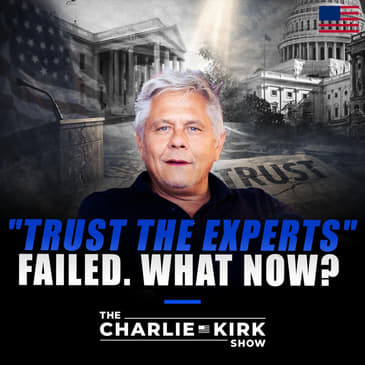
The present American political moment is defined by one word: Disillusion. All over the country, ordinary people have realized that the bureaucrats, professors, and other elites who dominated their lives were never acting in good faith and declined long ago. Novelist and thinker Walter Kirn examines the great turning point in American life in the 21st century, and ponders — what's next? Trump’s 2024 win, Kirn argues, wasn’t just political, but a reckoning for every institution in American life.
Watch every episode ad-free on members.charliekirk.com!
Get new merch at charliekirkstore.com!
Support the show: http://www.charliekirk.com/support
See omnystudio.com/listener for privacy information.
00:00:03
Speaker 1: My name is Charlie Kirk. I run the largest pro American student organization in the country, fighting for the future of our republic. My call is to fight evil and to proclaim truth. If the most important thing for you is just feeling good, you're gonna end up miserable. But if the most important thing is doing good, you'll end up purposeful.
00:00:24
Speaker 2: College is a scam, everybody.
00:00:26
Speaker 1: You got to stop sending your kids to college.
00:00:27
Speaker 2: You should get married.
00:00:28
Speaker 1: As young as possible and have as many kids as possible. Go start at turning point you would say, college chapter. Go start attning point. Yould say high school chapter. Go find out how your church can get involved. Sign up and become an activist.
00:00:39
Speaker 2: I gave my.
00:00:39
Speaker 1: Life to the Lord in fifth grade, most important decision I ever made in my life, and I encourage you to do the same.
00:00:45
Speaker 2: Here I am Lord, Use me.
00:00:48
Speaker 1: Buckle up, everybody, Here we go. The Charlie Kirk Show is proudly sponsored by Preserved Gold, leading gold and silver experts and the only precious metals company I recommend to my family, friends and viewers.
00:01:09
Speaker 2: All Right, welcome to the Charlie Kirk Show. I'm very excited about this next guest. I think he's one of the most impressive and important thinkers political commentators of our current moment, and not enough people in my opinion. I've told him this know about his thinking, his thought work, his writing, and that is Walter Kern. He's the editor at large of County Highway and he's co host of a This America Week. I think that's what it is. America this Week, that's what I got. It's going to make a little more sense. Yeah, America this Week with Matt Taybe, who's a great journalist in his own right, very accomplished. Walter. Welcome to the Charlie Kirk Show.
00:01:51
Speaker 3: I'm glad to be here. I'm really sorry that I postponed my last invitation while Charlie was around. It was the first Incas and I just wasn't sufficiently prophetic to know how short time was, and I thought I could do it later. And this is the visit that I'm doing later. And it's a sad one for me because I would have so wished to have talked to him.
00:02:17
Speaker 2: Yeah, I know. And you and I actually got to meet backstage at the Megan Kelly event here in Glendale, and I got to tell you I got to fanboy a little bit. I do that rarely, very rarely. But you know, I Blake understands this because we we we make content and there's only so much content you can consume. When you're making content as well, You've got you know you it's true. But America this week, which is funny that I got the name wrong. I listened to that often with you and Matt because I think you guys have a way of breaking down the news that's swirling, the big stories of the day, and so I wanted to have you on the show because I think, like I said in the intro here, you are an important thinker, You're an important I think distiller of these larger stories, and you make them make sense and you bring out the most important through line, right, So what do you really need to pay attention to? So this is we're going to have you on the entire hour here, Walter, and we just want to we want to make sense of what happened in twenty twenty five, maybe go back to twenty twenty four and back further, but we want to also look forward to twenty twenty six and in this new year that we've just embarked on a year that I'm grateful that we have. And so I haven't been so grateful for the passing of a year into the next as I have this when I will tell you that much. But so let's start at the big question. Help us make sense of our current moment. If you had to distill all of these disparate pieces, Somali fraud and Democrats are now pro maduro, and you know you've got cultural elements weaving throughout. What are you observing? What are you thinking about right now? Walter Kern, Well, let.
00:04:02
Speaker 3: Me, just for those who don't know me, introduce my point of view and my reasons for having it. I'm chiefly a novelist, and I was a literary critic and a kind of columnist for all kinds of magazines, from Time to the New Republic, Harper's Magazine, fairly liberal magazines. And I see us as living inside a story. There's a big story that goes back thousands of years, and there's a smaller story that goes back, you know, just years and then weeks and then days. And what I try to do is examine what's going on in terms of narrative, but not in the sense of pushing a narrative, as we you know, often see the mainstream media doing trying to get us to pick a preferred version of reality, but in terms of a real drama, a drama that involves the big things our lives, our freedom, our history as a culture, and the big events that affect it. So if I were to take this moment in time January twenty twenty six and tell you where we are in the current story as I see it, I would say we're at a first act break in which we suddenly look around and realize that not only were we right to distrust certain kinds of authority, you know, in the media and in government, you know, particularly I think under Biden, when we weren't even treated to the facts about his you know, health situation and mental condition. But due to this Somali fraud, which I think is just an aperture into a bigger story, we're suddenly realizing that we've been in the middle of a daylight theft, a theft of our resources, of our money, of our attention, of our ability to interpret things. Suddenly a new filter is dropping, and we're seeing that politics is not just about ideology, but it's about resources, and what I think is the ongoing cover up of a great diversion of our resources. So as Americans suddenly think about themselves, you know, paying the bills, paying their taxes, raising their families, in light of what seems to have been an almost full scale across the board. You know, we have the Minnesota example as a microcosm, but the macrocosmic example extends, you know, to the federal government and to many many states. We ask ourselves, are we in a society anymore that we can go on supporting? Just as the revolutionary colonists wondered if they could survive under the British we're starting to realize that we may be in a situation which the very legitimacy of our government, you know, and it's promises to protect us, to use our resources wisely to provide for the common welfare such as we believe it's necessary, are all empty, and in fact we've been in the middle of a con job. It's like it's I knew a big con man in my life, a guy who called himself Clark Rockefeller and who was a friend of mine for years, turned out not to be a Rockefeller, turned out in fact to be a murderer. And I remember the week after he was exposed in the news as a German immigrant who you know, had a whole other name and a whole other history than I had known him to have for ten years. I suddenly felt like I was floating in space. I was like, I don't know the guy's real name. All the stories he told me seemed to have been a cover up for a life of crime. I don't know his motives. I don't know if I'm in danger when I'm around him, because he was exposed as a suspect in a double murder, a grizzly double murder, many years before. And I went to the bank that day and I thought, I'm giving the bank my money, but I don't know where it goes after I hand it over. I was giving a key to a contractor who had to work on my house, and I said, but what if he is part of a burglary ring? And suddenly everything that I all the bonds of trust and all the expectations of reciprocity that go into daily living were broken. And I think we're in that as Americans. We suddenly looked around and realized we're on a spacewalk when we thought we were secure inside a spaceship.
00:08:50
Speaker 2: Hmmm, yeah, I really relate to that actually, because you know, given what we're going through with, you know, the trial for Charlie's assassin coming up, and you know, all these conspiracy theories swirling. It's it's sort of it suddenly occurred to me that, you know, listen, we went from don't trust the experts to never question the non experts. You know. It's like, but that's what you're talking about. It's like the legitimacy of the system when it becomes in question in such a massive way, especially following COVID and some of the revelations that we that we learned in that in the wake of that, it's it feels like there's no solid ground to place your feet.
00:09:34
Speaker 3: Imagining a drama in which you find out your wife is cheating on you, but then you find a letter and find out she's cheating you with your best friend, oh not only your best friend, three of your best friends, and you look around and you think, can I trust anything? How do I go forward? Where to what do I cling now in order to have solidity? And that's I think where we are.
00:09:57
Speaker 2: President Trump walked into a catch twenty two and taking office do nothing in America would be staring at a ticking debt bomb, the kind of crisis that could cripple our future. Instead, he's taken action with strong policies to slow the train and buy some time. But the effects of past administration spending are still working through the system, and experts predict dramatic price increases and market uncertainty. Trump is doing all he can, but no matter who's in office, protecting your retirement savings is ultimately up to you, and that's why many Americans are turning to real assets like gold and silver. Preserve Gold is our go to choice here at the Charlie Kirk Show. We use them because they make it easy to own physical gold and silver, even inside your retirement accounts, like an IRA or four oh one k now hear from Charlie in his own words.
00:10:41
Speaker 1: Preserve Gold is my go to choice for all my precious metal needs. They are the real deal and I recommend them to my friends, family and viewers.
00:10:48
Speaker 2: Get their free wealth Protection guide now by texting Charlie to five zero five zero five. President Trump is fighting for America's future. Now, it's your term to help protect yours. Yeah so, but yeah, how did we get here to this moment then, Walter, how did we get to a point where we can't trust the ground under our feet?
00:11:09
Speaker 3: Well? I think it's Act one because the Trump presidency and the re election of Donald Trump provided a kind of refresh to the whole cycle. You know, that was a point at which people who had anticipated and worked hard to bring about a result on the behalf of Donald Trump's election succeeded and sat down for a minute, reflected on their expectations and the promises that they felt they'd been made, and started over. And that first year of Trump is a pretty natural, a pretty natural time span to review. When it came in exactly almost a year ago, I think people were expecting justice. They wanted an immediate kind of redempt and even revenge for the sins.
00:12:03
Speaker 4: Of COVID, for the deep state hoaxes coup against him that had been going on for years, and for the deceptions that had come from the opposite party and from our own government in an attempt to unseat him.
00:12:22
Speaker 3: From the legal cases that were flimsy, to the charges about Russia and so on. So everybody got in their seat and they prepared for a gunfight at the Okay Corral and it didn't happen, And there was a lot of instant dissatisfaction, a lot of it fomented and aggravated by his enemies who want to create dissatisfaction in his followers. Look, he's not doing anything. Nothing will happen. He's not what he promised. He's not the gunslinger, he's not the agent of justice. He's just another politician. Well, I think that's just changed because both the revelations of this fraud which came, which are really an extension of the Dose revelations but with much more vividness, have suddenly come a spate of actions on his part, whether it's this Maduro raid, whether it's uh what we're seeing right now in Minnesota, which is a two thousand agent uh descent of federal force on what appears to be a criminal racket of almost unimaginable riches and and financial dimensions. And so this is the year of action. So combined with that sense of you know, floating and displacement that I described before, we're also getting a feeling, oh wow, we just shifted gears and the thing that we uh, maybe some longed for and felt frustrated that they hadn't gotten immediately. Is now going to come very swiat And uh, whether or not it's too late, whether or not it's you know, people have gotten too cynical to even believe justice as possible. I don't know, but it's an action time and he's trolygraphing it all across the board.
00:14:21
Speaker 5: I guess it's interesting me. As Andrew pointed out, you've been around a little longer than us, I.
00:14:26
Speaker 2: Do think if you want a reason for apta.
00:14:29
Speaker 5: Yeah, if you want to reason for optimism, you can look at in the late seventies, America was in malaise, as Carter called it. Even in the nineties, you get you know, Chuck Palinax is writing these novels about how everything's fake and terrible.
00:14:41
Speaker 2: In the nineties everything's awful.
00:14:43
Speaker 5: And of course, uh, maybe I'm only going off the movie here, but I know one of your books, Up in the Air is about a lot of the Onwei from. You know, since the corporate world is getting detached from human values and such, so is there anything to be said? This might just be a constant. Are things true worse now? Or maybe are we just psychologically worse because of the Internet.
00:15:04
Speaker 3: For example, Worse isn't a word I like to use, because the framing around better and worse is always changing. You can look at it in the short term, the long term, and so on. I think that things are actually starting to become hopeful because we've started to reach the roots of some of the problems that before we were confused, baffled and depressed by. I think people are starting to feel a sense of agency and comprehension about how these bad systems work and what might disrupt them. And I think they are moving out of a period of cynicism about bread by their I think, over exaggerated expectations of action into a sense that maybe it's possible for the bad guys to be defeated. We now know who they are, we know how their formulas work, we know how their crimes are set up, we know the scale of them, which I think is shocking people. And it's not Elon Musk anymore as it was last spring, and sort of putting himself out front. Is people like Nick Shirley and uh, you know the commoners who are suddenly picking up the pitchforks. But they're picking up the pitchforks in a pretty constructive way. You know, they're they're they're not baying for revenge, they're not rioting, They're not you know, just foaming at the mouth. They know where to look, and they're finding the evidence. They're gathering it, they're sharing it, and they are i think, preparing themselves for action. And they're and they're also persuading their neighbors and friends. I think, you know that all of this new critical information dropped over the holidays was a great opportunity for people to share it and discuss it and meditate on it. So just as January is when the New Year's resolutions kick in, I think this is kind of harmonically timed for people who want to kick into gear.
00:17:24
Speaker 2: Yeah, and you know, it's I have so many thoughts, Walter, you know it, I agree with you. You know, we had Jonathan Kieperman on just before the New Year, and one of the things that he was saying is similar in tone to what you're saying. He was saying, you know, the ship is pointed in the right direction for probably the first time in living memory, you know, and it's hard to communicate that to a base that is not going to be satisfied until you know, Fauci is strung up by his entrails in the public square, right, So you've got these exactly.
00:17:53
Speaker 5: Over always have to remind people because we secured the border overnight. That's such an unthinkably huge win that seemed impossible five years.
00:18:00
Speaker 2: Ago, one thousand percent. And uh, you know, and yeah, there's other there's other monsters to slay here. But you know, you talk about the sense of agency, and you talk about this new footing that we found in Trump and I couldn't help think about Charlie's reaction on election night, and I know what that was. I don't know if you've ever seen the clip, I have it ready to play.
00:18:20
Speaker 3: I haven't.
00:18:21
Speaker 2: It's it's a beautiful clip, and we were all here. What was happening in that moment was Charlie wouldn't let himself believe that it was possible until it was done, because he knew that he was He needed he needed to keep pushing, pushing, pushing, pushing, because the the agency that we had been robbed of in twenty twenty in twenty twenty two, it was we were almost had PTSD from it. And you could see this wiping away from him in the moment, and I think that's why it went so viral. Play cut two twenty three for Walter Fox News.
00:18:57
Speaker 6: Besides, Donald Trump is resident of the United States.
00:19:02
Speaker 1: We've got our republic.
00:19:06
Speaker 3: Let's go.
00:19:13
Speaker 6: Everybody should remember this moment. Look, I'm gonna I'm gonna echo Charlie from earlier. Remember where you were when this happened. Remember where you were when you realized that the UNI Party and all these you know, just the establishment. You said, it's time to actually participate. And look what you guys have done.
00:19:32
Speaker 5: And if anyone deserves to get tears in his eyes, it's Charlie.
00:19:37
Speaker 3: I think we all agree that.
00:19:39
Speaker 2: Something has worked harder than Charlie.
00:19:42
Speaker 6: We gotta we gotta hear some words here from you.
00:19:45
Speaker 5: Charlie.
00:19:46
Speaker 6: You put all this together, my man, Let's hear it.
00:19:48
Speaker 2: I am just humbled by.
00:19:51
Speaker 3: It's all got, It's all got, got along, got this is desk?
00:20:00
Speaker 4: Has it?
00:20:01
Speaker 3: Pennsylvania the beginning.
00:20:08
Speaker 2: That's a great clip, boys, so checked up watching it. Yeah, that's I just remember feeling like I couldn't believe it until it was true either.
00:20:17
Speaker 3: And let me tell you where I was on election night. I was here in Livingston, Montana, where I live, and I was at the Elks Club in downtown Livingston, population seven thousand. My magazine Slash newspaper, the one I help edit County Highway, which is an only in print paper, had announced on x that we were having a party at the Livingston Elks Club for election night. It was not a partisan party. Any of our subscribers were welcome, and so were people from town. Anybody who wanted to come was welcome. It was not going to be a Donald Trump celebration or Joe Biden's celebration. It was simply going to be a party for whoever showed up. Well, hundreds of people showed up. All we did was announced the invitation. They came from Europe, they came from all over the country. They were not all uniformly pro Trump by any means, By any means at all. We turned on the we turned on the news at about five. There were three TVs in the Elks Club, and then we started talking with each other and people started meeting for the first time and talking about how they got into the Livingston Montana which is, yeah, you know, a popular place to vacation, but it's also an obscure spot. Well, hours went by in which people were more interested in talking to each other than they were looking at the news. And I finally, you know, tip my head back up at the screen and I see Trump as one and I flashed back to twenty twenty one. I was alone in a cabin and I tweeted this. It was called Twitter. Then when there was that pause in the vote county, I said, uh, oh, everybody's now assessing. And by that I'm at democratic power structure is assessing what they need and how they're going to go get it. And then you know, we waited for a couple of hours. I'm on mountain time, and suddenly everything reversed, all the trends reversed. That's where the PTSD came from. Well in twenty twenty four, when I looked up and it seemed, you know, Trump had won, I thought, this isn't Trump winning. This is for all the closed churches, This is for all the closed businesses. This is for all the families that were set at each other's throats over minor things like masking and so on. This is for Russia Gate, which undermined the entire journalist structure of America, and enrolled them in a major lie as far as I'm concerned, which they at a certain point knew. This is for everybody who pretended they didn't realize we were being led by a zombie. It wasn't a win for Donald Trump. Charlie says, it was God that I think might be truer in this case than it is in many cases. I don't like to somehow think that God moves all politics. It's kind of sometimes a low affair. But in this case, it seemed like there was an opportunity to start climbing again, stop falling down the stairs, stop taking the blows, stop taking the whipping. And I felt in that room, even though there were a lot of people who weren't supporting Trump, a sense of refreshment. And I think getting ready for year two was what year one was all about. Even a fighter jet ney's a runway to take off. It can't just you know, there are some that can lift straight off. Most of them have to, you know, run along the ground before they can get airborne. And I think we're getting airborne at the moment.
00:23:54
Speaker 2: Yeah, I mean, would you even agree with that?
00:23:56
Speaker 4: Yeah?
00:23:56
Speaker 5: No, I think we saw that in the first Admin too. I would often tell Charlie, I thought the last year of the Trump administration was the best one, not ignoring COVID. All the background stuff was so good. It finally got appointments were really humminge. That's when you only got, for example, and they got anti DEI stuff.
00:24:13
Speaker 2: Year four, it.
00:24:14
Speaker 5: Was finally like, wait, we should do something on that. It was it just took too long. Now we're seeing a lot of stuff that we saw in year three or year four happening year one. And I think the valid hope is everything can accelerate even more in the years to come.
00:24:29
Speaker 2: They'll find more levers they.
00:24:31
Speaker 5: Can pull at the DOJ, at the State Department, at all these different agencies. There's a lot more awareness of what they're capable of doing. And I have I see every reason to be optimistic about what they'll be able to do in the years to come. On that front, at least, I think.
00:24:48
Speaker 3: A lot of people walked into Washington. I'm thinking of my friend Jay Baticharia at NIH and they had they'd flop. He'd flot COVID, he'd been a kind of COVID real list. These lockdowns aren't necessary. We're trying to stop something that's already spread too far. It's not a deadly disease if you look at the actual number of casualties versus those who've been infected and so on. Well, he came into Washington an honest man from Stanford University and represented, I think as much as purely as anyone, somebody whose voice had been suppressed, somebody who had been marginalized, and was going to represent real change. My conversations with him over the last year suggests and imply to me that when he got there, he suddenly realized that running a gigantic bureaucracy and being an honest person are a difficult pairing in this world, and especially in Washington. Getting getting people to explain to you how the workflow worked, getting people to, you know, not only say yes to an order, but perform on It was hard going through your staff and bringing real, outsider, honest energy to a situation which had been inert, obscure, self satisfied, often corrupt, takes a lot of time, and the other side was whipping up dissatisfaction with the pace. It was all a sudden. It was all of a sudden. Well, he's not delivering his promises fast enough the promises. They didn't want to see him deliver it at all. The other side was saying weren't being performed on quickly enough.
00:26:35
Speaker 2: It's a brand new year and a brand new opportunity to change the world for the better. This is one of our most important partners. It's easier than you might think. You can save babies by providing ultrasounds with Preborn together during this Sanctity of Human Life month, We're gonna save babies right here on the Charlie Kirk Show, to show the world that not only do we believe life is precious, but we're going to do something about it. Your gift to Preborn will give a girl the truth about what's happening in her body so that she can make the right choice. What better way to start this new year than to join us in saving babies. And twenty eight dollars a month will save a baby a month, all year long. A fifteen thousand and I know there's some of you out there that can do this. A fifteen thousand dollars gift will provide a complete ultrasound machine that will save thousands of babies for years and years to come, and will also save moms from a lifetime of regret. So start this year right by being a hero for life. Call eight three three eight five zero two two two nine. That's eight three three eight five zero two two two nine, or click on the preborn banner at Charliekirk dot com today. All right, So, Walter, you know, it occurs to me that so much of what we're talking around here is either a byproduct or a relative close cousin to this media industrial complex that was blown up at the advent of the Internet, and then it's been sort of this slow death march, you know, cable cutters, things, you know, we've been moving more digitally. That's created a massive opportunity for shows like this, creators like Charlie. Now myself and Blake are now public figures. So it's but but it's also created a conundrum for truth, for veracity. How do you verify things now we've got Ai. Blake was just telling me he couldn't verify whether it was.
00:28:26
Speaker 5: Crazy that story that you almost certainly heard where they blew up Chavez's mausoleum.
00:28:31
Speaker 2: Yeah, who goes shout.
00:28:32
Speaker 5: I can't I literally can't figure out if it's true or not because people are posting photos and other people are saying that is an AI fake photo, and I haven't been able to look in deep enough and it either could be true.
00:28:43
Speaker 2: So so what do we do in this landscape?
00:28:46
Speaker 5: There was another one someone posted a thread that was like, I work at uber eats and they're scamming everyone and like all their stuff, Like they're doing all this scummy stuff like special expedited delivery stuff that's all fake. It's just done to get more money out of you. And he had all this evidence and he sent it to a journalist and that was all AI fabrications. It was like an AI done hit job against a food delivery company.
00:29:11
Speaker 2: Well, all of these examples underscore the question I'm asking, and I haven't really distilled it in a very good good question yet, But will do you strike me as a guy who is, you know, very concerned with what is the ultimate truth? What is the deepest truth? What do we do when you have a population of three hundred and fifty million people, not to mention the global population all trying to suss through these different, you know, disparate information streams. How do you get everybody on the same page? How do you how do you get truth across What do we do in this in this landscape?
00:29:44
Speaker 3: You don't try to get everyone on the same page. That was an illusion in a grandiose, mythological white whale that was pursued in the age of television and mass media. It's no longer possible, and I don't think it's any longer desirable. One of the virtues of people not knowing what's real beyond the horizon is that they start concentrating on what's within their horizon. We have spent far too long in the United States knowing what's going on in New York, knowing what's going on in Los Angeles, knowing what's going on in Washington, and not knowing what's going on across the street. The difficulty of painting truth about what's going on around the world would cause us, I think, to slightly give up on it. Because there is a family, a house, a street, a town, a neighborhood, a church, a group of friends that needs your attention. I promise you those were the things that they tried to break up during COVID, when the power is that be tried to leverage that pandemic into permanent rule for themselves. They knew that their first strike had to be at your church, at your hardware store, at your grocery store, at your family, at your dinner table. Well, those are the things you have to reclaim first. You know. I have a friend who's very into solar magnetic storms and sort of doom and apocalypse around, you know, big earth changes and so on. And I thought to myself one night he'd warned me that there was a big objection of plasma from the sun and all the lights might go out. And I said, well, if the lights go out, where do I start? What do I do next? I figure out who I can trust, I figure out what I have to trade. I figure out, you know, what I can defend and who I'm going to defend. And all those questions that would come in the wake of a disaster are ones that we need to be asking right now, because the disaster is this, as you say, melting of reality and starting on first principles and starting at home and starting with the world you can look around and see with your own eyes is the solution. And then those pods, as it were, those cells, just like the body, The body isn't made of some big giant piece of you know, chicken nugget, it's got cells in it, little active, isolated engines that link up and work together. And at the cellular level, we have to I think, renew our uh you know, renew our contracts if we're going to have a bigger social contract. And this vain thought that everybody is going to be guided by some obelisk that beams truth down from the central authorities is does not serve us. Well, it causes it to ignore our own garden.
00:32:52
Speaker 2: M Yeah, I love, I love what you're saying. I mean we've been, you know, saying for a long time politics starts local, and you're kind of broadening that conversation to sort of say, look, we.
00:33:01
Speaker 5: Just got an email today someone who said they were inspired to get involved in Maricopa County politics.
00:33:06
Speaker 2: Great, Charlie, Well, yeah, absolutely, I mean that is that is where it starts, you know, Walter. I mean, I gosh, my problem with you, Walter is I want to talk about too many things and there's just not enough time.
00:33:20
Speaker 3: Well, I'll come back.
00:33:21
Speaker 2: I'm still bound by the clock here. I would be remiss if I didn't give you an opportunity to talk about what Charlie's assassination meant for our country. And you know, as I'm hearing you talk earlier, you mentioned Nick Shirley and this sort of new wave that is slowly kind of forming. You've got Dan Bongino that's coming back, and he's you know, he's saying he's going to wage war on certain you know, influences within maybe the conservative movement and beyond. I just think it's interesting. I believed, in my whole heart, especially after we got past the memorial, that there was going to be this sifting of movement. There was going to be this like this changing of the guard, sort of a new out of necessity, this newness that was going to be created out of the chaos and the loss. And I just so, without feeding you answers, I want to hear what you have to say. But I believe that there is something that we are observing. It it will not become clear to us until some time now. But what what did losing Charlie? What did you observe? What did it mean? And where are we going next?
00:34:29
Speaker 3: Well, to be very cold about it and systematic, as though I don't have a heart. A power vacuum develops when someone of Charlie's magnitude and competence and gifts is lost, and in that power vacuum, all sorts of opportunistic creatures come rushing in and they live by the law of the jungle. How much space that has been left vacant can I occupy? How securely can I occupy it? How can I find off competitors? And that was a frankly ugly process to watch, and I guess it still goes on to some extent, But in another way, it's a tribute to how big a space he occupied that it was, that it left so much vacant for so many sort of competitive Darwinian struggles over power and attention. But I think the real meaning of the thing is the meaning of the moment after that I felt and others felt, which was someone has just given in what it was not understood as a war but suddenly looks like one because of the combatant falling given everything. And he's given everything in the purest way. He you know, he wasn't a man behind us a plexiglass. He was someone openly sitting with a square stance before a crowd of his fellow Americans, taking all comers, listening and speaking back. He was the avatar of openness he and that that openness was rewarded with destruction. Was I think a shock that showed us how far we'd gone, how far we'd fallen. You know, when when when truly uh, you know, when demagogues and people who are you know, have armies behind them and so on, are assassinated, well, you know that they kind of lived by the sword. But to live, but to live by the word and die by the sword is a whole other thing. And to watch someone who lived by the word die by the sword was a terrible moment, and it affected me deeply. I'll be honest with you. I'm a little old for you know, campus activism and and a lot of the other things that try well.
00:36:52
Speaker 2: Yeah, but but you know I was.
00:36:55
Speaker 3: I was. I was aware with him, aware of him in my peripheral vision, and suddenly when he moved to the center of my vision in this terrible way, terrible way, I saw the best and worst of America in one lightning flash. I saw someone who still believed that freedom of speech, a sort of candor about your spiritual and religious beliefs in dialogue with people who maybe flat out opposed them can still lead to a happy ending that faith lives on. It was liberated from his body, but it spread everywhere, and I think it's starting to reassemble itself after a period of darkness. I mean, everybody was traumatized, whether they know it or not. And some people aren't their best under trauma. You know, they become very selfish or even kind of evil. But there is a waking up to the fact that this was a good force. It was almost too good for the world. It was dispersed by hatred, envy, resentment, jealousy, perhaps, I mean it won't.
00:38:16
Speaker 5: Think really, I think it is the best thing about this horrible tragedy that I've brought up is Charlie truly was cut down at his absolute peak, and so in a sense, his peak does.
00:38:32
Speaker 2: Live on forever.
00:38:33
Speaker 5: He's always as he was on that campus in throughout the year twenty twenty five. He was at his peak form in terms of argument, he was at his peak form in terms of how well he lived his life. He was getting better and better, and there's something very there's something very powerful about that, and that's a lot of the power of martyrs is the way they can endure forever. You never have to see that make mistakes or get old or lose their fastball. They're always in that pristine form.
00:39:05
Speaker 2: Yeah, Blake. Blake helped write the eulogy that we published at t posa dot com the day after, and I still don't know how you wrote it, Blake. When Charlie died, I basically I was shell shocked, like the world didn't make sense. I remember trying, you know, I was supposed to get out a statement, you know, about Charlie. We had received word that he had he was gone, you know, because there was some confusion about that, and I remember trying to write, you know, whatever it was I was supposed to write, and President Trump ended up true socially that Charlie was dead, and I remember just being so relieved. I mean, I couldn't put one foot in front of the other. It was like, you know, it was like that scene out of Saving Private Ryan, where it was just you know, it's just everything was moving in slow motion, but my body couldn't I couldn't make it function. So the fact that Blake in the in the middle of that night got the words out. But one of the things he said was that, you know, Charlie will will never grow old. You know, we'll never see him, you know, lose lose any of the grandeur and the glory of his youth. And I guess in some ways this far removed from it. I feel comforted in some ways that I always get to remember him that way, but I hate that I have to remember him too. So it's a bittersweet feeling. But I know that he's gone and there's no bringing him back.
00:40:39
Speaker 7: This is Lane Schunberger, chief investment Officer and founding partner of wy REFI. It has been an honor and a privilege to partner with Turning Point and for Charlie to endorse us. His endorsement means the world to us, and we look forward to continuing our partnership with Turning Point for years to come. Now hear Charlie, in his own words, tell you about why REFI.
00:41:00
Speaker 1: Tell you guys about why refight dot com. That is why are e f y dot com? Why refi is incredible private student loan debt in America, told us about three hundred billion dollars. Why refy is refinancing distress or defaulted private student loans. You can finally take control of your student loan situation with a plan that works for your monthly budget. Go to yrefight dot com. That is why refight dot com. Do you have a co borrower, why ref I can get them released from the loan. You're going to skip a payment up to twelve times without penalty. It may not be available in all fifty states. Go to yrefight dot com. That is why are e f y dot com. Let's face it, if you have distress or default the student loans, it can be overwhelming because of privacuit loan debt. So many people feel stuck. Go to y refight dot com. That is why r e f y dot com Private student loan debt relief y refight dot com.
00:41:48
Speaker 3: Well, you know, I I don't mean to be disputatious or niggling, but I don't think he was at his peak. I think I agree.
00:41:57
Speaker 2: I actually agree with you on this.
00:41:58
Speaker 3: I think he was just toward his peak. He was on an obvious track. He had momentum. He was like he was like a mountain climber who can suddenly see the top of the mountain, the top of everest. They've got their pack and you know they're going to get there. You know they're going to even get there or beyond and suddenly it's over. What that You know that happens to poets, rock stars, saints and a lot of people who die young and yet inspire us to pick up their pack and carry it. And I think we're going to have to go where he was going.
00:42:39
Speaker 2: I totally. I mean, a lot of people, you know, speculate was Charlie going to be president? Who knows he was.
00:42:46
Speaker 3: The kind of he was the kind of guy what I love about him. What I love about him was that he seemed like he still had the ability to change, He still had the ability to learn and to formulate new conclusions. Hey, he might have gotten to age thirty five and decided I don't want to be the President of the United States. I want to be X or I want to you know, write a book or whatever it was. I mean, though, he was dedicated to action and the turning point I think is most impressive to me in terms of getting stuff done. Like turning point, people wake up every day and they achieve goals that are small in the short term and huge in the long term. And we're not a society like that anymore. To see anybody be effective anymore, especially in a large scale movement, is astonishing, you know, and especially without tons of money. But I think that you know, he uh, I don't know what my original point was. Actually I strayed a bit there, But I don't know how he would have ended up. I only know that wherever he chose to go, he would have gotten there, and he would have gotten there superbly.
00:43:58
Speaker 5: What if he wasn't Weatherding, What if he'd really gone for becoming a college football coach?
00:44:03
Speaker 2: That was what you said.
00:44:05
Speaker 5: He always said if he got tired of gave up, he would just quit and coach college He would.
00:44:08
Speaker 2: He would joke at our chat all the time. He'd be like, fine, I give up, you know, I quit. I retired. He's like, I'm gonna go coach college football at.
00:44:15
Speaker 5: Universe where people are like, did you know that that college football coach.
00:44:18
Speaker 2: Used to be a political up? Exactly? Walter, You and Matt have a great show. I want to make sure people know where to find it and how to follow you on that stuff. We still have about six minutes here, but I really really love your guys's content there, so please like, what are you doing with Matt and what should people know about what you're up to.
00:44:39
Speaker 3: So Matt Kayubi is a muck raking reporter from the left. Really, I think he was at his greatest fame during the Occupy Wall Street years, as he basically took on high finance and showed they had committed crimes all through what we now call the financial crisis. But like me, sometime around the first year of the Trump resident's first Trump presidency, he started to see his colleagues fall for this ridiculous and unverifiable story of Trump being a Russian agent, and it alienated him from his cohort, as it did me. I was probably a little more to the right than Matt Taibe or a little more to the center. But we both found ourselves after a few years feeling deserted by are supposedly principled and supposedly conscientious colleagues, and so we came together in a sense of in the sense of both being stranded by not getting on the Russigate train. And what we try to do on our podcast that's a huge sports fan and is give you a sort of skybox play by play, a big picture nearration of events as though they were a game. Now we realize they're not a game, but we try to treat them as one with a lot of humor, with a lot of you know, mischief and kind of pop cultural reference, so that the heaviness of things doesn't destroy people. It's important to keep a light spirit. And when you talk about black pilling, absolutely, when you talk about black pilling, you're talking about the thing that bothers me most, and people who want good things to happen, Despair is a sin, and spreading despair is practically the sin that they tell us is the unforgivable sin against the Holy Spirit. When you try to destroy someone's spirit with pessimism, with cynicism, and you know, a little bit of that goes a long way. But when you try to give them the feeling that nothing you can do, nothing you can say, and no one can appeal to will it ever help you? It's lost and you're just living out the clock on this earth, feeling the pain and feeling the depression, you may as well go kill yourself. Well, that for me is that for me is the enemy in all respects. Because as long as you have a lightness, as long as you have a flow, as long as you have sort of a light on in your heart and in your mind there's a chance for change, but that is absolute death. And the black pill people who tell you know you've been betrayed again, don't expect anything. And they think they're being grown up, and they think they're being sophisticated, but what they're really doing is sending you to an early grave. And what they're really doing is opening the way for the true cynics, the psychopaths, the powermongers, to own you forever and enslave you. And so what Matt and I do is, if anything, an assault on the black pillars, you can still laugh no matter how dark things get.
00:48:05
Speaker 5: All right, Well, before we go, if you had to recommend one of your books to people, good questions who are watching or listening to this, So what would you say?
00:48:15
Speaker 3: You know, funny, there's a book with a terrible cover right there called Mission to America. Look at that terrible cover. I mean they did not even have AI as an excuse. And it's a story of it's a story of two missionaries who grow up in what's basically a cult isolated in the mountains of Montana, which hasn't gotten out into the world for one hundred years, and it's become so inbred, literally genetically inbred, that they're sent out in a van to try to get female converts in America two thousand and five. And they leave their mountain valley having never watched television, you know, being as innocent as Martians practically, and they hit the road to bring people to their beliefs system. And it's a story about faith. It's a story about modernity versus you know, the old ways. And it's a story about vulnerability, because I mean, the first time they sit down in a motel to turn on TV, they're there for eighteen hours. You know, they have no they have no immunity to it. I try, I try to show modern America from the point of view of people who aren't immune to its seductions, and it's you know, it's poisons and so on.
00:49:28
Speaker 2: I love that the way you describe. I've been describing things a lot like this lately, about we build up this immunity to things. And next time I have you on, Walter, I want I feel like since Trump came down those golden escalators, we as a country have been building immunities to the fake news, to the to the propaganda, to PsiOps to color revolutions, to hoaxes. And I would be super curious to have a conversation in depth about the immunities that we're growing now, because I think when we're talking about black pillar immunities, we're talking about this vacuum of this laws of the jungle, we're sort of building immunities to that. I have to believe good will win out. Truth will win out. But Walter, it's been an absolute pleasure.
00:50:12
Speaker 3: Oh, we know it will in the end. It's it's the short term we're working.
00:50:17
Speaker 2: I know exactly the midterms. That's what we're worried about.
00:50:20
Speaker 3: Walter.
00:50:21
Speaker 2: Yeah, and I want to talk to you next time about your conversion to faith, because you you were not a theist and now you are, and I would love to hear more about that. You've even in our calls, uh, Walter, that we had after we met you with Megan's, you've you've hinted at it, but I haven't got the details. So well, Walter Kerrn, the Great Walter Kerrn, will have you back again as soon as you'll have us.
00:50:43
Speaker 3: Thank you so much, thank you, and thank you playing.
00:50:52
Speaker 7: For more on many of these stories and news.
00:50:54
Speaker 3: You can trust go to Charlie Kirk dot com.