00:00:03
Speaker 1: My name is Charlie Kirk. I run the largest pro American student organization in the country, fighting for the future of our republic.
00:00:11
Speaker 2: My call is to fight evil and to proclaim truth.
00:00:14
Speaker 1: If the most important thing for you is just feeling good, you're gonna end up miserable. But if the most important thing is doing good, you'll end up purposeful. College is a scam, everybody. You got to stop sending your kids to college. You should get married as young as possible and have as many kids as possible. Go start at turning point, you would say college chapter. Go start aturning point youould say high school chapter. Go find out how your church can get involved.
00:00:37
Speaker 2: Sign up and become an activist.
00:00:39
Speaker 1: I gave my life to the Lord in fifth grade, most important decision I ever made in my life, and I encourage you to do the same. Here I am.
00:00:46
Speaker 2: Lord, Use me.
00:00:48
Speaker 1: Buckle up, everybody, Here we go. The Charlie Kirk Show is proudly sponsored by Preserved Gold, leading gold and silver experts and the only precious metals company I recommend to my family, friends and viewers.
00:01:09
Speaker 3: All right, welcome to the Charlie Kirk Show. It is February twentieth twenty twenty six. Today's lead is sometimes you have to come up with a lead, and sometimes the lead finds.
00:01:18
Speaker 4: Sometimes it is thrust upon you with great anticipation.
00:01:22
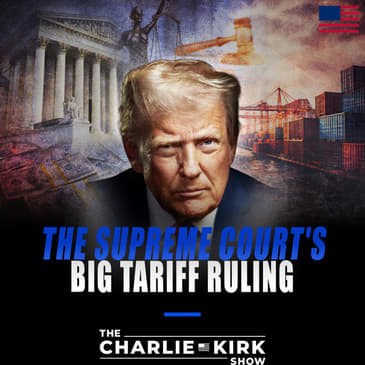
Speaker 3: And that is of course the tariff decision that has come down from the Supreme Court. Now we spent the morning pouring over this. We've got Jonathan Carney from Breitbart, who's kind of the resident tariff expert. He's going to be joining us any moment now, so I'm told. But this was a blockbuster decision that we had been waiting for now just to set the terms. This was any tariff that had been established by President Trump under what's called the IEEPA, which is essentially an emergency power that the president has been given by the Congress and he but it's never really been you to do tariffs. Now it's predecessor what was it called? It was like Training with the Enemy. Tradings with the Enemy Act was used one time in a limited fashion ten percent tariffs by President Nixon. So it's not completely without president but it the that law had been replaced by the iee PA and it had never been used by president in the way that President Trump was using. They have struck down President Trump's ability to do it. But there's so many wrinkles. So this is we should just just to set the stage here.
00:02:29
Speaker 4: This is mainly the this is the Liberation Day tariffs that were announced with great fanfare, and some of the reciprocal tariffs, yeah, about about ten months ago, as well as other terror the reciprocal tariffs. He did also a lot of what he was doing where you know, you'd see the president goes on truth social and reacts to something and says there will be a one hundred percent tariff on Canada or China. Until this has changed, a lot of those really aggressive tariffs that he would announce on short notice that's coming through this bill, the ie International Emergency Economic Powers Act, and what the Supreme Court ruled today, and it is a six to three ruling, so that involved of the justices who'd be considered more on the right. That we lost Roberts, we lost Gorsich, we lost Amy Comy Barrett. So that's two of President Trump's repicks in fact. And they said in essence that basically that the president's claim of power was too large, that the bill is not intended by Congress to allow the president to declare any emergency and thereby impose any tariff. So they imply, even in the ruling that if it had been if it had been more concrete, if he'd said these tariffs are maybe lower or for a more limited duration, temper probably would have held up stronger. They seem to take issue with what they say is the president claiming almost total unlimited authority, you might say, over the ability to regulate international time trade.
00:04:00
Speaker 3: And I think we have John Carney, Yes, we do, we have John. Welcome to the show. I know you got a busy morning. You're in hot demand this morning. With the tariff ruling, we've kind of set the stage here while we're waiting for you. The question then becomes what happens next. I've seen rumors that President Trump has a backup plan. Okay, so he can't do tariffs under ie E PA. We could disagree with that, We could agree with that. What happens next?
00:04:28
Speaker 5: So there are a number of plans. There's actually about six statutes that just on the face of themselves.
00:04:36
Speaker 6: Allow the president to impose tariffs.
00:04:40
Speaker 5: The reason why they wanted to do under AEPA, though, is there's a lot more.
00:04:45
Speaker 6: Procedural hurdles to these ones.
00:04:48
Speaker 5: So a lot of them you have to do multi month studies, but usually by the Commerce Department.
00:04:55
Speaker 6: Sometimes they have time limits.
00:04:57
Speaker 5: They can only be imposed for a little bit, so it'll be more complex. I've proposed something I call IASIS, which is a licensing regime that would actually link the ability of other countries to export to the US to a license fee that would totally be allowed under AEPA. So this is another thing that they can do under a EPA that the Administration hasn't yet fully considered. A big question to me is what do the other countries do? Remember a lot of them have lowered their own trade barriers, lowered their own tariffs in response to our threatening to raise tariffs. So the question is do they go back on this. If they do, I think that actually will provide a reason for Congress to actually give this authority to the US president. That's the clean way to resolve all this. Congress needs to enact Presidential Tariff authority tomorrow.
00:05:58
Speaker 3: Frankly, yeah, I think that's interesting. So you're saying you could enact in a license fee, which would essentially accomplish the exact same goal here. It would just be under a different name and That's kind of one of the pushbacks that Kavanaugh, who wrote the descent here, which is really fascinating. He basically says, although I firmly disagree with the Court's holdings, because he was the dissenter, the decision might not substantially constrain a president's ability to order tariffs going forward. That is because numerous other federal statutes authorize the president to impose tariffs and might justify most, if not all, of the tariffs at issue in this case. And then he goes on to list, which was I found interesting because he's basically giving a roadmap here. Those statutes include, for example, the Trade Expansion Act of nineteen sixty two, section two thirty two, the Trade Act of nineteen seventy four sections one, twenty two and two one, and the Teriff Act of nineteen thirty section three thirty eight. In essence, the Court today concludes that the President checked the wrong statutory box by real relying on AIPA rather than another statute to impose these tariffs. I it's so okay. I guess if we're going to go by the letter of the law, not by the spirit of it, this is probably in some ways you could consider the correct decision. But it's also bizarre and sort of insane, John, because there's other reasons to believe that he could ban all imports. The court is concluding he could just go to China. He could do that, We're gonna ban all imports from China, but we can't tear if you a penny.
00:07:28
Speaker 4: In fact, he seems to have more authority to do that even if he was just saying I am banning entire industries from coming into America.
00:07:35
Speaker 6: He could right, Yes, absolutely, that's a big problem.
00:07:39
Speaker 5: Kavanaugh actually points this out that there's that the majority decision basically says Trump is allowed to ban whatever he wants, but he can't oppose a one dollar tariff. That really doesn't make sense. I don't think it's correct as a matter of law. I think that the Kavanaugh Alito Thomas had the right view of the law in this.
00:08:02
Speaker 6: But it is the law.
00:08:03
Speaker 5: Now, you know, this is what the Supreme Court says. So the administration will look to all of these other powers, and.
00:08:10
Speaker 6: Believe me, they already were Everybody heard.
00:08:12
Speaker 5: The way that oral arguments weren't went. So this decision hasn't come to a as a surprise.
00:08:18
Speaker 6: To anyone. In fact, a lot of people.
00:08:20
Speaker 5: I mean, I would say the consensus was that the tariffs, at least all.
00:08:25
Speaker 6: Of the tariffs weren't going to survive.
00:08:27
Speaker 5: If there's any surprise, it's just how this is pretty you know, just says the president can't do this at all. There's a pretty blanket slopdown of the AEPA terffs. But like I said, even under AEPA, they could ban things, they could.
00:08:40
Speaker 6: Put license fees on things. So you can't use the magic word tariff.
00:08:45
Speaker 5: You know, we'll find another way to protect American Indusjon.
00:08:51
Speaker 4: The online world moves fast, and it's moving even faster these days. That's why TikTok approaches teen safety with families in mind from the start, because discovery and creativity are both wonderful things, but it's important to make sure that safety comes first as well. On TikTok, teenagers have over fifty built in protections right from when they join. Accounts routines all start private by default, They're not open to the entire world, and for those under sixteen, direct messages are turned off. Only their friends can comment on their videos. And that kind of approach matters because feeling confident and comfortable about these platforms your teenagers are on shouldn't mean digging through a bunch of menus and trying to set everything up yourself and worrying that you got it wrong. TikTok is taking a proactive approach. Their protections are built in from the moment those teenagers join, so that safety and peace of mind for parents is there right from the start. All of this is to say when safety comes first, discovery and creativity can follow without fear. Learn more by going to TikTok dot com slash guardians guide. That's TikTok dot com slash guardians Guide.
00:10:01
Speaker 3: John Carney from Breitbart major authority in hot demand. I called him early, though, and I got him as soon as this came down. I said, John, I need you, and you're like, I think I can make that work. All right, So what happens to the revenue?
00:10:15
Speaker 5: I will say, you know you, I'm very happy that you reached out right away, because you did get me. You were you were first, right after my own boss, Alex Marlowe.
00:10:26
Speaker 3: Well listen, he's got a wait, he's got a wait. We have business to attend you, So tell us about the revenue. Where's it going?
00:10:34
Speaker 6: So that remains to be seen.
00:10:36
Speaker 5: So we won't get any more revenue from then IIPA terriffs.
00:10:39
Speaker 6: So that's done. Those are coming off the books immediately.
00:10:42
Speaker 5: What happens to the say, call it somewhere between one hundred and fifty two hundred billion dollars that have been collected under these terps. So that's only, by the way, part of the revenue we've collected under jo I.
00:10:53
Speaker 3: Was gonna say say that number again, John, because it's about three hundred billion all in. How much was under AEPA.
00:11:00
Speaker 5: Between one hundred and seventy and two hundred like, call it one seventy as a good estimate.
00:11:05
Speaker 6: So some of that.
00:11:07
Speaker 5: May have to be refunded, but we don't know that yet. The Supreme Court's decision is actually totally silent on what happens next. Capito is like pretty critical of that. He's like, this could be a mess. It could actually take years of litigation because you'll have to prove that you paid the tariff, that you paid the tariff that was a NIPA tariff and not a different tariff, and there would be other considerations.
00:11:31
Speaker 6: It's not clear. You know that the money's going to go away right away.
00:11:37
Speaker 5: Uh, and so you know it'll that money won't come out of the US treasure. I'd say for quite a while. If I were a business entitled to the tariffs, what you what you did is you you basically made sure you had records showing exactly which tariffs you paid so that you can then come to the court later and say, please rec fund these.
00:11:58
Speaker 6: But it is going to be a mess.
00:12:00
Speaker 3: So we've got that. What number is that? Guys? I want that that that's the uh the refund quote from Kavanat, Yeah, get me that. Get me that. Well that this is so by the way, there's I believe this is Wharton School has done this. Yeah, Wharton UPenn has done that. This graph is an estimate of AIPA revenue and it has it at about one hundred and sixty four point seven billion a monthly revenue of twenty point eight billion dollars and they have it cumulative through January, so it's about it maybe is about a month delayed, so you're probably right about one seventy one seventy five on the I.
00:12:36
Speaker 6: Want to say, I just did that off the top of my head.
00:12:39
Speaker 5: So, uh, the fact that the Wharten School came in almost at the same number.
00:12:43
Speaker 6: I feel pretty good about that.
00:12:44
Speaker 3: That's pretty good, John. So you think this is going to be litigated, and apparently Wharton's School school is saying that importers generally have one hundred and eighty days after goods are liquidated to protest and request refunds from US Customs and Border Protection. So right, So the process is people paid the tariffs, they had to have.
00:13:06
Speaker 5: Submitted a basically a piece of paper saying I don't think I should have paid that tariff.
00:13:13
Speaker 6: One unfortunate think about that is, Look, the.
00:13:16
Speaker 5: Really big importers, big companies Walmart, the international companies that import stuff into the euth They've already filed that paperwork. It's really actually going to be the small guys who really get kind of messed around with here because they they probably didn't file the paperwork and or some of them didn't. Luckily, Look, you get one hundred and eighty days. So some of the tariffs that have been paid will still be eligible for refunds. But we again, we don't know what the refund process will look like. As far as I know, we've never had anything missed big where you know, you know, one hundred and fifty billion dollars, one hundred and seventy billion dollars is potentially being refunded to the people who you know, who paid the tariffs in the first place.
00:14:03
Speaker 3: Yeah, it's it's a it's I think Kavanaugh refers to it as a mess.
00:14:08
Speaker 4: Just he do he Yeah, and he even flags you know, there's issues a lot of imports probably already passed costs on to consumers at some point here, but now you know they can double dip from that. What does it do to all of our trade dealers with other countries that were premised on these tariffs.
00:14:23
Speaker 3: Do those stick around?
00:14:25
Speaker 7: Uh?
00:14:25
Speaker 3: He really?
00:14:26
Speaker 4: Just the truth is, it seems we don't know what is going to be unleashed by this.
00:14:30
Speaker 6: This is I will say.
00:14:31
Speaker 5: That if other countries start to start to say no, no, now we're taking back. We're going to raise our tariffs again, We're going to raise our trade barriers, that will at least be a moral victory for Donald Trump because he'll be able to say they did this because I imposed the tariffs. Now they're taking it away because the Supreme Court took away the tariffs. And that should be persuasive to Congress to actually absolutely come back because this Remember the court here did not say the president could not do this under the constitution.
00:15:02
Speaker 6: They said that the statute didn't authorize it.
00:15:05
Speaker 5: So Congress with one word in certain tariffs into a EPA, just one word amendment, and Trump would have the power to do it.
00:15:14
Speaker 3: Yeah, it's it's literally because in some of the oral arguments, as you mentioned, they just said, well, it doesn't say tariffs. So that's the whole point, even though like in the spirit of the law, it certainly indicates that he would be Now so just to read exactly what Kavanaugh said, I got the quote here. In the meantime, however, the interim effects of this Court's decision could be substantial. The United States may be required to refund billions of dollars to importers who paid the IEPA tariffs, even though some importers may have already passed on costs to consumers or others. So, you know, their whole argument was that Americans absorbed these taxes. That is probably not one hundred percent truth. It's probably about an eighty twenty import to American consumers twenty percent. But if let's assume that they were right about that. Then Americans are basically going to get double tax because of this this court decision, which is hilarious. He goes as acknowledged an oral argument. The refund process is likely to be a mess, last word to you, John.
00:16:13
Speaker 5: And it will a lot of this money is actually going to leave the US altogether because a huge amount of imports are actually done through foreign companies and their US affiliates, So it's actually going to be payments going to foreigners.
00:16:25
Speaker 6: As well, which is really unfortunate.
00:16:27
Speaker 5: It'll be a drag on the economy, and like like like Justice Capito said, it's going to be a mess going forward, but I imagine that will get very soon Trump announcing the new.
00:16:39
Speaker 6: Tariffs because they've been working on this.
00:16:41
Speaker 3: They have Conde exactly. Trump has a backup plan. Everybody, he has a backup plan. I would also say that we have just gotten word that he has a twelve forty five Eastern press conference that we're going to be looking for on this tariff decision. So twelve forty five, stay right here, we'll have it on real America's voice. John, I know you gotta go. You've got you got Marlowe. Uh probably screaming at you already, So tell him hi for us, Thank you for making it here. We know you got a busy morning. Jonathan Carney, Breitbart Economics editor. There you go, all right, So.
00:17:14
Speaker 4: We got an email. Kathy asked, is the possibility of refunding tariffs to the importers? A lot of them have passed costs onto consumers. Do the consumers get a refund?
00:17:22
Speaker 3: Also? The answer is no, nope, nope, No, it's consumers. The man gets screwed. This This is here's the thing. Cavanaugh went through trial by fire, the whole what was her name, uh, Betsy?
00:17:37
Speaker 6: Oh?
00:17:38
Speaker 3: What was Christine Blozi Ford? Christine Bla two front doors? She the whole thing, you know that where he went through a trial by fire. The guy's got steeled down his spine. Now everybody doubted him at first. Meanwhile, Gorsic in ACB, two other Trump appointees going against the president. Listen, you could make the argument that per perhaps this was textually just the right decision by the letter of the law, but it's there's a measure of insanity to it, because you could just ban all the imports. You can't tear if from a single Penny. If you knew Charlie Kirk, you knew this. He was a connector. Charlie believed in finding good people and connecting them with other good people that he cared about. When someone truly took care of him, Charlie would never hesitate to recommend them. Andrew Delray and Todd of Akin were two of those people. They personally helped Charlie and Erica with their mortgage needs, and Charlie trusted them completely. Whether it was a home buyer trying to qualify or someone needing to consolidate debt or see if they could get a lower rate in payments. These were the guys Charlie sent people to and right now, timing matters. The market has shifted and rates have come down. There's more inventory, bidding wars have cooled, and buyers finally have more control. But that window won't stay open forever. As rates come down, competition will return. That's why being prepared now is so important. Andrew and Todd at Union Home Mortgage over forty years of combined experience and guide you through the process clearly, no pressure, no guesswork. These are the people Charlie trusted, and they're the people you can count on.
00:19:09
Speaker 1: Reach out today to get approved for mortgage financing with Andrew and Todd at Andrewintodd dot com or called Triple eight Triple eight eleven seventy two with forty years of experience. They really are the experts and they make it easy because they keep everything in house called Triple Light Triple eight eleven seventy two or go to Andrewintodd dot com. That is Andrewintodd dot com.
00:19:30
Speaker 3: Joining us now is Mark Halprin, a great, great political analyst and commentator and a friend of the show. Mark, Welcome back to the show. Lots to discuss this morning thoughts with the you know, the Supreme Courts ruling on President Trump's use of tariffs. I have all this other stuff I was planning on talking to you about, and then this came across the wire. Give us the political implications. I know there's questions about canny Still do te ariffs? Can you use other mechanisms? What do we do with the revenue that came in? What happens with that? Is it go to a lower court, et cetera, et cetera? Politically? What does it mean?
00:20:08
Speaker 7: Well, first, saw, let me just tip let I miss you. Guys, haven't heard from you in a while. Haven't heard from you in a while. Good to hear from you.
00:20:15
Speaker 3: I'll call you every week. Mark we'll have you. We'll just make a standing in but good.
00:20:20
Speaker 2: I'd like that.
00:20:21
Speaker 7: So my first thought, just trying to be in the mind of the president, is he's going to be super annoyed at the Chief Justice.
00:20:27
Speaker 2: But he didn't pick the Chief Justice. He inherited it.
00:20:30
Speaker 7: But two of the three justices the president put on the court voted against him, Gorsicch and Cony Barrett. So my suspicion is the President probably will vent that on truth social But the larger issue, more than that, as you point out all the mechanical things involving terrorists which are super important, is this is the first time the court's really weighed in substantively on the president's powers. They've done some procedural things, but they've ruled against him. And there's a ton of pending cases in other areas, not about tariffs, where if the same justices or even a five to four vote against him decide they're not afraid to vote against Donald Trump. Right, everybody likes to pretend these are legal decisions they're political almost always. It's really disheartening because they should be legal, but justices are pretty political, not just the current ones, not just the ones picked by Republicans or the ones picked by Democrats. So if I were the president's political team, I'd be worried that they're in the future when some of these other cases come up, that they may be on the short end of five to four or six to three decisions that will really be impactful for what the president can do.
00:21:36
Speaker 3: Yeah, I agree with that, and it also one of the thoughts I had this morning was, you know, we hear about Democrats wanted to pack the courts, wanting to call it a lawless court, and here you go them doing exactly the opposite of what the President was lobbing for. Will that inspire any trust? I don't think so. They'll still pack the court go aheadlic Well, I I just real quickly.
00:21:55
Speaker 4: I would concern the other way that we know the President was very invested in this tariff case. I don't know that it would be an exaggeration to say it was his top personal brands, top priority. He's really fulminated on truth and in other venues about the importance of this case. Should there be any concern among people that the president might up rhetoric on Actually I don't need to.
00:22:20
Speaker 3: Listen to the Supreme Court on this sort of thing. Would do you think there's any hazard of that?
00:22:24
Speaker 7: I mean, I know that's talked about a lot, particularly on the left and amongst others. I just don't think so. I just don't see any indication. There have been a few things, like some of the immigration orders, like the planes that were in the air on the way to Venezuela, where people have sort of tried to suggest that that was lawless and violation of court order.
00:22:40
Speaker 2: It's a close that's a close call. But I don't think so.
00:22:43
Speaker 7: I'll tell you though, the other political thing that's that's where this decision is in the President's interest. And I don't mean give a short shrift to your question, but but I hope I sufficiently answered it. But you know, before the Supreme Court decision, there were three big pieces of economic news that were going to I think, really do harm to the markets. And for if you count what was happening in the last day with oil markets because of boys a betterran. First was yesterday, this firm Blue Owl Capital made some decision about about investors and money that really were spooking people and getting people to talk about is this the first sign like we saw in two thousand and seven leading into the economic crash of two thousand and eight. Then this morning we had two horrible economic numbers for the country and for the president politically, a lower than expected GDP number by a lot, a higher than expected inflation number.
00:23:36
Speaker 2: I will never know.
00:23:37
Speaker 7: What the stock market would have done today had we not had the Supreme Court decision on terrorists. But as I look down now, the Dow's up, and the Doaw's likely to end really far up because well, this is bad news politically for the president. The markets love this decision, and so if you talk about the implications politically for the president, if you hadn't had this decision, he'd be going into the State of the Union a lot of negative negativity about the economy. Now, a lot of people, at least in the markets, are going to be positive about the economy into the weekend and into next week because they don't want the terroiffs. And a lot of Republican politicians are going to be happy too because they don't want the terrorists.
00:24:14
Speaker 3: Well, and That's a good point, Mark, because we always have to kind of, I think in our mind we have to buyf kate between normy and politically plugged in. Right, politically plugged in, they're really into the DC of it all. They're into the tug of war, the political jockeying. The normies just want more money in their in the wallet. They just want to They just want to make sure that they got a job. They just want to make sure they can go to their soccer practice with their kids. That's those are the storylines, and I've sort of learned to think about it. Is what breaks containment, right, the economy breaks containment. This is what I knew about the halftime show that we did. It broke containment because you know, I'm getting hit up.
00:24:49
Speaker 2: Guy, you guys, you guys did a halftime show.
00:24:51
Speaker 3: We did a halftime show. Is this whole thing, Mark, I'll tell you about it.
00:24:54
Speaker 2: I heard a bit of I heard a bit about it. Some guy wore shorts. Sorry, yeah, they're.
00:24:58
Speaker 3: Called jorts, just to be clear, June shorts. It's a whole thing. Anyways, when you can see these things when they break containment. Now, the economy is just one of those things because it's a lived experience that breaks containment. It has this I think downstream effect, knock on effect politically, and yeah, there could be unintended consequences that are positive for the president. I think we need to keep that in mind. It's also important while we don't know what's gonna happen to the tariff revenue that's already been collected, which is in the hundreds of billions of dollars, that's gonna be kicked down to a lower lower court, and we're gonna find out what happens that hold other he'll take another year, Yeah, exactly.
00:25:34
Speaker 2: Yeah.
00:25:35
Speaker 3: But one of the things that I wanted to get to you was this incredible tweet that you had earlier. We covered it on the show, but I'm so glad you get to get put added layers to this. You were talking about uh polster and strategist Tony Fabrizio, Charlie Love Tony. He comes in with twenty five slides, a bunch of the cabinet. Are there about seventy five one hundred people. You even mentioned that what they ate I already him. That felt like a very marked detail to me. Their had their their chicken, so he's going into what men moderate and true independence are the true persuadable voters. And you said housing affordability. You also talked about these key and I saw the through line here, Mark, These are populist sort of you get you, you get a scalp issue, right. You said, messages that break through banning stock trading, for congress transparency on health insurance data including the pricing and claims reimbursement, lowering prescription drug costs, and the Trump tax cuts. These are all issues where you get to go, we got the bad guy, and that is very populist, and it's a conservative tinged populace where's we're not anti business, we're anti fat cat, we're anti oligarchy, we're anti corruption. Right, And so I thought that this was a very interesting through line that is a way for you to sort of bridge this conservative populist divide. Your take, well, I.
00:27:01
Speaker 2: Like the way you framed it. I think it's just right history.
00:27:04
Speaker 7: As they said at this meeting, and again, this is the president's sort of political high command, briefing the chiefs, the chiefs the staff, the cabinet members. They're chiefs of staff, their other senior aides. They have history against them. History would suggest that it's going to be difficult to not lose control of the House and maybe the Senate and the President's pull numbers currently are horrible. And so this is a group of political advisors who are battle tested. They're not a bunch of chickens with their heads cuts off, and they're coming in there to make the best case to this team about what to talk about where they can have a comeback. There's some tactical things. They can raise more money than the Democrats. They can try to make mischief and democratic primaries to nominate people who are less electable. They can do opposition research on some of these Democratic candidates. But in the end, they're swimming against two big tides, history and the president's approval rating. At the same time, there's a long time to go, and they're going to look to see what they can do again, particularly raising money. The one thing they said at the meeting that I think has not gotten as much attention as I thought it would is they said in the meeting, these are the right issues to talk about the ones you listed about health insurance and.
00:28:08
Speaker 2: About the Trump taxics, etc.
00:28:10
Speaker 7: They said, that's what the data shows, that's what you all should talk about when you're out campaigning, when you're on media, when you're on programs like this. They said, there's going to be a whole other campaign that's run by our best athlete, Donald John Trump.
00:28:22
Speaker 2: He'll talk about whatever he wants. Don't think.
00:28:25
Speaker 7: Don't think there's one campaign where the president's leading. There's one campaign he does, and then there's the parallel campaign that all the folks in the room say we need to do. And the president's going to talk about the twenty twenty election.
00:28:37
Speaker 2: He's going to talk about Joe Biden.
00:28:38
Speaker 7: He's going to talk about you know, Liberachi's hair, He's going to talk about where he likes to eat when he's in Dayton, Ohio. They said, you just can't worry about that, don't don't. That's not the role model the way the president does it. He'll do his thing. But they're hoping that these issues test very well, very popular with voters. As you said, they're populous. They play well with MAGA, but they play well with the center voter too. They're hoping that that's the message that they can drive through their advertising and through the surrogate activity during the fall.
00:29:09
Speaker 4: Do you think Mark that we might actually see action on some of those items. That one of those ones that set out banning stock trading. For Congress, I've been hearing about proposals along those lines since the big crash in eight. People have been talking about members of Congress getting rich off that sort of thing. I guess the problem is the member people getting rich off of this.
00:29:28
Speaker 3: Are the members of Congress. But is there a serious proposal to take.
00:29:31
Speaker 7: Out against their self interest? There is, and as you suggest, but it's been around forever. Maybe it'll pass this year. One of the big questions it's going to come out of the State of the Union on Tuesday is are Democrats willing to vote for stuff that they believe in, that they think be good for their constituents, but it will give the president a political win. Things like on housing. There's a big housing bill in the House and the Senate both pass separate bills are different, but there's some overlap. Our Democrats going to vote on final passage. So Donald Trump can have a signing ceremony and say he did something to make.
00:30:02
Speaker 2: Housing more affordable.
00:30:03
Speaker 7: Would they vote for the stock band and the President sign it where he gets to the front of the parade and gets credit. We're gonna have to see, and that on the stock trade thing, we'll have to see if Republicans want to vote for it, because plenty of Republicans have opposed that as well.
00:30:16
Speaker 3: Well, yeah, you so you're asking the fundamental patriot question. Do Democrats love America more than they hate Donald Trump?
00:30:23
Speaker 2: Yeah, it's a huge question. And that's a huge question.
00:30:27
Speaker 7: And to some Republican House members like their their vacation homes more than they like doing what the voters want regarding transparency.
00:30:34
Speaker 3: On listen, we are equal opportunity offenders when it comes to corrupt Republicans, Rhino Republicans, and listen, this is central to Charlie's legacy. He wanted a Republican party that was as conservative as its voters, that was loved its country as much as its voters. And so these are questions that we're going to see come to the fore and we're going to be pounding that drum. And I love the way you framed it. Here's the other thing you said, the border. Closing the border doesn't rate that well, it's and I remember this from Trump one point zero. Once we kind of got the border a little bit under control and all the craziness was done. It stopped even coming up in headlines.
00:31:07
Speaker 6: You know.
00:31:07
Speaker 3: It's like we had this huge fight over the wall and then it kind of fell off the map.
00:31:11
Speaker 2: It's a weird issues.
00:31:12
Speaker 3: I heard that.
00:31:13
Speaker 7: Yeah, you guys are too young to remember Janet Jackson, but she had a song called what have You Done for Me Lately? And that's that's that's what the research shows. It's just you know, yeah, you're glad you closed the border, but that's done. So now what are we doing next? And so you'll hear people talk about it. It won't be absent from the writer at the president certainly, but it's not a silver bullet. It's not something that they think should be at the centerpiece of making the argument for the midterm elections.
00:31:39
Speaker 3: Mike Lindell and My Pillow employees want to thank you for your great support this past year, and they are looking to make twenty twenty six the best year yet. As a thank you to our listeners, my Pillow is exclusively offering free shipping on your entire order and at wholesale pricing. That means they're bringing back the mega sale exclusively for our listeners. For example, the classic Mypillows are regularly forty nine ninety eight and now are marked down to only fourteen ninety eight. Turn any mattress into the best mattress ever with the Maid in the USA My Pillow My Mattress Topper and save up to one hundred dollars. Get a set of My Pillow Giza Dream Sheets for his low as twenty nine ninety eight or the six pack towel set for only thirty four ninety eight. Order now in your entire order ships absolutely free.
00:32:27
Speaker 1: Go to my pillow dot com today and use promo code Kirk. Don't wait. Be sure to order now. Call eight hundred and eighty seven five zero four two five or use promo code ki RK. That is my Pillow dot Com promo code Kirk.
00:32:40
Speaker 3: All right, Mark, just real quick. Here there's a EJ and Tony tweet, who you might remember. EJ and Tony was up for a spot in the Admin. Here he said, growth came in at just one point four percent, but here's why. Government purchases tanked almost five point one percent, pulling the headline number down almost a full percentage point. This is good news, and another side in the economy is being reprivatized. Is this cope spin or do you see any truth in that?
00:33:06
Speaker 7: There's some truth so that there's also some truth to the president's spin from earlier today, even before the numbers came out, which is really not supposed to do that the government shutdown, which he blames on the Democrats also ate into the GDP. But again, I've talked to a lot of economic experts since the numbers came out, and you know, they're not great. There's it's arguably the worst single day of economic data since Trump returned to office. And you can always look at the data. People at CNBC were remarkably unupset by it, but you can always look at the data and poke holes in it. But overall, no, the number was expected to be higher even with those caveats.
00:33:48
Speaker 3: Got it all right? Now? Two questions. We're going to get into ice fallout, the Minneapolis fallout, in the de escalation by Tom Homan. What are the ramifications on going? Is it something voters are going to forget? Secondly, Iran, so you can take the potential kinetic activities in Iran first or second. And the Ice Minneapolis de escalation question first or second.
00:34:14
Speaker 7: I think the main implication of ice is that I think Trish McLoughlin will probably replace Blake on the show.
00:34:19
Speaker 2: It would be my guest.
00:34:21
Speaker 3: Hey, you think, wow, you think that's a really you know, just Blake.
00:34:26
Speaker 7: To go back to Blake wants to go back to a quiet life of anonymity.
00:34:29
Speaker 3: YouTube will like Tricia much better. Mark. I reached out to you to start bringing you on the show and.
00:34:38
Speaker 7: No, no, I'm trying to bring you back to your your quiet life that you used to love so much. All of a sudden, it's like you get get on camera and all of a sudden, it's like Trish McLoughlin, out of my way.
00:34:46
Speaker 3: We've unlashed the monster and Blake. No, this is true. Well, yeah, Tricia, Tricia's leaving the DHS on the show on the market. Yeah yeah. I texted Trish. She said that that plan had been in place before and that she she actually stayed on longer than she was anticipated, just to make sure that the Minneapolis thing was handled.
00:35:06
Speaker 7: Well, yeah, so all right, that joke inside. We just wish Trisha the best. She's a great person.
00:35:11
Speaker 2: Uh.
00:35:13
Speaker 7: I think that, Uh, the the main impact of it is the Democrats are fired up.
00:35:21
Speaker 2: I don't know how the government.
00:35:22
Speaker 7: Normally I can make up a scenario and the government shut down partial or full. I don't know how this one because the Democrats are so fired up in Washington.
00:35:29
Speaker 2: And around the country. Uh.
00:35:31
Speaker 7: And again, one of the criticisms you guys have heard me make many times of the left is trumps arrangement syndrome and just anger about President Trump.
00:35:39
Speaker 2: They don't understand the other side. They don't.
00:35:41
Speaker 7: They don't listen, folks come on two ways. Sometimes they do, but in general they're not They're not.
00:35:45
Speaker 2: Sensitive to it. So I always say that to folks in Maga.
00:35:47
Speaker 7: You get so frustrated that the left doesn't understand why you support Donald Trump.
00:35:51
Speaker 2: You all need to understand.
00:35:52
Speaker 7: They're really upset about those two people being killed, really upset, and they they're upset about in a different way than President Trump says he's upset about it. They're upset at it because they think it's a manifestation of a lawless policy that's still largely in place, even though even with the withdrawal from Minnesota. So they're going to raise money off of it, they already are. They're going to have their base fired up for the midterms. They're going to be on the right side of some immigration issues. Most of the things that Republicans are criticizing in the proposal put forward by Senator Schumer and Jakim Jeffries are popular, They're not unpopular. Democrats have gone from being the party on the wrong side of immigration related issues to being party mostly not entirely on the right side of immigration related issues. So that's a big that's a big political fallout, and I don't know where it's going to go. And I think this, to a large extent, whatever impact it has on the midterms, the story will be told to a degree by how this partial government shut down.
00:36:48
Speaker 3: So you talk about how we don't understand each other, I understand why they would see those images and get fired up about it. There just seems to be zero acknowledgment of how we got here that you know, ten to fifteen million illegals storm the border and we just basically said to hell with our immigration laws for four years understanding about that, huh? And you're understanding that SANCTUARIESID has refused to cooperate, although I would say Tom Homan has made some progress there in Minneapolis and Minnesota broadly, but Okay, I digress.
00:37:18
Speaker 2: Good.
00:37:19
Speaker 7: There's also a little appreciation for the fact that they want people whose families are docks, who are docks themselves, who are under threat while they're trying to do their jobs and not protected by local law enforcement, to just go up there and walk around and let people try to run them over or shoot at them or harass them while they're having dinner.
00:37:38
Speaker 2: So no doubt that.
00:37:40
Speaker 7: But again, this is the sort of trap that both sides, red and blue fall into. You're pointing out things that are true, but you're pointing those out instead of saying, I guess maybe I don't have the full appreciation for why they're so upset about those two people being killed, because if I did, maybe i'd say, well, let me read Senator Schumer's proposals and see if any of those things we'd keep anybody else from being killed. So again, there they just just part of my job is to try to explain.
00:38:07
Speaker 2: Red to blue and Blue to Aric.
00:38:08
Speaker 7: Yes, I understand they're really they're really upset in a profound way that transcends their failure to close the border or appreciate that the border was open, and that's what.
00:38:18
Speaker 2: Led to this.
00:38:19
Speaker 3: It does strike me.
00:38:20
Speaker 4: It does feel like politically, as your tweet showed that there's this big difficulty in the President and the Republicans harvesting wins off of some of their biggest successes. As you said, the border shuts down, no one cares right away. We seem to have net outflow of legal immigrants, and it's like people forget about it. And I'm thinking about also, apparently we are some of the lowest we might have the lowest murder rate since the nineteen fifties. That's a very big shift from Allie Biden. Yeah, massive drops in all of the in major crimes in big cities, and it coincided with that push from the President, and he doesn't seem to be reaping much political benefit from that either.
00:38:56
Speaker 2: Well.
00:38:57
Speaker 7: I think if you look at a sort of below the radar of the the numbers of of the present mostly it's the economy. I think if the economy was positive and people felt that Trump economy was way better than the Biden economy, which they don't think some pultial they think the Bodom economy, Biding economy is better, then I think the president begetting a lot of credit about eighty percent twenty percent. You know, he's lost immigration because of because largely of Minnesota, and and I'm not going people aren't seeing well people are.
00:39:25
Speaker 3: I'm not convinced he's lost the issue wholesale.
00:39:28
Speaker 2: Not forever, not forever, No, not forever.
00:39:30
Speaker 7: But but the numbers are clear his his standing on do you approve of disapprove of the president's immigration policy. The numbers slipped dramatically, dramatically, So that's just a reality of where he is. He's not being he's not being able to offset the low numbers on the economy with high numbers on inflation on immigration.
00:39:48
Speaker 3: Fair enough, right, all right? Iran? Sixty seconds?
00:39:50
Speaker 2: Yeah, Iran.
00:39:51
Speaker 3: Uh.
00:39:52
Speaker 2: You know, people should be thinking about this.
00:39:54
Speaker 7: Not as a binary attack or don't attack. It's attack, big, attack, little or don't attack. And uh, he could attack tomorrow.
00:40:03
Speaker 2: He could. My sense right now is he'll wait ten days.
00:40:05
Speaker 7: Or so to give the Iranians a chance, maybe one more chance, to prove they're serious about negotiating. But if they don't come back within a week or so with a pretty serious not a not a stallball, but a serious, uh proposal to deal at least with their nuclear capability, I don't know yet about missiles. But if they don't come back with a serious proposal, I do think there'll be a substantial attack, and I think no ground troops, no nation building, but there'll be a substantial attack to try to degrade not just their nuclear missile capability, but to undermine the regime.
00:40:35
Speaker 3: I think, yeah, I would anticipate ahead of the snake operation similar to Venezuela, if they're going to do it. Mark Calprin to w A TV. Thank you, sir, excelle a, gentlemen, thank you. We'll see you being back. For more on many of these stories and news you can trust, go to Charlie Kirk dot com