
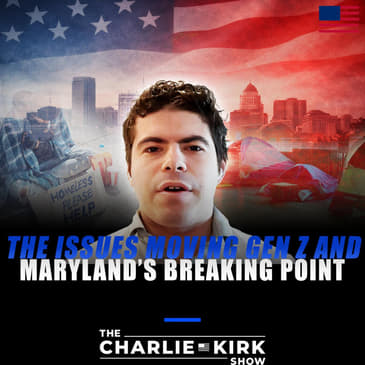
Two Turning Point chapter presidents break down the All American Halftime Show and why issues like voter fraud, affordability, and free speech are driving attention among young voters. New footage emerges in the Nancy Guthrie kidnapping case. Plus, Aaron Sibarium discusses the disaster of far-left rule in Maryland, where an entire apartment complex are about to be forcibly evicted because the state refuses to break up a massive homeless encampment.
Watch every episode ad-free on members.charliekirk.com!
Get new merch at charliekirkstore.com!
Support the show: http://www.charliekirk.com/support
See omnystudio.com/listener for privacy information.
00:00:03
Speaker 1: My name is Charlie Kirk. I run the largest pro American student organization in the country, fighting for the future of our republic. My call is to fight evil and to proclaim truth. If the most important thing for you is just feeling good, you're gonna end up miserable. But if the most important thing is doing good, you'll end up purposeful. College is a scam, everybody. You got to stop sending your kids to college. You should get married as young as possible and have as many kids as possible. Go start at turning point, you would say, college chapter. Go start at turning point, you say high school chapter. Go find out how your church can get involved. Sign up and become an activist. I gave my life to the Lord in fifth grade, most important decision I ever made in my life, and I encourage you to do the same.
00:00:45
Speaker 2: Here I am Lord, Use me.
00:00:48
Speaker 1: Buckle up, everybody, Here we go. The Charlie Kirk Show is proudly sponsored by Preserved Gold, leading gold and silver experts and the only precious metals company I recommend to my family, friends and viewers.
00:01:09
Speaker 3: All right, welcome back to the Charlie Kirks Show. Hour two is under way and we do these segments from time to time because you guys love them. We get so much positive feedback about them, and I think it's really important to involve the students that are out the front lines.
00:01:23
Speaker 2: They're the tip of the spear.
00:01:25
Speaker 3: On their college and high school campuses, so we want to hear from them, and I think for you and the audience, it's a really important learning opportunity to hear directly from our students. So today we have Leona Salinis from Texas State. She's the chapter president there at Texas State. Welcome Leona. And then we have Ben Mason, Providence Academy Club America chapter president, so we've got a high schooler and a college student as well. Leona and Ben, Welcome to the show.
00:01:51
Speaker 4: Thank you so much for having me, Andrew and Blake. I really appreciate this opportunity.
00:01:55
Speaker 5: Absolutely, yes, thank you very much for having us.
00:01:57
Speaker 2: Yeah.
00:01:58
Speaker 6: Absolutely, First thing to open with, did you guys watch the All American halftime show?
00:02:02
Speaker 5: Oh?
00:02:02
Speaker 4: Of course, And it was just a marvel to watch. I mean, I really appreciated how they made it. I'm just gonna be blunt American. I mean, this was our nation's sesquintineal sessequintennial right two hundred and fifty years of everything that has made America great and free, and the fact that some people had issue with that I think is just outrageous.
00:02:23
Speaker 7: I loved how they made it just have American values and just it spread of Christianity through with Robert Ritchie and what he said about just in till Till you Can't, I think it's a song or till I Can't, and just how they made the song about like God and of how like chasing Him in christ and as like as a Christian country, that's what we should pursue, not what the normal halftime show was going.
00:02:49
Speaker 3: Like, yeah, well, and I love that part that you're talking about, Like till you Can't is the clip I want to Yeah, so this is this is the clip to twenty two Get it Ready. So he it was a hit song that he's actually doing a cover of and that God woke him up in the middle of the night and said, there's one more verse that needs to be written for this song.
00:03:11
Speaker 2: To twenty two.
00:03:13
Speaker 4: There's a book that's sitting in your house somewhere that could use some dust.
00:03:18
Speaker 7: And off.
00:03:20
Speaker 2: There's a man who died for all our sins, the hanging from the cross. You can give you the lab Jesus and it give you a second chance till you can't. A really beautiful moment there.
00:03:36
Speaker 3: Absolutely So did you hear your friends talking about it? Or is this just because you guys were connected to turning point that you heard about it?
00:03:44
Speaker 4: I mean there, I couldn't turn to a place, whether in social media or in person, where someone wasn't talking about it. This seems to be taking over our nation right now, and I feel like as it should be, because these are conversations that we should be having and essential in comparison to bad bunnies. I think. I think the representation and the symbolism that we carried in our halftime show and are all American halftime show were absolutely everything that represents the NFL's key demographic and the fact that it was just the biggest day in American sports.
00:04:20
Speaker 2: Yeah, people don't realize this.
00:04:22
Speaker 3: It's actually the biggest social media day as well.
00:04:26
Speaker 2: I mean that's not surprising at all.
00:04:27
Speaker 3: We heard that from our reps at YouTube and at X and so it's like, I mean, it's just a.
00:04:32
Speaker 6: Ton of it have to be that or an election just everyone has to react to every clip of this or that.
00:04:37
Speaker 2: Well, you've been on a very boring game like that one.
00:04:39
Speaker 3: It was terrible good, terrible good. Can't be said enough, can't be said enough? What about you Ben? Did you hear people talking about it? Did we cut through the zeitgeist?
00:04:46
Speaker 2: Yes?
00:04:46
Speaker 5: They did. They loved it.
00:04:47
Speaker 7: They loved watching the American side of the halftime show more than the Bad Bunny. Whenever we heard about Bad Bunny going on, We're just like, hey, why is this guy going on here when.
00:04:59
Speaker 5: He he doesn't even speak English.
00:05:01
Speaker 7: He's promoting Puerto Rico and just wanting that culture a lot more and says that he won't have English in his music, which is crazy, and it was just super shocking for most students in my school. And because of that, they were just so excited to have where they can incorporate American values into the song through having Turning Point USA make.
00:05:22
Speaker 5: Their own and something where it's not because we can see.
00:05:26
Speaker 7: In the NFL that they're just like they become so woke if we look back into Black Lives Matter and putting all the George Floyd's signs on their back of their helmet and just the woke ideologists keeps perpetuating through having had Bunny on there and just having just bad kind of music where they want people to listen and just want to just instill them with this thing that's just not good for us as citizens and people who love America. And it was just great I think for everybody at Providence Academy, at my school and from other schools that I've heard of that they just love to hear just the American value side and having just Christian Judaeo Christian values, those kind of things incorporated into that.
00:06:14
Speaker 2: Yeah.
00:06:15
Speaker 6: So Ben, a Providence Academy are you in Minnesota? Is that the one in Plymouth?
00:06:19
Speaker 5: No?
00:06:19
Speaker 7: No, We're actually located in Tennessee, Johnson City.
00:06:23
Speaker 6: Oh alrighty, alrighty, Well it's a good name for a school.
00:06:26
Speaker 2: Yeah. But regardless, I want to ask both of you.
00:06:29
Speaker 6: Charlie very much wanted to be in touch what youth are talking about, what they think about things. So each of you, in turn, maybe Ben first, just what are when it comes to political issues, what is resonating with people at your school? How are they reacting to what's been in the news, maybe with ice, with affordability issues, any AI, any of that stuff. What are they talking about as we go into this midterm year, and you can be honest, if some of them are disappointed in the president or whatever, we want to know that.
00:06:57
Speaker 7: Yeah, So as we're going the mid terms, conservatives on my school and how they're feeling with the main issues would be just the immigration enforcement.
00:07:07
Speaker 5: It needs to be by partisan.
00:07:09
Speaker 7: It has to be a bipartisan issue because there's just so much polarization between the Democrats and the Republicans. And the Democrats don't want to build and we don't want to have the AUS Code thirteen twenty five. They don't want to kick out the people that are illegally here, and we need that to happen because of all the horrible things that come from having illegals here and they're coming here illegally, they're committing crimes. And Democrats need to start getting on the belt with that and wanting that too, because if they don't in the next four years or next two years, actually we're gonna see in twenty twenty eight if the Democrats win the election, they're going to completely change that and it's going to be a place where we're going to have illegals coming back into the country like we've seen in Biden's term where there was about ten million illegals that came across the border, and we.
00:07:58
Speaker 5: Need that to change.
00:07:59
Speaker 7: And we need people like Tim Waltz and Jacob Frey who are attempting suburb the will of the people. We need them to stop spreading their false rhetoric and just commenting on the Ice and saying that they're like the Gestapo.
00:08:11
Speaker 5: And there are people who are trying to.
00:08:12
Speaker 7: Hurt the American citizen by quoting the killing of Renee Good and ale It's pretty and saying that's just a horrible issue, and that's like the fall Ice Agency.
00:08:24
Speaker 3: Yeah, well, what about you, Leona's what are the top issues that you're hearing about or that you're feeling personally.
00:08:32
Speaker 4: So a couple of days ago, I was watching Cox News and they recently did a poll that said all of Americans their biggest concern, well, at least six percent of Americans are concerned mostly about the cost of living. Who isn't right now, I mean trying to recover from you know, bidonomics and such. But I think the issue is specifically that Republicans. I think we have an issue with voter complacency, right and The reason why is because the Democrats do nothing fearmonger. Right, every time they go to the ballot box, it's always, hey, it's like for death. Trump's either going to try and kill you or deport everybody who's a citizen. Right, Since things have been going a little bit better for Republicans and Trump isn't on the ballot, I'm afraid that we might not be as inclined to go vote. And I think that's very intimidating because right now all I see is the Democrats are trying to impeach Trump, and I think I think that's a real possibility that we need to be looking out for because if we don't take action soon, we.
00:09:31
Speaker 8: Can do that.
00:09:32
Speaker 6: Feel Leona, do you feel that they're like that complacency has taken hold?
00:09:36
Speaker 2: Like do you see that with conservatives on your own campus?
00:09:39
Speaker 9: Like?
00:09:39
Speaker 2: Is that a real concern? Are they are they? Is the fire flagging compared to last year?
00:09:44
Speaker 4: Absolutely, I'm not saying that the spirit isn't there, but when it comes down to actually going and voting, we just kind of have an issue with thinking everything is going to be okay. Because eggs are down eighty nine percent since Trump took office and gases down a dollar since last year. And so we actually see these positive effects coming out from the Trump administration. So we become comfortable in that, and we think we need to stop moving. But the Democrats, because they are fear mongered by everything, they never stop moving. So I think we need to enhance that. And my biggest personal concern, I would say is voter fraud.
00:10:24
Speaker 3: As America turns two hundred and fifty years old this year, we want to help Good Ranchers take a moment to remember the people who help build it. Not the ones in the history books, but the ones who woke up before the sun season after season without seeking any sort of applause. And those people are America's ranchers. For over two hundred and fifty years, ranchers have worked tirelessly to feed America through every kind of storm, droughts, wars, recessions, pandemics, changing markets, changing politics, but they never stop. That's the kind of legacy Good Ranchers was built on. Unlike others, Good Ranchers is a meet company one hundred percent committed to America, not just in words, but in practice. Every cut they offer is raised on local American farms. And ranches from the pasture to the final seal on every box. Their entire packaging and fulfillment process takes place right here in America, and if you ever have questions, their customer support team is also here in America. To top it all off, with every order place, Good Ranchers donates a portion of its profits to various veterans organizations. So as we head into a year meant to celebrate American culture, heritage, and the people who shaped it, Good Ranchers is standing right at the heart of that story. I'm actually a good Rancher subscriber myself.
00:11:33
Speaker 2: I love it.
00:11:34
Speaker 3: I love how easy it is to manage my orders. I also love it that if I get busy and I can't get one of the boxes shipped to my house, I'm just not there to receive it. I can pause or move any order in just a few clicks. It's super simple to do it. It's built around your schedule. To support a company that's committed to honoring America's past, present, and future. Visit goodranchers dot com today and if you subscribe to any of their boxes of one hundred percent of American meat, you'll save up to five hundred dollars a year, plus if you use our code kirk k I r K, you'll get an additional twenty five dollars off your order. That's kirk k I r K for an additional twenty five dollars off your first order on top of the five hundred dollars you're already saved this year just for subscribing Good Ranchers dot com American Meat Delivered. Leona, you were saying you're worried about voter fraud. Have you been paying attention to what's going on in Fulton County, Georgia.
00:12:23
Speaker 4: I'm vaguely familiar, but I don't know the in depth details of.
00:12:27
Speaker 2: It fair enough.
00:12:28
Speaker 3: But you but being in Texas, this is still something that you're concerned about. Is this what other students are talking about in your chapter?
00:12:34
Speaker 4: I try and bring it up to the chapter we have. I'm going to be completely honest. Being so close to Austin, we have a myriad of issues, specifically with a viewpoint discrimination. We have so many things we have to deal with, but especially with these you know, upcoming mid terms, voter fraud is something that is pressing on all of our minds incredibly so.
00:12:54
Speaker 3: God are you guys worried about ai h one b's as you're thinking about going into the workforce?
00:13:00
Speaker 2: Is that something kids are talking about?
00:13:01
Speaker 4: Not as not as much. We're usually more concerned on things that, really, I know, they do affect us. Everything that's going on right now is affecting us. But we're more concerned on things that directly affect us that we can kind of fix ourselves. Okay, like what like I was saying, viewpoint discrimination, Right, So we have a lot of administration and as well as professors who try and push back on us when in terms of when we're trying to get speakers, when we're trying to even table or just even just have a conversation with professors, they don't want to engage with us. And not only that, but then they do want to shut us down and they let socialists organizations run them up and do whatever they want and cause quite literally anarchay on can.
00:13:42
Speaker 3: In the great State of Texas, San Marcus, Right, isn't that what you guys?
00:13:45
Speaker 2: Are you guys are yep?
00:13:48
Speaker 4: I call it Auston by extension, Yeah.
00:13:50
Speaker 2: Exactly, the Greater Austin area. What about you, ben?
00:13:53
Speaker 3: What are the what what are you hearing the chatter from the students, not necessarily conservative ones. What what what are you hearing on campus when and uh when kids are talking to political things or cultural things.
00:14:04
Speaker 7: Well, I would say the thing that I'm hearing a lot from students is about the just the news outlets and how like the woke ones, especially how they go and they try to spread a lot of propaganda and tell this false narrative about just what's happening in society, going back to ice and just like telling stories that aren't true or half true, Ben, or something that's like completely made up, and.
00:14:28
Speaker 2: That does it succeed?
00:14:30
Speaker 6: Like is that unfortunately? Like is it getting in people? Like do you hear people say the oh you know, oh I saw this thing about killing cut they're killing.
00:14:39
Speaker 2: People like that?
00:14:41
Speaker 3: People repeat that, yeah, do you do you where are they getting their news?
00:14:45
Speaker 2: Ben?
00:14:45
Speaker 3: Is it mostly TikTok? Or where where do they get TikTok?
00:14:49
Speaker 5: Instagram?
00:14:50
Speaker 7: Snapchat even has their own like thing that you can go through and you can just find the news. And just like there's some people on the like on the way lave to just explain the news like no, that's not true.
00:15:03
Speaker 5: It's just their way of putting their own thoughts into.
00:15:06
Speaker 3: It, and Leoni in their end of Leona, are you are you feeling the same is that most people are getting getting their news from social media TikTok, Instagram.
00:15:15
Speaker 7: Oh.
00:15:15
Speaker 4: Absolutely. Usually it's so hard beat that to even have a conversation with somebody when they don't even understand what's going on. I mean a lot of people get their social media, not not I mean their news not just from social media, but it's very watered down because someone gets it from a TikTok reel and then says it to another person and another person and it gets completely diluted. That in Dean Weathers unfortunately.
00:15:38
Speaker 2: Oh jeez.
00:15:39
Speaker 3: Well, just remember employee Charlie's method. When you're having these conversations, ask questions drilled down on kind of their core assumptions, and once you once they reveal themselves, then you can sort of dismantle that core assumption. So ask a lot of questions where you should get that who told you that, what was their source? That kind of thing, and then and then you'll get to the root of the issue.
00:15:59
Speaker 2: Most often.
00:16:00
Speaker 3: Leona and Ben thank you guys so much for making the time and joining the Charlie Kirk show. It's so important to hear from you directly from the source the students out in the field. You are brave, You are the front lines, tip of the spear, and we salute you, thank you for your courage.
00:16:14
Speaker 5: Yes, thank you.
00:16:15
Speaker 7: I could I add one more thing actually about what she was saying earlier about voter ID.
00:16:20
Speaker 5: Yeah, so going with.
00:16:22
Speaker 7: Voter ID, the thing that was passing in the House was the Save Act and already passed them there and now hopefully it's going to pass in the Senate.
00:16:31
Speaker 5: And it's pretty funny actually, because this is one of the issues that.
00:16:34
Speaker 7: I'm facing at school with people talking about just votering Tegnerty like you were saying, Leona, and just that we need voter ID and all that, and that's coming from the Save Act hopefully in the coming few months. And it was pretty funny from this one guy who said, Chuck Schumer exactly, and he can played the Save Act to be the same thing as the Jim Crow Laws, and he says Jim Crow two point zero. And to me, there's no rational way to speak like that unless you're making it seem as if black people are less intelligent and that they can't think clearly enough to get their citizenship proof for the voter ID and just their voting process and the election. And it was also that CNN came out and said that eighty six percent of Blacks and eighty two or eighty three percent of Latinos want the voter ID to pass, and then that our election process is fair and there's no questioning for there to be fraud or anything like that.
00:17:39
Speaker 5: So I'm excited about that. Hopefully that will pass.
00:17:42
Speaker 3: Yeah, we've been following it closely. We've been following it closest since. Stay tuned on the Charlie Kirkshow because we're bringing in I think we have. There's a vote that's going to happen on tomorrow and then we're gonna have Chip Roy on Thursday to talk more about it.
00:17:54
Speaker 2: So stay tuned with that.
00:17:56
Speaker 3: Thank you guys again, God bless you, Stay safe, stay courageous, stay bun, stay firm.
00:18:01
Speaker 5: We got your back, all right, Thank you so much, appreciate it.
00:18:04
Speaker 3: Thank you, guys. So I want to bring some breaking news here, guys. We have there has been new images released by Cash Bettel three forty one, three forty two of the suspect in the Nancy Guthrie kidnapping case. This guy is fully masked, gloves on his hand, removing the ring doorbell, and we've got videos in now. Yeah, this is very creepy. So this looks like somebody that knew exactly what they intended to do, knew exactly what they were gonna do, and.
00:18:34
Speaker 2: This is the video.
00:18:35
Speaker 3: Now, they have retrieved this from remnant data that they collected from the ring doorbell that was actually removed, so they're obviously using pretty technical data specialists to retrieve this this video. In the middle of the night, this guy came up methodically removes the ring doorbell.
00:18:52
Speaker 2: Really really creepy stuff.
00:18:54
Speaker 3: I mean, this is you know, they're describing it as a needle in the haystack kind of situation. So we gotta pray that they figure this out and they find this person because this guy's completely masked, no fingerprints, no nothing.
00:19:08
Speaker 6: Yeah, he clearly knew exactly what he was going for. But we can hope. Uh, you know, the FBI releasing footage from Utah Valley is what ultimately led to Tyler Robinson being turned in, so so hopefully something very similar here.
00:19:22
Speaker 3: So there's another video here that the team has. Yeah, it's weird that they knew where the camera was. Go ahead and play this three p.
00:19:30
Speaker 2: Forty eight.
00:19:30
Speaker 10: What stands out to me too, is that remember how much we've talked about that area and how dark it is, and that you can barely see what's in front of your own eyes. And I know it was a full moon, but he's under the portico there where there it's probably very dark. He has no trouble identifying that there's a camera there. It's almost as if he knows there's a camera there, because it does appear as though he's trying to block the camera's vision of his face. This to me, I think you can easily kind of draw some conclusions here.
00:20:02
Speaker 2: It might be.
00:20:04
Speaker 10: Reasonable to say that was familiar with that area, was familiar with the camera's location, and came prepared.
00:20:14
Speaker 3: Hi, folks, Andrew Colvett here, I'd like to tell you about my friends over at why Refi. You've probably been hearing me talk about y Refi for some time now. We are all in with these guys. If you or someone you know is struggling with private student loan debt, take my advice and give them a call. Maybe you're behind on your payments. Maybe you're even in default. You don't have to live in this nightmare anymore. Why ref I will provide you a custom payment based on your ability to pay. They tailor each loan individually. They can save you thousands of dollars and you can get your life back. We go to campuses all over America and we see student after student who's drowning in private student loan debt. Many of them don't even know how much they owe. Why ref I can help. Just go to y refi dot com. That's the letter, why then refi dot com. And remember why Refi doesn't care what your credit score is. Just go to yrefi dot com and tell them your friend andrews.
00:21:10
Speaker 6: Hent you.
00:21:12
Speaker 2: Alrighty.
00:21:13
Speaker 6: Our next guest here, we have Aaron Sibarium. He's an investigative reporter with the Washington Free Beacon. You might remember he was a guest in this studio, met with Charlie last August, and we've been following his work with great interest. He's done a lot of great work on sort of the DEI stuff that's been out there. He exposed a lot of racial discrimination and COVID stuff, and he has the story last week. It's a little off brand from some of his prior stuff, but it's very interesting. I think it's worth keeping a good focus on the practical ramifications of far left governance, and this is a great example of it.
00:21:50
Speaker 2: Aaron, are you there?
00:21:51
Speaker 5: I am, How do you?
00:21:52
Speaker 2: Aaron?
00:21:52
Speaker 5: Welcome back?
00:21:53
Speaker 6: Yeah, welcome back to the show. I think I'll just let you kind of narrate this story here. But basically, you've got a story in Maryland, in a suburb right outside the nation's capital, where they allowed a homeless encampment to spread so much, and rather than evict, you know, shut down the homeless cacampment, they are shutting down the actual homes next to it because they have destroyed it. Can you tell that story to us?
00:22:18
Speaker 5: Absolutely?
00:22:19
Speaker 8: So. The story begins two to three years ago when this homeless encampment first started to coalesce behind the Marylander condominiums in Prince George's County, Maryland. Basically, over time, the encampment evolves from a few tents into something more like a shanty town slash open air drug market. Drug dealers are dropping off packages of crack and fentanyl to the encampment in broad daylight. There's MS thirteen activity in the area, there's tons of crime, and soon enough people from the encampment start to break into the condominium and defecate in the stairwells, do drugs in the hallways, cause all sorts of problems, and eventually they allegedly appear to have broken the heating system, which meant that half of the building was left without heat for the entirety of winter, including now when it's you know, like sub freezing temperatures in Washington, DC. As a result of this, the county, which had allowed the encampment to festerure for years and refused to arrest the people who were constantly trespassing on this condo's property, the county decides to evict not people from the encampment, but to evict residents of this condominium, saying that the lack of heat has rendered it unfit for human habitation, or rather, it rendered half of it, the half without heat, unfit for human habitation, and so as a result, in the next couple of weeks, hundreds of low income, predominantly non white families are likely to be forcibly evicted from their homes. All because of this massive homelessness and really criminal and drug problem that a blue county allowed to fester. And I should note here that I think it was eighty six percent of Prince George's county voted for Kamala Harris.
00:24:29
Speaker 2: Which is which is twenty years Yeah, it's yes, it is.
00:24:33
Speaker 8: It is the most democratic county in the country technically Washington, d C. Which is not a county as a higher Democrat exactly exactly.
00:24:42
Speaker 6: And so you're saying they're doing drugs out in the open, they're getting drug deliveries out in the open, there's gang members. And what was the statement of local police. I assume this had to be brought to their attention. Did they say anything about this camp?
00:24:57
Speaker 9: Yeah.
00:24:57
Speaker 8: So there is a video I have in my story where where the property manager is basically asking a police officer to arrest a homeless woman who's trespassing in the parking lot, and he says, well, there's so many of them and they're just kind of constantly coming through this hole in the fence that they created, going back and forth, that there's just really too many of them for us to arrest. And in the same breath he acknowledges that he just tells her to leave gives her a warning, she's gonna come right back. So they know that just giving them warnings isn't sufficient. There's one case I talk about in my story where the police come give someone a warning and then ninety minutes later they're back in the same stairwell smoking crap. So not arresting them doesn't solve the problem.
00:25:44
Speaker 9: It doesn't.
00:25:44
Speaker 8: It's not enough to just temporarily kick them out right.
00:25:46
Speaker 2: And it looks like we still just won't.
00:25:49
Speaker 6: Yeah, it looks like we also have a video where they almost seem to be like blaming the locals for this problem existing because they, you know, they do the do gooder thing and give some food to them.
00:25:57
Speaker 2: Let's play this clip. Two sixty five.
00:26:00
Speaker 9: We do have information from some of our officers that have been doing surveillance that more than one of your residents have actually been coming out of their condo and delivering food to the unhoused population. We have more than one verified sighting of that. So as we know, if we're going to have residents enabling this behavior, this unfortunately complicates it as an additional burden. They should not be delivering food to the unhoused population. That's only going to identivize the unhoused population to return and ask for more.
00:26:34
Speaker 2: I am losing my mind here.
00:26:36
Speaker 3: Like, by the way, if you what you're talking Aaron, just to watch Blake's facial expressions as you're describing the incidents.
00:26:43
Speaker 2: It is a show unto itself. It's just unreal.
00:26:47
Speaker 7: Like.
00:26:48
Speaker 6: So that's literally their justification that someone felt, you know, maybe moved by Christian impulse or humanitarian impulse probably maybe yeah, to give food to this person. And like it's the of the police to say, Okay, but this is an illegal encampment. We can't allow this to spiral a lot of control. And that's the that's their argument.
00:27:07
Speaker 2: Well, you gets even worse, so you lose your home.
00:27:11
Speaker 8: Yeah, well it gets even worse because at the same time that the police were telling residents of the condo don't feed the unhouse population, the county itself, for years has been delivering food to this very encampment through a street outreach program organized by the Department of Social Services, and furthermore, the police department itself also organized an outreach program sponsored by Wegman's grocery store that delivered food. It sounds like at some point, at least in twenty twenty three. There's a video we have in the story where the police officer who's describing this says.
00:27:51
Speaker 5: Yeah, you know, we did this for a while.
00:27:53
Speaker 8: We were trying to build trust and get people connected with shelters and services. We stopped because as uh the this is his words, the severe drug addicts uh just didn't want to get off the street because they liked they liked their spot behind the condo where drug dealers would just drive through the parking lot and deliver them drugs. Right, they didn't have to deal with the rules and regulations of homeless shelters. And this police officer is quoted on video as saying that to get them off the streets, you literally would have to put them in handcuffs. Right, So the county knows that this doesn't really work to get people out of there. It's a it's a good impulse, it's well intentioned, but it doesn't work by their own admission, And yet they kept doing it for years and then as they.
00:28:41
Speaker 6: Were I'm waiting for the reveal that like the crack is also supplied, Like the government has a crack lab and they're manufacturing, and like the tents are all going to be DHS issue or something.
00:28:54
Speaker 3: So this might feel to the audience is like a very niche story. It might feel, but I think it's really important. And here's why this is so indicative of left wing, far left governance. We're not talking like mayor Daily in Chicago that was a Democrat, but the city ran and the trains ran on time.
00:29:14
Speaker 2: Now that's time we're talking. We're not talking about that.
00:29:16
Speaker 3: This is a pathology of a certain ideology when it comes to You see this in New York, you see this in San Francisco, you see this in La I saw it when I lived in La These cities become completely ungovernable because they refuse to enforce basic law and order.
00:29:36
Speaker 2: Basic order does not.
00:29:38
Speaker 6: There was there's a related story that I saw bart in San Francisco. They just installed new gates that you can't jump turnstiles so that you can't jump them, and they were showing like the maintenance and fix its that they had to do, and it's literally fallen by over ninety percent or completely stopped. Like they went from you know, we needed eighty visits to fix stuff at this one station, and it's down to two or one or zero because they just got rid of. By making sure you couldn't break into the bart, you got rid of all the people who just go and randomly.
00:30:09
Speaker 3: I bet it's a lot safer then, yes, actually, well, and that's that's an example of a city that's very far left doing something.
00:30:14
Speaker 2: So yeah, we wanted to have.
00:30:16
Speaker 6: Aaron on about this both to highlight his work and just I think it is a perfect symbol like this could be your city if you give in.
00:30:22
Speaker 3: This is the whole I mean candidly. I mean it's just we don't enforce our law like path the country, just like giving up and enforcing the laws. But it isn't anarco tyranny. This is a perfect anarcho tyranny story because the labiding residents that pay their rent that we're doing Christian good deeds to try and help these these people giving them food.
00:30:41
Speaker 2: They get punished.
00:30:43
Speaker 3: They get punished while their local leaders completely drop the ball, and it's a really disgusting story. Good work on this, Aaron. This is a we follow your stuff a lot, just so you're aware, because you always come up with these these stories that just like you think they're they're parody, but they're actually true.
00:30:59
Speaker 2: This that's not the onion.
00:31:03
Speaker 6: The online world moves fast, and it's moving even faster these days. That's why TikTok approaches teen safety with families in mind from the start, because discovery and creativity are both wonderful things, but it's important to make sure that safety comes first as well. On TikTok, teenagers have over fifty built in protections right from when they join. Accounts, routines all start private by default, They're not open to the entire world, and for those under sixteen, direct messages are turned off. Only their friends can comment on their videos. And that kind of approach matters because feeling confident and comfortable about these platforms your teenagers are on shouldn't mean digging through a bunch of menus and trying to set everything up yourself and worrying that you got it wrong. TikTok is taking a proactive approach. Their protections are built in from the moment those teenagers join, so that safety and peace of mind for parents is there right from the start. All of this is to say when safety comes first, discovery and creativity can follow without fear. Learn more by going to TikTok dot com, slash guardians Guide. That's TikTok dot com slash guardians Guide. I really like to highlight it because I think it's very important to flag that there's actually so much stuff out there. I remember talking to Andrew when we met a few years ago, like how do you find stuff? And I think you would tell me, Andrew, like, there's actually just tons of stuff out there, and you just you poke it a little bit and there's so much you can find. And I want to remind people some of your hits you uncovered Minnesota, Utah, I think New York State, all of them were doing racial discrimination with their COVID stuff.
00:32:40
Speaker 2: And then another story that there's been.
00:32:41
Speaker 6: A recent update in you have really made a punching bag out of the University of California, Los Angeles. They've done a lot of discriminatory stuff illegally in California with their admissions to their medical school. And this is actually producing positive developments that aren't getting Wow. Yeah, they're not getting headline news yet. Stuff is moving forward. Can you tell us a bit about that earon?
00:33:07
Speaker 8: Yeah, So, there was recently a lawsuit against UCLA Medical School by Students for Fair Admissions, which is the group behind the Harvard Affirmative Action case that outlawed racial preferences and college admissions nationwide, and the lawsuit concerned UCLA Medical schools admissions policies, which are, as I've reported on at length, extremely discriminatory against white Nasian applicants. The latest update is that the Trump administration has now joined the lawsuit against UCLA. The Justice Department filed a brief in the case. And what makes this interesting is that the Justice Department managed to get its hands on MCAT data broken out by race for UCLA, which provides really, really strong, circumstantial evidence of discrimination. I think you have the tweet up there right now.
00:34:04
Speaker 5: But yet it's.
00:34:04
Speaker 8: Something like Hispanic matriculence, you know, on average, Yeah.
00:34:08
Speaker 6: It's sixty sixth percentile on average to get in for Hispanic applicants, and an Asian applicant would need ninetieth percentile. So that's a huge gap, and that is racial discrimination. It's we sometimes act exasperated, but we probably shouldn't because it is everywhere. But I feel like it's worth pounding the table on this that America has racial discrimination under the guise of equality, under the guise of this is anti racism and it's the exact opposite, and I think you've played a big role in really just calling.
00:34:42
Speaker 2: That out for the flagrant lie that it is. Yeah.
00:34:45
Speaker 3: Well, and Aaron, it's worth bringing up again that California has repeatedly voted against affirmative action policies, which this is, you know, akin to that.
00:34:55
Speaker 2: I don't see any other ways. They're trying to change the law again. They voted against it in twenty twenty.
00:35:00
Speaker 6: Yeah, they voted against it in twenty twenty. They're trying again now and this time they would only they would leave it illegal in colleges officially, but as we see, they do it anyway, do it anyways, but they want to make it legal for elsewhere like they they seem addicted to trying to legalize well, racial discrimination.
00:35:18
Speaker 3: It is, yeah, is what's the basis of the lawsuit? Is it the twenty twenty you know vote on I believe it was. Let's see here it was prop to nine.
00:35:30
Speaker 6: The basis of the lawsuit is that we have the Supreme Court has left more of an opening to this, correct, Aaron, that the Supreme Court has sort of said this is bad, but yeah, leaving it to lawsuits to really make schools living.
00:35:44
Speaker 8: Right right, So I mean, I mean they're suing I believe under both the precedent created in Students for Pair Admissions in twenty twenty three and Californio's drop two nine. You asked what the lawsuits based on. I mean, the factual allegations in the lawsuit are basically almost entirely derived from a series of stories I did in the spring of twenty twenty four where I got not just internal data and emails indicating discrimination, but also testimony from admissions officers for admissions officers and some other people close to the process who all said, yeah, they're lowering standards like crazy, depending on the race of the applicant.
00:36:28
Speaker 6: Yeah, and they're lowering standards. And then they told you that they're getting students as a result who are not prepared for a medical school curriculum. And then they're also going out of their way to make sure they don't fail classes. It causes a little damage everywhere down the line.
00:36:43
Speaker 3: Wasn't there a famous case in California Medical school?
00:36:46
Speaker 2: What was that case? I can't remember off the top of my head.
00:36:49
Speaker 3: Baki Baki, right, tell us about can you do you have the details?
00:36:55
Speaker 8: I don't remember all the details, but I think basically is the one that you know, kind of established that you can uh do affirmative action to some extent, but only as a plus factor. You can't do quotas, but you can consider race because diversity has these supposed pedagogical benefits. I think that was the case.
00:37:22
Speaker 3: Yeah, that's the that's the case where they established it. But there was actually a different one where there was a basically a black doctor who it's famous case because he ends up batching all of these.
00:37:34
Speaker 6: Yeah as this like you know, this success story, and then he turned out having he yeah, he was doing like illegal medical procedures.
00:37:42
Speaker 5: Yeah.
00:37:42
Speaker 3: I think eventually people killed some people. So this is like, you know, it kind of not to bring up a touch e centric. It reminds you of when United Airlines basically declared that they were going to make fifty percent of their new pilot corps, you know, minority or female exactly, And that's which Charlie says, well, if they start doing that, then I'm going to start looking in the cockpit and going like, boy, I hope you're qualified.
00:38:03
Speaker 2: Everybody took it as like a racial thing.
00:38:05
Speaker 3: He was saying, I don't do that now because we don't have these insane quotas in place. But if you're going to start lowering the standards for minority applicants at medical schools, this is a huge potential problem in liability, and we have historical precedent which proves that it's a problem. It actually is life altering.
00:38:25
Speaker 6: Aaron, I hate to put you on the spot, but I do. I'd love to use you as an example just what people can do if they investigate things. So, do you have any advice, Like, obviously there's so much UCLA is a school, it has campus reporters.
00:38:38
Speaker 2: A lot of our people are viewers.
00:38:39
Speaker 6: People who follow us are students themselves, high school colleges, law schools, and so on. Do you have any advice for someone who's thinking I might be interested in this field how they could Like, what could they look for in their own Yeah? Where do they start school?
00:38:55
Speaker 2: Yeah?
00:38:55
Speaker 6: What should they look at if they wanted to try to find examples of bad behavior in their own school or community?
00:39:01
Speaker 8: So it used to be easier because the schools would just post the illegal stuff online, and they stopped doing that once Trump started suing them and taking away all their money. What you should probably do now. And there's no guarantee this will you'ld fruit, but it's the best thing you can do is make friends with a lot of professors. You're going to have a tough time making friends with administrators, frankly if you're right wing and want to have an adversarial relationship to the school. But you know, make friends with the professors or administrators if you can find them who are closet skeptics or outspoken skeptics of DEI and kind of left wing radicalism, because they're the ones who are going to know where the bodies are buried. I mean, that's the best thing you can do and establish a good trusting relationship where the professors will feel comfortable telling you things off the record or on backgrounds.
00:39:54
Speaker 6: That's old school, It sounds hard, but it's really it does work because.
00:39:58
Speaker 2: Everyone is conservative about what they know, so.
00:40:00
Speaker 6: A ton of democrat college professors hate what's happened to these schools. Aaron Sibarium your work at the Washington Free Beacon. Thank you for coming on check him out.
00:40:09
Speaker 2: We'll see you all tomorrow.
00:40:11
Speaker 9: Thank you.
00:40:15
Speaker 2: For more on many of these stories and news you can trust. Go to Charliekirk dot com,