
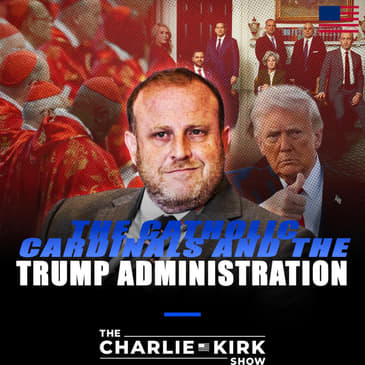
After dissing the president, the pope paid a visit to Algeria, where Christians are persecuted. Meanwhile, America's top cardinals are picking a fight with U.S. immigration laws. What is going on with the Catholic Church's leadership? Peachy Keenan talks about that and the departure of Eric Swalwell from American politics. Jacob Siegel discusses "The Information State" that uses control of knowledge to control the public. Jeremy Carl bids farewell to Viktor Orban, the best conservative leader of the past twenty years.
Watch every episode ad-free on members.charliekirk.com!
Get new merch at charliekirkstore.com!
Support the show: http://www.charliekirk.com/support
See omnystudio.com/listener for privacy information.
00:00:03
Speaker 1: My name is Charlie kirk I run the largest pro American student organization in the country, fighting for the future of our republic.
00:00:11
Speaker 2: My call is to fight evil and to proclaim truth.
00:00:14
Speaker 1: If the most important thing for you is just feeling good, you're gonna end up miserable. But if the most important thing is doing good, you'll end up purposeful.
00:00:24
Speaker 2: College is a scam, everybody. You got to stop sending your kids to college. You should get married.
00:00:28
Speaker 1: As young as possible and have as many kids as possible.
00:00:31
Speaker 2: Go start at turning point.
00:00:32
Speaker 3: You would say college chapter.
00:00:33
Speaker 1: Go start at turning point, yould say high school chapter. Go find out how your church can get involved.
00:00:37
Speaker 2: Sign up and become an activist.
00:00:39
Speaker 1: I gave my life to the Lord in fifth grade, most important decision I ever made in my life, and I encourage you to do the same.
00:00:45
Speaker 2: Here I am Lord, Use me.
00:00:48
Speaker 1: Buckle up, everybody, Here we go. Noble Gold Investments is the official gold sponsor of the Charlie Kirkshaw, a company that specializes in gold I rays and physical delivery of precious metals. Learn how you could protect your wealth with Noble Gold Investments at noblegold investments dot Com. That is Noblegoldinvestments dot Com.
00:01:17
Speaker 2: All right, welcome to the Charlie Kirk Show.
00:01:19
Speaker 4: I'm at the Mobile y ref Studios here in Palm Beach, Florida, the beautiful Palm Beach.
00:01:24
Speaker 2: Blake's holding it down in Phoenix.
00:01:26
Speaker 5: How we doing, Blake, Oh, it's doing great. We're in the main wy ref I studio. It's way cool you are than the mobiley ref studio.
00:01:33
Speaker 2: So Blake, I'm no.
00:01:35
Speaker 4: That's not true. This is pretty cool, I will say. But either way, y Refi is great. Check them out invest yrefi dot com.
00:01:42
Speaker 2: Blake, You're gonna be my beard today. That's how I'm referring to it. You are. You have a great beard. So it works. So we have lots of Catholic news.
00:01:52
Speaker 4: We're a bit in a stasis point right now with the blockade. We're in day two. It does seem like most vessels are being blocked that area around Iran. There's about two dozen ports, maybe up to thirty Iranian ports that are being blocked right now, which does hold long term significance. We will get into that as we know more. But vessels are being turned away. So as we're in this stasis in the middle East. We want to turn our attention to some of this action that's happening with on multiple fronts now, not just between President Trump and the Pope, but with some of the cardinals.
00:02:28
Speaker 2: And now he's also the.
00:02:30
Speaker 4: Pope has visited Algeria, which comes with a whole bunch of added controversy. And since you are the resident Catholic here, Blake, let's let you take it away.
00:02:40
Speaker 6: Ah.
00:02:41
Speaker 5: Really, really, it's just a bad day for me. It's a bad day. It's always annoying when Catholic leaders are making me frustrated. But it's inevitable. It's a big tent, it's a big church. But real quick before I tee off. Today is election day in Virginia. If you ignored all of our warnings that you needed to vote early, there, go vote now. You have vote five or six hours left to go to vote. Normally you only get to vote in one house race every cycle. You're voting in five effectively. And it matters even more because in Maryland, their bid to do we draw their map actually just failed. Democrats couldn't work it out. They started arguing too much. Failed, So we saved the house seat there. We can save five seats today, get out and vote. Anyway, back to the church, so we were talking a lot about the Pope, what he said about the conflict in Iran. He was saying God doesn't listen to the prayers of those who wage war. And then the President said some stuff critical of the pope, said he was soft on crime, and we didn't get to another topic that I think is equally important, which is we have a set of cardinals. Now there are the cardinals are the senior clergy of the Catholic Church. They elect the pope. There are several about almost two hundred of them around the world. There are seventeen of them in the United States. But many of them went and did an interview with sixty Minutes on Sunday where they were saying stuff just very overtly critical. Not just they weren't just complaining about the war. They were even complaining about immigration enforcement in this country. And I'll be frank that annoys me a good bit because it's one thing to say we should promote peace. Christianity's always promoted peace. It's one thing to weigh in on something light, something so clear cut, as for example, abortion or assistant suicide, where the church has always held the same view on that for two thousand years. But there are unfortunately Christian leaders who have come along and they've adopted this view that did not exist one hundred years ago, certainly did not exist two thousand years ago, that it's actually in moral for nations to have borders. So we want to play some clips from that. So this is one of those cardinals, Cardinal Joseph Tobin, and he's complaining about ICE doing their job. Let's play clip number ten.
00:04:58
Speaker 7: This past January, Cardinal Tobin called Immigration and Customs Enforcement or ICE, a lawless organization. Cardinal, those are strong words to call ICE a lawless organization. Why did you do that?
00:05:12
Speaker 8: I didn't say that they were people without law, though. When people act in this way, when they have to hide their identities to terrify people, when they can actually violate other guarantees of our Constitution and Bill of rights, well I think somebody's got to call that out. And I'm not the only one.
00:05:32
Speaker 4: Oh man, I have so many notes, so many thoughts. First of all, First of all, the masks, mister Cardinal, are because they're getting docks and their lives are getting threatened. Second of all, what about your criticisms for the protesters, the agitators, those who run Kama Cosm missions with their cars trying to run over ice agents. Any thoughts about that, And by the way, Blake again, you are my cover today. But it just it strikes me because you know, some of the same allegations not to deviate too far from what you're talking about here, are are leveled at the Pope himself because you know, here he is in Algeria, which is a predominantly Muslim country, and he hasn't visited Nigeria, where the you know, seven thousand Christians have been massacred in recent years, I mean up to fifty thousand since two thousand and nine. So it's this selective outrage that I find just the most troubling because then it just smacks of bias, of cognitive dissonance.
00:06:35
Speaker 5: Well, yeah, we can be Frank. The Pope runs a globe, he oversees a global organization. There is a limit to everything he can certainly where he can travel, everything he can say. But that emphasizes the point you're making, which is you create a narrative by what you choose to emphasize the most, what you choose to talk about even with Algeria. Now there actually are there are persecuted Christians in Algeria. They are all minority of a few thousand, and the Pope did talk about that there have been martyrs in Algeria within the last thirty years. But at the same time, yeah, if he's going to broadcast loudly that immigration enforcement is a problem, but not the fact that, for example in Algeria, in Algeria, churches get shut down by the government pretty often. They find excuses to hinder Christian worship. In Algeria, Christian proselytization is the illegal. They have convicted people of this within the last decade. And when you're not talking as much about that, not as loudly about that, but you're very loudly, for example, having church leaders say members of a country's government enforcing that country's long standing immigration laws are a problem. We have another clip from that that I want to make sure we play. Let's play clip number is it eleven?
00:07:50
Speaker 7: One of the busiest stretches of the southern border for illegal crossings.
00:07:55
Speaker 9: I feel it got to a point where it was getting out of control under Biden.
00:08:01
Speaker 7: Yes, you believe in strong borders, so what's wrong then with the current policy.
00:08:08
Speaker 9: This is a round up of people throughout the country, people who have been living good, strong lives, been here a long time, raise their children here and their children born here, and our citizens. That's what our objection is. I would like to know what Catholics feel about this indiscriminate mass deportation. I think that it's very clear the American people are saying, we really didn't vote for this.
00:08:32
Speaker 5: That really upsets me because that is that is bad moral leadership from me. You're in a senior position, you should know better. It is not indiscriminate. What it is is it is an enforcement of our country's laws. And you know it's actively immoral, enforcing laws only for some people and ignoring them for others. And this weird waffling where he says, well, it was out of control under Biden, but don't I don't like how it looks now. They're grabbing people who are who are inside the country. You're not standing up for the laws of this country. If you wanted to be a good leader, you might say, hey, parishioners, you shouldn't break America's laws to come here. You should try to come here legally. The way millions of other people in this country. Did you can still go to Mass in your home countries? Like this is not an attack by the Trump administration on the church. It's so frustrating to see this. Well, I know Charlie would always call out bad pastors among Protestant Christians. I think it's our duty to call out bad cardinals among the Catholics.
00:09:30
Speaker 4: I believe we do, in fact have Kevin Posovak, who is on assignment live from Dublin, Ireland.
00:09:37
Speaker 2: Kevin, can you hear me?
00:09:38
Speaker 6: Yes?
00:09:39
Speaker 9: I can?
00:09:39
Speaker 6: Can you hear me? Can you see me?
00:09:41
Speaker 2: Yeah? We got you, brother, all right?
00:09:43
Speaker 4: Tell us give us for a lot of people at home not paying attention to how this protest started. I know it's about gas prizes sparked by Iran, but there's a lot of layers to this. Tell us what it's like there on the ground and how it came.
00:09:55
Speaker 10: To be, Well, Andrews, So what happened is that Ireland is a nation about six million people, and just imagine Tamala Harrison won the election and they imposed all these breed New Deal policies.
00:10:09
Speaker 6: So the farmers are protesting here.
00:10:11
Speaker 11: That's what we're seeing with these chapter protests all along.
00:10:15
Speaker 6: The countryside this weekend.
00:10:17
Speaker 11: So what has happened is that there's taxes on top of taxes being taxed sixty percent on the leader of petrol over here. And you know we're seeing that they're protesting because that is unfair and they're already being tax first off for all asylum seekers, you know, refugees this and that from last year. So now on top of it with the inflation from the Iran conflicts.
00:10:49
Speaker 6: Uh, these people are fed up. These are blue collar people.
00:10:52
Speaker 12: This is uh go in the falls divide and he's been here behind the gin.
00:10:58
Speaker 6: Get them out because this he's just human games. They looked the.
00:11:04
Speaker 12: Government, they look at the government out ages for their voting is today on the nations and no confidence and the fifth the evening of seventy here is that would effectively mean that the teacher, the Prime Minister of Ireland was have to resign along with his gatnet and you don't have to be staff re elections to get the Irish patriotsy or heard. And effectively the fuel price is lowered to a affordable official rate. So you know, these people the legal living.
00:11:38
Speaker 4: So so Kevin, if I'm understanding this right, so you've got a nation that has been inundated with foreigners, a lot of signs out there saying Ireland's full Ireland for Irelish, for the Irish. Then you've got the around war that kicks off, which obviously has fuel shortages, fuel prices spiking, especially in Europe. This has added on top of the price increases that have come through Green New Deal type taxes.
00:12:08
Speaker 2: And then there's already.
00:12:09
Speaker 4: Taxes that have been imposed because they need to pay for the social services for these new immigrants.
00:12:15
Speaker 2: So meanwhile, the blue collar Irish are getting squeezed at all ends. They're sick of it.
00:12:19
Speaker 4: This kind of reminds me of the was it the Dutch tractor protests as well? This populist energy from the working class of the Europeans.
00:12:29
Speaker 2: So what are you seeing out there?
00:12:31
Speaker 4: Is it's safe? Are they staying peaceful? Is it rowdy?
00:12:36
Speaker 2: Like? What do they hope to accomplish with this protest?
00:12:38
Speaker 12: Sure so today, yes, and exactly we saw it in the Netherlands and in Germany, and in Canada a few years ago, and even in America slately.
00:12:46
Speaker 6: So they've taken the playbook.
00:12:49
Speaker 11: Here and they're doing slow rolling protests to show that they control the pooch fly basically no food or no farmers, no food.
00:12:58
Speaker 6: Okay, So what it is here is.
00:13:01
Speaker 11: That today it is peaceful, and you know, there are some there are some chant old songs and they want to be basically overthrowing the government by lawful means. And you know, there's no there's no shame in that. There's a lot of Irish pride going around. But again this crosses both political spectrums here. That's not about the left or the right, liberal, conservative, because it affects everybody.
00:13:30
Speaker 12: And yeah, so far it's peaceful, I mean by Irish standards and some.
00:13:37
Speaker 6: Of those fashions of people on earth.
00:13:39
Speaker 4: Yes, Kevin Pazelvich, let's we're gonna call it right there, my friend, good job, stay safe and we'll check in for more updates as this story develops. But there is a potential election that would be a voted no confidence within the Irish Parliament, thank you, Kevin, which would obviously spark a huge change in that nation's government.
00:14:02
Speaker 2: Sparked in part by the conflict in Iran.
00:14:05
Speaker 5: Blake Well, I mean, Andrew, we're just gonna have to figure out whether the demonstrators, if the demonstrators want less migration. That means it's a riot and an outburst and they need to crack down and seize their bank accounts. Whereas if they want a far left government to overthrow, then they want to overthrow the government that way. That means, you know, they're marching for democracy.
00:14:24
Speaker 2: Good trouble versus bad trouble. M Yeah, do you see.
00:14:27
Speaker 4: Yeah, you're obviously being a little bit sarcastic there, but I do think that's important of note you're making is that the same tactics could be deployed from the right at the left, but the media will paint one as virtuous the other as sinister and illegal.
00:14:41
Speaker 2: Yeah, and.
00:14:43
Speaker 5: Let's circle back to what we were saying in part one, Like, you know, it's such a great point with those cardinals where supposedly one of them complains, oh, ICE is a lawless organization. Well, first of all, that's not true, But second, you know what else is lawless? Millions of people coming into your country, living here, illegally, working here, illegally, stealing people's identities, all sorts of things. It's you know, remember a few months ago there was that New York Times profile of the guy who stole this other person's identity, and they tried to frame like it was a tragedy affecting two families, the guy whose identity got stolen and who got blamed for a bunch of crimes he didn't commit and got harassed by the IRS, and the guy who stole his identity. It talks about that guy going to church in the article. And you know what, I'd always wonder, why doesn't that guy's priest ever say, Hey, you should find a way to go back to the country you're legally allowed to be in. Hey are you stealing someone's identity. You shouldn't be doing that. It's so frustrating what these religious leaders.
00:15:40
Speaker 4: Well, and you know, to kind of make a further point, what you're saying, Blake, is that you know today there was a big breaking news story. We're actually gonna have Mary Margaret old hand tomorrow on it. But this the DOJ has released a eight hundred page report how the Biden administration and the Biden DOJ were targeting lifers, many of whom are Catholic, simply for their views that are long standing church positions on life and unborn babies. But you don't see a lot of noise being made about that, So that makes me wonder again the selective outrage is very, very frustrating.
00:16:18
Speaker 2: And again, I'm not a Catholic, blake.
00:16:19
Speaker 4: You are a Catholic putting President Trump's beef with Pope Leo aside. These are massive, massive, glaring inconsistencies, and I think they.
00:16:29
Speaker 2: Need to be called out.
00:16:32
Speaker 4: I wasn't expecting this, I have to say, but death of Recess it stopped me in my tracks. This isn't about dodgeballs and jungle gyms. It's about control. The modern American classroom didn't just happen. It was intentionally designed. It was standardized and centralized. And once you see who built it and who protects it, everything clicks. Billions of dollars are flowing through education bureaucracies every year, test scores collapse, and somehow the answer is always more money and less parental authority. The documentary breaks down how organizations like the NEA amassed enormous influence, how radical gender ideology entered classrooms, and why something as basic as recess movement, freedom childhood, you know, had to go. That's not random, that's systemic. Institutions protect themselves. They do not protect your kids and that's why this documentary exists on Angel Studio streaming platform Angel Guild. Angel Guild is willing to distribute films that challenge powerful systems when legacy media won't touch them.
00:17:34
Speaker 2: So right now, go to.
00:17:35
Speaker 4: Angel dot com slash Charlie and watch Death of Recess right now. If you're a parent or plan to be, you need to see this. That's Angel dot Com slash Charlie and watch Death of Recess without further ado. We have the great Peachy Keenan. It's been a little while since she's been back on the show. Welcome back, Peach Keenan.
00:17:57
Speaker 13: Thank you so much. Great to see you guys again.
00:17:59
Speaker 5: You're one of the holdout in California. That's why I wanted to get you on. There's been dramatic events a foot in that state. We have a lot of fans in California. They're always asking if we can save their state. We're always pretty honest. It's gonna be tough, but it does create a lot of entertainment and content and lessons for all of us at least.
00:18:18
Speaker 13: Yeah, it's a content gold mine. But yeah, please please blank save beef, hell get me out of here.
00:18:24
Speaker 5: So yes, the big news the big news, of course yesterday. Yesterday we talked about Eric Swalwell's unfolding scandal that forced him to drop out of the governor's race where he was the front runner. Now Eric Swalwell's done. He went from two weeks ago he was gonna be the next governor of California probably, and now he's out of the race, out of Congress, out of American life, possibly out of the public if they end up indicting him. He sort of issued a strange statement where he apologized to everyone he hurt while also saying the allegations against him are false. We can't really make much of that. We also have very entertaining responses from his rivals for the governorship. I think this one sent me by the team Katie Porter, where she says the allegations against Congressman Swalwell are horrifying. I'm thinking of the courageous women who have come forward to share their stories. We believe you and stand with you. And then, thanks to Elon Musk's X, we have the Lovely reader's Note. Katie Porter is an alleged domestic abuser who poured scalding on potatoes on her ex husband's head. She has been seen on camera verbally berating staff for minor slights and has been described as abusive herself.
00:19:37
Speaker 13: Yeah, we're so blessed by the copious wonders of the Democrats in California, and unfortunately now we're looking at me. I'm happy to see Swalwell go down. You know, he was such a thorn on everyone's side, but it was so strategic. It would have been great if this had come out when he was just him versus Steve Hilton after the primary, and then she would have been, you know, kind of just swept into office. So of course they had a it now and it was very strategic. They all have the same talking points. And now, unfortunately, as happy as I mc Swallwall go down and hopefully we'll go to jail, which is where all California Democrats actually belong. Unfortunately, now we're looking at Tom Steyer. No, no, no, which is like worse than news of Like, I don't I don't know what it's like when you're drowning, you know, someone hands you with anchor.
00:20:24
Speaker 5: As a as a California lifer kind of Yeah, layout what does this we were discussing yesterday, what does this really tell you about the California Democrat Party, where it's that mixture of ineptitude, you might say, because the state isn't well run yet. Also there's this real killer instinct in how they execute political hit jobs on their own people, and of course how they keep a stranglehold on their state no matter how messed up it is.
00:20:49
Speaker 13: Yeah, I mean they're ruthless. And you know, Sacramento has been run for I think decades now by a kind of cabal of you know, far left, almost like Marxist. You see some of these with like Scott Wiener, the San Francisco state Senator who's looking like he'll replace, easily replace Nancy Pelosi's seat in the House. And you know, he's the one who made it legal to give some knowingly give someone HIV. That is no longer a felony in California. That is a misdemeanor. He also made it okay for grown men to sleep with sixteen year olds that is no longer a felony. That is just kind of not not something you should probably you shouldn't do, but it's fine if you do. And so here's California. We're getting rid of Gavin Newsom which is a blessing, but I am very nervous about the future. We could be looking at a knockout punch of Tom Steyers governor and Nithia Rahman as mayor of Los Angeles. Who I know it's hard to believe, but she's actually worse than Karen new hair and baths.
00:21:53
Speaker 5: How is that possible? What would we get? Would we is she ma'am donnie but on the West coast or what would be the changes?
00:21:59
Speaker 13: Yeah, I say she's probably worse than Mom Dummie. I think she's a lot smarter than him, very clever. She's actually a multi millionaire kind of Hollywood elite. Her husband is a very well known, very successful television writer. He was one of the executive producers of Modern Family and all these big TV shows. But she pitches herself as this woman of the people. She's an open communist, and during COVID she was a thorn in the side of every small business in LA. She was draconian in the when it came to COVID regulations for businesses reopening. And now she's presenting herself as this woman of the people's populous. We're going to fix everything. We're going to finally get the homelessness off the street by building homes for them, and street medicine teams are going to go in and you know what, give them all methadone and keep them in their tents. So it's going to be a lot more of the same. And the thing is that she's a lot smarter than Carnback, So not a good combination for us.
00:22:54
Speaker 4: What about Spencer Pratt, Are we feeling that there's any possibility that he could surprise us?
00:23:02
Speaker 13: I think there is. I mean, I think there's always a chance, right, There always has to be hope. But when you look at la I think, you know, Karen Kamala Harris one Los Angeles city by like, you know, seventy seventy seventy five percent, and so if it's down to two people, it's it's likely going to be a Democrat. Unfortunately, now the only saving grace is potentially enough people were burned by literally burned by the fire, burned by COVID, have seen the decay of the city. They drive by the tents every day they have they're being attacked, you know, by you know, vagrants where they go to work and at their in businesses being closed down, maybe some people, enough people will see the light. But I've thought this every time, you know, I keep thinking like, oh, the Gavin Newsom recall finally, and it never quite works just because of the demographics in the city. They're not looking good.
00:23:56
Speaker 2: Well that's unfortunate. Yeah, Pig, I saw that.
00:24:02
Speaker 4: You Yeah, exactly, So you're you're saying that there's basically no hope.
00:24:06
Speaker 2: I mean I will.
00:24:08
Speaker 4: Say that there's always so yes, we have to I will, yeah, I will say that. My whole take on Gavin Newsom, and it's an unpopular one, is that as bad as he is, and he is very, very bad, that there's always worse, right, Gavin Newsom is still sort of cut from an older mold. He's he kind of still ascribes to certain norms. I think Tom Steyer, if he becomes your your governor, paint a picture of what that could be, especially if as a communist as mayor in Los Angeles. What kind of policies are you like really looking at at as a possibility.
00:24:42
Speaker 13: And I don't know, time's about Tom Stier because he's always thought of a kind of like joke, you know, when he props pops up in every presidential campaign. But from the what I've seen so far, because just from his tweets and his posts, you know, Newsom was always mindful of running for president, so we never kind of wanted to look too far left. He's he's canceled some of the crazy things that have come out of out of out of Sacramento, actually because I think he was trying to make himself plausible as a president. Syre has no such boundaries or guidelines. He came out yesterday with the posts that is the end of California, which is getting rid of Prop thirteen, which is what keeps people's property tax, you know, basically kind of quote unquote affordable. And they've been trying to overturn Prop thirteen for decades, which would jump everyone's property taxes, you know, by you know, ten x your property tax. It would kill the state. The tweet yesterday was about getting rid of the property tax just for corporations, and so I mean, if you're a small business, goodbye. If you're a huge if you're Google in Santa Monica, maybe you can survive that. So I don't really know all the implications of that, but he's just like a stock, you know, Cammie Light. But again, California is not run by the governor. It's run by the kind of deep state of California out of Sacramento. And these people will never be budged, like even you know, short Snegger couldn't crack that nut Styrin will just be their puppet and we will just get you know, more high speed train trains to nowhere.
00:26:09
Speaker 2: Sounds depressing.
00:26:11
Speaker 5: I feel like the story with California is it's always it's sort of it's always about the same as it was before, but a bit worse. There's a certain consistency to it that well, it's not admirable.
00:26:24
Speaker 4: But and Peach, I know we're going to get to the Catholic topic here as well. But you know, how much of this, just as a sort of cautionary tale to the rest of the country, how much of this is because of population displacement, immigration policies. And by the way, if you talk about Prop thirteen, the only thing holding that state together right now is these old core families in these old core neighborhoods that make.
00:26:48
Speaker 2: The communities work.
00:26:50
Speaker 4: That are a lot of them only able to afford California because they are priced in and grandfathered into Prop thirteen. What happens the displacement of California that you've already experience, and what you could experience if Prop thirteen is removed.
00:27:03
Speaker 13: Yeah, I mean every year I have to say goodbye to friends who move. I think we're losing another family this year going to Tennessee. In covid my our small Catholic school lost. You know, almost twenty families left for various other states, Idaho, Tennessee, and a lot went to Texas. These are Catholics who fled. Some people can't leave. I can't leave yet. My husband's job is sort of like change in here. So we're stuck for the moment. All our family is here for now. And so I mean, but I grew up here. I grew up in Paific Palisades. You know, my childhood home burn down in the fire. And when I was a kid, and this was a red state, bright red state. I remember Ronald Reagan and Nancy Reagan lived up my street. And when he went I was a very little girl, when we were on the front lawn when he drove to the airport to take office in DC, and my mother had us all waving flags and all the neighbors came out to like wave goodbye to the Reagans, you know and ladies. And I mean if you did that now, I mean, imagine that happening now in Pacific pal of States, people being pro ragged like it was just and so and it is one hundred percent due to the demographic change. I mean, this was like, what an eighty seventy percent white state and now it's I think it's reversed now it's I think thirty percent white. So a La County is like, I mean under thirty is probably like maybe sixteen percent. Why so everything you know, just it's just, you know, it is the great replacement, isn't It isn't a theory. It's over. So that's just what it is. That's sorry, that's just like what what we're dealing with here. And so you have all the all the consequences of that. And so, yes, California will spread. We're seeing it in California, the Californication of New York City and all these sort of big cities. It's frightening.
00:28:50
Speaker 4: Okay, Peacha, I know we're going to get to this Catholic story in just a second, but who knows, we might have just got sidetracked here. This is a news story of a woman accusing Eric Swallwell of rape.
00:29:01
Speaker 2: It just dropped sought thirteen.
00:29:03
Speaker 14: I only had one glass of wine. We were supposed to go to a political event, and he said he needed to get paperwork from his hotel room. When I arrived at his hotel room, I was already incapacitated and I couldn't move. My arms are my body. He raped me and he choked me, And while he was choking me, I lost consciousness.
00:29:41
Speaker 13: PEG your reaction to that clip, Well, they're really going for really going for him. If that's true, that's that's obviously horrible. I'm sure she's not the only one. He seems like he was a real dirt bag. I mean there's a ton there's like Infinity Infinity dirtbags and perverts and the Democrat Party. But he feels like that's not showcase like he was. Really he's really out of control. What does that say about the Democrat Party that they are just like producing so many not Ruben Diego might be going down, right? Was he maybe potentially one of the guys in that gross video? How many?
00:30:16
Speaker 2: How many confirmed? Yeah, we're confirmed about Ruben Diego.
00:30:20
Speaker 4: But but there are a lot of people looking into that. They are known to be close associates, close friends, but unconfirmed either way.
00:30:28
Speaker 2: I just want to be clear about that. But yes, that they are. And by the way, yeah, go.
00:30:35
Speaker 5: Ahead saying I'll be frank. I think I'm skeptical of the vast majority of allegations like this. I think it's always it always should raise an eyebrow when someone's coming forward years later to make an allegation that's effectively impossible to prove or disprove after that amount of time. And this is so clearly a politically related hit job as well, it raises an eyebrow. That's all I'll say. I have no doubt he's a bad dude. He almost certainly is cheating on his wife a bunch, but they're there. That's not in itself illegal. But I will say he has done a lot to bring this upon himself, because Eric Swawell, it's always there's a certain there's a certain good feeling that comes when people who egged on every left wing hysteria, every single moral panic of the past decade, fall victim to it themselves, and so to that extent, it is richly deserved.
00:31:28
Speaker 4: Yeah, I will sapocalypse no more shameless. Yeah, there's been no more shameless plugger of the me too. Believe all victims, victims deserve to be heard.
00:31:38
Speaker 2: President Trump's a bad guy.
00:31:40
Speaker 4: Let's get in with a shift and lie about the president. Paint him is some villain, and so it couldn't have happened to a nicer guy, certainly.
00:31:48
Speaker 2: But that is an explosive video, Peachy. I didn't mean to cut.
00:31:51
Speaker 6: You off, No, not at all.
00:31:52
Speaker 13: I mean, I just wonder how you know? Really the crime here is I those we're all terrible. But the real crime is the cover up because obviously everyone, all of his colleagues knew, all of them knew that at the very least he was doing, you know, unspeakable things and being a very like naughty boy. Did they know he was actually committing potentially assaulting crimes and rape. I don't know. But the cover up is really the disturbing part that all these women and all these Democrat liberal women who wear white to the State of the Union and meet too pins and called Trump a rapists and all this, they know who sol Well is, but they don't want to say anything because he's a reliable vote, and he's very popular with the media speaking out against Trump, and so that is just like disgusting. You know, if you're going to come out and you know, bash Republicans for being you know whatever, you think they're like being bad for women, but you're protecting actual rapists who are like your buddies, and you're just hanging out with them the Democrat parties. What does that say about feminism?
00:32:52
Speaker 2: Yeah? Well said, well said.
00:32:54
Speaker 4: And Nancy Pelosi, for what it's worth, is denied any knowledge of these accusations against Eric's well, which is noteworthy because even I had heard about them. And so if even I've heard about them, how has Nancy Pelosi, one of the leading Democrats in California, not heard about it?
00:33:11
Speaker 9: Right?
00:33:12
Speaker 4: By the way, it's if you can't have it, take it is his senior quote. Think about that, Eric Swawall senior yearbook quote. You can't have it take it age like milk's age, like milk. All right, peachy, we don't have any time here for for your deep thoughts, which is really frustrating for me. But you the Catholic controversy with Pope Leo, the Cardinals weigh in. We've been talking about this hour. Please your perspective.
00:33:39
Speaker 2: We have about a minute and a half.
00:33:40
Speaker 13: Yes, okay, yeah, So very quickly. You know, Pope Leo, you know, I'm a devout Catholic. I respect the Pope. People were excited about him. He's obviously what everyone assumed. He was sort of like a stock Boomer lib which all boomers in the in the in the church are all the Boomer priests are the same as him. He's anti war. That's fine, Okay, He's allowed to be anti war. That's totally within bounds. But I want to talk about those three cardinals who were on sixteen minutes really quick, Stupitch Tobin and what's his name McClary. These guys were you know, they're obama Ites there, they're far left, they are basically they were very close. They were proteges of Uncle Ted McCarrick, who was the disgrace you know, rapists, actual rapist in the DC area. He was hand picked by These were hand picked by Francis to be elevated as these like liberal look at them. These they represented Pope Francis's like ideals. They wanted to tamp down conservative Catholics, and so the rhymes and organic converts. This year was in spite of these guys, not because of them, and not even because of Leo. I mean, I would argue that Donald Trump was more It should get more credit for drawing people into the church. People want tradition and the church. It's still the only place you can really get that Latin and all the rest. And there are certain parishes where people are being drawn not to those guys, perishes.
00:35:04
Speaker 2: Blake, I'll let you take it. Take it away here, and I.
00:35:06
Speaker 5: Should say thirty seconds. We should shout out you have a book that's already out, and you have another that is coming up. We should twenty seconds. There you go, taut your line.
00:35:16
Speaker 13: Okay, great, thank you, Thank you, Blake. Yeah, my first book, Domestic Extremist, is still available. It's about basically on why you all should be more trad And then my new book is called Super Villains. It comes out September first. You can pre order it today at Passage Dot Press or on Amazon.
00:35:34
Speaker 5: Thank you very much, Empeach. We'll have you on soon again.
00:35:40
Speaker 4: I want to talk to you about an issue so many Americans face, and that's health insurance. There's an organization I really, really appreciate. Called Christian Healthcare Ministries CHM is a faith based alternative to health insurance. And this is real stuff, folks like You've got to listen.
00:35:57
Speaker 2: In With HM.
00:35:59
Speaker 4: You're not paying it into a company's profit margin. You're investing in a community with less overhead than the competition. You get reliable support through the giving and prayer of fellow members. Members contribute every month to help pay for each other's medical bills, allowing believers to afford the care they need. Because they're not insurance, you get access to your preferred doctor or hospital without network restrictions. You heard that right. If you want to see massive savings in your healthcare budget, CHM has four low cost programs for every stage of life, starting at just one hundred and fifteen dollars a month plus. You can enroll or switch your program at any time. See why so many believers are taking a leap of faith. Start today by visiting Cchministries dot org, slash Charlie and use promo code Charlie for a fifty percent credit towards your first month. That's Schministries dot org. Slash Charlie and use promo code Charlie.
00:36:55
Speaker 5: Andrew had to step away, so I'm Blake here flying solo for the next hour. But I think we have a good time. I'm very excited about this next guest. It's a topic I think will be very interesting. So I want us to welcome Jacob Siegel. He is an editor at Tablet Magazine, and he's also the author of a new book called The Information State, Politics in the Age of Total Control. Jacob, Welcome to the program.
00:37:23
Speaker 15: Thanks for having me.
00:37:23
Speaker 3: Good to be here.
00:37:24
Speaker 5: All right, let's dive right into it. That's a very ominous cover. Looks a lot like a cover of a Kafka novel. At a glance, I'm guessing that's deliberate. What is what is the information state.
00:37:36
Speaker 15: It's a new kind of political regime that rules not through the consent of the governed in the way that we expect a democracy to rule. And it doesn't rule through the formal procedures of law and constitutional procedure. Instead, it it rules through control of digital code. So it essentially moves decision making power or from the recognizable centers that we know from the framer's intention, from the history of America. It takes sovereignty and decision making power from there and it relocates it essentially into the digital infrastructure. So dbanking is an example of how the information state exercises power, mass information operations, mass censorship, all of these are the sort of tools of the trade of what I'm saying is really not just an abuse of government power, but an entirely new kind of political regime that's coming into being, and we're watching it be born now.
00:38:39
Speaker 5: Yeah, and I guess as laid out, I looked through a summary of the book, and it looks like we're kind of seeing what we were warned about twenty five years ago with the launch of the war on terrorism with the Patriot Act. We started to get concerned about extremism online, terrorist activities online, tracking those things online, and now we're seeing it turn around where they're a built like the hunt for terrorists abroad has turned into this hunt for terrorists in the United States, and that's turned into as you say, de banking, but also especially the censorship apparatus. Correct, Yeah, that's.
00:39:16
Speaker 15: Right, And there really is a straight line from this massive expansion of surveillance powers, and not only governmental surveillance powers.
00:39:24
Speaker 3: You know, the.
00:39:25
Speaker 15: Patriot Act was part of it, but what also happened after nine to eleven is that the social media companies and the telecommunications companies were essentially turned into kind of private surveillance units that were doing the work that the government couldn't do because it was unconstitutional. So they were pulling all of this data in, they were harvesting this data through programs like Prism that we found out about through the Snowden leaks, and so the entire commercial side of the Internet was also essentially functioning as a kind of mass dragnet. Now, so what ended up happening after the War on Terror started to wind down or as it entered at second decade, was that entire apparatus for surveillance counter terrorism was redirected from targets abroad to targets at home. So that huge machinery of repression and surveillance started to get targeted against Americans inside the United States, first through programs like what was called Countering Violent Extremism that were monitoring the Internet for extremist behavior in the US ostensibly tied to terrorism, and then finally through this new counter disinformation establishment.
00:40:38
Speaker 5: All right, and so this counter disinformation establishment, can you describe what it is? Because the sense in the book, it's not even just government, it's almost this it's this alliance that exists between government agencies like the FBI, but also this NGO blob complex, and that's a very important part of this information state. Correct, Yeah, that's.
00:41:00
Speaker 15: Right, because right now, as I'm saying, there's this new thing coming into being, which is this kind of informational power that essentially takes over governs through control of the digital platforms. But you know, we still have a constitution in the United States, there's still laws that prohibit spying on American citizens. And so the government is aware that it can't carry out all of these functions it might like to carry out, and so it outsources this work through NGOs, through these sort of cutouts that it creates, and it establishes these convoluted institutional networks. And this really kicked into high gear in twenty sixteen with the creation of something called the Global Engagement Center, which Obama chartered just as he was leaving office. And it was really the premier government run counter disinformation establishment. But the way it worked in its own mission statement was not just to carry out actions on its own as a federal agency. It was to affect what it called the whole of society effort. So the whole purpose was to align different powerful institutions what they called stakeholder institutions across American society. You know, that could be media, it could be financial institutions, universities, etc. Get all of them on the same page. Get all of them bought into this new mandate to not only counter foreign disinformation, but this expanding laundry list of bad forms of information. So foreign disinformation grew to domestic misinformation, which then eventually included malinformation, which became an actual term within Another government agency called SISA under the Department of Homeland Security made part of its mission monitoring the Internet for malinformation, which referred to true statements, factually statements that were perceived to cause harm.
00:43:03
Speaker 5: Can you give us examples of that malinformation? And was this actually censored suppressed? I suppose, what are some good examples of that?
00:43:11
Speaker 15: So malinformation could include somebody questioning the efficacy of coronavirus vaccines. It could include somebody questioning climate change, climate change skepticism, opposition to the war in Ukraine, opposition to the withdrawal from Afghanistan.
00:43:30
Speaker 3: All of these were.
00:43:30
Speaker 15: On the list of issues that the not both the government agency SISA and the related institutions that were working with it, like the Election Integrity Partnership and other sort of related angos. These were the kinds of narratives that they were monitoring that they, in coordination with the social media companies, were looking at. It's very hard to say exactly how many posts online were censored, you know. I went to Washington, DC interviewed more than a dozen people who worked directly on this kind of thing, and I didn't get a single, you know, solid estimate from anybody. It just in the millions, is all anyone could tell me. Because there were deliberate firewalls created between the social media companies and the sort of NGO partners and the federal agencies. So it was set up in such a way that they were trying to create a denial of liability for everybody involved. Now some of this came out through the Twitter files and other reporting, but just to give you an example of how it worked, you know, if, for example, the Election Integrity Partnership informed the social media platforms Twitter, Facebook that they were concerned about a particular narrative online, they didn't necessarily need to then tell Facebook or Twitter every post that they wanted censored. The social media platform could just dial it down on its own ability.
00:45:01
Speaker 5: It's sort of a perfect censorship machine because you just say, oh, as the government, we're concerned about this, we dislike it, and they do all of the censorship for you. But it's not ordered, so you know, it's not violating the First Amendment. The information state. I want to take an excerpt from this. It's getting at one of the most extreme cases of this censorship apparatus that exists indirectly in American life, and everyone's gonna remember this story. On the eve of the twenty twenty presidential race, the New York Times published a frontal attack on the principle of free speech. On the cover of its Sunday magazine. There was an essay the First Amendment in the Age of Disinformation the US sized author Emily Basilon, a graduate of Yale Law School, made the case basically that free speech only free speech threatens democracy as much as it also provides for its flourishing. And just days after this article came out, we got the Hunter Biden laptop story. And if you've forgotten how heavily that was suppressed We've heard a lot that the Intel agents I believe fifty of them came out and said this shows the hallmarks of Russian disinformation. But it wasn't just that they smeared it as disinformation. On Facebook, you were not allowed, not merely not to post the article. You could not message the article to people in a private message. The New York Post had its Twitter account blocked because they were publishing a true story that their reporter had researched. This is really the this is the information state, as you're describing it in full flower. It's government and NGOs and news publications creating this miasma that just justifies the suppression of true information. Isn't that correct?
00:46:45
Speaker 3: Yeah, that's absolutely correct.
00:46:46
Speaker 15: In it I mean it's actually even worse than that, in the sense that the FBI had obtained those laptops in I believe it was December of twenty nineteen, so for months pro to the scandal over the laptops becoming public, they were in the FBI's possession, which means that the bureau had already certified that they were authentic. They knew that they weren't Russian plants of some sort, and yet the FBI went to the social media platforms prior to the leaked documents based on the laptops and prior to the New York Post reporting on the laptops, and told the social media companies, hey, we expect there to be another Russian hack and dump operation in the lead up to the election. This time we think it's going to target hunter Biden. So the FBI actually colluded in what was really an information operation to suppress legitimate reporting on the laptops, despite knowing that the laptops were authentic because they were in the FBI's possession.
00:47:52
Speaker 5: Outrageous. Outrageous. But let's follow up too, I guess the obvious question. So they've built this apparatus and it managed to exist throughout, frankly the first Trump administration, even though it was often actively hostile to it, and as apparatus still exists in our government. How do we go about breaking this information state? How do we take it apart and bring back normal functioning media environment, normal functioning information environment. How do we get as free as we were in the nineteen nineties.
00:48:22
Speaker 15: Well, I think one of the things we need to look at is data ownership, and this is something I've been talking about for a while, but I think that it's an important idea to get out to the public. Essentially, when we're on the Internet, all of our data is being harvested from us. It's free as it's leaving us, right, we don't get anything for it. As we're producing this data. It's treated as if it's free, but then it's bundled in ways that monetize it, so it becomes extremely valuable. And because there's this sort of mass data harvesting its scale, it makes it possible to create these sort of manipulated mass media environments. Now, if you had to actually pay people for their data that you're using, I think it would disincentivize a lot of the collection of data, which would disincentivize some of these mass surveillance efforts, and that in turn, it would have a kind of cascade effect where it would also disincentivize censorship because the censorship relies on the mass surveillance. So essentially creating something like a property rights structure for people's data is a step in the right direction. The other thing I would say, and you know, I sort of I come at this less in the sense of immediate political solutions and more in terms of what I think is wrong with the environment in a kind of bigger picture way, because the policy stuff is just not my specialty. But I would say in a big picture sense, one of the things that the Internet has done and that social media has done, is that it's really eroded national borders and boundaries. So if you're somebody who believes in border enforcement, we have to carry that same sensibility over to online spaces. We have to think about what does it mean to create an environment on social media, for instance, where Americans can enter into a political conversation with other Americans that's not going to be inundated by people who are not Americans stepping into that political conversation. I think X has taken a good step in that direction by you know, adding to the user data of posters on that site where they're posting from. But there's more that can be done in that direction.
00:50:41
Speaker 5: All right, what about so that's data ownership private sector? One minute? Is there something we can do to really what should for example, what could the Trump administration do to dismantle this if it was of a mind to do so. In the three years it has, I mean, it's.
00:50:54
Speaker 15: Taken some very serious steps, I would say, you know, seriously rolled back both and the GEC. So the two primary federal agencies that were involved in this were immediately targeted by the Trump administration. It doesn't mean they can't be reconstituted at some point in the future, that the duties of those offices can't be moved elsewhere.
00:51:16
Speaker 3: But the other thing is to.
00:51:19
Speaker 15: Start to introduce legislation that a bit like the settlement we just saw come out of the Missouri versus the Biden case that prohibits coordination between the federal government and social media companies about posts to censor. So that settlement, which was just reached in this big case that went to the Supreme Court and then got kicked down, it only lasts for ten years, and it only prohibits some of that activity.
00:51:49
Speaker 5: Thank you very much. We're actually out of time on our segment, Jacob Siegel, the Information State, check it out. Thank you very much for coming on.
00:51:56
Speaker 15: Thanks for having me.
00:52:00
Speaker 4: America is entering its two hundred and fiftieth year, and the direction of this country is being decided right now in our culture and our economy, and who we choose to support matters more than ever. Most wireless companies don't care who you are or what you believe. They just want your money. Patriot Mobile is different. For more than twelve years, they've stood with Americans who believe freedom is worth fighting for, funding the Christian Conservative movement when others stayed silent. And here's the deal. You don't have to give up quality or service when you switch to Patriot Mobile. They deliver premium priority access on all three major US networks, so you'll get the same or better coverage than you have today. Think switching is a hassle, it isn't keep your number, keep your phone, or upgrade. Their one hundred percent US based support team can activate you in just minutes, still paying off a device. Patriot Mobile even offers a contract buyout. This is a defining year. We gotta work together to save our country. So go to Patriotmobile dot com slash Charlie or call nine to seven to two Patriot and use promo code Charlie for a free month of service. That's Patriotmobile dot com slash Charlie. Or call them at nine seven to two Patriot using the promo code Charlie and switch today.
00:53:12
Speaker 5: We haven't talked about it yet, but there was something very unfortunate that happened on Sunday. To people who care about Christianity, people who care about conservatism, who care about nationalism around the world, you might already know what I'm talking about. There was an election in the small European country of Hungary, and to talk about it, we're going to be joined by Jeremy carl He's a fellow at the Claremont Institute. He's the author of the Unprotected Class, and he was one of Charlie's favorite nominees to this administration. Unfortunately, the Senate was not playing ball. Jeremy, are you there with us?
00:53:50
Speaker 3: I am here with you. It's a pleasure to be with you.
00:53:52
Speaker 5: All right, thanks for joining us. So yeah, just to set the stage here, Victor Orbon was the Prime Minister of Hungary for the past sixteen years. He definitely when you'd reach around and you'd try to find a leader who you'd say, like, who's the guy you think is doing everything right or mostly everything right? And I think you and I would both agree Victor Orbn is a guy we would look to. While every other European country was bringing in immigrants by the millions, he was saying, Hungary is above all four Hungarians. We're going to preserve our national character. While every other country was racing towards secularism, he was promoting Christianity in his country, and especially while everyone else is annihilating the family. They took a lot of steps to protect the family, but sixteen years is a long time to hold power, and they were defeated in Sunday's election. Jeremy, can you explain to us how did this come to pass?
00:54:48
Speaker 16: Yeah, well, I've I've spent a couple different fellowships in Hungary for a few weeks each over the last few years, so I have had some time to sort of spend there and understand a little bit about kind of what's going on. I think you kind of hit on the key thing, which is sixteen years is just a long time. Helmet Cole who was the prime minister who unified Germany after Communism, it was in for sixteen years and eventually you just got bounced. Now do I think that there were things that were problems. Yes, the economy was still sluggish. I think ongoing corruption, while sometimes perhaps overstated, was still a real issue. I think that there were people who were not happy about the way that Russia Ukraine relations were being handled by Orbattol that there were equally many who were happy that he was keeping Hungry out of that. But I just think that combined with a huge amount of pressure from the European Union standing on media outlets with holding funds, doing everything they could to help Orbon's opponent, and you know, this time, it just turned out to be too much to overcome.
00:55:54
Speaker 5: Yeah, it really I think one of the I wanted to talk about this because there's important lessons from it, which is, even if you really deliver, if you deliver on the border, if you deliver on family stuff, if you deliver on a lot of your red meat issues, it's it's almost it's politically unforgiving because you still also have to deliver on the core stuff, which is you have to make sure the economy is growing and you have to make sure that you're not seen as corrupt shady. If that, if that reputation gets embedded, it can destroy even the best policies. And I think that's a big takeaway to take from here. But I also wanted to bring it up because I've seen a lot of defeatism about it, because let's be frank a lot of a lot of bad stuff might be about to happen in Hungary. It's if you want to proof that it's a bad sign. We have a tweet by Barack Obama on Sunday night which got sixty five million views, where he says, the victory of the opposition in Hungary yesterday is a victory for democracy, not just in Europe, but around the world. It's a testament to the resilience and determination of the Hungarian people, a reminder to all of us to keep striving for fairness, equality and the rule of law, which, as you and I know, it's one hundred percent bunk. Hungary is a good example of it's a good example look towards for all the attacks that they'll bring against you, which we've certainly seen play out here in America, that you can hold every election, you can campaign fairly in every election, you can literally win four elections in a row and then finally lose one, and they'll just say you're not democracy, because for them, democracy doesn't mean holding elections, doesn't mean winning elections, doesn't mean listening to what the people want. It means listening to what we've decided needs to happen. In Brussels or at Davos, or at the United Nations or wherever Barack Obama happens to be.
00:57:45
Speaker 3: No, that's exactly right, and I think it's notable.
00:57:48
Speaker 16: However, if you want to look for some bright spots, and I do think that there are a few amidst the gloom here. Madjar who is the candidate who beat him, is a former member until actually very recently, a fairly senior member of Orbon's party, who essentially almost ran to his right on some issues. Certainly he did not give any ground on immigration or national identity or some of these things, and he basically said, you know, I'm going to kind of do a lot of the same things that Orbon was doing, but I'm going to sort of improve relationships with the EU and maybe you know, alter a little bit of visa v Ukraine and Russia, and I'm going to cut down on corruption. Now, I think there's reasons to be pessimistic if you look at George Soros's son and Obama sending out celebratory tweets that this is in fact what's going to happen. But the fact that at least he was, you know, that's how he felt he needed to do to win.
00:58:48
Speaker 3: Is an indicative of.
00:58:49
Speaker 16: The fact that Orbon really has set the political tone in Hungary in a way, and so that that's a pretty big achievement.
00:58:56
Speaker 5: Yeah, well that's another warning. As you say, his opponent, it's pretty funny. His name was Peter Magyar, which is kind of like having a guy run for president named John American. But this guy, as you said, he had to run as Oh, I'm also tough on immigration. In fact, I believe he even claimed that a handful of migrants who had come into Hungary had eaten animals in one of the city's zoos, so he did that attack still hasancy. He said, he's actually a squish on immigration. I'll be just as tough. He used Ukraine. I had a friend who was just in Budapest and he said the ads he saw really made it look like the election was a referendum on Ukraine and on Russia. But you have to be wary because we've already seen reporting. The European Union is really celebrating this because Orbon was by far the gutsiest leader and standing against them. They were cutting off European Union funds, saying you're an autocracy. You're acting anti democratically, and they've already been saying, will release these funds if you get on board with the euro if you get on board with immigration, if you get on board with a lot of our foreign policy agenda, and so a lesson here is you have to be ready for these guys who are going to promise you I'm not going to change any of the big stuff you like with this guy. But if they're more vulnerable to pressure from the outside, from globalists, from Soro's world, from the European Union, from the global American Empire, as it were, you're going to lose your country eventually.
01:00:25
Speaker 3: Yeah, I think that's the concern.
01:00:26
Speaker 16: And actually, the other aspect of this that I think is very interesting that I'm actually writing about right now is the degree to which it showed how much, to be frank, a number of our key senators still hate Trump's foreign policy.
01:00:41
Speaker 3: Now.
01:00:42
Speaker 2: JD.
01:00:42
Speaker 16: Vance went all the way to Hungary to campaign or about in the waiting days, which shows how much of an emphasis we put on this as an administration. He Trump and Rbon had been very close, good friends you had in the wake of this election, immediately MACA. Donald had a sort of celebratory op ed on Fox News, which kind of was indistinguishable from somebody something that would have been tweeted by Hillary Clinton. You had Roger Wicker, who's the chairman of the Senate of Armored Services Committee from greatly.
01:01:15
Speaker 5: I want to read that because it's think of what we read from Obama earlier. There's a similar tweet from Hillary Clinton. And now we have this Senator Roger Wicker, a Republican from a republican state. The freedom loving people of Hungary have voted decisively in favor of democracy and the rule of law. I congratulate them and Peter Magyar, the next Prime Minister of Hungary. They have rejected the malign influence of Vladimir Putin, the world's most malicious dictator and decided their own future. So contrast this by a Republican senator and what was stated by Obama, they're practically indistinguishable. This is a guy. He's saying this about a country that stopped mass immigration, a country that gave I believe they gave a lifetime tax examint to any mother who has four children. They would give loans to newly married couples, and it would be fully forgiven if you had three kids. This is a country that did it right, and they did it while holding in winning elections. This is a country that dismantled their NGO deep state. They did it right. And if we have Republican senators who can't see what an asset that was, what an ally that was, and all they see is Vladimir Putin everywhere, they shouldn't be leaders in our party. Period.
01:02:27
Speaker 3: Yeah.
01:02:27
Speaker 16: Well, obviously I agree with you, And again I think the shocking thing is not so much that he thinks this. I mean, I know, frankly a number of Republican senators who, based on my own experience through the Senate, either think this or to a first approximation, you know, at least will entertain it. But that he felt comfortable enough to just say it. And again he didn't even frame it in terms of, well, you know, I'm glad that I'd like to see us be more pro Ukraine, and I think the opposition to let us do that.
01:02:57
Speaker 3: And that's great.
01:02:58
Speaker 16: I mean, that would be still pretty bad in my view, because he could just be silent, but he literally repeats like the last talking points on rule of law, on democracy that are just false, and so it's a shocking example. And there's a couple other Senators who also chimed in of just how much Trump continues to fight with his own party to set the direction of his foreign policy.
01:03:23
Speaker 5: I want to close the loop on Hungary. Victor Orbon a leader a lot of us admire, people around the world admire he kind of set the template for what a populist right leader was capable of doing. As a result, Vice President Vance was actually showing some support for him before the election. Obviously didn't work out, but as the Vice President explained, he knew it was unlikely to save him, but you had to try because he was an ally of ours who deserved it. Let's play clipait.
01:03:51
Speaker 17: I think that Victor Orband's a great guy who's done a very good job. I think that his legacy in Hungary is transformational, sixteen years fundamentally changing that. But one of the reasons why we decided to do that, Brett, is not because you know, we can't read polls. We certainly knew there was a very good chance that Victor would lose that election. We did it because he's one of the few European leaders we've seen who has been willing to stand up to the bureaucracy in Brussels that has been very, very bad for the United States. We didn't go because we expected Victor to cruise to an election victory. We went because it was the right thing to do, to stand behind a person who had stood by us for a very long time. So this wasn't about Russia, and fundamentally it wasn't about Europe. It was about the United States and the fact that he's been a good partner to both me and the President personally, but also to the United States.
01:04:38
Speaker 5: I'm sad that he lost. I really admire that from the Vice President. I think that message of standing with those who stand with us, who stand for what we believe in, is a very positive one, and I think it's ITTs. It was gutsy of him to go, because he had to know it was likely that he would lose and they'd do the whole oh advance kiss of death on this guy. It's nonsense. We stood up for someone who was worth standing up for.
01:05:01
Speaker 16: Yeah, No, I mean I agree, and I thought it was it was admirable. It was admirable of Trump to send him. It was obviously admirable of advance to go and you know, wasn't able to change the outcome. But I do think that it sent a good message to our allies that if you're with us, that we are going to stand with you. And I think over the long term, obviously that's a very good message to send. And then obviously, you know, we'll see what happens with the new guy. I think it'll be it'll be interesting to see whether he really taxed to the left or whether he attempts to sort of continue at least some of Orbon's legacy and but but maybe play a little nicer with the European Union.
01:05:39
Speaker 3: So we'll we'll just have to see how that develops.
01:05:41
Speaker 5: All right. And one final thought on that, he's out of office after sixteen years and he lost bad, but that does not make him a failure. It doesn't make any leader of failure. Politics is all about buying your country time. And while London looks unrecognizable compared to just twenty years ago, Budapest is still a great city. I've been there. It's lovely to visit. I encourage everyone to do so, and that's a testament he can always be proud of. I want to hit another topic in these last five minutes, Jeremy. The White House published in Economic Report for twenty twenty six, and it's very much after your own heart. You wrote the book The Unprotected Class. It's all about how white Americans, especially straight white male young Americans, that classic persecuted group. They're unprotected, They're discriminated against by our businesses, by our governments, by academia. And the justification for all of this, of course, is that with DEI we would unleash massive amounts of growth. And the White House says they looked at the numbers and not so much. They release numbers on Monday that said industries that heavily pursued DEI programs were about two and a half percent less productive than those that did not. So DEI, in addition to being racist and discriminatory, is making us all poorer.
01:06:55
Speaker 16: Yeah, I mean, I think it's totally plausible. I always do approach these large mac economic studies that somebody's done a little graduate training in economics with a little bit of skepticism. I think that you're you're kind of trying to deal with, you know, large, multi causal things, and it's it's hard to just pinpoint them But that having been said, what they're really saying and trying to quantify is just something that should be screamingly obvious to everybody, because if you do array with the propaganda words around DEI, all we're basically saying is when you hire people who are less qualified based on the color of their skin or some other you know, characteristic of theirs other than their competence, you're going to wind up with a less efficient, less powerful business.
01:07:37
Speaker 3: That is almost a tautology.
01:07:39
Speaker 16: I mean, it should be obvious to everybody, and I, you know, I salute them for at least trying to put a number on that that turns out to maybe not be so insignificant.
01:07:47
Speaker 5: Yeah, it really highlights kind of the outrages. It's good that we've mainstreamed DEI almost as a negative thing, but it's also ridiculous that we use terms like DEI when we could just say racial discrimination is actually bad, and we are constantly accused of it. Yet it is the left that has built their entire political ideology on discrimination that we need to put a thumb on the scale for hiring, whether it's based on race, based on sex, based on sexual orientation, based on any number of things, and they just they basically just lie about it, and they tell us this is fairness when we should be able to stand up and say, very obviously that's not true.
01:08:28
Speaker 16: Yeah, I mean absolutely, And again I think part of their control of language is how they keep political power.
01:08:34
Speaker 3: And it's one of the reasons why when I when I.
01:08:36
Speaker 16: Put anti white racism in the title of the subtitle of the Unprotected Class, even guys like Chris Rufo, who've done great work on this and endorsed the book, you know, they sort of did a you.
01:08:47
Speaker 3: Know, intake of breath, like are we allowed to say that?
01:08:49
Speaker 16: And you know, my view, which I think you now see a lot more politicians saying that since the book came out, is that it's very important to just be really clear about what we're talking about and not like them, you know, you know, hide behind terms like affirmative action or DEI. What they're doing is racial discrimination or they're doing gender or sex discrimination, and we should just be really clear that, like what they're doing is un American and we should call it by its name.
01:09:16
Speaker 5: Absolutely absolutely, It's just such a ridiculous thing they've been able to run this scam. I'm sure you monitor this because you're such the expert on it, can you give us a sense how much progress has the Besides this report, has the administration been making on dismantling this apparatus, both within government and within the private sector.
01:09:37
Speaker 16: I think they've done a great job, all things considered. I'm a huge fan of Harmeat Dylon, who is our Assistant Attorney General for Civil Rights at the Justice Department. She and her team, I think have been doing outstanding work. They had to backfill a huge amount of staff because when she came in and said, hey, guess what our definition of civil rights is, actually that you're going to treat everybody equally, A lot of the existing attorney's had no interest in that, and so she lost about seventy percent of her attorneys.
01:10:03
Speaker 3: She had to build that staff back up.
01:10:05
Speaker 16: But from everything from getting rid of disparate impact to getting rid of DEI, to everything from I mean they're kind of suing on. They've created a Second Amendment division. They've pursued religious freedom issues.
01:10:20
Speaker 3: That have been very favorable. So I think we've done a lot.
01:10:23
Speaker 16: On the other hand, this problem was not made in a year, and I think sometimes people on our side get a little too impatient in just thinking we can snap our fingers in undo it in a year. There is a whole host of executive orders, laws, etc. That have to be undone, and then there's a bunch of lawsuits that need to be fired filed against people who continue to break the law. So we've made a lot of good progress, but there's still a lot of work to do.
01:10:52
Speaker 5: That's absolutely right. Jeremy again. You can check out his work. He's with the Claremont Institute and he's the author of the Unprotected Class. Thank you for coming on, Jeremy. I know we had to bring you on on short notice, so thank you again and you take care. For more on many of these stories and news you can trust, go to Charliekirk dot com.