
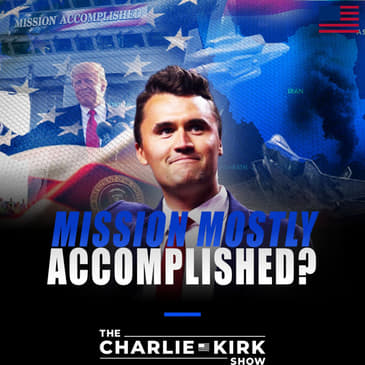
Is the Iran campaign mostly complete, or just ramping up? The show discusses President Trump's latest comments on the conflict, then lets Sen. John Kennedy and Energy Secretary Chris Wright join in. Plus, today marks six months since Charlie's assassination. The show commemorates Charlie, and talks about what is becoming a worrying threat to holding his killer accountable: The far left's embrace of jury nullification to let their radicals get away with their crimes.
Watch every episode ad-free on members.charliekirk.com!
Get new merch at charliekirkstore.com!
Support the show: http://www.charliekirk.com/support
See omnystudio.com/listener for privacy information.
00:00:03
Speaker 1: My name is Charlie Kirk. I run the largest pro American student organization in the country, fighting for the future of our republic. My call is to fight evil and to proclaim truth. If the most important thing for you is just feeling good, you're gonna end up miserable. But if the most important thing is doing good, you'll end up purposeful.
00:00:24
Speaker 2: College is a scam, everybody.
00:00:26
Speaker 1: You got to stop sending your kids to college. You should get married as young as possible and have as many kids as possible. Go start at turning point, you would say college chapter. Go start aturning point youould say high school chapter. Go find out how your church can get involved.
00:00:37
Speaker 2: Sign up and become an activist.
00:00:39
Speaker 1: I gave my life to the Lord in fifth grade, most important decision I ever made in my life, and I encourage you to do the same. Here I am.
00:00:46
Speaker 2: Lord, Use me.
00:00:48
Speaker 1: Buckle up, everybody, Here we go. The Charlie Kirk Show is proudly sponsored by Preserved Gold, leading gold and silver experts and the only precious metals company I recommend to my family, friends and viewers.
00:01:09
Speaker 3: All right, welcome to the Charlie Kirk Show. It is March tenth, twenty twenty six. Welcome Blake, Howdy, it's that time again. Lots to get to you. We got a jam packed show for you. Senator John Kennedy is going to be joining us. And then we've got a crazy story about leftist training juries to let the criminals off the hook. Yeah, it's bad, it's real bad, so we want to make sure we get to that. Then we've got Secretary of Energy Chris Wright joining us. Lots of news about the straighth Horn moves oil prices. We're going to get into it actually with Senator Kennedy as well. It comes from Oyl State Louisiana.
00:01:45
Speaker 2: And then we.
00:01:46
Speaker 3: Have Professor Ray from Hillsdale College gonna give us a whole history of Iran in that region, what this conflict really means for that. So lots of educating today, lots of explaining what's actually going on behind the headlines, because listen, there's a lot of short term push and pool you're gonna feel. There's a lot of Twitter chatter, there's gonna be a lot of social media chatter. There's gonna be a lot of headlines what's really going on, and there are some long term impacts that are gonna be felt. I mean, I kind of liken this too. You know, we live in historic times, Blake, where you could make the argument that Reagan in the eighties gave rise to Clinton's booming economy in the nineties, right, And so we are in that kind of an era where President Trump is doing a lot of hard things. You don't have to agree with everything. I'm not asking you to beat the drums of war. I certainly am not. But when you think about the foundations in the Middle East from an energy security standpoint, from a geopolitical standpoint, we are living in historic times and we have to understand where these pieces will lead, where they are going to take us in the years ahead. So we're gonna educate us, all of you ourselves as well. But first we got to get to what happened. There was another shooting and an American consul at this time in Toronto. Let's get the press clipping. We're gonna explain what's really going on here, clipbait.
00:03:11
Speaker 4: At this stage, I can confirm that the RCMP is working closely with the Toronto Police Service and our international partners who will assist us in a fulsome investigation into the shooting that took place overnight early this morning at the American consulate behind us. At this time, the INSET team has been engaged as this is a national security incident and we're working with Toronto police and others to understand the motivations of those involved.
00:03:41
Speaker 5: All right, use picture of the Canadian Mounty is like slamming the table.
00:03:45
Speaker 2: What could the motive be? So? Yeah, so this is what's so funny about Canada.
00:03:50
Speaker 3: Right, they won't say that it was a Muslim guy who's upset about the Iran conflicts so he went and shot up a US consulate in Toronto.
00:03:57
Speaker 5: Have this guy locked in a room and he'll be like I did it for IS. They'll punch him in the face. Stop speaking in reddles.
00:04:03
Speaker 2: Yeah, what is your motive? We all know what this is.
00:04:06
Speaker 3: Obviously, over the weekend we saw those two young men that were inspired by ISIS propaganda to go throw IDs and a bunch of protesters in New York. And now we have a shooting at a US consulate. There was obviously the Austin bar nightclub shooting where a number of people were shot. If you were killed, we know what the motivation is. So this is essentially the bargain that your leaders have made with you in the West. They've said, don't be racist. You've got to import the Third World, or you're racist and you're gonna like it. Invade you, you know, your your communities, invade me harder, daddy, that's the bargain. Now, what did you get out of that? You got approximately nothing, except now every time the Muslim community feels offended, you have to watch fellow Americans get shot up and bombs thrown at them. So, congratulations, Western man, this is the world that you've created, and for no particular reason. But this is a sad truth of this new reality that we live in. We have a bunch of Muslims all over the country now, all over the West, including Canada, England, France, Germany, And when they get offended there might drive their car into your parade or your Christmas festival. They might shoot up your consulate or throw IDs at you when you're protesting on the street, or they might just be your mayor in New York. So that's the breaking news. It's not good news, but it's unfortunately the reality that we live in.
00:05:35
Speaker 2: Now.
00:05:35
Speaker 3: There is another angle that is also happening, and we're gonna get into this with Senator Kennedy when he joins. But President Trump told some reporters last night that the military mission is nearly complete.
00:05:50
Speaker 2: Now. The markets loved this.
00:05:52
Speaker 3: The Dow Jones was down all day yesterday when shooting back up ended the day up almost two hundred and forty points. Oil, which had spiked almost as high as one hundred and fifteen hundred and twenty dollars a barrel, is down around ninety now. So the war is very nearly complete, is the interesting.
00:06:11
Speaker 2: Way that he put this. So let's make sure.
00:06:14
Speaker 5: He said it's very complete, but also just beginning, which I think, And then a reporter asked him about it, and he said, in the way only Trump can it could be both. Yeah, well both, We're very complete so far and we're just beginning. How complete are.
00:06:26
Speaker 3: The words of Charlie? The unpredictability is the point. But it's interesting to see the markets react to this. Let's see here cut seven on Iran.
00:06:36
Speaker 5: You called it an excursion. You said it would be over soon. Are you thinking this week it will be over?
00:06:41
Speaker 6: To days?
00:06:42
Speaker 7: I think so okay, very soon. Look, everything they have is goun including their leadership. In fact, they are two levels of leadership and even actually, as it turns out, more than that, but two levels of leadership are gone. Most people have never even heard about the leaders that they're talking about. So it's obviously been very very powerful, very effective.
00:07:05
Speaker 3: So yeah, to Blake's point, I think, you know, we had Robert Barnes on yesterday and he was basically suggesting the president could declare victory at any point he wanted at this at this time and use that as an off ramp.
00:07:19
Speaker 5: It seems he could possibly even declare victory while still waging the conflict.
00:07:24
Speaker 3: I actually think there is a strategic brilliance to this though. Actually, I think the President understands that the Navy has been essentially degraded to the point that it's going to take them years, if not decades, to recreate the military infrastructure. I think they've got about twenty percent of the rocket launchers missile launchers remaining. I'm assuming those are going to be some of the cleanup work that's going on right now. The real question, though, is at what point, from a regime standpoint, is victory real. You know, you gotta understand, the regime tried to assassinate President Trump a couple of times at least they are. And by the way, the new leader, the son of Kamanee or whatever, his wife was killed.
00:08:08
Speaker 2: His son was killed. He must ain't killilled.
00:08:10
Speaker 5: No one has seen him yet. He might be a figurehead the president. Look, the President said he it's not going to be a long drawn out conflict. We have to hope that's true. I think it will be politically harmful if it is not true. So of course we want to have this end quickly. I think everyone wants it to end quickly. But the question is is how much will they be able to achieve before they can just say, all right, we're done and go home. But the thing that is inevitably true is it's a lot easier to start a conflict than to end it. And to some extent, as you said, all that all the new Supreme leaders family members got killed. But if he doesn't want it to end, what if he says, I'm going to send suicide bombers everywhere that we can one.
00:08:52
Speaker 3: There's a larger question about what it's going to take to get the population to take back their country or do we even want that?
00:08:57
Speaker 2: Do we even care?
00:08:58
Speaker 3: And it seems that in recent days, last two days specifically, the admin has been signaling that that's not as that's not as huge of a concern as maybe we anticipated at the beginning. Remember, they've lost about fifty of their you know, sort of political leaders, their top brass, so it'll be interesting to.
00:09:16
Speaker 5: See Howdy Blake here. Legacy Box has been a proud sponsor of The Charlie Kirk Show All the Way since twenty twenty one, and we're grateful that they have continued supporting a community that values family and tradition. You know how we talk about protecting what really matters, it's not just finances or politics, it's also your family memories. We all have our old VHS tapes, our old film reels, maybe boxes of photos that are sitting in your closet. But time is not on your side. Those tapes will wear out, the film will fade, and before long, the stories of your own childhood, your parents, and your grandparents, those can all be lost. And that is where Legacy Box comes in. Legacy Box makes it simple. You order their Legacy Box kit, fill it with your old media, and you send it back to them. Their expert team carefully digitizes everything and they return both the originals and a new secure digital version that you can stream, share and keep in your family forever. It's so simple, it's like magic.
00:10:15
Speaker 1: Go to legacybox dot com slash krk to say fifty percent and take care of it today. You'll be glad you did. That is legacybox dot com slash kirk. Legacybox dot com slash krk. That is legacybox dot com slash kirk.
00:10:32
Speaker 8: The brain is an amazing organ It starts working in a mother's womb and it does stop working until you get elected to coms.
00:10:48
Speaker 6: Man.
00:10:49
Speaker 8: I answer your question. Even dunc tape can't fix stupid. If this country was founded by geniuses but it's being run by a bunch of idiots, Anybody who votes for any of these bills without.
00:11:07
Speaker 6: Seeing the fine print is like a rock only dumber.
00:11:11
Speaker 8: Putting the vice president in charge of solving this problem, I don't know.
00:11:16
Speaker 6: It's like making El Chapo.
00:11:18
Speaker 8: The drugs are God created the world, but everything else is made in China. If the Aliens landed tomorrow and said take me to your leader, it would be embarrassed.
00:11:34
Speaker 2: All right.
00:11:34
Speaker 3: We have Senator John Kennedy on his first time on the show, so we wanted to make it special and do a brief montage of some of his greatest hits. Senator, Welcome to the Charlie kirkshawtz an honor to have you. I hope you didn't mind our celebration of some of your quips and whimsies. We love them here and so does the country. Welcome to the show.
00:11:58
Speaker 8: Well, thank you. I would deny everything, guys, but you have the video. Yeah, there's no thanks for having me Andrew.
00:12:09
Speaker 3: Yeah, absolutely, it's honored to have you here, sir. We're you know, there's so much to talk about. You are the senator of a of an oil state, a state that's a lot of its economy is revolves around refineries and shipping, and there's a lot of news right now. So I wanted to get into that as a first step, and then we'll get into some of the DHS stuff. What's going on in Iran, How are you feeling about it? How is Louisiana feeling about it? And give us your perspective.
00:12:38
Speaker 8: I don't want America to be the worlds policeman, but on occasion we have to intervene because one of the bad guys is trying to be the world's policeman. Here's what our intelligence showed. You would think after the curb stomping that America and Israel gave Iran back in June, that they would have learned their lesson.
00:13:09
Speaker 6: They didn't.
00:13:11
Speaker 8: Our intelligence showed that Iran had restarted its nuclear weapons program. It was producing between two hundred and six hundred missiles a month. Its goal was to stockpile so many drums and so many ballistic and cruise missiles that it could threaten to destroy the entire Middle East if anybody interfered with their renewed efforts to get a nuclear weapon. That's not a world that's safe for America. The President, in my opinion, did not start a war. He's trying to prevent a war. It will be a limited excursion. So far, we've destroyed seventy five percent of their missile launchers. We're destroying their missile manufacturing facilities, their drone manufacturing facilities, their new efforts to get a nuclear warhead. We're destroying all of the infrastructure for the Revolutionary Guard.
00:14:30
Speaker 6: I think that.
00:14:30
Speaker 8: Will be complete, gentlemen, in the next few weeks, and then I expect the President to withdraw. I do not believe he will send troops. If he sends troops, the thud you hear will be me face planning from surprise.
00:14:53
Speaker 2: Please don't do that.
00:14:55
Speaker 3: But I think that's a really good assessment. And I think that you know, when conflict started, I felt that the it had not been sold properly to the American public. I trust the President and his instincts, and we have his back, but I did not feel that it had been sold properly. I do feel that comments from Senator Secretary of Rubio, from JD. Vance, from Secretary of Hegseth have completed the picture. And I think you've done a beautiful job there. Senator the question Andrew.
00:15:25
Speaker 8: If I could say, if I can say this, I think you're I think.
00:15:28
Speaker 6: You're you're, you're you're dead on there.
00:15:31
Speaker 8: Look, we both know the president UH as long as I've known him. He one of his character traits is that he grows anxious when he has an unexpressed thought. He has no filter, and sometimes that prevents him from articulating a message that is as tight or coherent as we would like.
00:15:55
Speaker 2: UH.
00:15:55
Speaker 8: Rubio is there to help. UH headset there to help. And what I just told you is what we have been told by the administration in classified and unclassified briefing.
00:16:11
Speaker 2: Yeah, I think you are a great messenger.
00:16:15
Speaker 3: It's one of your hallmarks, and I think you've done a very good job of that right now.
00:16:20
Speaker 2: Now.
00:16:20
Speaker 3: The question, though, is there's also a political calculus. And one of the things that I've been aware of is that this could be the absolute spot on right decision from a national security perspective, but it could have political ramifications. I can tell you, Senator that you know, the gen zers that we're talking to on campus are students. They're telling us that young people they don't want this conflict, even those that voted for President Trump do not want this conflict. What would your message be to gen zers watching and listening that are skeptical of any war.
00:16:55
Speaker 8: Well, look, those are fair questions that are being asked. People remember well Afghanistan, people remember well Libya, people remember well a Raq. Those are very fair questions.
00:17:14
Speaker 6: What I would tell them is the truth. What I just said.
00:17:18
Speaker 8: I'm not going to repeat it. This is a limited intervention. It's not something we wanted. We negotiated with the late Ayatola, who's now who's now as dead as Woodrow Wilson, and I don't wan't shed a tear for him.
00:17:39
Speaker 6: We negotiated with him for weeks.
00:17:42
Speaker 8: He said no to everything except once, and it became clear that we were going to get nowhere. I would like to see the president. He hasn't asked me for advice, so you know, I'm gonna offer it anyway. I would like to see the president address the nation and say here's why I went in and here's when I'm coming out. Uh, here's what we've accomplished. Here's my objective.
00:18:10
Speaker 3: Uh.
00:18:10
Speaker 2: Senator.
00:18:10
Speaker 3: So we've been told, we played the clip before you joined, that you know this could be nearly complete and that it's going to be short. So now we're hearing the messaging kind of pivot. There's a little bit of a pivot in the messaging. What what does success look like in this conflict? If Comani's son is still, you know, the the new supreme leader.
00:18:31
Speaker 6: Well, here here's what success looks like to me.
00:18:34
Speaker 8: And I don't speak for him, but I think it a President Trump would would agree. Successful to me is Iran or the political theological leadership in Iran having four wheels down and they're actual dragging drone manufacturing facilities gone missile manufacturing facilities gone, new steps to obtain a nuclear warhead gone, Ranian Navy gone, I Ranian Air Force gone. As much infrastructure as we can find for the Revolutionary Guard gone.
00:19:15
Speaker 6: And then the good people, and they.
00:19:17
Speaker 8: Are good people of Iran who don't want these uh, these these knob heads running their country any more than anybody else in the world does, will have an opportunity, perhaps maybe to to choose their own government. Success to me looks like a few more weeks. I don't want to leave too soon, just because of my democratic colleagues are screaming like they're part of a prison right. They're not going to support anything that President Trump does. But but that's what success looks like to me.
00:19:55
Speaker 5: I guess rational consider a lot of people have is if we if we even if we do all that destruction, if we come out and the regimes is still in place and still despises us, would we be able to go back? I guess I would just be worried. Is this just a giant, a bigger version of what happened last summer? Where we go in and we break a lot of stuff, but the fundamental problem is still there and might even hate us a lot more.
00:20:22
Speaker 9: Well.
00:20:22
Speaker 8: I supported what we did last summer, and I support what we what we're doing now. I'm not gonna repeat everything I just said. The question I think most fair minded people have to ask themselves is is the world better off after we leave around this time? Having done what I just said we were going to do, and we're doing it, We're almost done. Is the world better off?
00:20:49
Speaker 9: And?
00:20:49
Speaker 8: I think the answer and are the Iranian people better off? Have we completely solved the problem? No, it's going to take regime change, but the people of Iran are going to have to determine that they want resume change.
00:21:04
Speaker 2: Look, the.
00:21:07
Speaker 8: New Supreme Leader just like the old Supreme Leader. They believe that their God tells them to kill everybody who doesn't agree with them, not just Americans, not just Israelis, even their fellow Muslims. I don't think any fair minded person believes that they are not trying to obtain.
00:21:30
Speaker 6: A nuclear weapon.
00:21:32
Speaker 8: I don't think any fair minded person believes that if they obtain a nuclear warhead and the missile technology to deliver it, they will use it and once they get it, I don't think any fair minded person believes that that will not lead to nuclear proliferation.
00:21:48
Speaker 6: Every country in.
00:21:49
Speaker 8: The Middle East will obtain a nuclear weapon, so will Japan, so will South Korea, so will Australia, and then it's off to the races. We have a chance to stop it. Does it necessarily mean regime change? I don't know, guys. I hope so, but you know I have to I can't predict the future. I have to wait for it like everybody else.
00:22:13
Speaker 6: Let me say it again.
00:22:14
Speaker 8: I don't want America to be the world's policeman, but there are times that we have to intervene to keep the bad guys from being the world's policeman. And this is one of those times. Yeah, and let me just say I talked about this in my book.
00:22:31
Speaker 6: I don't know why this.
00:22:32
Speaker 8: I don't know why this is, guys, but there's some people in this world. They're not mixed up, they're not confused, they're not sick. It's not that their mama and daddy didn't love them enough.
00:22:44
Speaker 6: They're just bad people.
00:22:45
Speaker 8: If I make it to have and I'm gonna ask God why some of them run countries and if you weakness around them invites the wolves. Every single time, you have to be careful. We don't want another war in the Middle East, but this limited excursion is necessary.
00:23:08
Speaker 3: I think that's so well said. And the title of your book is just too good. We have to I have to mention it how to test negative for stupid and why Washington never will and.
00:23:20
Speaker 2: By Senator John Kennedy. Everybody check it out.
00:23:23
Speaker 3: Senator, you did the country a great service, and I'll explain why I think that in just a second. But you had a questioning a line of questioning that led to a series of events at DHS, and I'm going to play that clip for everybody.
00:23:38
Speaker 2: Cut three.
00:23:39
Speaker 8: You're testifying that President Trump approved this ahead of time.
00:23:44
Speaker 6: So I m to understand.
00:23:46
Speaker 10: We had conversations about making sure that we were telling people.
00:23:50
Speaker 8: No, ma'm I'm I asking you a short interrupt, but the President approved ahead of time. You spending two hundred and twenty million dollars running TV ads across the country in which you are featured prominently.
00:24:04
Speaker 10: Yes, sir, we went through the legal processes, did it?
00:24:09
Speaker 6: Yes? He did.
00:24:11
Speaker 10: Yes, Okay, And one thing Senator I think would be helpful to know is how effective that communications has been.
00:24:20
Speaker 2: Senator Obviously that interaction led to.
00:24:24
Speaker 3: Your colleague, Senator Mark Wayne Mullen being announced as to the new DHS secretary.
00:24:30
Speaker 2: So I have a I have a.
00:24:31
Speaker 5: Question, what do you have against Senator Mullen poising him into the bureaucracy.
00:24:42
Speaker 6: Look, I accept for responsibility for that. That was me.
00:24:47
Speaker 8: Nobody put me up to it, Nobody asked me to do it, nobody approved my questions.
00:24:53
Speaker 6: Uh, that was me.
00:24:56
Speaker 8: Uh, I have I have a lot of gratitude to the former secretary in her department for securing the southern border. Actually was President Trump who secured the southern border. She and her team implemented his policies. But there are management problems at the Department of Homeland Security.
00:25:17
Speaker 6: I only got to talk about two of.
00:25:19
Speaker 8: Them in the limited time I had, But there are others, and they are distracting and we're distracting from President Trump's agenda and our agenda to make this country better. Number two, A quarter of a billion, not a million, quarter of a billion dollars to run ads in which the secretary starred. To me, they looked like political ads. Quarter of a billion dollars and apparently they weren't bid out, and they allegedly went to.
00:25:58
Speaker 6: Friends of hers.
00:26:00
Speaker 8: Consider that spending porn the President didn't approve it. I'm gonna call out spending porn every single time, doesn't matter who doesn't. And you can write that down and take it home to Mama. And if somebody gets upset about that, they need to fill out a hurt feelings report because I'm gonna keep doing it. And that's all that it was to it. It wasn't some deep dark agenda. It was meet my doing. Some liked it, some didn't. But I will tell you this, I've seen President Trump mad before, but this time, as I said the other day, he was mad as a murder hornet.
00:26:44
Speaker 2: Yeah.
00:26:45
Speaker 3: Well, interesting background that you were probably not aware of. We spent the whole day before the announcement was made that there was gonna be a change of leadership calling this out. And why it was so important was because the Democrats have known about this stuff and they were waiting to pounce. And if they get power in after the mid terms, god forbid, they were going to use this against the President and you. So you did the nation of service, and I'll prove it to you. Here's Jamie Raskin in the House cut.
00:27:17
Speaker 11: One investigation into the hundreds of millions of dollars that Secretary Nome channeled to various political friends and intimates of hers, so that that money can be reclaimed for the American people. Hundreds of millions of dollars might be a joke to somebody in the Trump cabinet, but it's not a joke to the American people.
00:27:39
Speaker 3: And I've been hearing rumors, Senator that they were going to use these for impeachment, maybe impeachment of Nome, maybe impeachment of President Trump. So you getting ahead of this did a great service to the country, and I genuinely thank you for it. And it's no disrespect for some of the achievements, but yeah, we'd have been here in rumblings ourselves, and so I think you did a really great thing and it showed a lot of courage. So the question is you had you had a hearing this morning where somebody was saying that the judges, the judicial activists that are fighting ICE and deportations are braver than our ICE agents, and you you said that that guy triggered your gag reflex. I thought it was another brilliant line. Tell us what success looks like at DHS deportations. It's one of the central planks of the President's agenda.
00:28:28
Speaker 8: Legal immigration is legal illegal immigration, you see I legal?
00:28:33
Speaker 6: Uh duh.
00:28:35
Speaker 8: Our immigration laws are not some second tier statutes that people can violate without consequence. We need to enforce our immigration laws. Number two. How you enforce the matters, they have to be enforced in accordance with due process, with equal protection, uh, in accordance with the standards set forth for reasonable suspicion in the Supreme.
00:29:01
Speaker 6: Court case of Terry Vill Ohio.
00:29:04
Speaker 8: If you want to protest them, you have every right as an American. You do not have the right to protest violently. Violence undermines the morality of what you say your movement stands for. Gandhi knew that doctor King knew that Mandela knew that protesting violently is also exquisitely stupid.
00:29:35
Speaker 6: You're going to get hurt.
00:29:37
Speaker 8: Most cops that I know, the vast majority, will leave you alone unless you do illegal stuff. And then if you do illegal stuff, they're going to enforce the law. That also seems to me to be a matter of common sense. I think Mark Wayne will bring some common sense back. I think Mark Wayne trusts Tom Holand, who I think has done an admirable job.
00:30:00
Speaker 6: I think he will be firm.
00:30:01
Speaker 8: I think he will be fair, and I think he will be confirmed by the United States Senate. I think the President has chosen him well. He's tough as a pine knot, and I hope he gets you confirmed quickly.
00:30:17
Speaker 3: Senator, one last question for you, and I know you got to run here. There is some rumors of what if any sort of deals could be made with these blue jurisdictions, the sanctuary cities and sanctuary states, and to get them to cooperate. Some people have mentioned that we might have to offer up a pathway for dhaka.
00:30:37
Speaker 2: Recipients or something.
00:30:39
Speaker 3: Right, these are things that are going to grade against the base the people in this audience. Do you feel like some sort of deal needs to be made in that way or is that what they're going to demand? How can we get the Democrats to even fund DHS. There's a lot of questions here, but is there anything that you'd be willing I know you're not the secretary, but is there anything that you'd be willing to offer up in exchange for getting them to cooperate with ice detainers?
00:31:06
Speaker 8: Don't I don't think there's anything we can't offer up. I wouldn't support, offering them up anything. Most of these people believe in open borders. They believe in They are also the ones who told us to defund the police. We've seen that vampire movie. We know how it turns out. They also that now they want to defund ice. That's ultimately what this is all about. You can't reasonable people like that. If if I were king for a day, I'm not, don't aspire to be, I would. I would use every legal mechanism I could to withhold their money, because what they're doing refusing to enforce federal law, not changing it.
00:31:49
Speaker 6: They are just.
00:31:50
Speaker 8: They think they're smarter and more virtuous than the American people, and can and can pick and shoes among which of our laws they think are just or unjust.
00:32:00
Speaker 6: I would withhold their money.
00:32:02
Speaker 8: Many of these people, many of these people think America was wicked when it was founded, and it's more wicked today.
00:32:09
Speaker 6: I don't know, not all of them, but many of them do that.
00:32:13
Speaker 8: They're they're they're they're they're king of the hill, top of the lists.
00:32:19
Speaker 6: Crazy. I'm sorry, but that's the way it is.
00:32:23
Speaker 8: And I don't think anything we offer them will get them to change their minds Now, It's not all my, my, my, my Democratic friends, but there's some of others are just scared guys. The Karen wing of the Democratic Party wants to defund ice, and the Karen wing of the Democratic Party has told all all the elected officials who happen to be Democrats that if they don't do their best to defund ice, they the Karen wing will will punish them the rest of their natural lives. And they're scared.
00:32:54
Speaker 2: I think you're right.
00:32:55
Speaker 3: The radical left wing fringe of the Democrat Party or the progressive coal controls the party. And sometimes I wonder about our own side.
00:33:04
Speaker 2: Senator. You know, we're talking about this.
00:33:06
Speaker 3: Everybody wants to Save America Act Pact passed, and it seems like I just we can't make any progress on it, and this audience is frustrated by that.
00:33:16
Speaker 2: I'm frustrated.
00:33:16
Speaker 8: Well, I think you'll see some progress soon. I support the Save the Act. I'm a co sponsor. Here's what I think we ought to do. I think I'm in the minority. The short way home here is a reconciliation. If we do do it, the reconciliation, we only need fifty one votes. Some of my colleagues say, Kennedy, you know that's crazy. It'll never never pass muster under the Budget Controlled Actor, which is one of the parameters on your ability to do something to reconciliation.
00:33:51
Speaker 6: There's what I say.
00:33:53
Speaker 8: Look, I've seen things pass muster under the under reconciliation and what we call the bird Bath that I never thought had a chance. And I've seen other things that I thought were slam don't get turned down. Uh if if if I were king for a day, I'm not, but I would go hire the best legal minds I could find for us to craft a provision around the Save Act that would pass muster under the Budget Control Act and and would survive a bird bath. And I would take our shot. And I don't know why we haven't done that.
00:34:33
Speaker 6: We could have done it weeks ago.
00:34:36
Speaker 8: I'm not criticizing anybody, but that's just the way I would do.
00:34:39
Speaker 3: It, Senator John Kennedy, Thank you so much, sir, And again your book. I want to make sure I get the title because it is a it is a good title, How to test negative for stupid and why Washington never will Uh God bless you again, sir for your your your questioning, your honest questioning I think you did the nation of a tremendous service, and thank you for articulating the vision I think that you have that the President shares in Iran.
00:35:07
Speaker 2: I think it's the right one. So God bless you guys.
00:35:10
Speaker 6: For good man, I'll listen to you all the time.
00:35:12
Speaker 2: Thank you, Thank you, sir, God bless you folks.
00:35:17
Speaker 3: Let me tell you something straight up. I'm extremely picky about what I put in my body in what companies we support. Here, Blackout Coffee checks every single box. This is a family run American company roasting fresh coffee in the USA, built by people who believe in hard work, freedom and America. No global corporations, no fake activism, no lectures, just darn good coffee made by Americans for Americans. This is coffee that actually stands for something, and I drink it every day right here on the show. From Morning Reaper and Brutal Awakening to seventeen seventy six dark roasts in their two A medium roast.
00:35:52
Speaker 2: They've got something for everyone.
00:35:54
Speaker 3: They even have instant coffee, real Blackout coffee with no machine, no mess, Just add water, stir and you're ready to roll. Go to Blackoutcoffee dot com. Slash Charlie and use code Charlie for twenty percent off your first order. That's Blackoutcoffee dot com slash Charlie. Blackoutcoffee dot com slash Charlie. And for an even better deal, sign up for Blackout Coffee subscription. Save money, get free shipping, enterned free coffee through their rewards program just for drinking what you already love. Your coffee shows up fresh on schedule and you never run out.
00:36:24
Speaker 1: That's Blackoutcoffee dot com slash Charlie. Check it out promo code Charlie.
00:36:30
Speaker 5: Well, I'm sure a lot of you already know, and remember today is six months since what happened to Charlie, and one of the concerns we all have is making sure that the man who killed him is convicted. And one thing we're all becoming much more aware of is the potential for our jury system to be a weak point in making sure that criminals are held to account for what they do. And so there was a piece yesterday in the Washington Freebeacon. They do a lot of great work about this fact that there is a left wing group training activists on how to undermine the jury system. And so we have the reporter who wrote that, Pisa Thomas Cadanacci. Are you there, Thomas, I'm here, Hey, welcome to the program. So this group Freedom Trainers, why don't you just tell us what they're doing, what they're telling people, and what the ramifications of this would be.
00:37:23
Speaker 12: Absolutely well, I really appreciate you having me on, first of all to talk about this, because I think it's such an important issue and it's certainly something that's going under the radar. So also just at the forefront, I want to say, this is something that I had to do multiple double takes on because I couldn't believe what I was coming across when I was researching this. Essentially, there's a group based in DC that it's focused on DC right now, but it could clearly be something that spreads across the country, and perhaps it has. But what we see is they're working in DC to undermine Trump DOJ prosecutions that are taking place in the DC the Attorney's office. And so what the group does is essentially educate members of the jury or themselves, try to infiltrate juries and went on there. They vote quote in favor of their conscience, not in favor of the law, and obviously this has a number of ramifications. One thing I just want to say, also off off the start, is you know, the the DJ itself is not early an agency that often comments on things like this, But I thought it was very telling that after we reached out, they did want to comment, and they gave a pretty forceful response to our reporting here, saying that they're aware and that they're you know, anyone who engages in this type of activism should be held accountable.
00:38:47
Speaker 5: Is there a way to hold them accountable? Because I suppose what seems like a vulnerability here is, as they point out, it basically is legal to do this to decide you get on a jury and just decide I'm not going to convey for any reason whatsoever. Now, as your piece points out, judges and lawyers will attempt to remove such people. But all their training materials here are basically how to sneak onto a jury so that you can rig the verdict correct exactly.
00:39:16
Speaker 12: And so one thing I will know is in their training materials and in their webinars which I attended, they say that there are sort of unambiguously legal maneuvers that you can take, such as you know, quote educating the public in the way that they're doing handing out flyers in near courthouses. That appears to be one of the main things they do. They camp outside of courthouses during jury selection and try to give pamphlets to prospective jurors. And those pamphlets, which I also obtained, will have all sorts of different, uh you know, legal rationales to try to help jurors you know, vote again their conscience. But in addition to the unambiguously legal that they say, there are the quote legal but risky. This is where the duj could potentially step in the legal but risky are things like discussing this process with jurors before deliberations begin. This is something that's almost certainly happening. But again, no one's been caught doing this or publicly stating that you intend to nullify. That's something that they again they say is legal but risky. I highly doubt that people who want to thwart a duj prosecution are going to just come out and openly say it. But it's that first point discussing nullification with jurors, especially in the process of giving out one of these pamphlets and you know, quote educating that could be a potential hurdle for them in the future.
00:40:49
Speaker 2: You know what just reminds me of is like you know those jurists on the the on the jurors rather on the O. J.
00:40:57
Speaker 3: Simpson trial that were just like they some of them admitted afterwards that they they knew he was guilty, but they just were it was a get back for Ryan King.
00:41:06
Speaker 5: And it's there's a lot of other cases, if you know, every prosecutor in a big city has seen it happen where this and it's a vulnerability because you need the Supreme Court actually confirmed in a case recently, you need unanimity of twelve jurors to convict in a criminal case, and you only need one holdout of those twelve to have a hung jury. And you know, it's difficult to bring a trial, it's time consuming to do a trial. You have to start over if there's a hung jury. And that's what they're telling people in these materials. If you you only need to be that one holdout, and you can just say I'm not gonna convict, I'm not convinced, I'm voting not guilty, and you can blow up the whole case. And we were seeing this over and over with the grand juries, they're not indicting cases the federal government's bringing. But you only need one of these people in the Luigi Manngoni case. You might only need one of these people in the Tyler Robinson case.
00:41:57
Speaker 2: And it's it's scary.
00:41:58
Speaker 12: It's giving people the opportunity, people, people who might have been activists before. It's giving them that sort of like quote unquote legal backing to go ahead and thwart an entire prosecution, regardless of the evidence, and regardless of the fact that the system, the justice system in the US, which we all love, is built on that idea of fairness, and so if people try to undermine that, that could undermine the American public's confidence in the system itself. Also, just give you a few examples. There was the case in DC of the sandwich man who threw a subway sandwich at a National Guard member and the grand jury failed to indict. And this group and their webinars really seems to suggest that this was a case of people who are on the jury who didn't really care about the evidence. They go through this in detail, you know, asking the participants of their webinars about you know, if you were on the jury, what would your excuse be for voting against indictment in this case? And they all kind of list their examples, and then you know, the trainer gets up there and says, well, you can really give whatever or no explanation for your vote. You can just simply vote against if you agree with the guy who assaulted the member of the National Guard. And so that that's one example, and I think that there's going to be multiple of these. They also cite the case of, you know, there was the case of six members of Congress who you know, put out a video saying that members of the military should in many cases reject and turn down orders from Trump himself. And those six members of Congress we were not indicted because a grand jury decided that there was not enough evidence in that case. So there are these examples, and they're happening, and you know, my personal fear when I see this stuff is that you know, it will spread to you know, the Tyler Robins and trial, it will spread to the Luigi MANGEONI, it will spread to a number of other trials. You know, I'm actually an energy reporter, and one thing I've done is report on climate cases in which you know, states and cities accuse the biggest oil companies of causing climate change. And these are cases where billions of.
00:44:20
Speaker 2: Dollars are at stake.
00:44:22
Speaker 12: So if you get one, you know jury that with a couple of people on there who are activists and don't really care about the law, they could actually with their vote, you know, really damage the economy by destroying the oil companies who are probably falsely being accused of causing weather events, you know, like hurricanes. And so I think there's there's really a large impact that this could.
00:44:53
Speaker 6: Have moving forward.
00:44:55
Speaker 2: You got to give it to lefties.
00:44:57
Speaker 5: They are so very or organized in being very evil.
00:45:01
Speaker 2: Yeah.
00:45:02
Speaker 3: They they constantly open up new fronts in the assault on Western civilization.
00:45:07
Speaker 5: And I'll be frank, I think I don't want to soft pedal this. This is one of the things that frightens me the most. I've been thinking about it, you know, coming up for a long time that this is this is a weakness in our system because it is in the constitution that you need a jury verdict to convict somebody of a crime. It is something that's been around in the Anglo legal system for a very long time. And if you have you know, complete polarization a long political lines or along racial lines. Where you can't assemble twelve people to consistently convict someone on any crime that has racial valance or political valance, the country's going to fly apart. And this has happened before in I believe Ireland under the British there would be terrorist attacks on like British officials and like juries would just not convict and so they basically had to revoke the right to a jury trial in Ireland to make sure they could convict people of crimes. In Britain. Right now they're trying to revoke the right to a jury trial for any crime with a sentence of under three years. They're just the general decay of their system. And so this is a very judges judged and yeah, we have judge problems. And this is a right that has been so integral to American civilization Western Anglo civilization for so long and now we're seeing it being used to further tear it down.
00:46:28
Speaker 3: Yeah, I think the left go back. I mean, it's probably dates back further than that, but you know, you see the rise of critical theory in the in the law schools going back to the nineteen eighties. They've identified our judicial system and our criminal justice system as a point of weakness for a long time that they're looking to exploit. You know, it makes you think of the John Adams quote. You know that the our founding documents are only you know, good for moral and upright people, right, they're wholly inadequate for any there any other. So it makes you nervous when you see the degradation of our people that then filter into the system that we need to function correctly. Final words here, we got to get ready for our two here in Secretary Chris Wright, who's coming up next, but the floor is yours to wrap up this this Yeah.
00:47:18
Speaker 12: I'll just think three quick points here. At number one, this group Freedom Trainers is housed at a larger, pretty major nonprofit called Community Change. Community Change is funded by kind of all the usual suspects, Rockefellers, the Arabella Network, Open Society, which is George Soros's network, and then Hansuergweeze's network as well, who's another foreign billionaire influencing American politics. Number two, they say they've already trained hundreds of thousands of people, which is a little alarming. And number three, I will say that. One of the leaders of this group and someone named Maria Stephen. She was on The Colbert Show recently as a sort of what he described as a non resistance or a non violence resistance scholar, whatever that means, and she talked about the dangers of ICE and how ICE officers can again reject orders from their higher ups in their course.
00:48:25
Speaker 6: Of doing business.
00:48:26
Speaker 12: So those are kind of three points I wanted to make to kind of show people how prevalent this is right now and how really we need to start becoming more aware of this.
00:48:37
Speaker 3: Those are really salient points, So thank you for adding those. You got to believe that there's got to be some law that these people have triggered that we can prosecute.
00:48:47
Speaker 5: It's using really hit the historic strengths of our system against it.
00:48:53
Speaker 3: Oh it's kind of like immigration. H Yeah, kind of like our compassion or openness. Thank you so much. This is super fascinating, terrifying, but important for us to go through. So thank you for making the time. And sorry the schedule got pushed back.
00:49:07
Speaker 2: A little bit there. Awesome. Keep up the great work.
00:49:14
Speaker 5: The online world moves fast, and it's moving even faster these days. That's why TikTok approaches teen safety with families in mind from the start, because discovery and creativity are both wonderful things, but it's important to make sure that safety comes first as well. On TikTok, teenagers have over fifty built in protections right from when they join. Accounts routines all start private by default, They're not open to the entire world, and for those under sixteen, direct messages are turned off. Only their friends can comment on their videos. And that kind of approach matters because feeling confident and comfortable about these platforms your teenagers are on shouldn't mean digging through a bunch of menus and trying to set everything up yourself and worrying that you got it wrong. TikTok is taking a proactive approach. Their protections are built from the moment those teenagers join, so that safety and peace of mind for parents is there right from the start. All of this is to say when safety comes first, discovery and creativity can follow without fear. Learn more by going to TikTok dot com slash guardians guide. That's TikTok dot com slash guardians Guide.
00:50:24
Speaker 3: We should be joined shortly by Secretary of Chris Wright, Department of Energy.
00:50:30
Speaker 2: Secretary of US Secretary of Energy.
00:50:33
Speaker 3: Big big job right now, because everybody's talking about oil and I just checked it.
00:50:39
Speaker 2: It is down eleven percent today.
00:50:43
Speaker 5: It's all over the place.
00:50:44
Speaker 2: It's down.
00:50:45
Speaker 5: Every single commodity is now just another cryptocurrency swing. You're so twenty five percent today, you know, just cause no, you're absolutely right.
00:50:54
Speaker 3: It's it like we talk about how our brains get impacted by social media and by everything being digital, and these things used to move like an oil taker slowly, that they would turn slowly, but now everything's so quick.
00:51:07
Speaker 2: You had a spike.
00:51:08
Speaker 3: So on March it looks like six at some point it went from about eighty seven dollars a barrel to one hundred and seven. Now on some of the I think after hours trading, it spiked all the way up to almost one hundred and twenty. But now it's been slowly coming down. It's back at eighty four seventy three. That is Brent crude oil per barrel. There it is, and it's going down. So we're gonna have secretary right. It looks like he's just getting seated. So they're gonna give me the go ahead and just a second there. But this is the big job right now for this administration. There's a whole bunch of education that needs to happen. And hopefully Secretary Right can walk us through how the price of oil then is translate it's delayed which a lot of people don't realize, into the price of the pump, and what we can do to bring down those costs, what we can do to get the straight of horn Moose, which is effectively blocked right now. How do we get that opened up? What is it going to take.
00:52:12
Speaker 2: Is it insurance, ensuring the tankers? Is it? Is it working with the oil companies? Is it?
00:52:17
Speaker 3: Do we just have to keep bombing the hell out of Iran until they relinquish? All right, I'm told Secretary Chris Right is ready. Welcome back to the show. Secretary, you have a huge job right now. You're looking at Venezuela, you're looking at Iran, you're looking at your pride. You're making a lot of phone calls, so thank you for making the time.
00:52:38
Speaker 2: Tell us.
00:52:38
Speaker 3: So the price of Brent crude is at eighty three forty four right now, it's coming down.
00:52:44
Speaker 2: What's it? Why is it coming down? And what more can we do.
00:52:47
Speaker 13: Well, Andrew, thanks for having me.
00:52:49
Speaker 9: I appreciate you, appreciate all your viewership.
00:52:53
Speaker 13: So yeah, the.
00:52:53
Speaker 9: Straits of Hormus that most of the Middle Eastern crude flows through have been effectively close since this conflict started.
00:53:02
Speaker 13: That's what drove them up.
00:53:04
Speaker 9: And of course the biggest answer here is to end Iran's ability to attack the United States bases, terrorize their neighbors, and threaten oil supplies.
00:53:16
Speaker 13: That they've been doing for forty seven years.
00:53:19
Speaker 9: So right now, you know they are uncontrolled and they have so much armaments they're able to scare shipping traffic off. But every day, every hour, we're degrading the Iranian nation's ability to terrorize their neighbors, threaten energy supplies, and kill American soldiers. This has been a forty seven year long conflict. They've always put a premium on raised energy prices higher than they should be because Iran always had the risk of this sort of wanton projection of their power over this critical waterway. And so why they've treated in the short run is the United States, in consultation with a bunch of other nations that are part of the International Energy Agency, have agreed or are in the process of working an agreement to release oil out of strategic petroleum reserves to replace a fair amount of the lost crude oil coming out of the Strait, so that will keep global oil markets supplied going forward.
00:54:26
Speaker 13: There are oil stores around the world.
00:54:30
Speaker 9: We do have surplus oil production capacity in the world, but a lot comes out of the Strait of Hormuz. So the price and fear factor are raising prices because of the lack of flow of energy. But ultimately, we need to degrade Iran's military ability to do what they're doing today and what they've threatened to do and on and off done for forty seven years.
00:54:52
Speaker 3: So with a solution, I've heard different ideas floated out ensuring insurance for these tankers, I've seen potential military escorts. Are any steps being taken on either of those two fronts?
00:55:08
Speaker 13: Oh?
00:55:08
Speaker 9: Absolutely that those were the first steps we announced. I was saying the recent movement in oil prices was because of the potential release coming. The first things we announced was the commercial insurance market for ships. You know, rates were going up and it wasn't clear if that market was really open.
00:55:26
Speaker 13: So we've offered to reinsure the insurance.
00:55:28
Speaker 9: Companies which will allow the insurance market to open back up. But tied together with that is people will transit the straight when they believe the risk is relatively low, so it's physical security for the ship captains to go through. Now, we've had a large oil tanker went through the straits forty eight hours ago.
00:55:48
Speaker 13: We have others that are interested to try to do.
00:55:52
Speaker 9: That, but you know, that's not clear yet whether we've degraded Iran's capacity to cause trouble enough to make transit safe. One has gone through and it worked fine, but you know there's still risks there.
00:56:08
Speaker 13: Every day we're degrading them.
00:56:10
Speaker 9: But when we degrade them enough that it seems like a ship escort with the US military is enough to ensure safe travel.
00:56:17
Speaker 13: That'll be a great day. And I think that's not too far away. But you know, somehow we need to get that energy flow into the world again.
00:56:25
Speaker 9: And of course the US has a lot of levers to pull and are act.
00:56:28
Speaker 13: And are working this.
00:56:29
Speaker 3: Every day every day, So the Secretary the you know, there's a whole piece to this where I think the average American consumer is a little uneducated about the price fluctuations. Right, So we've seen the price at the pump go up, and I noticed that it was up even further today, even though the price of Brent has come down. Can you just educate us on the time delay? How does the pricing work? Because you know, the left will always say that the oil companies are conspiring against and you know, using fear in the market to you know, price gouge us and make a bunch of extra profits.
00:57:06
Speaker 2: What's really going on?
00:57:07
Speaker 13: No, this is just markets. This is supply and demand.
00:57:11
Speaker 9: You know, if you raise your gasoline prices up really fast before your cost of crude has gone up, your neighbor next door is going to eat your lunch by keeping his prices a little bit lower than your prices. And gasoline is separate than crude oil. You know, the US exports gasoline, we import gasoline. Gasoline is traded all around the world. It's very tied to the price of crude, but there are times where gasoline prices, you know, trade with different time lags and sometimes even different directions than crude price. In the long run, they're very tied together, but they're separate markets. And the market for diesel is separate, and the market for jet fuel is different as well.
00:57:52
Speaker 13: But Andrew.
00:57:53
Speaker 9: One key thing to think of here, we're going through a short term dislocation and we are all feeling it. The President is keenly aware, I think, as everyone knows of gasoline prices and diesel prices and costs for American consumers.
00:58:06
Speaker 13: He is keenly aware.
00:58:08
Speaker 9: In fact, it may seem backwards right now, but this war is the large part because of the President's concern of energy prices for American consumers over.
00:58:17
Speaker 13: The long run.
00:58:18
Speaker 9: Iran, who has been a threat to oil supplies, Iran who's driven the previous price price spikes in the late nineteen seventies.
00:58:27
Speaker 13: That was Iran that led to that huge.
00:58:29
Speaker 9: Price bike and the gas lines and all that.
00:58:31
Speaker 13: That was Iran.
00:58:33
Speaker 9: The President seeing, boy, that same nation is arming itself massively with missiles so that they can make it so hard to attack them that no one will, so they can finish building.
00:58:44
Speaker 13: Their nuclear weapons.
00:58:45
Speaker 9: Imagine a nation that's so trouble oriented to have nuclear weapons and a massive weapons arsenal.
00:58:53
Speaker 13: They could dictate to the world the price of energy.
00:58:56
Speaker 9: And I think previous presidents were just kicking that can down the road.
00:59:00
Speaker 13: Well, it didn't blow up on my watch.
00:59:01
Speaker 9: And that's kind of a risky thing, and they've kicked it down. They kicked that can down the road. This president's bold. He thinks about American consumers, and he thinks long term, that is not a situation the US wants to go into.
00:59:15
Speaker 13: They're they're arming themselves so hard right now.
00:59:17
Speaker 9: In the negotiations, they weren't indicating any willingness to not be massively armed and ultimate possessors of nuclear weapons. And I think he rightly saw this window could close. This window could close. They could rain hell on our soldiers and make it very hard for US to push back on them, and they could dictate global energy prices, and that's not tolerable to President Troup.
00:59:39
Speaker 2: Let's talk geopolitics here.
00:59:41
Speaker 3: We saw what happened in Venezuela and that incredible military precision. We're all in awe of our military. But that opened up a new supply with a cooperative country. Have you seen the impacts of that yet? Are we still kind of ramping up there?
00:59:57
Speaker 9: Yeah, oil production is rising in Venezuela and we're I'm thrilled to see that so quickly, you know, But to meaningfully add the global supply, that's sort of six twelve eighteen months. It's not many years. We'll see hundreds of thousands of barrels a day of additional production out of Venezuela before this year is over. Very excited about that, and of course, a huge reduction in drug running. It was just out of some of the Americas and they said the murder rate has plummeted in Trinidad and Tobago because of the president's enforcement against running drugs on boats in the ocean there north of Venezuela.
01:00:31
Speaker 13: So look, great progress in Venezuela. Great progress.
01:00:34
Speaker 2: Well, that's great to hear. I mean, it seems like it could.
01:00:38
Speaker 3: Be the model in a place like Iran, potentially if we get a leadership there that's also willing to cooperate. I'm skeptical that we're there yet, but obviously that's the hope that this would be the last time we'd have to deal with a bad actor that's sowing terrorism throughout the region. But I mean, could you in theory not see regime change and still get the ultimate result that we want, which is an end to the conflict, an end to the destruction and end to the violence and the end of the terrorism, and then a cooperative potential partner in that region. Let's talk about potential positive outcomes in Iran if you don't see regime change.
01:01:17
Speaker 9: Yes, Look, of course, this operation was not premised on regime change. It was premised on they're building up such such a daunting supply of missiles that is, shielding a nuclear program.
01:01:29
Speaker 13: That's just unacceptable.
01:01:31
Speaker 9: Whoever rules Iran cannot have an impenetrable mass of missiles with a nuclear weapons stockpile behind that. So if we get a better regime, that would be great. But as you said, we might get remnants of the existing regime. But they're so defanged in their ability to project power to support the terrorist proxy groups around the Middle East that they pivot their behavior. How are they going to stay in power in their country if they're poorer, if they're not as much of a military power, they better start to live in a little better lives for their people. So we have to degrade their military capacity. That is the ultimate job of this mission. But achieving that mission may have positive spinoff effects as well.
01:02:17
Speaker 3: So we're told that China gets about seventeen percent of its energy from Venezuela and Iran. Right, they were getting cut rate prices black market sanctioned oil.
01:02:28
Speaker 2: What explained to the audience.
01:02:30
Speaker 3: What this means from an energy standpoint for the CCP and Jijiping. What are the felt impacts here and what are the long term impacts.
01:02:40
Speaker 13: Yeah, this is not good news for China.
01:02:42
Speaker 9: Certainly, China has three discount oil suppliers, Venezuela, Iran, and Russia. Venezuela is no longer a discount oil supplier to China. In fact, most of Venezuela oil flies to the United States because it's cheaper to transported here and it all sells at market prices, so it's no longer cheap oil for China. China's not happy about that. They've they've lost a client state in the Western Hemisphere, as has Russia and as has Iran. So Venezuela is not just good for energy, it's good for geopolitics. So we're thrilled to We're thrilled with that development. I'm sure China is very concerned about the same thing with Iran. They've been getting very discounted Iranian crude and at the end of this, again, we don't know who's going to be leading Iran, but it will be a different Iran than going into this and in Iran with massively shrunk and military capabilities, massively shrunken ability to terrorize American soldiers in the region, their neighbors, and global oil supplies.
01:03:43
Speaker 13: So yeah, it's this. We're changing the calculus for China quite a bit with.
01:03:47
Speaker 9: These two, uh, with these these two changes in posture with these two nations.
01:03:53
Speaker 3: So there was in Iran, Yeah, and there was some news made that you know, we we kind of offered in all of a couple of days worth to Russia. What's the logic there of allowing them to more freely trade oil? Is it just to bring prices down or is there any concern there?
01:04:12
Speaker 13: Yeah?
01:04:12
Speaker 9: No, and so definitely not in all of branch to Russia. This was no change in policy towards Russia. Here's how China treats its discount oil suppliers. You send your crude to us, We'll unload it when we want. We'll let it stack up in convoys, having to wait at sea for weeks or months at a time, because if we knew that, we'll get to buy it from me even cheaper, because you'll be desperate. So there's a lot of just floating Russian oil it's going to be unloaded at Chinese refineries maybe thirty or sixty days from now.
01:04:45
Speaker 13: But yet we have Indian refineries.
01:04:48
Speaker 9: The second biggest importer of oil in the world after China is India. So India was going to shut down some of their refineries, slow their production of gasoline and diesel, which they sell into the global market. That put up prices of for gasoline and diesel even here in the United States. So we said, hey, we're not changing our policy towards Russia, but you know, for thirty days, go ahead and buy that Russian crew that's floating offshore, keep your refineries open, keep your energy production up, and absorb that oil. So it's basically trying to replace or bring forward some of these lost barrels that aren't coming out of the Straits.
01:05:25
Speaker 13: It is not a change in our policy towards Russia.
01:05:27
Speaker 9: There's a lot of floating Iranian crude off the oceans as well. Now, of course we have no change in policy for Iran as well. But if for short oil and we have pragmatic solutions to bring oil to market, you know, we're looking at all of those things. That's about protecting American consumers.
01:05:44
Speaker 3: Yeah, well, that's that's very good insight. Thank you for that. Actually, I think that's an important distinction. People need to understand that this has knock on effects for even allies like India. Last question here, Secretary, I know your time is tight the next steps in this process. I mean, everybody's wondering when this is gonna end. I know you don't have a crystal ball. When will energy prices come back down? When will the price of gas come back down? What's your message to the American people?
01:06:15
Speaker 9: So American people is you know, God bless the American troops, God blessed President Trump's leadership. The military progress has been tremendous. We are massively degrading their ability. You're destroying their missile launchers, their missiles themselves, and their fabrication, their factories that build missiles, that build drones, that build all these weapons. We're just degrading their ability to reign terror on their own citizens, on the American soldiers, and on the nations.
01:06:45
Speaker 13: In that region.
01:06:46
Speaker 9: And at the end of this, we want to remove Iran's ability not just to threaten the military destruction they've done, but also their ability to threaten the flow of energy. Ultimately, President Trump is doing this to low were the long term cost of energy because the biggest threat to the flow of energy around the world is Iran, and Iran is going to be defanged. So this is short term pain a long term gain.
01:07:12
Speaker 3: Secretary Chris Right at the Department of Energy, you're you know, I just want people to understand, he runs the Department of Energy, but he has more energy than just about anybody I've I've encountered in recent memory, but besides maybe President Trump. You know, the President Trump might have more energy, but you are an active, creative, energetic force at the Department of Energy. So thank you for making the time. And I just I think you're you are one of the more fascinating.
01:07:41
Speaker 11: Uh.
01:07:42
Speaker 3: There's so many in the admin. We have some we're blessed to have such a great administration, but you are truly a remarkable, remarkable leader of that department.
01:07:49
Speaker 2: So thank you, sir. We appreciate you taking the time and coming on with us today.
01:07:53
Speaker 9: Thanks so much, Andrew, and you have President Trump is indeed tireless. I can't quite keep up with him, but I'm doing everything I can can to be as close as possible to his work ethic and his energy level.
01:08:04
Speaker 2: But yeah, he is.
01:08:05
Speaker 13: He is a freak of nature.
01:08:07
Speaker 2: Thank you, he is. And you're doing a great job. So keep up the great work.
01:08:10
Speaker 3: I'm sure you'll get those those that price the pump back down soon enough. So God bless you. We'll talk with you soon. Thank you again, thanks so much. As America turns two hundred and fifty, we want to help Good Ranchers take a moment to remember the people who built it, and those, of course are America's ranchers. For over two hundred and fifty years, ranchers had worked tirelessly to feed America through droughts, wars, recessions, pandemics, changing politics. They don't stop and that is the kind of legacy Good Ranchers was built on. Unlike others, Good Ranchers is a meat company that's one hundred percent committed to America, not just in words, but in practice. Every cut they offer is raised on local American farms and ranches, from the pasture to the final seal on every box. So as we head into a year meant to celebrate American culture, Good Ranchers stands right at the heart of that st I am actually a good rancher subscriber myself, and I love how easy it is to manage my orders. When life gets busy or traveling, I have pause or move my order and just if you clicks, it's simple, flexible, and actually built around your schedule. To support a company that honors America's past president and future, visit good Ranchers dot com. When you start your plan, you'll get a you'll get to pick a free meat that will be included in every order for life, and you'll get twenty five dollars off your first order using my exclusive code Charlie. That's Charlie for twenty five dollars off your first order, just to try Good Ranchers out because they're that confident you'll love it. Good Ranchers dot com American meat delivered.
01:09:42
Speaker 2: All right.
01:09:43
Speaker 3: I'm excited about our next guest, Doctor Paul Ray. He's a professor of history at Hillsdale College. He's the chair of the Charles O. Lee and Louis K. Lee Western Heritage Center. He's also the director for the Senator Center of Military History and Strategy.
01:09:59
Speaker 5: Ooh, that sounds fun, So.
01:10:00
Speaker 2: We want to talk to doctor Paul Ray. Welcome to the show. Doctor.
01:10:03
Speaker 3: It's great to have you back. You you are a very accomplished gentleman.
01:10:06
Speaker 6: He thank you, and it's good to be back.
01:10:10
Speaker 2: It's great to have you.
01:10:11
Speaker 3: We want to talk about Iran, and again we're approaching this as an educational segment. We want people to understand Iran better. So what do people need to know about the people in the history of Iran better.
01:10:23
Speaker 14: Well, the first thing to understand is the Iranians are an ancient nation, very much aware.
01:10:31
Speaker 6: Of themselves as a nation.
01:10:34
Speaker 14: If you look at the Arab world, if you leave a side Egypt, none of the countries in the Arab world are really countries in the old fashioned sense of the word. The Egyptians have always been on their own and they have a very powerful understanding of.
01:10:50
Speaker 6: Who they are.
01:10:53
Speaker 14: The rest of the Arabs are part of Islam, and there's no Syria, there's no Iraq, so that's a European creation. But Iran is a nation. And when Islam came to Iran, when they were conquered by the Arabs, they didn't switch their language, they didn't go over to the language of the Qur'an. They retained Persians. So there was a kind of cultural resistance built on a pride in their nation. That's extremely important for understanding them. Now if you look at recent history in that.
01:11:33
Speaker 6: Part of the world, I mean, look.
01:11:35
Speaker 14: They were a great empire in the sixth century BC. It is Iran that was responsible for the Xerxes invasion of Greece. If you look at the recent history of Iran, it's not been entirely positive. It was a kind of plaything. In the nineteenth century the oil in the south, the British exploited that very little to the money went to the Iranian people. And one consequence of this is the Kijar dynasty was overthrown by a general who then became Shaw. And it's the Shaw's father, the father of the Shaw.
01:12:19
Speaker 6: That we knew fifty years ago.
01:12:23
Speaker 14: The Pahlavi family took over and his goal was to restore the Iranian nation, to restore Persia to its strength, and to do that he had to get the Russians out they were threatening in the north, and the English out of the south. And he tried to play with the Germans during World War two was a way of getting rid of the English and the Russians, and the English and Russians joined together and booted him and put his sixteen year olds on the shaw that we once knew in power. Now, these two people, the two Paula Vishas, had a kind of goal for Iran. Their model was Mustapha Camal of the Ottoman Empire and then of Turkey, the man who came to be called Ata Turk. And what they wanted to do is to bring Iran into the twentieth century. So they were major modernizers. At Turk succeeded in this, and he was able to succeed in this because after World War One, the allies that had won that war, the British, the French, the Italians and so forth. The Greeks wanted to split up Anatolia among them, and he was sent. He had been the hero of the Battle of Gallipoli fighting against the British.
01:13:55
Speaker 6: He was sent by the Sultan.
01:13:58
Speaker 14: To disarm the population of Anatolio, and he did the opposite. He turned them into an army. He defeated the Greeks, drove them out, the Italians of the French and the British withdrew, and he created modern Turkey. So he was a hero, and as a hero he was able to get away with a great deal. And what did he try to do well. He tried to push Islam into the private sector to create a secular state. He abolished the caliphate, which went all the way back to the time when Muhammad died. When they set up radio stations right in the beginning. Half of the radio announcers in the nineteen twenties were women, half of them men. Took a long time for Barbara Walters to become an announcer in the United States. Think of that difference. In nineteen fifty there were more women teaching at Turkish universities than an American universities, more women chairing departments in universities than in American universities.
01:15:05
Speaker 6: Same thing was true for Egypt. So there was a kind.
01:15:09
Speaker 14: Of modernizing movement that swept the Islamic world Egypt as well as Iran. But the Pahlavis weren't heroes. They didn't have the advantages he had, and they ran into trouble, both from the British and the Russians, as I explained, but also from the Mullas, who did not want Turkey to be dragged kicking and screaming into the twentieth century.
01:15:39
Speaker 2: Iran, Iran, right, yeah, yeah.
01:15:42
Speaker 6: Iran you're actually right.
01:15:44
Speaker 14: So what happens in the fifties and sixties is that the younger of the two Shaws achieved some success by using the Americans to get the British out.
01:16:00
Speaker 6: Ingements are worked out so.
01:16:02
Speaker 14: That a great deal of the proceeds from the oil that came from Iran ended up in the hands of the government.
01:16:09
Speaker 6: What did they do.
01:16:11
Speaker 14: They built roads, they built schools, they built hospitals. They sent large numbers of Iranian students abroad to study. At the time of the Iranian Revolution in nineteen seventy nine, there were fifty thousand Iranian students study in the United States, and they were buying a great deal for Iran. There were fifty thousand Americans living in Tehran, mostly businessmen, selling them weapons and everything. You could imagine, this attempt to get them rapidly. Moving into the twentieth century upset people. A lot of the students who went to the United States were radicalized and came back wanting to throw out the Shaw. A fair number of them were communists. Then there were the rural people who were devout and the Mollahs. One of the things that the younger Shaw did was called the Green Revolution. He took land away from the great landowners, including the Molas, and he distributed among the peasants of Iran. So what builds up gradually is a kind of explosion. There are two parties.
01:17:38
Speaker 6: To this explosion.
01:17:40
Speaker 14: On the one hand, there's the religious party led by the Ayatollahomeni, who was a man of cunning, ruthlessness and eloquence. On the other hand, there was a mass of people with no particular direction and no particular leader, the people from the leading families in Tehran, the younger people, and the ones who had studied in the United States. The consequence is when the crisis came in nineteen seventy nine, Homiani managed to fool the urban population, this modernizing population, into thinking that they could live with him perfectly. Well, the revolution takes place, the shot is pushed out.
01:18:31
Speaker 6: He was a.
01:18:31
Speaker 14: Dying man at that time, dying of cancer, and Homeni then edges out the urban population and he establishes something like a totalitarian regime. The other day, I gave a talk here at Hillsdale College on this, and I woke up in the morning and I asked myself, I wonder if there are commissars in the Revolutionary guard and in the Iranian Army, that is to say, political officers.
01:19:03
Speaker 6: In Russia. This was the people from the.
01:19:06
Speaker 14: Party who watched over the military guys, watched over all of the officers, and I went to Ai, that source of great wisdom, and on this occasion it really was a source of wisdom because it provided very good detail on this. And yes, there are commissars in the Iranian Army. So this is a regime of surveillance in which the guardians are surveilled also by Mullahs who serve as political officers. They can arrest anyone of the officers of the military officers. They can reverse any decision that a military officer makes.
01:19:48
Speaker 6: This is quite.
01:19:51
Speaker 14: A well disciplined, well organized regime.
01:19:56
Speaker 3: If you knew Charlie Kirk, you knew this. He was a connector. Charlie believed in finding good people and connecting them with other good people that he cared about. When someone truly took care of him, Charlie would never hesitate to recommend them. Andrew Delray and Todd of Akin were two of those people. They personally helped Charlie and Erico with their mortgage needs, and Charlie trusted them completely, whether it was a home buyer trying to qualify or someone needing to consolidate debt or see if they could get a lower rate in payments. These were the guys Charlie sent people to and right now, timing matters. The market has shifted and rates have come down. There's more inventory, bidding wars have cooled, and buyers finally have more control. But that window won't stay open forever. As rates come down, competition will return. That's why being prepared now is so important. Andrew and Todd at Union Home Mortgage bring over forty years of combined experience and guide you through the process clearly, no pressure, no guesswork. These are the people Charlie trusted, and they're the people you can count on.
01:20:53
Speaker 1: Reach out today to get approved for mortgage financing with Andrew and Todd at Andrewintodd dot com or call Triple A Triple as eleven seventy two with forty years of experience, they really are the experts and they make it easy because they keep everything in house. Called Triple eight Triple eight eleven seventy two, or go to Andrewintodd dot com that is Andrewintodd dot com.
01:21:14
Speaker 3: As Blake mentioned earlier, it is the six month anniversary of us. I don't call it an anniversary, It's a six month mark of losing Charlie, and the team has a tribute video in honor of the great Charlie Kirk, our friend. We wanted to play it for you. Play cut ten.
01:21:32
Speaker 1: This is why your faith is the most important thing. You are commanded to go do something productive with your life. You are not commanded to go sit idly by and just receive. You are commanded to go give and to produce, and to risk to then go so into other people. That is a biblical idea that has made the world a profoundly better place. We must put God first in everything that we do. We are nothing here but just for a short instant, short little glimpse. We act not out of outcome, but we act out of obedience. Everybody, this was not earned. You guys were a vessel. We were a vessel. Psalm one, oh seven to one, Oh give thanks to the Lord, for he is good or his steadfast love endures forever.
01:22:19
Speaker 10: I have to say this without getting emotional, but I'm very proud of my husband.
01:22:22
Speaker 11: You are so intentional with your faith and you are so intentional with just how you are as a father and a husband.
01:22:28
Speaker 1: Becoming a father has made me, first of all, understand that what I'm fighting for is beyond even yourself. We do not wrestle against flesh and blood, but against principalities and darkness and spirits, because at its core, what we are fighting is a spiritual battle. And if you're here and you don't believe in God, okay, fine, I'll pray for you, and I hope you find Jesus Christ as your Lord and savior because it will.
01:22:51
Speaker 11: Change your life.
01:22:56
Speaker 13: How do you want to be remembered.
01:22:59
Speaker 1: I want to be remembered for courage from my faith.
01:23:03
Speaker 2: That would be the most important thing.
01:23:04
Speaker 5: The most important thing is my faith in my life.
01:23:13
Speaker 2: We miss you, Charlie.
01:23:16
Speaker 3: Six months doesn't feel real still six months almost exactly. Yeah, lost him on September tenth, and it is March tenth.
01:23:25
Speaker 2: So here's to you, Charlie, and.
01:23:30
Speaker 3: We had to play it. This is his show. It will always be his show, So blake any thoughts, you know it's.
01:23:44
Speaker 5: Eric has said that if Charlie was given the choice to undo what happened and come back, he wouldn't. She thought because of what was unleashed by it. I like to I've gone a couple of times in the last week or so where we have one of the buildings here on the on the campus is just all of the male packages gifts. Yeah, we've received or that people have left outside the campus, which we still encourage people to come. We still see people there. So if you're passing through Phoenix, stop by. We'd love to see people make a visit. Uh But I look at that and you know, we still get the emails as well, you know, people talking about they started going to church because of Charlie, they kept going to church because of Charlie.
01:24:29
Speaker 2: Some of them.
01:24:30
Speaker 5: We even get ones where they say, I'm not really sure if I believe God exists, but I'm still going because Charlie said too. And you know, we want to encourage that, you know, leave your heart open. And we've seen so many cases of that, and I think Charlie would even say, like, if you know, if it would help one other person come to Christ, you know, my martyrdom, you know, it would be worth it. And we're not seeing it's not one person, it's it's hundreds thousands, you know, maybe around the world. Yeah, you know, hundreds of millions, because it is a true it truly did have a global impact.
01:25:01
Speaker 2: Uh.
01:25:02
Speaker 5: And it's also true that because because of what happened to him, we never have to see we never have to see Charlie lose his fastball. We never have to see Charlie get old, become you know, become tired. He's always as he was. He's I would have loved that brave. He's that brave young hero going out onto the campuses speaking to young people, reaching young people. And we'll always have that example.
01:25:29
Speaker 3: Even Doctor Ray, I know you're hanging in there. Maybe a little pivot on the six month mark of losing Charlie. You're a historian. What did what did Charlie's contribution and what happened? What did it mean historically? What in the whole scheme of things? What does it mean to you?
01:25:48
Speaker 14: Well, he started something, and he was sufficiently a force that I don't think it's simply going to stop. I mean, like, you know, you're continuing his show. I was on his show when he was still with us, back in July and August a couple of times, and I was struck by his energy, his sincerity, his open mindedness. He was interested in listening as well as in talking. But the other thing is he was a young man who moved a great many people. And I don't think that's going to stop. And obviously you don't think it's going to stop, or you wouldn't be continuing.
01:26:45
Speaker 6: The Charlie Kirk Show.
01:26:47
Speaker 2: Correct.
01:26:48
Speaker 3: Yeah, And he enjoyed his conversations with you, doctor. I know that you bring a wealth. I literally was sitting here the whole time just you provided context to the Middle East that I was not aware of, between the Turks and the Egyptians and the Iranians. And and he loved learning. He loved That's why he loved Hillsdale. You know, he called it the beacon of the North America's greatest university's college. And you guys are continuing that on and we're continuing to work with you guys, and we're continuing to work with doctor arn and we just really appreciate your perspective. I know this was a pivot that I didn't pref I didn't prepare you for, doctor, but you've you've handled it brilliantly. And it's a credit to Hillsdale College that you are part of their faculty, and you guys can all learn from the great professors at Hillsdale. Go to Charlie for Hillsdale's I didn't you know, it's not why we had doctor ray On.
01:27:46
Speaker 2: We wanted to learn about the history of the region.
01:27:48
Speaker 3: But check it out because Hillsdale is one of these institutions that makes America so special. It preserves it's like salt that you preserve these great ideas is for another generation. So check it out. Charlie for Hillsdale. Final word to you, Professor.
01:28:05
Speaker 6: Ray Okay, I'll tell you a story.
01:28:08
Speaker 14: I spent some years in Turkey eighty four to eighty six, and I went back there in two thousand and two met a group of Turkish journalists, one of Iranian journalists with them, and at that time there were pro American demonstrations at soccer games by just people doing it, chanting in favor of America, and I thought, maybe this is the time the revolution is going to go under And I asked the Turkish the Iranian journalist, and he said no. The people who handle security in Iran were graduate students in Eastern Europe and the communist period. They know how to handle the crowd. And then he added, what they don't know how to handle this their own children. There will be a counter revolution in are, Ronnie said, but it's going to take some time.
01:29:03
Speaker 6: Mm hmm oh, well, some time.
01:29:04
Speaker 14: Has passed, but maybe not enough time.
01:29:07
Speaker 6: We will see in the next few.
01:29:09
Speaker 3: Weeks, doctor Ray, Professor Ray, thank you so much for your time.
01:29:14
Speaker 6: Pleasure to be with you again.
01:29:19
Speaker 2: For more on many of these stories and news you can trust, go to Charliekirk dot com.