
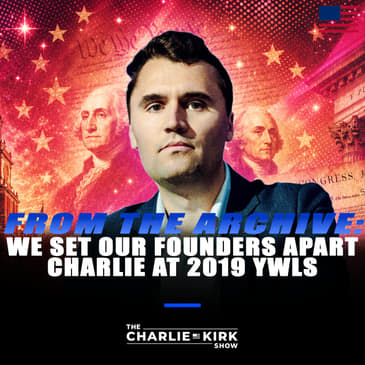
Even back in 2019, Charlie had an exceptional way of explaining what made America exceptional. At one of the earliest iterations of YWLS, Charlie explains what made Washington, Jefferson, and Hamilton so much more remarkable than conquerors like Napoleon or Alexander the Great. Simple: Because they built a limited government that would live beyond them, rather than maximizing power for themselves and their descendants. And as a result, the American republic has blossomed to be the greatest nation in history.
Watch every episode ad-free on members.charliekirk.com!
Get new merch at charliekirkstore.com!
Support the show: http://www.charliekirk.com/support
See omnystudio.com/listener for privacy information.
00:00:03
Speaker 1: My name is Charlie kirk I run the largest pro American student organization in the country, fighting for the future of our republic.
00:00:11
Speaker 2: My call is to fight evil and to proclaim truth.
00:00:14
Speaker 1: If the most important thing for you is just feeling good, you're gonna end up miserable. But if the most important thing is doing good, you'll end up purposeful. College is a scam, everybody. You got to stop sending your kids to college. You should get married as young as possible and have as many kids as possible. Go start at turning point, you would say, college chapter. Go start at turning point you say high school chapter. Go find out how your church can get involved. Sign up and become an activist. I gave my life to the Lord in fifth grade, most important decision I ever made in my life, and I encourage you to do the same.
00:00:45
Speaker 2: Here I am Lord, Use me. Buckle up, everybody, Here we go.
00:00:56
Speaker 1: Noble Gold Investments is the official gold sponsor of the Charlie Kirkshaw, a company that specializes in gold I rays and physical delivery of precious metals. Learn how you could protect your wealth with Noble Gold Investments at noblegold investments dot Com. That is Noblegoldinvestments dot Com.
00:01:17
Speaker 2: Thank you so much.
00:01:18
Speaker 1: It is such it's just it's just amazing to see how this Young Women's Leadership Summit grows year after year.
00:01:26
Speaker 2: And I said this last night.
00:01:27
Speaker 1: I want to say it again now to the entire audience, just the people that make this possible, our donors and our supporters, and our board members, those of which that that we honored last night, and those of which that wish to you know, remain in the in the not not on the forefront of that.
00:01:45
Speaker 2: Thank you.
00:01:46
Speaker 1: Thank you so much for thinking of us and supporting us. You make all of this possible.
00:01:50
Speaker 2: So thank you.
00:01:53
Speaker 1: So I want to take this time today to kind of break down the three big things we believe at Turning Point USA. And then I want to open up for questions and we can have some good back and forth and no questions are off limits, but we're gonna do questions, not speeches for three minutes and then a question after that. Okay, right, we like that good. So at Turning Point USA, we believe in three big things. First thing we believe is that America is the greatest country ever to exist in the history of the world. That America is the most benevolent, the most generous, the most accepting, the most creative, the most entrepreneurial country ever to exist in the history of the world. So you should applaud that, by the way, And what's so concerning to us at turning point USA is the rise of anti Americanism on college campuses. Does anyone in the audience feel as if it's almost now the predominant viewpoint to be anti American on your campus?
00:02:56
Speaker 2: Raise your hand.
00:02:57
Speaker 1: This is in our own country and the media will refuse to cover this, of course, that in our own country we have people that want to deconstruct the prosperity and the excellence and the success that we're enjoying today.
00:03:12
Speaker 2: But why is.
00:03:12
Speaker 1: America the greatest country ever to exist in the history of the world. It's not because we have the most people. China and India have more people than us, a lot more people. In fact, China has almost four times as many people as we do, India almost three times as many people as we do. It's not because we have the most land. Russia has almost tripled the amount of land that we have. It's not that we have the most natural resources. I mean the Middle East around Saudi Arabia, Russia, they have natural gas, they have oil, so why is of course we have all those things. But that doesn't make a country excellent. What makes a country excellent is the ideas of which that country is founded upon, and the ideas that are embedded in that culture.
00:03:55
Speaker 2: That we all accept.
00:03:56
Speaker 1: And there's a difference between the American culture and the culture of Europe and the culture of almost all the rest of the world. Something that we take for granted that all of you have heard throughout your whole life, which is, if you don't succeed at first, try try, try again. This is a uniquely American value. We are more forgiving of failure in this country than any other country in the world. There's almost an expectation of perseverance. There's almost an expectation that you're going to push through difficult times and that you're going to be better tomorrow than you were today, and you're gonna better today than you were yesterday. If I were to describe what it means to be an American, the first thing I think of is meritocracy.
00:04:37
Speaker 2: That's a big word. What does that mean?
00:04:39
Speaker 1: That means that we reward hard work, and we reward people who play by the rules. So simple, those two things that if you work really hard and you make a series of good choices for a long period of time, you'll be able to look five years, ten years, fifteen years later and see your life improved. Most of the world does not have that guarantee. Most of the world, unfortunately.
00:05:05
Speaker 2: Let's use India.
00:05:07
Speaker 1: In India, if you work really hard and play by the rules, for six hundred million people in India, it means their life will be exactly the same fifteen years from now that it is today. That even if you go to the school that you're assigned to, even if you try really really hard at your job, it doesn't mean much of anything. Your life might have a slight improvement unless there's some exception and there's an amazing thing that happens and someone takes a risk on you. Because in India there's a cast system and it's really hard to break out of that cast system.
00:05:35
Speaker 2: Now it's not as.
00:05:36
Speaker 1: Formal as it was one hundred years ago, but it's culturally a cast system still in India. And so that's the first and the second thing is this really really big word called intergenerational stratification. Now, what does that mean essentially, that means it's the guarantee. It's the promise that in America that your kid's life and definitely your grandkid's life will be better than your current life today. And you should have paued that because again, in a lot of countries across the world that have amazing, beautiful people, that's not a guarantee. There's a reason why the waiting list to come into this country is tens of millions of people long. That people dream and they go to bed every single day. This one thing they think about is I hope I get a letter in the mail from my embassy or the US embassy allowing.
00:06:24
Speaker 2: Me to be a legal immigrants the United States.
00:06:26
Speaker 1: That's what's on the minds of hundreds of millions of people every day. And so the guarantee that if you do the first thing, you work hard and play by the rules, that your life and your kid's life, and definitely your grandkid's life will improve. I ask this question almost all the time, and I guarantee very few people in this room can say that you have it worse than your grandparents. Very few people in this room can say that unless your grandparents were John D.
00:06:55
Speaker 2: Rockefeller or the Melon family.
00:06:58
Speaker 1: I almost guarantee everyone in this room has a higher standard of living, has more opportunity, and is more liberated than their grandparents work. That's a sign of an excellent country. So we go behind the values of America, just like the Christian Trinity. Now I'm a Christian first, an American second, a conservative third in that order. Okay, just like the Christian Trinity, there is an American trinity. And this is from my very good friend Dennis Prager. We love Dennis Prager, don't we, sam pass me. The American trinity is three big things, the first of which is the phrase e pluribus unim, which is a Latin phrase which means out of many one. When America was founded, almost on the Presidential Seal and many of our founding documents, this phrase kept on popping up, e pluribus unim. It was the first country ever to be founded on unity and not division. It was the first country that was trying to bring people together. It was a country that, of course, we failed on that at first in a lot of different ways. But our ability to correct from our mistakes over time is a sign of excellence. It's not who you were, but it's how far you've come. It's not where you were one hundred years ago, but it's the choices that you've made to be able to correct any mistakes that you once had. Now, that phrase e pluribus unham is so important because it's not about pitting people against each other. It's recognizing, first and foremost, there is only one race, the human race, and that we have more in common than ever will divide us. The second part of the American trinity is one word, and the word is liberty. And we love a lot of people on the left love to talk about liberty. They love to say, oh, yeah, we're all into liberty, and for maybe two issues if that. But liberty is great and we all should support it. But you should be able to do what you want to do as long as it doesn't harm somebody else. But you have to take responsibility for your actions if things don't go the way you want them to go. You should be able to start a business, you should be able to go to the school you want to. But if for whatever reason that doesn't work out, who's responsible.
00:09:12
Speaker 2: You're responsible.
00:09:13
Speaker 1: It's not your teacher's fault, it's not your professor's fault. It's not the patriarchy's fault. It's none of those people's fault. Instead, you have to look inwardly as the best, as the only way to actually change things as you see fit. The third part of the American trinity is the phrase in God we trust. It is on all of our currency, and it is a phrase that we should never forget.
00:09:44
Speaker 2: At the American founding.
00:09:46
Speaker 1: On the principles of our country, we recognize our rights come from God, not from government. That we recognize we have natural rights when we are born. This is so important because therefore we we as this citizens here we created the government. The government did not give us permission to exist. This is juxtaposed so differently than the Rissoian view or the leftist view that for whatever reason, government has to grant us permission to do certain things. Instead, it's the exact opposite that we all gave. We give our designation, and we give our contract towards the government, and the government is accountable to us. We're the shareholders of the United States Government. And you put all this together, what does the results look like? Well, America, despite the mistakes that we've made, never forget this. America has made mistakes but America is not a mistake, and.
00:10:45
Speaker 2: We are one of the only.
00:10:46
Speaker 1: Countries ever to exist in the history of the world to voluntarily send our own citizens to go die for the freedoms of others. We are a country that time when there is world conflict, when things break out, they don't call the Belgians. They definitely don't call the French. When there's conflict, people say where are the Americans. Bring in the Americans, and whether it be a natural disaster, a tsunami, of flood and earthquake, it is American leadership. And that goes to the other point I talked about. We are the most generous country, the most benevolent country ever to exist in the history of the world. America gave away We as a country gave away five hundred billion dollars to charity last year that.
00:11:39
Speaker 2: We know of that we know of.
00:11:41
Speaker 1: That means and that doesn't count the meals that you paid for a friend who needed it, or an uber for a friend that was a little short of money. That's not even a counter This is just money that the IRS was able to designate that went to charities. Five hundred billion dollars is the combined GDP gross domestic product of almost all Eastern Europe. So we voluntarily gave away money, so much money, it's essentially the entire wealth of entire countries. I believe firmly that the best way to help the least of these, to help people that are struggling, is not through big government bureaucracies.
00:12:17
Speaker 2: It's through churches, it's through.
00:12:19
Speaker 1: Synagogues, it's through mosques, through local community centers. And when we lose that, when we lose looking out for other people, when we lose that as a country look to government to solve our problems, all of a sudden, we become worse ourselves. You become more bitter, and you become more selfish. Government will take care of that for me. I don't need to give to charity. I don't need to help the person on the side of the street. We become hardened to the world around us because it's somebody else's responsibility, when in reality, it should be everyone in this room's responsibility to lend a helping hand to somebody who needs it.
00:12:59
Speaker 3: How much are life, liberty in the pursuit of happiness worth to you? This is the question America's founders had to answer. You see for more than one hundred and fifty years, America's thirteen colonies governed themselves until Britain declared they had no right to self rule. So ordinary people had to make extraordinary choices and risk their lives, their fortunes, and their sacred honor to fight for independence, and against all odds they won, and in victory they built one of the most stable and lasting republics in human history. Now experience the American solution like never before, thanks to our friends at Hillsdale College. Revolutionary America, a new documentary from Hillsdale Studios and narrated by Tom Selleck, brings the founding of our nation to life through the voices of those who lived, alongside insights from leading scholars and commentator. I'm telling you, Hillsdale has outdone themselves with this. It's amazing. You've got to check this out. You've got to. Frankly, you got to buy tickets to see this film, So please, please, please something. You could take the whole family too, You can take your friends, I mean listen. At a time when history is often distorted in schools and classes immedia, this is your chance to see the stories that really happened and ask yourself, what would you risk for freedom? Face the decisions our founders grappled with in Revolutionary American, a Hillsdale Studios film only in theaters May thirty first through June second, So get your tickets now by going to Hillsdale dot edu slash Revolution. You do not want to miss this opportunity to see this on the big screen. Hillsdale dot edu slash Revolution. To locate a theater near you and buy tickets for Revolutionary American one more time. That's Hillsdale dot edu slash Revolution.
00:14:43
Speaker 1: So second thing we believe at Turning Point USA is that the Constitution is the greatest political document ever written in the history of the world. The Constitution was not written for the times. It was written to stand the test of time. The Constitution the brilliance the Founding Fathers. The Founding Fathers were the first victors and winners of a conflict and a war that voluntarily gave up political power. The Founding Fathers could have created the Washingtonian Franklin Jeffersonian ruling class that would have ruled like kings over Virginia, the Northeast, and the Southeast. They're the first winners of a war that won power and then gave it back and made themselves less powerful after the war than they were before.
00:15:35
Speaker 2: Think about that.
00:15:38
Speaker 1: Could you imagine Napoleon, Alexander the Great, or Genghis Khan winning a huge military victory and then giving up that power afterwards, or Julius Caesar, any of these conquerors, these military leaders that we study, and there was one common denominator about Alexander the Great, Napoleon, and Julius Caesar and Genghis Khan, the empires that they built that was around their savagery, and their conquests fell because it was about around them, and it was around force. The Founding fathers studied history, They studied Socrates and Plato and Aristotle. They studied their thinkers of the Scottish Enlightenment. They studied the Bible.
00:16:16
Speaker 2: That's right.
00:16:17
Speaker 1: The Bible had a huge impact on the American Founding and they created a document, the Constitution, that was not an analysis of the times, but instead an analysis of human beings. As much as we like to convince ourselves that people change over a period of time, we're exactly the same today as we were five thousand years ago in Babylonia and in the Indus River Valley and all across the world. Human beings are very predictable creatures, and especially predictable when it comes to government. When it comes to government, human beings do the same thing time and time again. They start with saying good things. They put someone that they trust into power, or that person forcibly puts themselves into power through conquest or war. They do some good things for a short period of time, and then that power starts to corrupt them, and it corrupts them for a longer period of time. And you might get lucky, you might win the lottery and get a good king. You might get a good king. Good king, right, that means he's not killing people. That's the definition of a good king. But then, you know what the problem with a good king is usually a good king has really really bad kids, and then you have a really big problem, and there's no way.
00:17:38
Speaker 2: To correct that.
00:17:39
Speaker 1: And so the founders they studied even the problems with just flat out democracy.
00:17:45
Speaker 2: Big myth.
00:17:46
Speaker 1: We are not a democracy in this country. We're not a democracy, and we should never be a democracy.
00:17:53
Speaker 2: We are a.
00:17:53
Speaker 1: Constitutional republic with a democratic means of putting individuals in position power.
00:18:00
Speaker 2: What's the difference.
00:18:01
Speaker 1: Well, a republic has certain truths, certain inalienable rights, if you will, that are enshrined in the foundational pillars of that country. A democracy is if fifty one percent of this room decides that no one needs to own guns.
00:18:18
Speaker 2: It becomes that way. That's a democracy.
00:18:21
Speaker 1: If fifty one percent of this room says we need to get rid of free speech, a democracy, it becomes that way. In a constitution republic, eighty percent of this room could say, well, let's get rid of the Second Amendment, and we'll say, well, look, actually, it says very clearly in our republic that these rights are enshrined upon our founding. A constitutional republic is the greatest preventative measure from tyranny. So founding fathers did not do what Plato tried to do. Plato tried to create utopia. He tried to create perfection. This is what the left is trying to sell everyone in this room today. And I got harsh piece of reality. Life is suffering. You're not going to be able to create utopia. It's never going to happen. But you can create better, you can create not as bad as today. Because why is this? This is very this is drawing straight from Hobbes, we as human beings tend to put ourselves in positions and put in patterns of behavior where we act very selfishly, and especially when it comes to government. So we need a government that is not perfect, because that will never happen. But one as the Founding fathers that said, you see this system of government, this will work. It's not going to be perfect, but it will work. Don't screw it up. That's what the Founding fathers gave us. As they never promised perfection, is they never promised that you will be able to eradicate the ills of prejudice, the things that the left tries to say that they'll be able to get rid of. We just need another ninety three trillion dollars for a green New Deal, and that and that alone will be it. How many more programs have they been trying to sell us for the last one hundred years, And by the way, the funny thing is every one of these programs actually makes us less free, less competitive, and further away from our founding roots. And yet the promise that the left always tries to do is we're just one more government program away to perfection. We're just one government program away to getting us in charge.
00:20:35
Speaker 2: And what makes us.
00:20:36
Speaker 1: As conservatives or libertarians or freethinkers so different than the left is we admit at the beginning we will.
00:20:43
Speaker 2: Never achieve perfection.
00:20:44
Speaker 1: It's just not going to happen because human beings are going to act selfishly.
00:20:48
Speaker 2: People are going to commit crimes. There.
00:20:50
Speaker 1: You will have corrupt politicians. But do you know what the founding fathers realized is all right.
00:20:55
Speaker 2: You will have corrupt politicians.
00:20:57
Speaker 1: You can get rid of congress people through a vote by other men members of Congress. You are going to have corrupt members of the courts. You can impeach a Supreme Court justice. You will have presidents that should be impeached. This president is not one of those presidents that should be impeached, by the way. And here's the method that other parts of government can check itself, because the government is nothing more than an expression of the citizens. And here's the other important thing to remember about the Constitution is that the states created the federal government. The federal government did not create the states. That we were a collection of states that came together in a federalized system. And because of that, we should have what's called these laboratories of democracy. I love the fact that Florida is able to experiment with charter schools and no income tax, unlike California, which is bankrupt and broken and busting at the scenes.
00:21:56
Speaker 2: And you could see.
00:21:56
Speaker 1: The differences between Florida, a state that is creating jobs, balancing budgets, expanding opportunity for minority kids, and California, which has an increasing homeless population, Like you wouldn't believe that is more wealth inequality than any other state that has businesses leaving it daily, that loses people with wealth. That and there's this attack on wealth all the time in our culture, in our society. You cannot get rich in this society without making other people rich along the way. Just because someone got rich does not mean somebody else got poor got poor.
00:22:34
Speaker 2: Getting wealthy in.
00:22:34
Speaker 1: A free market system means you had to create wealth for other people along the way. So if the United States Constitution did and what it has done has allowed.
00:22:43
Speaker 2: This prosperity to exist.
00:22:46
Speaker 1: If you look at the differences between the French founding, which is rooted in Rossau, which believes not in the individual. See, that's what's so important is that we as Americans and we as believers in the US Constitution recognize the sovereignty.
00:22:59
Speaker 2: Of the individual.
00:23:00
Speaker 1: You have a right to free speech, you have a right to own a firearm, you have a right to privacy.
00:23:05
Speaker 2: I'm not going to tell you how to live your life.
00:23:08
Speaker 1: The French founding is completely different. It's we're a collective body that the individual comes second or third or even further down there. That there is a social contract that we all exist to and it's the government that really is the one that is going to be the most important thing in our life.
00:23:26
Speaker 2: And what's the byproduct of that.
00:23:28
Speaker 1: Well, you've seen France not be as successful as America over the last one hundred years.
00:23:33
Speaker 2: I think that's a pretty fair thing to say.
00:23:35
Speaker 1: And I love some parts of France, Like I'm not trying to be like it's not like an anti French speech, Like, don't get me wrong, but it's unmistakable that whether it be the entrepreneurs, the companies, the benevolency, the charity, the ford thinkers, the authors, the writers, the cultural influence, which founding was better for human flourishing, Which founding was better for the individual to attain their dreams. One that dives in mediocrity, like the French where they basically take the entire month of August off, where every time anything goes wrong they go in the streets and protest it because things cost a little bit more, because they want to blame other people, and instead of America, we're like, well, just work harder, like get another job. That's an American value and the French value is to get in the streets and blame somebody else for it.
00:24:28
Speaker 3: I want to talk to you about an issue so many Americans face, and that's health insurance. There's an organization I really really appreciate called Christian health Care Ministries. CHM is a faith based alternative to health insurance. And this is real stuff. Folks like you gotta listen in. With CHM, you're not paying into a company's profit margin. You're investing in a community with less overhead than the competition. You get reliable support through the giving and prayer of fellow members. Members contribute every month to help pay for each other's medical bills, allowing believers to afford the care they need. Because they're not insurance, you get access to your preferred doctor or hospital without network restrictions. You heard that right. If you want to see massive savings in your healthcare budget. CHM has four low cost programs for every stage of life, starting at just one hundred and fifteen dollars a month plus. You can enroll or switch your program at any time. See why so many believers are taking a leap of faith. Start today by visiting chministries dot org. Slash Charlie and use promo code Charlie for a fifty percent credit towards your first month that shministries dot org. Slash Charlie and use promo code Charlie.
00:25:43
Speaker 1: The third thing we believe at Turning Point USA is that we believe that free enterprise capitalism is the most moral, proven and effective economic system ever discovered.
00:25:56
Speaker 2: Free enterprise.
00:25:58
Speaker 1: Let's talk about what free enterprise isn't first, because I'm sure all of you on campus here have to deal with the misrepresentations around capitalism and free enterprise. Let me tell you what free enterprise isn't. It's not cronyism. It's not being able to buy special access in DC. It's not being able to have the correct lobbyists to get government contracts. It's not having well positioned office on offices on K Street. It's not having the right politicians on speed dial so that you can get your company treated correctly.
00:26:27
Speaker 2: That is cronyism.
00:26:29
Speaker 1: And as we like to say, and it's a saying from again Dennis Prager, the bigger the government, the smaller the citizen. And as free enterprise capitalism, let me tell you what it is now. It's the ability for every individual.
00:26:41
Speaker 2: Right.
00:26:42
Speaker 1: We come from that idea of the individual to be able to buy what they want to buy, sell what they want to sell, keep what they earn, trade as they wish, as long as it does it harms somebody else.
00:26:53
Speaker 2: That's free enterprise capitalism. And what's the buy product of that.
00:26:57
Speaker 1: Well, over time, three big things happen, andree enterprise capitalism. Prices go down, the quality of goods go up, and more people get access to those goods. What used to be considered luxury items in Western society, every single person has right now in this room. In the nineteen eighties, it was a luxury good to have a cellular phone. It was a luxury good that most of it was this big, and some of them are only in cars. And now every person in this room has a supercomputer. I'm guessing most of them are Apple, and that has a supercomputer. That the prices have been going down over.
00:27:36
Speaker 2: Time, the quality has gone up.
00:27:38
Speaker 1: When I was in high school, Any high schoolers out there, we love.
00:27:40
Speaker 2: Our high schoolers. Thank you for being here. Love our high schoolers.
00:27:43
Speaker 1: When I was in high school, the iPhone was just getting released. We had those old things called eye touches. Anyone remember I touch? Do you remember the iPods? Were used to have to go like this? And you have to put the high schoolers right now are saying, what on earth are you talking about? When you used to have to rotate your finger to be able to get to the next But I was really good at that, by the way, really good back and forth. There were no apps, there was no color. It was nothing more than an iPod. That's right, an iPod where you had a lit up screen. This was ten years ago, and we laugh at it as if this was the Mesozoic era, only in a free market system with a keyword competition, competing for all of your attention, competing for all of your money, competing for your your time and your appreciation. Could you have something that you're able to film this speech? I you're able to take pictures that you're able to communicate with someone halfway around the world. This is only possible in a free market system, and we could prove it because in countries such as let's just use Venezuela that embraces socialism and not so good ideas, the biggest concern for most people in this room, I'm sure at times is my phone is running out of battery or my uber is late. And I'm half kidding, of course, but I'm sure these are things that stress everyone out in Venezuela. They're worrying where am I going to get my next singular meal for the week, Where am I going to get one shower for the month? Where am I going to be able to have a place to sleep for just this one day?
00:29:36
Speaker 2: And then I'll worry about tomorrow.
00:29:38
Speaker 1: And Venezuela, which is such an important example, has the most oil and natural gas reserves of any country in the entire world, more than Russia, more than even the United States, more than Saudi Arabia, more than Iran. And only socialism could screw that up. And they did something very important in the early two thousands. They nationalized their oil assets. The government took over all the oil and natural gas. So when the government takes something over, there's no price system. This is the argument for private property. When there's no price system, things get really inefficient. Cronyism takes over. I think cronism is bad. Now just wait till government owns everything. It would be like the TSA running our oil and gas industry.
00:30:26
Speaker 2: Okay, if you.
00:30:28
Speaker 1: Want to just make somebody a conservative, bring them to Atlanta's airport at five am and say you don't have TSA pre you don't have clear and you got to get to your plane in forty five minutes. Go, And at the end of that, say, are you still going to be voting for Democrats after this? Because there's no way that you could appreciate the government. And I don't mean to I don't mean to mischaracterize TSA workers, but I think we would all agree that there is a lack of spirit, a lack of accountability, and a lack of energy amongst TSA workers versus the people that work at Chick fil A, Right, And what's the difference is that the people that work at Chick fil A, they're instilled with values. It's private enterprise. They have to turn a profit. And if you don't do your job at Chick fil A, you're not going to have that job anymore at TSA. If it don't do your job, you get promoted. That's government versus free enterprise.
00:31:35
Speaker 2: And we see that.
00:31:35
Speaker 1: Kind of tension time and time again. And so we at Turning Point you say, believe in these three big things, and that's it. Now. I have personal opinions about all sorts of different stuff, and you guys can ask me about those things. And we always want our speakers to talk about any issue they want to talk about, whether it be abortion and guns, and you guys have heard from all of that.
00:31:52
Speaker 2: But as an organization, these are the three things that we believe.
00:31:55
Speaker 1: We don't consider these to be political at all. These are not things that should be replublican or Democrat, or even conservative or liberal. These should be inherently agreed upon things as a country that we all accept. And so I will juxtapose the American trinity with the leftist trinity, and then I would love to open it up for questions because I want you all to understand what we're up against. And I think a lot of you do understand because you're on college campuses today.
00:32:24
Speaker 2: We at Turning Point USA believe.
00:32:26
Speaker 1: Whatever happens on college campuses will soon happen in the halls of Congress, and will soon happen in corporate boardrooms. College campuses are the Canarian, the cold mine. They're the leading indicator. They are the cultural war of things to come. Alexandria Acasio Cortes did not come out of nowhere. She was created in the university system. She is a prototype of the professors. Does anyone knows someone like AOC who's constantly wrong but never in doubt? Anyone know her any you see a.
00:33:00
Speaker 2: Lot like her?
00:33:00
Speaker 1: And I'm not trying to attack her personally, I'm not. I am going to critique her ideas, and I am going to put some criticism towards how committed she is to believing she's correct and everyone before her was wrong. It's a really dangerous thing to believe that everyone before me was incorrect. What is the word that comes to mind? And boy, that takes a lot of hubris and pride to think that everyone before you is incorrect and you and you alone are now the standard bearer of what is righteous and true. That takes a lot of hubris and a lot of pride, doesn't it?
00:33:31
Speaker 4: So?
00:33:31
Speaker 2: What is the leftist trinity?
00:33:33
Speaker 1: Let's go through the American trinity again, as Dennis Prager talks about it, e pluribus unim, which means out of many one that there's more that unites us than divides us. Second liberty that you can do what you want to do as you see fit as long as it doesn't harm somebody else, But you have to do what, take responsibility for your actions.
00:33:50
Speaker 2: A belief in the individual. The third thing in God.
00:33:53
Speaker 1: We trust that our rights come from God, not from government.
00:33:56
Speaker 2: That is the American Trinity.
00:34:00
Speaker 1: Is the leftist trinity, not eat pluribus unum.
00:34:04
Speaker 2: Definitely not.
00:34:06
Speaker 1: You'd be divide and conquer men versus women, rich versus poor, police versus citizens. They want to pit people against each other at all times. It's not about unity. It's about bosses versus employees. It's not about finding common ground or compromise or having differences but still understanding those differences. Instead, it's what they did in the Kavanaugh hearing, interruption, chaos, demagoguery, misrepresentation, character assassination. That is what they want. Was what happens when you're able to divide. The second part, you're able to conquer when you keep an entire portion of the American population in permanent fear. When you keep an entire portion of the American population.
00:34:55
Speaker 2: That begins to hate the other part.
00:34:56
Speaker 1: Of the American population, they call us deplorable, they call us irredeemable, They call us clinging to our God, guns, and religion. They call us slow, petted, They call us the smelly Walmart people. They call us flyover country. They have contempt for us, but they don't know us. They don't and because as soon as they're forced to talk to us, as soon as they're forced to have a conversation with us, as soon as they realize that we care about this country, then all of a sudden, they might hate us less. But the hate is what drives them, and they need that to be able to divide and conquer and attain power, because within chaos makes it really easy to get power. The second part of the American trinity we talk about is liberty. It's definitely not liberty for the left, it's control. How can we control people we don't want? For example, they don't want black students to be able to go to better schools. They want to control them in failing public schools. They don't want to be able to have women have firearms to defend themselves against predators. Instead, they want to have them living young women living in a place of fear so they can control them. They don't want to actually have economic opportunity for disenfranchised communities all across the Midwest. Instead, they'd rather give them a bunch of government stuff so they can one so they can control them.
00:36:21
Speaker 2: That is a huge pillar of the.
00:36:23
Speaker 1: American Left and the final thing in God we trust. No, no, no, The left does not believe in that. It's in government we trust. That's what the left believes at every turn, at every issue. It's not what the individual can do, it's not what people can do. Instead, it's what government can do. And I fear for a country where we as a people will not look inwardly to fix problems, but instead say, oh, the government will fix it for us, or the government will do it better than we can. And that has never ever been the case. Instead, it's free people looking out for their fellow citizens, making good choices around core common values that has always proven to create the greatest contry ever to exist.
00:37:06
Speaker 3: Here's what your financial advisor won't tell you. By the time the news tells you to buy gold. It's too late.
00:37:13
Speaker 2: You're waiting.
00:37:13
Speaker 3: I get it. Everybody's waiting waiting to see if the ceasefire holds, waiting to see if the straight of horn moose reopens, waiting to see what happens next. But gold isn't waiting for you. It moves on fear, on instability, on the unknown, and it moves faster than you can react. So while you're waiting for certainty, the rest of the world is planning for what comes next. You can wait or you can get prepared. You can't do both. Remember the best time to put on a seat belt is before the accident, not after. If you're ready to act, reach out to my friends at Noble Gold Investments. They help Americans protect their savings with precious with physical gold and silver ship to your door or held in a tax advantage IRA, no taxes, no penalties to roll over a four to one k or existing IRA. Give them a call at eight seven seven four six five three four seven. That's eight seven seven six four six five three four seven, or visit Noblegold Investments dot com slash kirk. That's Noble Goold Investments dot com slash kirk for your free investor Kit five minutes today can protect decades of savings Noblegold Investments, dot com slash Kirk.
00:38:24
Speaker 1: And so with that, I would love to open up for some questions until they yanked me off stage.
00:38:28
Speaker 4: So hey, Charlie, so what would your response be to someone who says or asks why you hate socialism? If we have socialist programs within our country right now and more a mixed economy.
00:38:44
Speaker 2: Great. I get this question all the time.
00:38:46
Speaker 1: So people say, oh, Charlie, you know you don't you? You say you hate socialism, but what about the roads, and what about the bridges, and what about Medicare? And what about social security and all these things? So let's break this down. Who hears heard this argument before?
00:39:00
Speaker 2: Heard this argument?
00:39:01
Speaker 1: Good? Good? So let's define what socialism first and foremost in is socialism?
00:39:06
Speaker 2: And they can't escape this?
00:39:07
Speaker 1: And Bernie Sanders believes this socialism is the constant march towards the eradication of private property and government control of production. Okay, it's that constant march towards that. Now, we as conservatives and we as libertarians are freedom thinkers and freedom lovers.
00:39:25
Speaker 2: We are not anarchists.
00:39:26
Speaker 1: We do believe that there are some things that government should do police, fire, roads, bridges, but we also recognize the best way to do that is what.
00:39:36
Speaker 2: Local local police.
00:39:38
Speaker 1: We don't want to federalize our police force, right, local firefighters where you have a local fire station.
00:39:45
Speaker 2: Local schools.
00:39:46
Speaker 1: Right, we don't want common core. We want localized control of education. And with that, with that, you're able to have accountability towards where that money is actually going and you're able about to see what.
00:39:59
Speaker 2: You're paying in.
00:40:00
Speaker 1: Now, if you have a problem with that, then you can go to your school board meeting, you can go to your local city council and say, I don't like the fact that it's taken three years to reconstruct this road.
00:40:10
Speaker 2: This is not right.
00:40:11
Speaker 1: And they're going to feel your pressure because then they have to see you at football games, and they're gonna have to see you at the grocery store, and they're gonna have to see you everywhere they go in the community. You know what's the problem with DC is there's no accountability. In order to go see your elected officials, you got to get in a plane, go to DC and maybe they'll take a meeting with you. Maybe, And that's the beauty of localized control. Bernie Sanders, for example, one of the big things that Bernie Sanders pillar, just so you understand, is the same Medicare for all, which is the complete nationalization and government takeover of one sixth of the American economy, the healthcare industry. One six that's the eradication of private property. That's telling private doctors they can't practice anymore. That's telling private chiropractic clinics. I'm sure some of you go to chiropractice. Chiropractice have been really great to me in some ways. You can't do this anymore. It has to all run through government. So it's the constant march towards the eradication of private property. The final thing I'll say is this, They use social Security and Medicare all the time to say these are socialist programs.
00:41:10
Speaker 2: Let me tell you why that's wrong, and.
00:41:11
Speaker 1: Then I'll give you a piece of kind of a little piece to think about.
00:41:15
Speaker 2: In response that number one.
00:41:17
Speaker 1: People pay directly into Social Security as a proportion of the wages that they earn, so they have a job throughout their life and all of you see that in your paycheck right now. I actually think young people should be able to opt out of the Social Security tax, which would be a seven percent raise for everybody. They shouldn't forcibly take our seven percent of our earnings every single paycheck, but you pay into it and you're able to see hopefully that money actually doesn't go to a trust fund. That's the other part of it. And so here's the other criticism towards it. If their idea of optimal socialism is really Social Security, which has not in a trust fund and it's going to be bankrupt in five years and is going to.
00:41:58
Speaker 2: Run a deficit.
00:41:59
Speaker 1: If they're optimal view of socialism is Medicare, where we have over fifty billion dollars of documented waste every single year, that's their idea of optimal socialism. I actually I am not crazy about that, and there's a lot ways where it could be. Those those benefits that people pay into could be a lot better. And I'll say, for us young people, we should not be forced to pay seven percent of our wages every year, annualized for the rest of our life to something that we might see how many of you are so sick and tired of getting your paycheck and it's way less than you think the government is stealing your earnings, every single paycheck for a promise that they're not going to fulfill, and they say they will and they're not. This would be the biggest tax cut for students and young people and middle class workers the country has ever seen. But instead, corrupt politicians want to keep a bloated federal government going and they're taking the earnings of every single person in this room. So thank you for this question. One or two more? Okay, one more, last one.
00:43:03
Speaker 5: Hi, Charlie. My name's Lauren. I'm from Las Vegas.
00:43:05
Speaker 2: I'm a big fan.
00:43:07
Speaker 5: I went to school in San Francisco, and I was liberal my entire life, and now in the last year I've become kind of conservative.
00:43:15
Speaker 1: Up a conversion story thanks to you as well.
00:43:18
Speaker 5: Thank you, But I feel like, you know, when I was a liberal, I looked at people on the right like the bad guys, like they were evil, And now as a conservative, I look at people like we're always talking with the left and like those people and the leftist and liberals, and it just feels so divisive, and I'm wondering, is there a more productive way to have a conversation. Is there a way to humanize people? Is there a way to look at people as Americans instead of looking at it like the left and the right and always like demonizing people.
00:43:47
Speaker 1: Yeah, great, great point, Thank you and so. And welcome to the conservative side.
00:43:52
Speaker 2: By the way, thank you and so.
00:43:57
Speaker 1: One of the great things I get to do every single year's actually to college campuses and speak. I see our NYU chapter leader Asha right here. Who else had a campus clash on your campus? Raise your hand, that's awesome, and Asher will tell you.
00:44:11
Speaker 2: You'll tell you.
00:44:13
Speaker 1: What do we always do when we ask for questions. We ask for the disagreements to go to the front of the line. Right, In fact, we demand it, right, We like extract the disagreement. And I think and I'm not And you guys can make your own assumption looking at the videos. We always treat everybody with respect and we listen to what they have to say. In fact, we want it to be a forum of discussion and debate and dialogue and that collision of ideas. And I totally agree, because I think there's too much division and divisiveness.
00:44:44
Speaker 2: Then we do the same thing. And at the end of every one of.
00:44:46
Speaker 1: These events is then I'll ask the audience, I'll say, how many of you have gone to see some liberals speak on campus at some point in your college career, many hands will go up. So did any of them ever demand that can serve go to the front of the line and ask questions saying no. And so we have a responsibility as free speech advocates to be the ambassadors of decency and respect we do to hear what other people have to say and to find common ground.
00:45:18
Speaker 2: Now, some of you have seen my videos.
00:45:19
Speaker 1: When people really start to go up and irritate and they just poke, well then they're going to get the cross examination that I'm happy to deliver with facts and deliberate and a deliberate approach. And so, but first I just want to say, that's an amazing testimony because we are seeing thousands, tens of thousands, hundreds of thousands, millions of people stop being liberals, leave the left and come to a different side. I think it's truly amazing. So thank you for that. And so in closing, let me just say this before we introduce our amazing next speaker.
00:45:52
Speaker 2: Who's totally terrific.
00:45:54
Speaker 1: If you're kind of on the fence and this is your first turning point USA event, you now get the three big things that we believe, and you understand why we fight and why we're doing what we're doing. We want to get a chapter started on your school. If you're on the fence, raise your hand. If you're starting in the process, or run a Turning Point USA chapter, raise your hand.
00:46:12
Speaker 2: It's amazing.
00:46:13
Speaker 1: Look at that. Look how cool that is. Go find these individuals, talk to them. We have our field staff all here. We want to grow our influence on campus dramatically throughout especially the next year and a half. It's so so critical, and so get engaged, get involved in that. And then I have one personal shameless plug that I'm asking of everyone in this room. Thank you if you guys could please subscribe and give five stars to the Charlie Kirk Show on Apple Podcasts.
00:46:40
Speaker 2: That would be amazing.
00:46:41
Speaker 1: So and in closing, guys, young ladies, you have such an amazing opportunity in front of you, and it's such a great honor to be able to host this kind of venue for all of you. And we have Turning Point USA have your back through everything. So if you encounter campus bias, a professor that says something they shouldn't or anything, we're here as an ally and as a support arm all along the way, and that's why our staff exists and why we do what we do.
00:47:09
Speaker 5: For more on many of these stories and news you can trust, go to Charliekirk dot com