
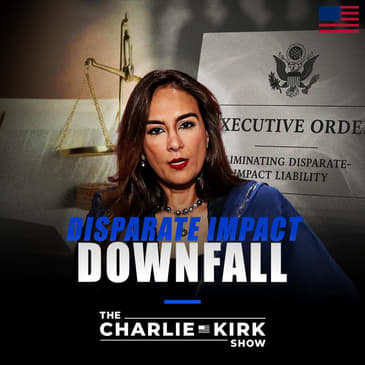
At the heart of the federal DEI machine is the doctrine of "disparate impact." Now, the Trump DOJ is moving rapidly to rip that doctrine to shreds. If they succeed, it will have a transformative effect on the whole country. The DOJ's civil rights chief Harmeet Dhillon explains why her move is so crucial and long-overdue, and the show reacts to Trump's 2024-style rally in Pennsylvania.
Watch every episode ad-free on members.charliekirk.com!
Get new merch at charliekirkstore.com!
Support the show: http://www.charliekirk.com/support
See omnystudio.com/listener for privacy information.
00:00:03
Speaker 1: My name is Charlie Kirk.
00:00:05
Speaker 2: I run the largest pro American student organization in the country, fighting for the future of our republic. My call is to fight evil and to proclaim truth. If the most important thing for you is just feeling good, you're gonna end up miserable. But if the most important thing is doing good, you'll end up purposeful.
00:00:24
Speaker 1: College is a scam, everybody.
00:00:26
Speaker 2: You got to stop sending your kids to college. You should get married as young as possible and have as many kids as possible.
00:00:31
Speaker 1: Go start at turning point.
00:00:32
Speaker 2: You would say college chapter.
00:00:33
Speaker 1: Go start aturning Point.
00:00:34
Speaker 2: Yould say high school chapter. Go find out how your church can get involved.
00:00:37
Speaker 1: Sign up and become an activist.
00:00:39
Speaker 2: I gave my life to the Lord in fifth grade, most important decision I ever made in my life, and I encourage you to do the same.
00:00:45
Speaker 1: Here I am Lord, Use me.
00:00:48
Speaker 2: Buckle up, everybody, Here we go. The Charlie Kirk Show is proudly sponsored by Preserved Gold, leading gold and silver experts and the only precious metals company. I recommend to my family, friends and viewers.
00:01:09
Speaker 1: Everybody, welcome to the Charlie Kirk Show. Lake. It's a good day. It's a good day, December tenth.
00:01:15
Speaker 3: Here we are in studio, lots going on, and by the way, some really really great news, Yes, huge news for Erica and the team, and really for Charlie. We have just got the Wall Street Journal published it this morning. Charlie Kirk's newest book is a hit and it is out of stock on Amazon.
00:01:34
Speaker 1: Here you go.
00:01:35
Speaker 3: Yep, that's the graphic from the Wall Street Journal. The story, and here, of course is the book Stop in the Name of God, Why Honoring the Sabbath will Transform your life. Erica has been doing an amazing job. She of course was on this show yesterday promoting it in Charlie's stead, and just couldn't be more proud of her and everything she's doing. I mean, she's going on the five. I think she doing out Numbered this morning. Hannity Radio calls, she's doing she's doing the whole circuit. Obviously, this is her first time doing this. Like, you know, people don't realize this about Erica. It's not like she's been trained like Charlie over twelve years of doing repeat reps exactly.
00:02:14
Speaker 4: She's doing tremendous, yes, absolutely immense, Yeah, beginning to end, top to bottom.
00:02:19
Speaker 1: Yeah, so they've been pressed.
00:02:21
Speaker 3: They've they've sold like sixty thousand copies in the first day of this book, which is really good, tremendous.
00:02:26
Speaker 1: Yeah, and they're doing.
00:02:27
Speaker 4: Realize books don't always sell that much.
00:02:29
Speaker 3: These no forty five books dot com. If you want to get your your yeah, if you want to get your copy. It's just and I And I said this in a tweet yesterday that I pitched Charlie on doing all kinds of different politics books. Like we were talking about what is his next book going to be? And he was just adamant. He's like, no, it's going to be about the Sabbath. I've been wanting to write this book for a long time.
00:02:51
Speaker 1: I really want to write. I was like, okay, but like the Sabbath, you know, And it's just aproposts.
00:02:56
Speaker 3: It's almost like he saved his most important book for last and a lot of that.
00:03:00
Speaker 4: Is most timeless one because all the other ones, they're a moment in time. College will hopefully be either destroyed or reformed. You don't need to call it a scam anymore. Right wing revolution that was all about what the next GOP admin should do. But this is one you could have thirty years from now, fifty years from now, two hundred years from now.
00:03:18
Speaker 1: Yeah, one thousand percent.
00:03:20
Speaker 3: I want to play a couple of clips from Erica being on The Five yesterday just because it was so it was I mean, I don't remember the last time I saw kind of like a guest host on The Five, especially you know, promoting a book. So thank you to The Five and Jesse and Greg and Dana and.
00:03:37
Speaker 1: Even Jessica Taralov. She was very sweet.
00:03:40
Speaker 2: Two nineteen el Jesse and Greg are in a Bible study group together?
00:03:46
Speaker 1: Are they really because of Charlie Kirk?
00:03:48
Speaker 5: Okay? That is really cool.
00:03:49
Speaker 4: So every morning, that is really every morning we wake up and we read a passage.
00:03:54
Speaker 6: And then we text about it, Okay, and it is because of Charlie.
00:03:58
Speaker 5: I love that.
00:04:01
Speaker 3: So what are you saying is Harold, Jesse and Greg? So Harold's the liberal and Jesse and Greg are not. And they're all in a Bible study because of Charlie. So we found that out yesterday, which was which was amazing. Here's Erica Kirk telling The Five about how President Trump has been there for her in this time two twenty.
00:04:19
Speaker 7: When Donald Trump secured peace in the Middle East. The next day he flew back so DC to deliver my husband's Metal of Freedom to me. He didn't have to do that. So a lot of people, I understand there's a lot of policy and everything involved, but also I am very proud to have Donald Trump as our president.
00:04:41
Speaker 5: I really am.
00:04:42
Speaker 7: He's a good man.
00:04:43
Speaker 1: He's a good man.
00:04:44
Speaker 3: And you know two three three, put that picture back up stopping the name of the tops number one on Amazon bestseller list, a book out, like it's sold out on Amazon.
00:04:56
Speaker 1: They're going to do print more. Yeah, I've been checking.
00:04:58
Speaker 4: It looks like we only have physical cop This looks like that's where books there approaches.
00:05:02
Speaker 3: And I'm really happy to have my my copy. And I'm like literally reading a couple chapters every night, and I'm telling you this book is I mean, I know, it's like people would expect me to say.
00:05:14
Speaker 1: I would probably remain silent if I didn't have anything nice to say about it.
00:05:17
Speaker 3: Actually, I would just sort of say, you know, check it out, support support Charlie Erica, like it's really freaking good man. You know, when God instituted the Sabbath, he wove rest into the fabric of creation and on the seventh day, God finished his work that he had done, and he rested on the seventh day from all his work that he had done. Genesis too too. God did not rest because he was tired. He rested because he was satisfied, and he invites us to do the same. There's like all these little like tidbits that these breakthrough ideas in this book, and it's just it's just phenomenal. So, uh, congratulations to Eric and the team, the team at Winning Team Publishing forty five books dot com if you want to get your copy, Erica's actually get It was funny because, uh, we've been this morning, I've been texting with a bunch of people with you know, Eric is going to do Glenn Beck's show tomorrow morning, and then so we got into a conversation with Glenn's team and then so Glenn's actually going to join us at the top of the show tomorrow, which will be great, and we can talk about that many other things. But there's another big news story that was near and dear to Charlie's hall, and it's near and dear to Blake's heart.
00:06:21
Speaker 1: So we're going to hit it at hour one.
00:06:22
Speaker 3: We're also going to bring har Meat Dylan from the DOJ Civil Rights Department on at the second half of this hour to talk about it. But that is, of course the rolling back of disparate impact standards within the DOJ and within the federal government. Blake, what is disparate impact if you had to boil it.
00:06:39
Speaker 4: Down, alrighty, So disparate impact is more people are thankfully becoming aware of it. But it's been around for half a century at this point, and desperate impact is sort of the it's the spearhead for a lot of what we'd call the DEI regime, the agenda, the dictatorship of America, which is where instead of things coming down to merit coming down to measurable ability, where we reduce things to quotas, to favoritism, to discrimination based on race or sex, or national origin or who knows what. And you know, I think this is actually a good opportunity to bring in Charlie because he was talking about this in April when there was a Trump executive order concerning this. And we're going to get to the follow up in a second, but this was Charlie summing it up.
00:07:29
Speaker 1: Let's play two thirty six.
00:07:31
Speaker 2: In nineteen seventy one. There was a Supreme Court case Greggs v. Duke Power Company. Duke Power was sued because for people to get certain jobs at the company, they required them to either have a high school diploma or pass an aptitude test. Black applicants were less likely to have a diploma, and they they didn't do as well on the aptitude test. The Supreme Court ruled that Duke's job requirements were quote justified, were not justified by business necessity, and so they were illegally discriminatory unless the doctrine of disparate impact was bored.
00:08:02
Speaker 4: So what he's saying there is the idea was this was a neutral test. Is just having a high school diploma or taking this aptitude test, no one could really. There was no one actually coming in and saying, oh, don't hire black people, but they were just less likely to do well as well on this test. And the court said, well, we don't think this test is close enough to what you need employees to do at this company, and because it doesn't have an equal outcome between these two groups, it's discriminatory. So it's what took our law from what most people think of when they think of discrimination, where you're deliberately discriminating against people. And they're saying anything you do, if it has an unequal outcome, can be labeled illegal, can be labeled the illegal discrimination can get you sued. And what that's turned into is you essentially anything can be illegal because news flash, Andrew, everything has unequal outcomes. Everything in the world. No one, Actually, I think we have this as well.
00:09:01
Speaker 2: Literally every standard imaginable has created has some sort of disparate impact against a group. Nobody on this planet has ever designed a test or a standard that men, women, blacks, whites, Asians, Hispanics, Catholic, Jews, gaze straits do so equally. Well, the very idea is an absurd fantasy. You're going to have different outcomes. But what disparate impact does, says the test itself is wrong. It is a loophole that you could drive a semitruck through. It's a little sliver. You say, oh, disparate impact, Well that's the big deal here. No, no, no, no. This has been exploited by DEI actors for the last thirty years.
00:09:42
Speaker 1: Thirty last fifty years.
00:09:44
Speaker 3: Yeah, and again, one of the things I want to get into is aptitude tests. We used to acquire these to get a job in the federal government ye for example. And the one of the best examples of this was the NYPD. I brought it up before a class of chiefs the nineteen thirty nine. Now this had controversy because they claimed it was anti Semitic or anti Jewish. But here's what's interesting. They had so many applicants. They just selected candidates from the top scores on the Civil Service exam. Farm oid officers made it to retirement or achieved high rank performance than any other year. President Trump walked into a catch twenty two when taking office, do nothing in America would be staring at a ticking debt bomb, the kind of crisis that could cripple our future. Instead, he's taken action with strong policies to slow the train and buy some time. But the effects of past administration spending are still working through the system, and experts predict dramatic price increases and market uncertainty. Trump is doing all he can, but no matter who's in office, protecting your retirement savings is ultimately up to you, and that's why many Americans are turning to real assets like gold and silver. Preserve gold is our go to choice here at the Charlie Kirk Show. We use them because they make it easy to own physical gold and silver even inside your retirement accounts, like an IRA or four O one k now here from Charlie in his own.
00:11:00
Speaker 2: Words, Preserve Gold is my go to choice for all my precious metal needs. They are the real deal and I recommend them to my friends, family and viewers.
00:11:07
Speaker 3: Get their free Wealth Protection guide now by texting Charlie to five zero five zero five. President Trump is fighting for America's future. Now it's your term to help protect yours. Blake, we were talking about aptitude tests, good or bad.
00:11:24
Speaker 1: Apt To tests are great.
00:11:25
Speaker 4: They're one of the fairest things we have in modern life.
00:11:28
Speaker 1: Oh they're racists.
00:11:29
Speaker 4: Oh now, there are a lot of things get called racist in America.
00:11:32
Speaker 1: You know, it's funny.
00:11:33
Speaker 3: Charlie loved Thomas Soule's book on disparate Impact. It was a discrimination and disparities right and the whole theme of the book is that you challenge single explanations like single factor explanations, so disparities are not solely due to discrimination, exploitation, and genetics. There's multivariate analysis that needs to be done. It's complex thinking like you can't just say what's great.
00:11:56
Speaker 4: About aptitude tests is anyone can walk in and do well on a test, whereas every other standard people propose as alternatives, They're always much more likely to favor people who have networks, who have other things they can take advantage of. Frankly, it's way better to be a person with money with an informal system than just a system where whoever scores best does best.
00:12:17
Speaker 3: I recommend everybody check out Thomas Soul's book Discrimination and Disparities. It's one of Charlie's favorite books to quote, and in it Soul challenges single factor explanations. And what that means is there is disparities in racial outcomes. Blacks and Hispanics tended not to do as well on certain aptitude tests. We can ask questions why that is. So they got rid of aptitude tests largely in order to get into the federal government, you had to pass you had to take a PACE test, which was what is it Stanford.
00:12:52
Speaker 4: Political and political or professional career examinations, an administrative career examine.
00:12:57
Speaker 3: Yes, and so we still have some tests the federal government, but widely been removed.
00:13:02
Speaker 4: That's that's the important thing about disparate impact, it doesn't actually ban tests. They're still For example, the maybe unless they got rid of the State Department has long had a test to get in. And for example, but what when we say, I said desperate impact makes everything illegal? It literally does make everything illegal. And what that means is that you have government by vibes. So, for example, with disparate impact, a company if they say we're just going to give every job applicant an IQ test and hire the top scorers, they'll get Historically they would get a very questionable look from the federal government. It would feel legally risky to do. But if they say you need this or that college diploma to be hired by us, it's very unlikely that they would be a questioned, even if that diploma isn't super directly related to what they're hiring for. And both of those things have a disparate impact. You know, Whites and Asians are more likely to have college diplomas than Black Americans, for example, So why is one looked at negatively and the other isn't. It basically just comes down to how the bureaucrats feel. It's vibes based, and government bureaucrats and lawyers like colleges, they like diplomas, they like liberal colleges, dispensing these job granting credentials to people that you have to pay a ton of money for and they don't like iq tess And so you get this ViBe's based government. And then you also get that's what also drives that hr ratchet that Charlie would talk so much about, which is you avoid getting the government after you by doing all these big, loud, expensive signals that you're not racist, that you're not sexist, because everyone's breaking the law because everything's illegal, so you just are trying to say, don't eat me, because they can't eat everyone. And this all loops around to why we're talking about this today because one of the great things going on in this administration, something that's not talked about enough, is they have been waging war on this monstrosity. The reason we had those Charlie clips is President Trump did an executive order to roll back desperate impact last April, and just yesterday we had a great announcement from the Department of Justice's Civil Rights Division where they're going after the traditional disparate impact prioritization in their office. The quote they had from their division. The prior disparate impact regulations encourage people to file lawsuits challenging racially neutral policies without evidence of intentional discrimination. Our rejection of this theory will restore true equality under the law by requiring proof of actual discrimination rather than just enforcing race or sex based quotas or assumptions and the other thing that we had yesterday. Because of this, the civil Rights divisions, A bunch of employees of the DOJ's Civil Rights decision A Division have released an open letter denouncing the direction that the department has been headed in. And it turns out about seventy five percent of lawyers of career lawyers and the DOJ's Civil Rights Division have left because they are outraged at the direction the Trump administration is taking it. God bless America.
00:16:03
Speaker 3: Yeah, this this is better than DOJE. This is better, you know, like the seventy five percent of a of a single of a weaponic bureaucracy.
00:16:11
Speaker 4: The commisar, the woke commissars, as Charlie like to say, get them out gets his former DOJ staff criticized leadership for abandoning civil rights mission. That's a that's a good thing.
00:16:23
Speaker 3: It's amazing stand up and clap, and we are gonna We're gonna give har Meat Dylan her her kudos and a and a warm congratulatory welcome onto this show. Because listen, you're losing seventy five attorneys that are leaving the DOJ Civil Rights for two seventy Yeah, seventy sorry, more than two hundred former employees, Yeah, criticize what they call an ongoing destruction of the Civil Rights Division. This is the This is bigger and more impactful than most people could possibly realize because yeah, you know, Charlie said thirty years, this has been going off fifty years in our federal government. When you see a sliding of standards, when you see an abandonment of meritocracy, when you see that, like I think there's this prevailing fog over the country where it just feels like things don't matter anymore. It's like, oh, well, people just get away with crap and nobody gets held accountable. This is one of the root causes for that where it's, like Charlie used to say, it was like whose line is it?
00:17:22
Speaker 1: Anywhere?
00:17:22
Speaker 3: Where the points are made up and the rules don't matter. That's what modern society is starting to feel like, why does it feel that way. Part of the root cause of this is desperate impact. It's and by the way, the legal profession getting infected with DII and critical theory and all of these things. It floods out into the wider culture and the wider society, government, bureaucracy, civil order, and things fall apart. Over time, things grade, and so if you want to get to root causes, you have to get rid of desperate impact. This is a huge, huge development. A new Hillsdale College miniseriies on Colonial America offers a fresh way to think about Thanksgiving beyond the food and the political debates. It reminds us what we should be truly thankful for our freedom, our prosperity, and our faith. In a brand new six part documentary series, Hillsdale College professors will teach you the religious, the political, cultural, and economic ideas that shaped a uniquely American culture during the colonial period. This Hillsdale course will focus on the forging of the American character that made the Revolution possible and why it's more important than ever to remember and reclaim that character today. This Hillsdale College mini series is completely free and it's easy to access plus Hillsdale offers more than forty other free online courses. Go right now to Charlie for Hillsdale dot com to enroll. There's no cost and it's easy to get started. That's Charlie for Hillsdale dot com to register. C h ar l I e fo r for Hillsdale dot com.
00:18:59
Speaker 1: All right, Welcome to the show.
00:19:00
Speaker 3: Harmy Dylan, Assistant Attorney General for the Civil Rights Division. Harmy, Welcome back to the Charlie Kirkshaw. I think this is the first time we've had you back, if I'm not mistaken in this brave new world that we're living in, so welcome.
00:19:13
Speaker 1: We're honored to have you.
00:19:14
Speaker 6: Thanks for having me. It's always an honor to be on this show.
00:19:18
Speaker 1: Yeah. Absolutely.
00:19:19
Speaker 3: I told the audience harmat that we were going to give you a very warm welcome because you have you have done what I think even Doge was not able to do, and you are just I'll let you describe it the way you want to, because I know these things can be sensitive in the actual official halls of power. But you're cleaning house at the DOJ's Civil Rights Division. There's a report this morning. We celebrate these changes and also there's news on disparate impact. The floor is yours, harmy Well, thank you.
00:19:51
Speaker 5: So much, Andrew.
00:19:52
Speaker 6: And so yes, I'm in the news this week because there are hundreds of disgruntled former Civil Rights Division lawyers who voluntarily quit. I didn't fire them after I told them that their job was going to be to protect the civil rights of all Americans, not just the chosen few and their pet projects that they had been pursuing for decades here in the Civil Rights Division.
00:20:15
Speaker 5: Two hundred of them or so immediately.
00:20:17
Speaker 6: Quit and took a five month payout, so we're one hundred thousand dollars worth of severance pay and then over the last few months, another close to one hundred have quit. And yet you know, they're writing and the press, Reuters covered it, and they say that I'm trashing the DOJ.
00:20:34
Speaker 5: I've changed its mission.
00:20:36
Speaker 6: I'm making them making attorneys do stuff they don't want to do, and it's against the storied, historic vision of the DOJ. But I completely disagree. I'm really proud of the work that we're doing.
00:20:48
Speaker 5: And obviously it seems obvious to me.
00:20:50
Speaker 6: That the United States Department of Justice should be justice for all Americans, not just some Americans or some winners of a victim of deepstakes. And I think that actually is very popular with Americans. And we're continuing to do the core focus of our work. We're protecting people with the disabilities, We're even protecting prisoners. We're protecting the rights of students in schools, employees in the workplace, contractors, people who are discriminated against hate crimes, anti semitism, actually all the same stuff that we did before. We're doing it, but we're just doing it for everybody, not just for some.
00:21:25
Speaker 5: And we're going to keep doing it that way.
00:21:27
Speaker 6: So if you don't like it, too bad, this is how it's going to be for the balance of this administration and hopefully beyond, because shouldn't the DOJ be for all Americans. So I'm really proud of that, and this criticism just shows that we're over the target.
00:21:41
Speaker 5: Andrew, it's amazing, and so it's amazing.
00:21:44
Speaker 3: Yeah, Harmy, Like, trust me, we are this news. We literally like standing up and clapping before when we saw it. I'm telling you so again, just to reiterate, about seventy five percent of attorneys left the DOJ Civil Rights Division and claim amid claims of coordinated effort to drive them out. No, they quit on their own accord. You did not fire them, and they claim that you're bandoning the civil rights mission of the DOJ.
00:22:10
Speaker 1: I think this is great.
00:22:11
Speaker 3: Is it safe to say, harmeet that the DOJ's Civil Rights Division is now hiring.
00:22:15
Speaker 1: There is some spots that opened up.
00:22:18
Speaker 6: Okay, so thank you for mentioning that. I was itching to say that. And so to be clear, we have a huge agenda. So it isn't just sort of there's no goal to shrink the Civil Rights Division. We actually have a huge affirmative agenda. I'm suing fourteen states right now, and they're going to be more on that list.
00:22:34
Speaker 5: By the end of the week. A lot of exciting litigation.
00:22:37
Speaker 6: We just sued Minneapolis for discriminating against teachers who are not minorities, and on and on and on and so we are hiring, And so lawyers with at least eighteen months experience who are interested in serving a tour of duty to help their country can apply at USA jobs dot gov and look for Civil Rights Division.
00:22:58
Speaker 5: We are hiring as.
00:22:59
Speaker 6: Fast as we can qualified candidates who are willing to do the work. I just articulated and force all of our federal civil rights statutes with a lens of all Americans and this administration's priorities.
00:23:11
Speaker 1: What's that U are elegant, Harmy? I want to put it up.
00:23:14
Speaker 5: On USA jobs dot.
00:23:17
Speaker 1: Gov, USA jobs dot gov.
00:23:19
Speaker 3: If you want to go work with Harmeat Dylan and you are an attorney that wants to defend the civil rights of all Americans. Novel idea, novel idea. I know, you know it's funny about this whole thing. I mean, yeah, it's crazy. Go to USA jobs dot gov and I'll have the team put it up on that lower banner there so everybody can write it down.
00:23:38
Speaker 1: You know what's crazy about this?
00:23:39
Speaker 3: You know, when they started this stuff back in the sixties, right disparate impact, which we're going to talk about next. You know, I get it, okay, it was like, let's say it was eighty three percent white country. Now we're basically fifty percent.
00:23:51
Speaker 1: We're on track to.
00:23:52
Speaker 3: You know, I think the last census had whites at what fifty six to fifty seven percent of the population. You give that another ten years, it's going to be uh, probably under fifty percent, maybe right around fifty percent. I mean, that's what we're kind of like losing every ten years at a ten year clip. When I was born, I think we were around eighty percent white still. But as this happens, you're going to see I don't know, some of this old way of thinking about how white equals bad oppressive majority, Like it's it's got to necessarily we've got to rethink the way this is happening, because if you're just going to say that another one of the minorities in this country, like I mean, it might be minority majority, but like still, it's not the same dynamics as it was in the past. And we have to make sure everybody is getting protected. And one of the ways that you do that, sorry, if you want to chime in their harmony, feel free.
00:24:40
Speaker 6: Yeah, so let me talk about that. I mean, like, let's be very frank here. We have a history of discrimination in our country. There were slaves, they were not white, and they were then kept down by mainly southern but not exclusively Southern states. And so the Civil Rights Act of nineteen sixty four included a very important law that I've personally used for most of my career, Title seven, which protects people from discrimination in employment, and then In nineteen sixty eight, the Civil Rights Act added this provision that we're going to talk about Title six, and that deals with all the folks who have contracts with the government, government contractors, and anybody who does business with the governmentor receives money from the government, including all American universities except for Hillsdale pretty much, and all.
00:25:27
Speaker 5: School districts and so forth.
00:25:28
Speaker 6: It's a pretty vast coverage of this statute, and the DOJ provides.
00:25:33
Speaker 5: Guidance on it.
00:25:34
Speaker 6: And so I don't want to bore people with too much legal ease, but I think this is a really important law and important development.
00:25:40
Speaker 5: And Supreme Court in nineteen seventy one.
00:25:43
Speaker 6: Issued a case called Duke Power versus Griggs, and this was about a janitor who allegedly was impacted negatively by some policies and hiring at Duke Power. And that started this concept of disparate impact. So, in other words, you no longer necessarily had to prove in your discrimination case, whatever the context was, that you were actually being the victim of intentional discrimination.
00:26:07
Speaker 5: You could simply prove that there's a.
00:26:08
Speaker 6: Hiring process or a policy, or there's certain you know, tests that are required.
00:26:12
Speaker 4: And I because we were We were going back and forth on that at the top of the show, and the line we were discussing, which I'm a big fan of, is disparate impact. Seems to just it literally makes everything illegal because nothing is actually equal except I guess true random chance, right.
00:26:28
Speaker 6: It really shifts the burden to get away from the plaintiff and to the employer to defend themselves. And when you use statistics, as you know Mark Twain famously said about statistics, lives and damn statistics.
00:26:42
Speaker 5: You know, you can chop and slice and dicee them and prove anything.
00:26:46
Speaker 6: And I mean we have statisticians here in the Civil Rights Division who you can give them a premise.
00:26:51
Speaker 5: They'll be able to come up with some formula to prove it. That's not how we should be running our businesses or our world.
00:26:57
Speaker 6: And so as to Title six, when the United States gives federal funds, whether it's in a contract basis or grants, we have now issued a guidance that says that this fifty years of discrimination against frankly law abiding practices and businesses and recipients is over.
00:27:17
Speaker 5: It is harming a lot of people. It is wrong, and you.
00:27:21
Speaker 6: Should go back to having to prove intentional discrimination. By the way, there may be statistical cases to be brought there that so we're not banning the use of statistics. What we're saying is we're not going to let people use statistics.
00:27:33
Speaker 5: To assume a default of discrimination.
00:27:35
Speaker 6: And people are going to have to prove their cases, and that includes the government.
00:27:39
Speaker 5: Sometimes that includes me.
00:27:40
Speaker 6: If I have to bring a case against a school district or against a university, I have to use my evidence and prove the case, not just to have a default assumption of discrimination. Because that has hurt so many people in our country. It is eroded merit based hiring. It has put companies on the defensive. It has encouraged and now institutionalized quotas from every institution, including the boardrooms of America's largest corporations, because they're all government contractors. And so this is so damaging. And if we can just reverse that back to an assumption that Americans.
00:28:18
Speaker 5: Are good generally speaking, we follow the law.
00:28:21
Speaker 6: If something bad happened to you prove it with intentional discrimination evidence. I think that is really a great development for all Americans.
00:28:29
Speaker 3: Politico's framing of this is hilarious. DJ Rolls back anti discrimination rules. Trump officials say the requirement to consider racial impacts was itself a form of discrimination. Says the Justice Department. On Tuesday moved to end long standing civil rights policies that prohibit local governments and organization that receive federal money from maintaining policies that disproportionately harm.
00:28:48
Speaker 1: People of color. Why are you hurting people?
00:28:50
Speaker 3: Repealing the government's fifty year old disparate impact standard will make it harder to challenge potential bias in housing, criminal law, and employment.
00:28:57
Speaker 1: I mean, it's basically frames.
00:29:00
Speaker 3: It is, as you're ripping away this sacred shroud from the protection for disadvantaged people.
00:29:08
Speaker 1: Harmy.
00:29:09
Speaker 6: I'm clutching my imaginary pearls here, Andrew. And the fact is that that's all fake news.
00:29:15
Speaker 1: Okay.
00:29:16
Speaker 5: I have been a.
00:29:17
Speaker 6: Lawyer for over thirty years, and the last twenty years of it has been as a plane of slawyer proving discrimination cases. You can absolutely do it without this unnecessary crutch, and we will continue to pursue and take action against discrimination here at the DOJ.
00:29:34
Speaker 5: I do it every day.
00:29:35
Speaker 6: Just follow a lawsuit today, and we'll be filing some more later this week. And we're just leveling the playing field and returning it back and to be I want to conclude by saying, when Congress passed the law Title six, nowhere in that law doesn't say disparate impact. That's not Congress's intent. It was made up by a court and we're getting rid of it here at the DOJ.
00:29:56
Speaker 1: Well, God bless you. Harmony K.
00:29:57
Speaker 3: Dillon, Assistant an General at Civil Rights Division of the DOJ. Thank you so much for all your great work. You are crushing it and we are so proud to have you on this show.
00:30:09
Speaker 1: Go get a job.
00:30:10
Speaker 3: If you're a lawyer out there, go work with harme meet and help make the country a better place. God bless you. Yeah, USA Jobs dot Gov.
00:30:17
Speaker 1: Thank you, Harmey.
00:30:20
Speaker 8: This is Lane Schomberger, chief investment officer and founding partner of y REFI. It has been an honor and a privilege to partner with Turning Point and for Charlie to endorse us. His endorsement means the world to us and we look forward to continuing our partnership with Turning Point for years to come. Now hear Charlie in his own words, tell you about why REFI.
00:30:40
Speaker 2: I'm want to tell you guys about hyrefight dot com. That is yr ef y dot com. Y refi is incredible. Private student loan debt in America told us about three hundred billion dollars. Why refy is refinancing distress or defaulted private student loans. You can finally take control of your student loan situation with a plan that works for your monthly budget. Go to yrefight dot com. That is why refight dot com. You have a co borrower, why reef I can get them released from the loan. You're going to skip a payment up the twelve times without penalty. It may not be available at all fifty states. Go to yrefight dot com. That is why are e f y dot com. Let's face it, if you have distress or to fault the student loans, it can be overwhelming because of privacuit loan debt. So many people feel stuck. Go to y refight dot com. That is y r e f y dot com Private student loan debt relief, yrefight dot com.
00:31:29
Speaker 3: I just want to remind you Charlie's last books most timeless book stop in the name of God. Why honoring the Sabbath will transform you? Lev I don't get anything out of this except for the satisfaction of knowing that the good people out there across this country, really across the world. I bet are enjoying Charlie's book. It was a labor of absolute love for Charlie to do this book. Chapter seven, The Sabbath Improves Your Sleep. Charlie was passionate about sleep. I want to share a little seak with you. I hesitate to call it a superpower because that sounds grandiose, but it's true. It's incredibly powerful and available each and every one of us. In our hyper hustle culture, we venerate the sleepless. I began noticing this in high school, where the best students seemed to operate on little sleeps. Caffeinating themselves through the day became a badge and honor to say they pulled an all that nier.
00:32:19
Speaker 1: That didn't change as I got older.
00:32:21
Speaker 3: Sleep is so good, and he says, Charlie used to proudly sleep nine to ten hours a night.
00:32:29
Speaker 1: He found a way to do it. I don't know how he did that.
00:32:33
Speaker 3: It decreases your attention span and parish judgement, slow reaction time, emotion volatility, higher cortisol levels.
00:32:38
Speaker 1: Charlie didn't want any of that, so he slept a lot. Taking a sabbath will help you do that, all right, Blake.
00:32:42
Speaker 3: President Trump was in Pennsylvania in a Trump rally last year.
00:32:46
Speaker 4: Yeah, he loves to have those rallies. Just have a rally for now and then it recharges energize.
00:32:50
Speaker 3: I think there's a little more to it. But yeah, we'll talk about that. But I think it was uh, I think it's fat. We're gonna have Rich Barris on and so we can talk about the polling. Saw some disturbing results out of Miami. They have a Democrat mayor now first time in thirty years in Miami, which is not a good sign. We've struggled with some of these special elections things are you know, let's just in.
00:33:13
Speaker 4: The end, we are this is it comes down to who is winning elections and in control of things that the only way you can get what we just talked about with disparate impact is by controlling the Civil Rights Office. The only way to do that is by winning elections. Same thing throughout the country. And so it's unfortunate what happened in Miami. But yeah, so President Trump, he was in Pennsylvania holding a rally, and I want to open with It's not as fiery as the others, but I like it because I think it's him taking show advice.
00:33:38
Speaker 1: We get shows. The feedback loop is alive. So let's play to twenty seven.
00:33:43
Speaker 9: And I have no higher priority than making America affordable again. That's what we're going to do. And again, they cause the high prices and we're bringing them down. It's a simple message. If I had one message tonight, you know this is being covered. I go all over the world. This is crazy because I have made this speech in a little while. You know, when you win, When you win, you say I can now rest. So Susie Trump, do you know Susie Trump sometimes referred to as Susie while Susie Trump.
00:34:12
Speaker 1: Yeah.
00:34:12
Speaker 4: So I liked that because we've gotten emails about this. There was that clip that was taken out of context where he says affordability is a hoax, and people thought, oh, he doesn't care.
00:34:20
Speaker 1: No what it was.
00:34:21
Speaker 4: He was saying, I am fixing a problem created by the Biden administration and going to bring prices down. That's that's all the messaging needs to be. And he says It's pretty simple, he says, it's very simple.
00:34:34
Speaker 3: They messed it up. We're fixing it. Yeah, real wages are going up. The price of gas nationally, the average is below three dollars, first time since before Joe Biden took office. And so I mean there are good signs. I mean, the price of Thanksgiving meal was down twenty five percent according to the administration. I did not personally check on that. I'm sure mine was actually up because we had more people around this year. But the point is the present Trump's feedback loop is alive, and well, there's been some consternation. I mean, for those who are not aware, they're little rumors and rumblings behind the scenes that you know, President Trump isn't on Twitter.
00:35:09
Speaker 1: He's not getting that.
00:35:11
Speaker 3: Those rallies are kind of work as a poll test for him, kind of a focus group, if you will. He says certain things, pays attention to what gets the biggest applause lines, and then he kind of like dials in his messaging that way. So if you're just dealing with issues of state all the time and you're kind of confined into your White House bubble, you're going to miss some of those feedback loops. So how do you make sure that President Trump is hearing from the base, especially in the wake of Charlie being gone. Charlie was a great conduit for that kind of stuff. Well, this is this is proof that the message is getting through, that people are hearing.
00:35:43
Speaker 1: Hey.
00:35:43
Speaker 3: Affordability, affordability, affordability, domestic, domestic, domestics. So this is a whole affordability tour in Pennsylvania. I like it because I when as soon as President Trump during Thanksgiving announced he was doing a Third World immigration moratorium.
00:35:58
Speaker 1: Things.
00:35:59
Speaker 3: You know, I made a prediction that this was going to be one of his most popular policy planks of all time, and he's hitting this hard to twenty one.
00:36:09
Speaker 9: If you don't share our values, contribute to our economy and assimilate into our society, that we don't want you in our country. We don't want you. I mean elon Omar and the people from Somalia. They hate our country and they think with stupid people, which actually when they allow that to happen, they are that's headed by Governor Walltz, one of the dumber people around. Nobody's given but think of it, He's given not like peanuts, billions. These are people that don't work in their own country, their own countries are fans, they have no money, and yet they come into our country and steal tens of billions of dollars. How stupid are we to allow that to happen.
00:36:51
Speaker 3: Just hammer away, hammer away at this, And I actually, I'm it.
00:36:55
Speaker 4: Really is the perfect thing because the Left has boxed itself in ideologically where they're they're so radicalized on immigration they can never admit that any group of immigrants is just not worth bringing into America. And this is it's like the perfect specimen in terms of they cost a lot of money, so they're not contributing that much economically. They're very culturally hostile, they're very clannish, they're not assimilating well. And they have this avatar who's so unappealing ilhan Omar.
00:37:25
Speaker 3: Gosh, she's awful. She married her brother to get in here. I have to the third world country real quick.
00:37:30
Speaker 1: This is funny. I hope they bleeped it. Ride the dump button to twenty four.
00:37:34
Speaker 9: I've also announced a permanent pause on third world migration, including from hell holes like Afghanistan, Haiti, Somaya, and many other countries. I didn't say, oh you.
00:37:54
Speaker 1: Did that's a good moment.
00:38:03
Speaker 8: For more on many of these stories and news you can trust, go to Charliekirk dot com.