
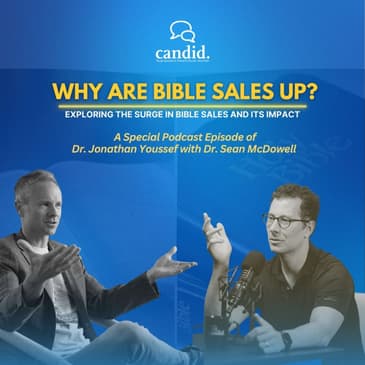
Why are Bible sales experiencing a surprising 22% surge? Is Western culture becoming spiritually curious again? In this episode of Candid Conversations, Jonathan Youssef welcomes Dr. Sean McDowell—author, speaker, and Biola University professor—to unpack this unexpected trend.
Sean shares insights from his years of engaging the next generation on matters of faith, culture, and apologetics. Together, they explore:
- Why a sharp rise in Bible sales should give us pause—and cautious hope
- How cultural voices like Jordan Peterson and Jonathan Rauch are contributing to renewed interest in Christianity
- Why secularism may be losing momentum among young adults
- How Christians can better engage a spiritually curious culture today—not with confrontation, but with conversation
Drawing on historical shifts, current research, and his experiences equipping students and churches, Sean encourages believers to rethink how we present the gospel in this pivotal moment. Instead of arguing like it's still the era of the "new atheists," it’s time to listen, ask better questions, and meet people in their spiritual hunger.
Guest Bio
Dr. Sean McDowell is a professor of apologetics at Biola University, the cohost of the Think Biblically podcast, and a best-selling author. His latest book, Apologetics for an Ever-Changing Culture, helps Christians address today’s toughest questions with clarity and compassion.
Connect with Sean:
Website: seanmcdowell.org
YouTube: Sean McDowell
Instagram: @sean_mcdowell
For more original podcasts from Leading The Way, please visit ltw.org/subscriptions
[00:00:05] Hello and welcome to Candid, where we never settle for less than the truth. I'm your host, Dr. Jonathan Youssef. Each week, we'll tackle tough issues, answer your hard questions, and take a candid look at the Christian faith. Today, we're honored to have Dr. Sean McDowell with us. Sean is an influential voice in Christian apologetics, a Biola University professor, and an author passionate about equipping the next generation to defend their faith.
[00:00:34] Sean is also the co-host of Think Biblically podcast, one of the most popular faith and culture engagement podcasts. His latest book is Apologetics for an Ever-Changing Culture, which addresses some of the biggest challenges facing Christianity today. Sean, thank you so much for taking the time to be on Candid Conversations. My pleasure, Jonathan. Been looking forward to it.
[00:01:04] Sean McDonnell Well, for those who may be listening, who maybe think the McDowell name sounds familiar and maybe aren't familiar with all things Sean and even Josh McDowell, give us a little bit of your background, your story, how you got into apologetics. Sean McDonnell Sure. First off, I've been married to my high school sweetheart, and it's 25 years this spring, and we have three kids. Sean McDonnell That's my full-time job. Sean McDonnell Yeah, there you go. Get your priorities right.
[00:01:33] Sean McDonnell Yeah, I've been teaching 12 years at Biola University, Taub School of Theology, in the Masters in Apologetics program. Sean McDonnell Before that, I taught a decade of high school Bible in apologetics and worldview. Sean McDonnell Essentially, I'm a communicator. Sean McDonnell My heart is the next generation. Sean McDonnell My heart is to defend the faith. Sean McDonnell Yeah, I've written books making the case for the resurrection, case for intelligent design, a biblical view for students thinking about some of the most thorny ethical issues of our day.
[00:02:03] Sean McDonnell Then I use Instagram and like you said, our podcast and YouTube to just help Christians defend the faith and invite non-Christians to consider the credibility and life-changing power of Christianity. Sean McDonnell That's amazing. Sean McDonnell That's noble work, right? Sean McDonnell That's not easy. Sean McDonnell You mentioned it.
[00:02:23] Sean McDonnell It's thorny issues that probably a lot of Christians have not dealt with themselves, but need to be equipped with in order to engage the culture, to have helpful conversations. Sean McDonnell And so we're really grateful for your work in that area. Sean McDonnell Well, Sean, you know, one of the things we saw was this trend of increase in Bible sales last year, increase of 22%, which is a massive shift. Sean McDonnell And your name came up.
[00:02:52] Sean McDonnell We said we need to talk to Sean McDowell and kind of figure out what's going on. Sean McDonnell What are all these things signaling? Sean McDonnell What do they mean? Sean McDonnell And so I guess our questions are sort of, what do you think is driving a renewed interest Sean McDonnell In Scripture? Sean McDonnell And I guess that kind of another leading question might be, do you know who's behind the purchasing of Bibles? Sean McDonnell Is it young people? Sean McDonnell Is it older people? Sean McDonnell Is it kind of spread across different generations? Sean McDonnell So I think you're right that this is a massive shift.
[00:03:19] Sean McDonnell It's enough to give you pause because it's not like a two or three percent jump. Sean McDonnell That's right. Sean McDonnell It's not a bump, a little bump. Sean McDonnell Yeah, exactly. Sean McDonnell But on the other hand, I'm somewhat hesitant. Sean McDonnell I think we need two, three, five years of data to really jump. Sean McDonnell Is it important to draw some kind of cultural definitive shifts from this as opposed to some unknown factor that causes the drive?
[00:03:42] Sean McDonnell Now, as a whole, this may be a piece of a larger shift we're seeing with an openness to spiritual things. Sean McDonnell When you go back to the middle of the 20th century, and there's a time cover in 1966 or 67, and ask the question, is God dead? Sean McDonnell And just proclaim that God was out of a job.
[00:04:04] Sean McDonnell You move into the early 21st century, the first decade, you have the new atheists just proclaiming and filling up the news of the God conversation that God is completely out of a job. Sean McDonnell And it's anti-science, anti-humanitarian. Sean McDonnell We're moving towards this era where God is dead and we'll be better for it. Sean McDonnell You also have the rise of the nuns, N-O-N-E-S, of less people defining themselves. Sean McDonnell And it would seem like there's this trajectory where we're headed maybe towards Europe getting more and more secular.
[00:04:34] Sean McDonnell But this study pops up and gives us pause. Sean McDonnell And actually, I just saw in the New York Times that there was an article about the decline in Christianity has slowed. Sean McDonnell And they talked about, interestingly enough, going back to 2019, how those who define themselves as nuns has either stopped or radically slowed down what it was in the past.
[00:04:59] Sean McDonnell And they pointed out in this article that it's not just, typically women are far more religious than men. Sean McDonnell And in this case, you don't have that split. Sean McDonnell It's actually men and women, you know, boys and girls in terms of younger adults, that are showing kind of less bleeding of the Christian faith, so to speak.
[00:05:21] Sean McDonnell So to me, this Bible sales is one kind of bump that gives me pause and just says maybe this shift towards secularism is slowing down. Sean McDonnell I don't know that there's evidence that it's reversing, although in places like the UK, we are seeing more young people going back to church than previous generations. Sean McDonnell So I guess to answer your question, it's enough to give me pause. Sean McDonnell It's enough to make me stop and go, something's going on here.
[00:05:49] Sean McDonnell I want to know more and see where the data leads in the next two, three to five years. Sean McDonnell If someone were to force you to have a response, someone who had a podcast and wanted you to give an answer, in your line of work, what are you hearing from, you know, experts or the people at your university?
[00:06:12] Sean McDonnell What's kind of the general, if you had to kind of start to put a couple of pinpoints, we're not going to hold you to it in five years if you end up being wrong, but just from your, you know, you're obviously experienced in this. Is it cultural shifts? Is it a hunger for the word? You know, if you had to kind of pinpoint a couple of theses, theories. Sean McDonnell Yeah, that's totally fair. I'm happy to do that.
[00:06:36] Sean McDonnell I think part of what the new atheists reflected, the first decade of the 21st century roughly, was this strong reaction against Christianity in particular. Without only works if you have a generation of people that at least know or think they know what Christianity is and are hurt or angered or disillusioned by it. Sean McDonnell Well, now we have these new voices, people like Barry Weiss and Tom Holland and Jonathan Rauch and Jordan Peterson.
[00:07:07] It's as if these secular voices are rediscovering the Christian worldview and saying things like Jordan Peterson did. And he may be a Christian now. I'm not exactly sure how to take his terms, but he's certainly far more favorable to it. But he said things like it's the basis of Western civilization and the impetus for science.
[00:07:28] I mean, Jonathan Rauch, a gay atheist, said in the New York Times maybe three months ago that America quite literally needs Jesus to survive and flourish. Now, he doesn't mean that in the way you and I think we need Jesus. But that's a completely different tune than what we're used to hearing. So I think there's a combination of a generation that's been raised up without religious roots, but also without religious baggage.
[00:07:57] And there's a deeper hunger. There's a deeper brokenness relationally and spiritually brokenness. There's mental health concerns. There's division in our culture. And I think there's a leaning into wonder. And so Rod Dreher, who's a New York Times columnist, he's Catholic, had a book come out, just came out in February. It's called Believe.
[00:08:19] And he said in the past 10 to 15 years in his audience, there's been a shift towards more of a curiosity about spiritual things and an interest and an openness that wasn't there. Rod Dreher, an Orthodox writer, wrote a book called Living in Wonder. And he talks about how even interest in UFOs and psychedelics hints at a deeper spiritual yearning that's taking place in our culture. So I think that's what's going on.
[00:08:46] Now, everybody's not turning to Christianity and buying Bibles. I think that's one interest. But we're seeing this spiritual interest and I think an awareness that secularism is dead. And it can't fulfill the deepest yearning of the human heart, let alone save civilization. Yeah, that's interesting. You know, we've had Michael Horton on who's written spiritual but not religious. And, you know, thinking through, it is interesting.
[00:09:12] It does seem like maybe this is a – and this is kind of probably where we'll go with our conversation. But there's this fascination, intrigue, interest in the spiritual world. And so it could kind of explain, let's try some different things. And so there's probably going to be a little bit of, you know, there's a bump and increase in Bible sales. And some people are going to, you know, come to that and say, oh, I found my answer. This is my new thing.
[00:09:40] Some people might say, not sure if that's my thing. But I guess here's where I'm curious for the believer who's listening to this. How do you use that to your advantage in terms of you're coming at this as an apologist? Which is interesting because, you know, an apologist is about, you know, the argument, making a defense. We're almost like the tables have turned. You're not necessarily having to make a defense.
[00:10:04] You're actually making a presentation for someone who's already high interest in what you have to say. So now what you say, this is really interesting because what you have to say has a lot of, we believe in the sovereignty of God, of course, but he uses his people.
[00:10:21] And if his ambassadors are going out and they're ill-equipped and they don't know how to articulate actually what the gospel is and they don't know how to say these sorts of things and have answers to some of their questions, that'll be a tremendous disservice to what could potentially be a great shift in kind of Western society. So from your perspective, what are you, how do you kind of help fill in some of those gaps?
[00:10:48] Some I've been thinking about a lot and have tried to pivot and realize that I think I have a ways to go. Is there still a tendency, I think, among apologists and voices in the church to speak as if we're addressing the new atheists still. When that movement died a decade ago, I don't think they represent most atheists.
[00:11:11] I don't think most people are angry at the church trying to take down Christianity, you know, writing books, how God isn't great and it's a delusion. I think most people have issues with the church or they be Christians. Fine. I think most people are more just curious though. And so if our posture would shift a little bit and just be like, you know, let's have a conversation. Let me ask you some questions.
[00:11:37] Then I think we can make a lot more headway and be heard more than the kind of culture war dialogue that so characterized our response to the new atheist. Now, with that said, is there a time and place to call out certain nonsense prophetically? Of course there is. Of course. But for most people, I think this indicates there's a spiritual openness. There's a curiosity.
[00:12:03] And if we just do what Jesus did, which is asking questions, you know, the Gospels and Acts, we have recorded 340 questions that Jesus asked. In Paul's letters, 262 questions.
[00:12:18] So what if we as Christians got better at just making arguments and just listening to people and inviting conversation and then sharing who Jesus is, how he's changed our lives, what the gospel is? I think we get a greater reception and interest than we even can imagine. Interesting that you pick up a point. Do you find that in some Christians' fears, there's a lot of this sort of like us versus them?
[00:12:48] And it's like we are the defenders of the faith. And anyone who is not with us is against us. And our objective is to kind of in almost like a brute force make our arguments rather than a little bit more of a gentle, using conversational, using questions to sort of pierce into people's preconceived ideas of what they think the Bible is or what Christianity is. Do you notice that at all? Sure.
[00:13:17] I think that can be true politically. I think that can be true theologically on positions that people hold. I think that can be true on social issues that people hold. That can be true within the apologetics community. I mean, we're wired to like defend the faith and argue for certain things. So it's easy to fall into that trap.
[00:13:38] You know, I don't think there's anything wrong insofar as it goes in talking about issues like life and defending the most vulnerable amongst us when science and scripture is clear. I mean, pro-life is pro-Christian hands down. But how we practice that, how we advance that, how we live that out, that's where we need to have some debate and dialogue about what's the most effective way to do this.
[00:14:07] So there are issues where there is kind of an us versus them. But my concern is we take a lot of secondary issues. And I don't mean life as a secondary issue. Let me be clear. I think we take certain secondary issues, theologically, culturally, make them essential, create an us versus them. Then it's not a very helpful way to proceed and move forward. Yeah, it kind of loses that winsome edge to it.
[00:14:33] Your new book tackles kind of classic and modern challenges to Christianity. What are some of the biggest cultural shifts that are forcing apologetics to sort of adapt to today? Yeah, that's a really important question. So I would argue that Jesus was a kind of apologist. He was brilliant with his philosophy, like he split the horns of a dilemma.
[00:15:02] He reasons and argues with the religious leaders. Just read John 5 through 8. He was much more than an apologist, but he was no less. Paul was a kind of apologist, making a case, defending his views. Read Acts chapter 17. The apostles are. Read Acts chapter 2 in the entire book of Acts. Some of the first church fathers were apologists. Apologetics always has been and always will be and should be a staple of the Christian faith.
[00:15:32] But how we do it needs to adapt and shift to our cultural moment. So I think there's a few things. One is there's just such a high rate of mental health concerns, depression, anxiety, loneliness, relational brokenness. That affects how we process truth. That affects how we understand who God is.
[00:15:57] If you have a broken relationship with your earthly father, that might affect the way you view your heavenly father. In fact, I think a case can be made that if you have relational brokenness, you're more inclined to adopt a relativistic worldview. And so part of this book is to say, given there's a whole chapter on kind of like the mental health crisis. How do we do apologetics in this cultural moment? That's one example. There's the phenomenon of deconstruction that's taking place.
[00:16:25] People have always left the Christian faith, but it's been talked about. There are TikTok accounts. There are people pushing deconstruction. How do we do apologetics in this cultural moment? Of course, the elephant in the room is online. Alan Parr, a friend of mine with a big YouTube channel, wonderful online apologist, talks about what are just strategies for doing apologetics online. There's some issues that have shifted. So I've talked about the new atheists.
[00:16:53] The church has spent, at least apologists, has spent a ton of time responding to the new atheists. When atheists and agnostics at most together are maybe 10, 12% of the population. But a high percentage of Americans and beyond believe in reincarnation and tarot cards and astrology and new age. We've got to engage new age ideas even more than we did in the past. That's kind of a new issue that's arisen. So those are just a few of the shifts.
[00:17:22] There's a lot more than that that I think is taking place. But essentially, I'm saying defending the faith is something we're all called to do. But there's new issues we need to be aware of and new strategies and challenges to do this effectively for individuals and for the church. Yeah. Your book has contributions from like 23 different Christian thinkers. Was there any kind of insight from one of the authors that sort of came as a surprise to you?
[00:17:49] Or was it more insightful than maybe you had thought? Oh, gosh, that's an interesting question. You know, one of my favorite ones, we added some interviews. Somebody told me it's a favorite part of the book. There's two-page interviews. And I interviewed Hilary Ferrer from Mama Bear Apologetics. We've had her on, yeah. Oh, you have? Good. She's fantastic. Well, I asked her why there's like this movement of women in apologetics. And she said, women tend to respond to different issues than men do.
[00:18:18] Women are motivated when they feel like it's affecting their kids and affecting their family. And I thought, that feels so obvious. How did I miss that? But I'm like motivated by culture and ideas and the world that's changing. She's like, when it hits home, that's where women get engaged. So is there a way to frame it and approach it and equip women in the way they care about apologetics? Such a good, important insight. Yeah, for sure.
[00:18:47] No, I think that whole Mama Bear mentality is, it comes through clear from her perspective when you start thinking about it. Because you're right, it's not this foreign outside thing that's way out there distant from me. It's at our doorstep mentality. And so you're right, women tend to kind of step up to the plate when it comes close to the home front.
[00:19:09] How we communicate the gospel has, and I think we've talked a little bit about this, has really changed in the past two decades. I mean, even thinking about the cultural shifts that have come in, what are some of the strategies that Christians adopt for evangelism?
[00:19:28] And we can even talk a little bit about how do we engage on digital platforms without coming across as, you know, preachy or heavy handed or, you know, what's sort of the stuff that you guys are wrestling with as you think about all that? I think we have to adapt to each platform according to what's unique about that platform.
[00:19:49] And so Twitter slash X is going to be a little different than Instagram and TikTok, which might be different than Rumble and say YouTube. So that's sometimes people are like, I'm just going to do all these platforms, make a video, drop it on all of them. And people know that you're not engaged in that platform according to kind of the rules that that platform is set up for. Right. So I use TikTok. I use Twitter.
[00:20:18] I think my favorite platform really is YouTube. And I mean, people are looking at YouTube now for news. Viewing is passing and surpassing Netflix. I just heard this morning. I started channel in 2010, but I really started about five years ago. And I wish I had started before then. And what I like about YouTube is there was a guy who started Bobby Conway about a decade ago and he called the one minute apologist.
[00:20:47] And people wanted these quick one minute YouTube videos. Now people are watching long form stuff and content. Hence, Joe Rogan, three, four, a while ago, he had like a five hour conversation. I mean, my goodness. Yeah. Yeah. Stamina to do that. People are staying with it. It's crazy. Stamina. That's right. You've got to figure out that this is such a big conversation, but I think people who do it well figure out who's my audience.
[00:21:16] How do I best reach them? What kind of content are they looking for? And so for me, my approach is just I interview a lot of Christian experts on near death experiences, on the resurrection, the evidence for God. But I try to regularly have conversations with people who just see the world differently. Now, sometimes I have debates. I invited Michael Shermer on as one of the leading skeptics in the world. We had a two hour debate on morality and consciousness.
[00:21:45] It was cordial and respectful. It was like fun. We were going back and forth. But that's kind of the exception for me. More often, I just sit down with somebody and ask questions and lean in and try to like model for people. How you just have a conversation with somebody who sees the world differently without getting angry, without stereotyping. And I found a good audience of people respond to that.
[00:22:11] Now, if you want to get views, that is very different than really wanting to reach people. Yeah. No, you're right. Those are not the same things. And I see a lot of Christian creators who are trying to provoke and shock and insult. And their channels are much bigger than mine. But I think you lose more than you gain for the kingdom by falling into that trap. And I think Christians need to avoid it.
[00:22:37] So we need to be different, not only in our content, but also in the way we use these mediums. And the way we talk about people and treat people, the medium and the message, the way we engage it must be different. And Christian apologists don't always do that. Yeah. This is kind of a subject matter that I'm not like great at. But that's why I'm going to ask you because like you, I want to have the experts on.
[00:23:04] But I mean, so obviously artificial intelligence is kind of the buzz thing at the moment. And then you have through AI, deep fake misinformation abounds. I mean, it's hard to know what's real and what's not real for a lot of people. How can they discern truth from error? And I don't mean like theologically. I'm just saying what's being presented out there.
[00:23:31] How should we be working towards identifying misinformation and from that capacity? That's a great question. And it's one that's evolving and changing all the time. I just saw an article this morning on AI about how certain AI systems, not only either they're programmed intentionally or not, but like competing in chess.
[00:23:54] And then when the AI is losing, it's supposed to find a way to still win, even if it has to cheat to do so. Where did my queen go? I don't know if that's a reflection of human fallenness intentionally or unintentionally built into it.
[00:24:12] But now so many of these are like not only just hallucinations that, you know, so-called accidentally have false information, but are programmed in a way to accomplish the end, even if it involves propagating false information. Yeah, interesting. And so that means it's like doubly concerning.
[00:24:35] Plus, we're at the point with video now, at least to the naked eye, you almost cannot tell what is genuine and what's not. So one thing I try to do, and man, I can't say I do this perfectly, Jonathan. But when I hear something to see something, I have a voice in my head almost every time that says double check. Yeah. Double check. Oh, that's a good thing to have. Read another perspective. So I've cited a couple times.
[00:25:04] I read the New York Times every morning, in part because I want a different perspective on issues that I probably would naturally hold. And it's the most influential newspaper. And I read the Wall Street Journal consistently. But then I listen to many more conservative podcasts. And I'm always comparing and contrasting back and forth to just try to make sure I hear both sides on issues before I land on something.
[00:25:28] You know, my dad told me growing up, he goes, if something sounds too good to be true, it's probably too good to be true. If something sounds too like just I don't know how I frame this with news. It just fits your narrative too much. You want to believe it's true. It's probably not true. Double check it. So I think that's the best thing Christians can do. So honestly, Jonathan, I've had a few people in the past few months, a few people have asked about my podcast.
[00:25:56] Like they'll bring their phone up and it's just, it's probably somebody a little older. They're like, you know, how do I follow podcasts? And I'm like, well, I'll find it for you. And I pull up people's podcasts and I just look at it. And it's all podcasts of people that tell them what they want to hear. It's like an echo chamber. Echo chamber. Yes. Right. So listen to both sides, read both sides, pause before you assume that something is true.
[00:26:24] Get more information, read things carefully. And then we still might be fooled, but that does the best to minimize it. You know, the Bible says there's a proverb that says the first to speak in court sounds right until the cross-examination begins. So cross-examine even our own ideas and beliefs. You wonder just with the increase of the deconstruction movement, how many people were doing that?
[00:26:50] They were doing an echo chamber of things and not seeing the full picture, not asking questions of what they believed or what they were being told. And so then they kind of fell down a path. And that could be for a spurious faith. That could be for deconstruction. And it's I think what you present is right on. Do the investigation. I have a friend that says all truth is Christ truth. So there's really nothing for us to be afraid of.
[00:27:18] So don't think, oh, if I go to that website, if I go to that news source, they're going to brainwash me and I'm going to walk away, you know, a completely different person. Just slow it down. You know, this isn't craziness. You know, let's look at things from the different perspectives and come to a more helpful conclusion, which I think is this is great advice. As we wrap up the first part of our conversation with Dr. Sean McDowell, we've explored some fascinating
[00:27:47] insights about the significant increase in Bible sales and what this might indicate about our cultural moment. Next time, we'll continue our conversation with Sean and explore how Christians should respond to this changing landscape. How should believers engage if people are more open to spiritual things? We'll discuss the evolution of apologetics, practical digital evangelism strategies, and
[00:28:15] how to equip yourself to navigate challenging conversations with grace and wisdom. Join us for part two of our conversation with Dr. Sean McDowell on Candid Conversations. Until then, thank you for listening to Candid Conversations. If you found this conversation helpful, please share it with someone who might benefit. Subscribe so you never miss an episode and leave a review so others can find us. We'll see you next time.