
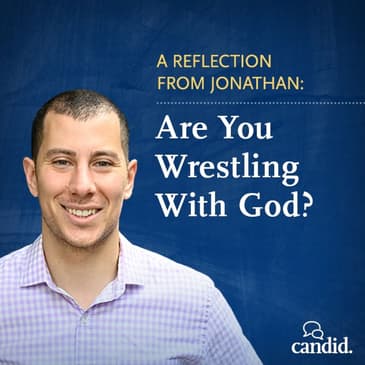
Are you committed to Christ but searching for guidance? In this new reflection, Jonathan Youssef explores the gripping Biblical story of Jacob—a tale of struggle, transformation, and divine engagement. Jonathan connects his own experiences with Jacob’s journey, offering insights into the challenges of perseverance, the power of repentance, and the profound ways God works in our lives.
Listen and deepen your understanding of spiritual growth and how our trials can lead to profound blessings. This is a must-listen for anyone seeking inspiration and guidance from God.
To ask Jonathan a question or connect with the Candid community, visit https://LTW.org/Candid
Facebook: https://www.facebook.com/candidpod
Instagram: https://www.instagram.com/candidpod
Twitter: https://twitter.com/thecandidpod
TRANSCRIPT:
This transcript recounts Candid Conversations with Jonathan Youssef Episode 255: Wrestling with God: Jonathan Youssef
In seventh grade, I joined my middle school wrestling program. For two weeks, we ran and did all kinds of exercises, and then we would wrestle each other for the rest of the time we were there. And I did not like it. I lost to a guy who was younger than me. I lost every day. I was terrible. And I was tired of losing, and I lacked perseverance. There is little more humiliating than being wedged under the fat arm of a sweaty teenage boy, and I thought, This is as low as it gets.
Well, our reflection today is about wrestling and persevering. I’ve always been intrigued by the biblical story because it has so many layers. It’s multifaceted and multidimensional. And it’s a little bit dangerous, meaning that there is potential to miss the main point of what the text is saying and to misunderstand or misrepresent it.
Over the years, I’ve reread it, read commentaries, listened to talks, and consumed all I can to try to understand it better. I want to know what is taking place at this really important moment in salvific history.
We have this man, Jacob. He has been at odds with his brother since birth. Even in the womb, he and Esau are wrestling with each other. He is at odds with his father over who is the favored son. He is at odds with who should be blessed. He’s at odds over who had the birthright in the family. He’s used trickery and deception to achieve his purposes. He’s at odds with his Uncle Laban, a master trickster himself.
But in Genesis, we begin to see the undoing of this character, Jacob. He’s being undone, and he’s being changed and transformed through these middle chapters of this book. He’s served his crooked uncle/father-in-law for twenty-some-odd years, and in many ways, he’s echoing the prodigal son here. Having come to himself, he’s leaving Laban here, and he’s coming home, you might say, to the homeland of his father, to his older brother, and although God has begun to work in him, although he is a new man, as it were, spiritually, it becomes clear that God is not finished with Jacob yet.
And so this chapter unfolds with three dramatic pictures. First, in verses 1 through 21, we have the picture of Jacob returning. God has been working in his life, as we just noted. God has also been working in the lives of Jacob’s two wives, Leah and Rachel, and now Jacob has sent word to his brother, Esau, the brother who swore that he would one day kill his little brother in a very Cain and Abel-type fashion.
So Jacob sends the word, “Hey! I’m coming home.” He’s really only able to do this because the Lord has told him, “The day will come that I’m going to bring you back to this land. And I am promising that I will do you good, that I will prosper you, and that I will be with you.”
If you remember the account of Jacob’s ladder, where Jacob falls asleep, and he envisions this ladder coming down from heaven, and the angels ascend and descend upon the ladder, the Lord tells him, “I will be with you. I will bring you back to this land. I will give it to you and your offspring. And the whole earth will be blessed through you and your seed.” And, of course, it reminds us of the very same promise given to Abraham.
He promises to keep and return him to that land, and now that day has come. In verses 1 and 2, we read that the angels come and meet Jacob. It’s confirmation that the Lord is with him. He names the area Mahanaim, meaning “two camps.”
Now, perhaps he’s referring to the fact that it’s his camp and the Lord’s camp; the Lord’s camp will be his shield and protection. Because he’s going to need it. And the report comes back, “Hey, Esau’s coming to see you. He’s got four hundred guys with him. It’s going to be great, right?”
Okay, either Esau is rolling out the red carpet for his little brother, or Esau has come for his vengeance, and he has not forgotten 20 years of anger and hostility. Verse 7 says, “Then Jacob was greatly afraid and distressed.”
Now, when it comes to our fears and the Lord, do we find that the way that the Lord enables us through our fears is by removing the fear, removing the obstacles? Or do we find that He gives us greater reasons not to fear than to fear? Here is Jacob, and he’s stuck in a difficult situation. He cannot return to his Uncle Laban; he’s terrified to go forward to his brother, Esau, and the unknown. What's he going to do?
Well, he’s a different man now. He probably would have used skill and trickery to weasel out of this in his past life. He would have found a crafty way to save himself, even at the cost of his own family.
But he’s a different man now, and Jacob perseveres despite his hesitancy, fear, and distress—unlike my illustrious wrestling career.
And then we see Jacob do something we’ve never seen him do in Scripture. He gets on his knees, and he pleads with God. He’s praying for God’s help in his dreadfully fearful situation. And Jacob prays the longest prayer in the book of Genesis. And the prayer shows us that he now belongs to the Lord. It’s evidence that the Lord is working in your heart, is it not, when you begin to call on His name, and it’s not just, “Lord, I’m in a mess. Help me out of this,” but rather, it’s “God, you promised to be with me. You promised to protect me. And so I’m coming to you, claiming on those promises.”
And that's what Jacob does, “Lord, you said that you would do good to me. Fulfill your promise to me.” You notice it’s not a panicked prayer, “God, get me out of this bind, and I’ll build a hundred churches for you.”
No. Instead, you have a man at the end of his resources, holding onto God's promises to bless him, and then he patiently sits, trusting that the Lord will act.
Then, we see another change in Jacob: a repentant heart. It’s an attitude of repentance. That's what’s happening with this whole procession going out to Esau. He sends the people and the animals and tells them to give a message to Esau: These gifts are from your servant, Jacob. Now, he’s scared, yes, but he’s coming behind us. He’s indebted himself to you. Do you want a sign of a changed life? Do you want a sign of a repentant heart? You are prepared to go to the person you have offended, and you say to them, “Because of what the Lord has done in me through the power of the Lord Jesus Christ, I can come before you and serve you.”
Think of Zaccheus, “A wee little man was he. He climbed up in the sycamore tree for the Lord he wanted to see. In the British version, it says, “And Jesus said, ‘I’m coming to your house for tea,’” because they all drank tea back then. But what does Zaccheus do? Does he just say, “Lord, I’m sorry. I was bad. I did wrong. Forgive me, Lord,” and then just move on?
No! He gives four times back. He repays his debts. It’s evidence of a changed man. And that's the other thing that Jacob is doing, right? He’s gifting these 550 animals. He’s saying, “Brother, I stole your blessing. I used deception and trickery for my own advantage, and now I’m giving it back to you” because I understand I need to be made right with you.”
It’s more than just feeling sorry in a moment. In Scripture, repentance is God's work of grace in my heart. I am sorry for my sin and find His forgiveness, but I’m also working towards restoration, repairing whatever damage I have caused.
The story is told of a machinist or factory worker in the Ford Motor Company in Detroit who had, over several years, borrowed tools and equipment, but never returned them. The machinist was thoroughly converted and was baptized. He wanted to put his faith into practice, so he came back to work to his boss, to the foreman, and he brought all the tools he had stolen and all the equipment he had taken, and the foreman didn’t know what to do. And he’s repenting, and he’s confessing what he’s done, and so the foreman, impressed by this, cables Henry Ford and says, “You’re not going to believe this. This guy’s come back, and he’s brought everything with him,” to which Ford cabled back, “Dam up the Detroit River and baptize the whole city.” That's what's happening here with Jacob. He’s bringing the blessing back. The blessing that the Lord has poured out on him, he’s giving it back.
Jacob returning. Then we have a second scene, which I’m sure we’re all a little more familiar with, and this is the scene of Jacob wrestling. He’s not only sent his possessions on, he’s sent his whole family ahead. Verse 22 states, “He took his wives and servants and his eleven children, and they crossed over the Jabbok at night.”
And then, in verse 24, he’s all alone, and a man grabs him in the darkness and begins to wrestle with him. My seventh-grade self’s nightmare because I didn’t like wrestling. That was the allusion to that if you’re following along.
Who do you think Jacob thinks he’s wrestling? It’s most likely that he thinks he’s wrestling with the man who swore to kill him, the man that all of this procession and all this fuss is about. At this moment, Esau is who Jacob thinks his most significant conflict is with. The one I have to wrestle with is my brother, it’s Esau.
But that is not who he wrestles with in the night, as we find out later in this passage and as we read in Hosea chapter 12, which is a little brief commentary. We find out that Jacob is, in fact, wrestling with some manifestation of God in the flesh, a pre-incarnate Christ. And so then we’re left to ask the question, What will God gain from this, from wrestling with Jacob? He’s already sent all his possessions on ahead. Surely, God is finished with Jacob. He’s repentant, he’s confessed, he’s done it all. There is no box left to check.
But you see, Jacob has given all he has back, but the most important thing is that he has yet to give back. Do you know what it is? It’s Jacob. It’s Jacob himself. And Jacob may think that Esau is trying to get what is his, which is to take Jacob’s life, but the reality is that God is wrestling with Jacob to take what is His—which is Jacob! And this wrestling, it’s like a father with a child. You know there’s a way I’m not a good wrestler, as we’ve illustrated, and you’re trying to catch up with me on this. But there’s a way for me to wrestle with my children while they’re young, though my son is getting to the age where I can’t keep up with him. But there’s a way for me to wrestle with them, which keeps them engaged for a long time in which I never lose, and they never lose. That's sort of what God is doing with Jacob here.
But then He does this thing where He touches Jacob’s hip, and now Jacob has this dislocated hip, and you need your hip as a pivot to wrestle, so now he’s got nothing, he’s zero. And he’s clinging to God, and God is saying to him, “Let me go. Let me go,” and Jacob says, “I’m not going to let you go unless you bless me.”
Here’s the context of these situations: The lesser is always blessed by the greater, so Jacob acknowledges that he is holding onto the greater being. I imagine he’s still not sure who he’s wrestling with, but he’s holding on, and he sees by the power that's rendered his hip inoperable that he’s holding on to a greater being. And he’s saying, “I will not let you go unless you bless me.”
If you go back and look at Jacob's life, you know what you’ll see? Jacob is immensely blessed. Everything he does is blessed, right? That's what God promised to do, and that's what he’s receiving. Everywhere he went, every person he interacted with was blessed, just as God has blessed us immensely. If only we had eyes to see, we could have blessing upon blessing in our lives and still miss the main point.
The main point is not the blessings, plural, but God’s blessing. And what is God’s blessing? It is that He has every part of us. And how Jacob enters into this blessing is obvious: God says to him, “What is your name?”
And the response is one word: Jacob. Jakob. What's in the name? Twister is the etymology of the name Jacob. Twister, deceiver, heel-clutcher. And now God has gotten to the bottom of the issue: it’s a confession. I am unrighteous, I am a sinner. My identity was in who and how I could trick them.
God is going right for his heart, saying, “Give me your heart, Jacob. That's what I want.” You see that God is prepared to dislocate Jacob’s hip to have Jacob's heart. That may be what God is saying to you, that the way to your heart is by the divine dislocation of something you take pride in, which is a source of great strength for you. Maybe you notice He’s touched the very thing in which you have depended on for your life, and He’s taken it away from you. That's what's happening to Jacob. The Lord draws him in to say, “Jacob, it’s not all the things in your life that I want you to give me; it’s yourself that I want.”
But you see, there’s a third scene, a beautiful scene. Jacob returned, Jacob wrestled, and now Jacob was limping. In the next chapter, chapter 33 of Genesis, we see Jacob return to his brother Esau, but he’s not at the back of the caravan as he was before with his plan. He’s at the front now and prepared to take it all. But we’re told that he’s doing two things. One, he’s bowing down seven times, and the other is using the language of “I am the servant, and you, Esau, are the lord.”
But I think if you were there that day to watch this encounter, those would not be the two things you would have paid attention to. I think the thing that would have captured your attention would have been this: his limp. Why is this significant? Because, beloved, this is a picture of the Christian life. Men and women who have been dislocated to different degrees because of the work of God in their lives and caused to limp, humbled under His sovereign, mighty hand; caused to limp, caused to be conscious of this for the rest of their lives of their weakness and their dependence on the Lord. Dependent on His forgiveness, dependent on His power—moment by moment, day by day. But the sun has risen upon them.
I wonder if you’ve come across one of these people. And it doesn’t always have to be a physical variation of this; sometimes it’s unseen, the wound, the dislocation. But when we were in Australia, there was a young man. He was in our Bible study, and he looked like he had been in a fire. He had an autoimmune disorder, and he received a bone marrow transplant from his sister, but the transplant caused his body to fight against itself. And so his body was covered in sores and blisters everywhere, and ulcers filled his mouth. Walking was difficult; eating was difficult.
As I said, he was in our Bible study, and so when I asked him his story, he said to me that he was a great swimmer. When he was in high school, he was actually training for the Olympics for the Australian national team. Then he started feeling strange, and his swim time started getting slower and slower, and that's when all the medical issues began in his life.
And he told me, he said, “You know, before, I was a good kid, but I was very full of myself. I was arrogant. But God reached in and dislocated a part of me, taking away things I loved doing.”
And even through his anger, frustration, agony, and pain, he never left the Lord, and the Lord certainly never left him. He would testify to the goodness of God, despite what everybody saw physically with their eyes when they encountered them. His faith and his dependence on the Lord remained until the Lord called him home a few years ago.
This is how the Lord said to him, “I want every part of you. I want your heart.” You see, this is not just a principle of spiritual usefulness for Jacob and for us; this takes us to the heart of the gospel. For you see, there would be another night, centuries later, where two wrestlers were engaged, but this time a Son with His Heavenly Father, as He said, “Let this cup pass from me.” And there is an equality in the wrestling. “Let this cup pass from me, and yet, I will not let you go despite what is coming, the agony and the shame that will be borne on the cross. I will not let you go, Father, until you bless them,” which is why He says, “Father, forgive them, for they know not what they do.” And so He, as Paul says, upon that cross became a curse so that the blessing may come to us.
Where are you today? Perhaps you’re on your way, like Jacob, and you’re walking through repentance and forgiveness. Are you willing to give up a little but not the whole? Perhaps you’re wrestling with God over these things at this moment, and you give a little, but then you fight for others, and it’s a give-and-take relationship, and it’s very back and forth. Perhaps you want to let go, or perhaps you have let go in the past, and the Lord keeps re-engaging with you in this wrestling match, and He’s waiting for you to say, “Don’t let me go. I will not let you go, even if it means me having a limp for the rest of my life.”
Do you have a limp? Do you have a dislocation? May the Lord be gracious to us as He pursues our hearts.
For more original podcasts from Leading The Way, please visit ltw.org/subscriptions
[00:00:06] Hello and welcome to Candid, where we never settle for less than the truth. I'm your host, Dr. Jonathan Youssef. Each week we'll tackle tough issues, answer your hard questions, and take a candid look at the Christian faith. When I was in seventh grade, I joined my
[00:00:25] middle school wrestling program. For two weeks, we ran and we did all kinds of exercises and then we would wrestle each other for the rest of the time we were there. And I did not like it.
[00:00:41] I lost to a guy who was younger than me, and I lost every day. I was terrible. I was tired of losing and I lacked perseverance. Well, there's little more humiliating than being wedged under the fat arm of a sweaty teenage boy,
[00:01:00] and I thought, I'm pretty sure this is as low as it gets. Well, our reflection today is about wrestling and persevering. It's a biblical story that's always intrigued me because it has so many layers. It's multifaceted and multidimensional, and it's a little bit dangerous.
[00:01:21] Meaning that there is potential to miss the main point of what the text is saying, as well as to misunderstand and misrepresent it. Over the years, I've gone back and I've reread this section and I've read commentaries
[00:01:38] and I've listened to talks and consumed all I can to try to understand it better. I want to know what is taking place in this really important moment of salvific history. In the story, we have this man, Jacob. He's been at odds with his brother since birth.
[00:02:03] Even in the womb, he and his brother Esau are wrestling with each other. He is at odds with his father over who is the favored son. He is at odds with who should be blessed. He's at odds over who has the birthright in the family.
[00:02:22] He's used trickery and deception to achieve his purposes. He's at odds with his uncle Laban, a master trickster himself. But in Genesis, we begin to see the undoing of this character Jacob. He's being undone and he's being changed and transformed through these middle chapters of this book.
[00:02:48] He served his crooked uncle slash father-in-law for some 20 odd years and in many ways, he's really echoing the prodigal son. Having come to himself, he's leaving Laban here and he's coming home, you might say, to the homeland of his father and to his older brother.
[00:03:13] And although God has begun to work in him, although he is a new man as it were spiritually, it becomes clear that God is not finished with Jacob just yet. And so this chapter unfolds with three dramatic pictures.
[00:03:30] First, we have in verses 1 through 21 the picture of Jacob returning. God has been working in his life as we've noted. God has also been working in the lives of Jacob's two wives, Leah and Rachel.
[00:03:45] And now Jacob has sent word to his brother Esau, the brother who swore that he would one day kill his little brother in a very Cain and Abel type fashion. And so Jacob sends word that I'm coming home. And he's really only able to do this
[00:04:04] because the Lord has told him the day will come that I'll bring you back to this land and I am promising that I will do you good, that I will prosper you and I will be with you.
[00:04:16] If you remember the account of Jacob's ladder where Jacob falls asleep and he envisions this ladder coming down from heaven and the angels are ascending and descending upon the ladder and the Lord tells him,
[00:04:31] I will be with you. I will bring you back to this land. I will give it to you and your offspring. And through you and your seed the whole earth will be blessed. And this of course reminds us of the very same promise that was given to Abraham.
[00:04:47] He promises that he will keep him and return him to that land and now that day has come. In verses one and two, we read that the angels come and meet Jacob. It's a confirmation that the Lord is with him. And so Jacob names the area
[00:05:07] Mehenam, meaning two camps. Now perhaps he's referring to the fact that it's his camp and the Lord's camp. The Lord's camp is going to be his shield and his protection because he's going to need it.
[00:05:23] And so the report comes back, hey your brother Esau is coming to see you and he's brought 400 armed men with him. This is going to be great.
[00:05:34] Okay, so either Esau is really rolling out the red carpet for his little brother or Esau has come to seek his vengeance. And he has not forgotten 20 years of anger and hostility. Verse seven says, then Jacob was greatly afraid and distressed.
[00:05:57] Now when it comes to our fears and the Lord, do we find that the way that the Lord enables us through our fears is by removing the fear or by removing the obstacles?
[00:06:14] Or do we find that rather he gives us greater reasons not to fear than to fear? Here is Jacob and he's really stuck in a difficult situation. He cannot go back to his uncle Laban.
[00:06:34] He's terrified to go forward to his brother Esau and the unknown. What is he going to do? Well, he's a different man now. He probably would have used his skill and his trickery to weasel
[00:06:48] his way out of this in his past life. He would have found a crafty way to save himself even at the expense of his own family. But he's a different man now and we see that Jacob perseveres despite his hesitancy, his fear, and his distress.
[00:07:03] Much unlike my illustrious wrestling career. Then we see Jacob do something very different. Then we see Jacob do something that we've never seen him do before in scripture. He gets on his knees and he pleads with God. He's praying for God's help in this dreadfully fearful situation.
[00:07:33] And Jacob prays the longest prayer in the book of Genesis. The prayer shows us that he now belongs to the Lord. It's evidence that the Lord is working in your heart, is it not? When you begin to call on his name and it's not just,
[00:07:51] Lord, I'm in a mess. Help me out of this. But rather it's, God, you promised to be with me. You promised to protect me and I'm coming to you claiming on those promises. And that's what Jacob does.
[00:08:06] Lord, you said that you would do good to me. Fulfill your promise to me. You notice it's not a panicked prayer. God, just get me out of this bind and I'll build you a hundred churches.
[00:08:20] No, instead you have a man who's really at the end of his resources and he's holding on to God's promises to bless him. And then he patiently sits trusting that the Lord will act. Then we see another change in Jacob and it's a repentant heart.
[00:08:41] It's an attitude of repentance. That's what's happening with this whole procession that's going out to Esau. He sends the people and the animals and he tells them to give a message to Esau. These gifts are from your servant Jacob.
[00:08:58] Now he's scared, yes, but he's coming behind us. He's indebted himself to you. Do you want to see a sign of a changed life? Do you want to see a sign of a repentant heart?
[00:09:12] It's that you are prepared to go to the person you have offended and you say to them, because of what the Lord has done in me through the power of the Lord Jesus Christ, I can come before you and I can serve you. Think of Zacchaeus,
[00:09:35] a wee little man was he, he climbed up in the sycamore tree for the Lord he wanted to see. And Jesus said, I'm coming to your house for tea. But what does Zacchaeus do? Does he just say, Lord, I'm really sorry. I was bad. I did wrong.
[00:09:53] Forgive me, Lord. And then just move on? No, he gives four times repayment. He repays his debts. It's evidence of a changed man. And that's the other thing that Jacob is doing, right? He's gifting these 550 animals. He's saying, brother, I stole your blessing.
[00:10:17] I used deception and trickery for my own advantage. And now I'm giving it back to you because I understand I need to be made right with you. It's more than just feeling sorry in a moment. In Scripture, repentance is the work of grace
[00:10:35] that God does in my heart. I am sorry for my sin and it finds his forgiveness. But I'm also working towards restoration, repairing whatever damage I have caused. The story is told of a factory worker in the Ford Motor Company in Detroit
[00:10:54] who had over a number of years borrowed tools and equipment, and he had never returned them. The factory worker was thoroughly converted and was baptized, and he wanted to put his faith into practice. And so he came back to work to his boss, to the foreman,
[00:11:14] and he brought all the tools that he had stolen and all the equipment that he had taken. And the foreman didn't know what to do. He's repenting and he's confessing what he's done. And so the foreman is really impressed by all of this.
[00:11:28] And so he sends a cable to Henry Ford and he says, you're not going to believe this. This guy has come back and he's brought everything with him. To which Henry Ford cabled back, dam up the Detroit River and baptize the whole city.
[00:11:45] That's what's happening here with Jacob. He's bringing the blessing back, the blessing that the Lord has poured out on him. He's giving it back. Jacob returning. Then we have a second scene, which I'm sure we're all a little bit more familiar with.
[00:12:05] This is the scene of Jacob wrestling. He's not only sent his possessions on, he's sent his whole family ahead. Verse 22, he took his wives, his servants and his 11 children, and they crossed over the Jabbok at night.
[00:12:21] And then in verse 24, he's all alone and a man grabs him in the darkness and begins to wrestle with him. Now, who do you think Jacob thinks he's wrestling? It's most likely that he thinks he's wrestling with the man who swore to kill him.
[00:12:39] The man that all of this prosecuted. The man that all of this procession and all this fuss is about. Esau at this moment is who Jacob thinks his most significant conflict is with. The one I have to wrestle is my brother. It's Esau.
[00:13:01] But that is not who he wrestles with in the night. As we find out later in this passage, and as we read in Hosea chapter 12, which is a commentary on this account, we find out that Jacob is in fact wrestling with some manifestation of God in the flesh,
[00:13:20] a pre-incarnate Christ. And so then we're left to ask the question, what will God gain from this with wrestling with Jacob? He's already sent all his possessions on ahead. Surely God is finished with Jacob. He he's repentant. He's confessed. He's done it all.
[00:13:40] There's no box left to check. But you see, Jacob has given all he has back. But the most important thing that he has, he's yet to give back. Do you know what that is? It's Jacob. It's Jacob himself.
[00:14:03] And Jacob may think that Esau is trying to get what is his, which is to take Jacob's life. But the reality is that God is wrestling with Jacob to take what is his, which is Jacob. And this wrestling, it's like a father with a child.
[00:14:26] There's a way for me to wrestle with my children, which keeps them engaged for a long time in which I never lose and they never lose. A sort of humbling myself to wrestle on their level. That's sort of what God is doing with Jacob here.
[00:14:42] But then he does this thing where he touches Jacob's hip. And now Jacob has this dislocated hip. And you need your hip to pivot in wrestling. So now he has nothing. He's zero and he's clinging to God. And God is saying to him, let me go.
[00:15:01] Let me go. And Jacob says, I'm not going to let you go unless you bless me. Here's the thing about the context that we know of these situations. The lesser is always blessed by the greater. So Jacob is acknowledging that he is holding on to the greater being.
[00:15:22] I would imagine he's still not sure who he's wrestling with, but he's holding on and he sees by the power that's rendered his hip inoperable that he's holding on to a greater being. And he's saying, I will not let you go unless you bless me.
[00:15:39] If you go back and look at the life of Jacob, you know what you'll see? Jacob is immensely blessed. Everything he does is blessed, right? That's what God promised to do. And that's what he's receiving. Everywhere he went, every person he interacted with is blessed
[00:16:00] just as God has blessed us immensely. If only we had eyes to see, for we can have blessing upon blessing in our lives and still miss the main point. The main point is not the blessings plural, but God's blessing. And what is God's blessing?
[00:16:25] It is that he has every part of us. And how Jacob enters into this blessing is obvious. God says to him, what is your name? And the response is one word, Jacob. What's in the name? Twister is the etymology of the name Jacob. Twister, deceiver, heel-clutcher.
[00:16:54] And now God has gotten to the bottom of the issue. It's a confession. I am unrighteous. I am a sinner. My identity was in who I could trick and how I could trick them. God is going right for his heart. And he's saying, give me your heart, Jacob.
[00:17:22] That's what I want. You see that in order to have Jacob's heart, God is prepared to dislocate Jacob's hip. That may be what God is saying to you, that the way to your heart is by the divine dislocation
[00:17:41] of something that you take pride in, something that is a source of great strength for you. Maybe you notice he's touched the very thing in which you have depended on. Something which you have depended on for your life, and he has taken it away from you.
[00:17:58] That's what's happening to Jacob. It's the Lord drawing him in to say, Jacob, it's not all the things in your life that I want you to give me. It is yourself that I want. But you see, there's a third scene. Jacob returning, Jacob wrestling, and now Jacob limping.
[00:18:18] In the next chapter, chapter 33 of Genesis, we see Jacob returns to his brother Esau. But he's not at the back of the caravan as he was planning to do before. He's at the front now and he's prepared to take it all.
[00:18:33] But we're told that he's doing two things. One, he's bowing down seven times. The other thing is he's using the language of I am the servant and you, Esau, are the Lord. But I think if you were there that day and you watched this encounter between these two
[00:18:50] brothers, those two things aren't something you would have paid as much attention to. I think the thing that would have captured your attention would have been the limp of Jacob. Why is this significant? Because beloved, this is a picture of the Christian life.
[00:19:09] Men and women who have been dislocated to different degrees because of the work of God in their lives and caused to limp. Humbled under his sovereign, mighty hand, caused to limp, caused to be conscious of
[00:19:25] this for the rest of their lives, of their weakness and their dependence on the Lord, dependent on his forgiveness, dependent on his power, moment by moment, day by day. But the sun has also risen upon them. I wonder if you've come across one of these people.
[00:19:45] It doesn't always have to be a physical variation of this. Sometimes it's unseen. The wound, the dislocation. When I lived in Australia, there was a young man who was in our Bible study and he looked like he had been in a fire.
[00:20:01] He had an autoimmune disorder, which he received a bone marrow transplant from his sister, but the transplant caused his body to fight against itself. And so his body was covered in sores and blisters everywhere and ulcers filled his mouth. Walking was difficult, eating was difficult.
[00:20:22] So when I asked him his story, he said to me that he was a great swimmer. And when he was in high school, he was actually training for the Olympics for the Australian national team. Then he started feeling strange and his swim time started getting slower and slower.
[00:20:39] And that's when all the medical issues began in his life. And he told me, you know, before I was a good kid, I was very full of myself though. I was arrogant.
[00:20:51] God reached in and dislocated a part of me, taking away the things that I love to do. And even through his anger and his frustration and his agony and his pain, he never left the Lord and the Lord certainly never left him.
[00:21:10] He would testify to the goodness of God, despite what everybody was seeing physically with their eyes when they encountered him. His faith and his dependence on the Lord remained all the way until the Lord called him home a few years ago.
[00:21:27] This is the way that the Lord said to him, I want every part of you. I want your heart. Because you see, this is not just a principle of spiritual usefulness for Jacob and for us. This takes us to the heart of the gospel.
[00:21:47] For you see, there would be another night centuries later where two wrestlers were engaged. But this time a son with his heavenly father, as he said, let this cup pass from me. And there is an equality in the wrestling. Let this cup pass from me.
[00:22:10] And yet I will not let you go despite what is coming, the agony and the shame that will be born on the cross. I will not let you go father until you bless them. Which is why he says, father, forgive them for they know not what they do.
[00:22:30] And so he, as Paul says upon the cross became a curse in order that the blessing may come to us. Where are you today? Perhaps you're on your way like the rest of us. Perhaps you're on your way like Jacob and you're walking through repentance and you're
[00:22:51] walking through forgiveness. Are you willing to give up a little but not the whole? Perhaps you're wrestling with God over these things at the moment and you give a little but then you fight for others and it's a give and take relationship and it's very back and forth.
[00:23:10] Perhaps you are wanting to let go or perhaps you have let go in the past and the Lord keeps reengaging with you in this wrestling match. He's waiting for you to say, don't let me go.
[00:23:23] I will not let you go even if it means me having a limp for the rest of my life. Do you have a limp? May the Lord be gracious to us as he pursues our hearts. Candid is a podcast from Leading the Way with Dr. Michael Youssef.
[00:23:46] Don't forget to connect with our social media pages on Instagram, Twitter and Facebook. And subscribe to Candid Conversations on your favorite podcast platform so you never miss an episode. While there, please leave a review. It does help people find us.
[00:24:03] As always, thank you for listening to and sharing this episode.