
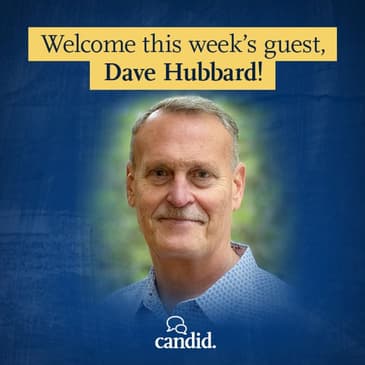
In this NEW episode of Candid Conversations, host Jonathan Youssef welcomes Dave Hubbard back to the program. Dave is a former NFL football player and pastor at The Church of The Apostles. In this encouraging episode, he shares his rich experiences and insights on serving both within the church and in the broader community. With a background that spans professional sports to full-time ministry, Dave offers a unique perspective on the importance of active service and its challenges and rewards.
After you listen to this episode, you may have questions. We would love to hear from you! To ask Jonathan a question or connect with the Candid community, visit https://LTW.org/Candid
Also, join the conversation on our social media pages:
Facebook: https://www.facebook.com/candidpod
Instagram: https://www.instagram.com/candidpod
Twitter: https://twitter.com/thecandidpod
For more original podcasts from Leading The Way, please visit ltw.org/subscriptions
[00:00:00] It's imperative that Christians discover the unique gift that God has given them in
[00:00:08] ministry with the talents and so forth and how He's wired them and to get out of the
[00:00:12] huddle and to get on the line of scrimmage and to use those gifts.
[00:00:17] Hello and welcome to Candid where we pastor at the Church of the Apostles. In this episode, Dave shares wisdom from his years of faithful service in the church and some insight on trends he's seen over the past 40 years in Christian homes. So we had missionaries living in our home and I'm really happy that that happened because it gave me a world of you that growing up in a out in the country in Napa, California. Back when it was the country. Yeah. I would have never gotten. So it really gave me perspective and so forth and kind of what missions was all about. And
[00:03:02] our church too was really consistently focused on, look, we've got to be connected and we've got to be using the gifts that God's given you in some capacity in that regard. Just in thinking through that, I mean, most Western governments have set up a lot of those safety nets and things like that that if kind of, we may be, we come to this later
[00:04:21] if you wanna keep going with your story,
[00:04:22] but it's, they've been set up to where almost
[00:04:24] the church doesn't need to do certain things.
[00:05:24] what used to be. In your right, it was all the churches, or religious organizations, and the whole hospital system, as you said, all of that was all churches.
[00:05:29] And yeah, so I would say the biggest thing that happened that kind of moved probably
[00:05:33] churches off of that whole aspect of serving was the government taking charge of all of
[00:05:39] that. And so the idea became then, which is detrimental down the line is, you know,
[00:05:43] okay, well, I pay my taxes. out of the NFL and directly into full-time ministry. And it so happened that the senior pastor who I served with was an ex-high school coach out of Southern California, Los Angeles. So that put ex-high school coach and an ex- NFL happily together, till they're now 30 yards, 40 yards going backwards. And he finally breaks into the huddle. And at this point, they're laying on the ground, so their helmet's off, chewing on a blade of grass, you know. And he's like, what does it matter with you people? And so then to a person moving around the huddle, all these different reasons
[00:08:21] why they don't want to break the huddle. And it's like be proactive, you have to be intentional in order to make that work. So, you know, the most compelling verse is Ephesians 2 10, for God's workmanship, God's handy work created in Christ Jesus to do good works, which God prepared in advance for us to do.
[00:09:40] So the translation is God created us to do good works
[00:09:44] and has prepared the way Spirit comes to dwell to our willess. But why don't we just go home at that point? Why does it got to say, okay, it's my good news. Yeah, it's really good news. You're coming with me.
[00:11:00] And at that point, we just leave the planet right into our future forever home.
[00:11:05] I think a part of that is antenna up and radar constantly going. I think it should be right where you live and the neighbors that surround you,
[00:12:20] those in your subdivision. And so that up what worked out a deal with farmers
[00:13:40] where they kind of leveled the fields
[00:13:42] at that particular time.
[00:13:43] So it was a huge area and you'd come in
[00:13:45] and kind of set up a tent city.
[00:13:47] And so you had your areas with us Why are you staying across the border and then going through the rigour-mour-roll and it was to come across every day And then go back every day we could plough fields. You could stay right here. We would welcome you whatever so
[00:15:04] Taking that back. I said okay. I'll do it, but we're gonna we're not doing the tent city thing
[00:16:26] We're gonna park for the village and all of that. So the lesson learned from that was I think a really important one, almost leaning back into the question you just asked to the neighbors and the rest. It's easy to do kind of a motel missionary kind of thing, where you're kind of doing something but you're kind of not in and that's something that really has to change. We have to get off of that kind of mentality and really get, again, in the line of scrimmage, get down in the dirt if you will, get our fingernails dirty, which means at that point that you're
[00:17:40] again building relationships. You don't build relationships in that kind of
[00:17:43] situation. You're in and out, you know, how the church was doing what they were doing as far as small groups, volunteerism, care ministries and missions and so forth. Yeah.
[00:19:03] And I think from there, we then migrated into the social gospel righteousness. Yes. Here's an illustration. I heard this in a message from Alistair Begon. He wasn't using it necessarily in this context, but I found it fascinating. He said he was in Scotland, and he sees a billboard advertising the need to give blood. Okay.
[00:20:20] And it's a picture of a small boy.
[00:20:23] He obviously is sick.
[00:20:24] You know, he's definitely sick.
[00:20:25] He needs a blood transfusion. billboard was all about the person in need, acknowledging the sacrifice that would be necessary to meet that need. The message of the second billboard was all about the person serving, playing off the notion that by doing so, you can feel better about yourself. It becomes as virtue signaling. And look good to everyone else. Yes. Yeah. Yeah. Post should put kind of a heavy hand of obligation to serving necessarily on young couples with children. They're in a mission field all their own. Especially when they're sick. And so it's age of
[00:23:01] stage of life. The seasonal thing I think, of when a family has a new child, people from kind of different walks and stages, cook and prepare meals and bring them to the family because that's such a good example. So you're now a recipient of that loving community. You've taken a burden off of them.
[00:24:20] They have a lot going on that serves them well.
[00:24:23] And then what it shows them is that takes you through that process. Even though to make that more local, okay, is have a homeless person or someone and actually along- Or pay-cues incarcerated or- Yes. And they do a lot of that. Yeah. Along with all the gifts that you're giving, that you sacrifice and you put something together.
[00:25:41] And that's, I think, really important in America
[00:25:44] we're a consumer society, right?
[00:25:46] Consumers have been very materialistic
[00:25:48] and very selfish. runners, but they're not all good runners, but it's not only if they're fault. Right. So constantly we're running into situations where, you know, I can't pay the rent. Well, why can't you pay? You know, and so that becomes like almost a mission field where if you're willing to go there, where you can get involved in their lives and show them the love of Christ and
[00:27:00] even potentially lead them to Christ. as it related to here's a people that are their dirt poor. They have less than nothing, but they're happy and they're fulfilled and they're not depressed. And you know what I'm saying? I mean, they're there. So experiencing that is really, really powerful and it does change your life going forward.
[00:28:21] I kept track with a lot of these students even to this day
[00:28:24] and they still ways to serve, find out what your spiritual gifts are and start putting them in practice. Look around you, look in your neighborhood, look at your schools that your kids are in and think about avenues where you can connect, you can plug in, you can build relationships with people because everybody
[00:29:41] has some level of struggle to some degree and again, we want to be able to have some