
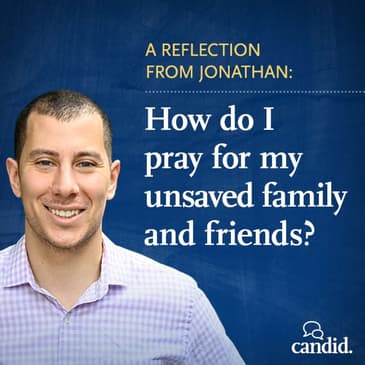
Many of us grapple with the question, "How can I effectively pray for and reach my loved ones who do not know Christ?"
In this reflection, Jonathan Youssef delves into this profound topic, offering Biblical insights on the purpose of prayer, the balance between God's sovereignty and our responsibility, and the privilege of interceding for our unsaved loved ones.
Tune in for a thoughtful exploration of these important themes. If you have any questions after listening, we’d love to hear from you! Connect with Jonathan and the Candid community at https://LTW.org/Candid.
Engage with us on social media:
- Facebook: https://www.facebook.com/candidpod
- Instagram: https://www.instagram.com/candidpod
- Twitter: https://twitter.com/thecandidpod
For more original podcasts from Leading The Way, please visit ltw.org/subscriptions
[00:00:00] Hello and welcome to Candid, where we never settle for less than the truth. I'm your host, Jonathan Youssef. Each week we'll tackle tough issues, answer your hard questions and take a candid look at the Christian faith. Would you mind leaving us a review today? By leaving a review and rating it helps others find us, and it would be a huge help. Using your favorite P spores.
[00:00:29] Using your favorite podcast platform, go to our show and leave a rating along with the review, and perhaps next week we will mention you on the show.
[00:00:38] Today I want to talk about an issue that comes up almost every week for me.
[00:00:46] And a question that I hear over and over again, and I see posted on social media or articles written about, and it is the question of
[00:00:59] how do I pray for my unsaved family members, my unsaved friends?
[00:01:05] And that is a really big question, and I think in our conversation today this will probably raise additional questions, which is good because we should be thinking and asking good questions and investigating and not just sort of taking things
[00:01:24] right at the face value and kind of leaving it alone. It's good to be inquisitive. This Christian faith is a rational faith.
[00:01:32] It can stand up to inquiry, it can stand up to attack, it can stand up to anything that you throw at it, but you have to be a person who is being honest and genuine with the responses that come back, whether it's through scripture or through a leader in the church who you trust.
[00:01:53] There's an element of having to be completely transparent with those things and being honest with the response that's given and not acting out of emotion, or even experience to some extent, but really weighing these things out.
[00:02:07] I even think of our recent interview with Dr. Krueger and his talking about those people who argue with you just for the sake of argument, that they're just throwing up a smokescreen.
[00:02:20] Again, this will raise other questions, but if we're being honest and we're asking these important questions about prayer, about reaching our unsaved family and friends, then I think we need to have this moment of honesty together in allowing the word of God to speak to us and speak to our hearts and our minds.
[00:02:40] And so, really, the first question is why pray at all? I mean, if you've listened to this podcast with any regularity, you know that I'm very big on the sovereignty of God and I'm very big on the sovereignty of God, because scripture is very big on the sovereignty of God.
[00:02:54] It is all throughout all the pages that God is working things together for His purposes, for His glory, according to His will, and that's the amazing story of mankind in that God sent His Son for salvation, that He's prophesied and promised that this one will come to crush the head of the serpent.
[00:03:16] And then we, of course, read about the coming of Christ in the New Testament, and then now we are a part of this narrative that has existed since the beginning of time, and we're all included in this, and how God has drawn us into this story.
[00:03:33] And He has been sovereign over all of these things through all time, and we read that through all of the passages of Scripture.
[00:03:40] So, why pray at all? Again, we come back to this question, and it really is because God tells us to pray.
[00:03:50] That's clearly in Scripture. Jesus teaches His disciples how to pray in Matthew chapter 6 in Luke chapter 18.
[00:03:57] We read in Philippians chapter 4, Paul says, "To make your requests known to God, we see that making requests known, praying to God."
[00:04:08] And prayer is a big topic in and of itself. I mean, thinking the way we pray with thanksgiving, the way we pray in adoration for who God is, not just a list of making our requests known to God, but these other aspects of prayer as well.
[00:04:24] But prayer has been exemplified throughout Scripture. It's been exemplified through various characters. It's, of course, exemplified through Christ Himself and His being diligent in times of prayer to the Father.
[00:04:37] And then we even see that in Church history all the way up, of course, until today.
[00:04:42] But then if we're going to kind of deviate from why prayer, if God is sovereign, and we're going to kind of shift it towards this topic of the lost, the unsaved friends and family,
[00:04:57] we think of verses like John chapter 6 where Jesus says that, "No one comes to me unless the Father who sent me draws them."
[00:05:06] And so we again hold to this understanding of the sovereignty of God, that He is over all of these things.
[00:05:15] So what do we do with that? How do we hold those two things? Because in all honesty, there is a tension that exists there, the responsibility of man and the sovereignty of God.
[00:05:25] How do those things exist together?
[00:05:30] And the question is, what do we do? What do we do with that?
[00:05:34] Well I think the first thing is that sovereignty should give us great comfort. I think people tend to sit on the fence with the issue of sovereignty because they're not sure how it makes them feel.
[00:05:46] They think of the idea of damnation and hell and they wrestle with that and they keep thinking, "How could God, how could a sovereign God send people to hell?"
[00:05:54] That question is, as we've said in previous episodes, starts off on a wrong foot.
[00:06:01] But this issue that the sovereignty of God should be of great comfort to us again as we're thinking about our lost and our unsaved.
[00:06:10] Family and friends because if God is not sovereign then it depends on our works alone for the salvation of people which would be impossible. We just that is not how, it's not how things were created. It's not the way that God operates and that would put such a tremendous weight on us and I see people who think that that is how God operates and that's how the world system works.
[00:06:40] And they carry this almost unbearable burden and they almost to flagellate themselves.
[00:06:47] You know they beat themselves up over this and that's not how it should be.
[00:06:51] We must understand that God is a big God that God is sovereign over these things and we have to hand these things over to him because that's what he's desiring.
[00:07:02] He's desiring that we would die to self, that we would trust him, that we would understand and believe that he is good
[00:07:09] and that he is working things out according to his purposes, not according to our purposes or what we think is the right thing.
[00:07:17] And that's a really big step, that's a big step in faith, in trusting that God is good.
[00:07:25] That's why we go to church on Sunday and sit under the authority of the Word of God which is reinforcing this fact and we read it throughout the Old Testament, we read in the New Testament through the gospels, through the epistles
[00:07:38] that God is trustworthy, he has proven himself so.
[00:07:43] And so it is in our best interest to put that trust wholly and completely with him.
[00:07:51] Now that also doesn't mean as we're talking about this issue, that also doesn't mean that we don't do anything or that we do nothing.
[00:07:58] So if people are elect, then you just stay at home and do nothing and leave it.
[00:08:04] That interpretation and understanding is also unbiblical.
[00:08:09] That's not what we're called to do.
[00:08:11] Jesus sends his disciples out to proclaim the good news and we see in the New Testament
[00:08:17] some people accept, others reject, some are drawn, others reject.
[00:08:22] A believer is still called to be a witness of the goodness of God and end of the wickedness and the deception of sin.
[00:08:33] So that's what we're called to do.
[00:08:35] We're not called to save people, if you understand what I mean by that.
[00:08:39] We are not the ones who do the saving.
[00:08:41] We cannot open someone spiritual, you can't hold someone down on a table and force their spiritual eyes open, right?
[00:08:47] That just doesn't make any sense.
[00:08:50] We have to go back to John 6.
[00:08:52] We remember that it is the Father who draws them.
[00:08:56] It's the Holy Spirit who opens their spiritual eyes to see.
[00:09:00] So what we are called to is we're called to be witnesses, right?
[00:09:05] And what does a witness do?
[00:09:06] A witness tells about what they've seen and heard.
[00:09:10] And I think sometimes we confuse this and we may do another episode on testimony a little bit later.
[00:09:16] I think sometimes everyone thinks that testimony or witnessing is just witnessing what's happened to us.
[00:09:22] Well, there's an element of truth to witnessing what's happened in your own life.
[00:09:26] But that is not the most valid point.
[00:09:29] That is not the most valid testimony.
[00:09:32] Yes, it is what happened.
[00:09:33] But then, I mean, if you think about our day and age today, where truth is relative,
[00:09:37] someone else could give testimony to something that completely contradicts your testimony.
[00:09:43] So the testimony can't just be what happens in your own experience, in your own life.
[00:09:46] It has to be upon something that is foundationally true, that is historically accurate and witnessed and testified.
[00:09:56] And so the testimony is not just of what God has done for us, but the testimony is what God has done period.
[00:10:03] It's the testimony of what God has done in history with mankind.
[00:10:08] What God has done in the sending of his son, Jesus Christ, for the remission of sin for those who put their faith and trust in Him.
[00:10:18] That's the good news, not just that He saved me, a wretched sinner that I am,
[00:10:25] but that He has made salvation available to all who would repent and believe.
[00:10:31] That is the good news, that is the good news.
[00:10:35] And so we, again, are called to be witnesses of that goodness, of His character that we have seen evidenced in our own lives.
[00:10:43] And again, more importantly, we have seen evidenced in Scripture in the lives of so many and has been testified to.
[00:10:50] And then on the other end of that, as we said earlier, it's a witnessing to the deception of sin.
[00:10:55] We've seen the deception of sin in our own lives.
[00:10:58] We see the deception of sin throughout Scripture.
[00:11:01] And so we testify to these things to people.
[00:11:05] But here's where the witnessing to the lost, unsafe friends and family becomes difficult and challenging.
[00:11:15] I always think of Jesus' words where He says, "A prophet is not accepted in his hometown."
[00:11:21] And I had a friend whose family member was lost and I said, "You know, how much do you try and witness to this person, your brother?"
[00:11:31] I think it was.
[00:11:32] And He responded to me, "A prophet is not accepted in his hometown."
[00:11:37] And I never thought of it within that context, but I think it's right in that sometimes family has a lens and a prism through which they look at a family member.
[00:11:47] And as much as it is, it would be our heart's desire that they would come to faith through our testimony,
[00:11:55] again, not of our personal testimony, but our words of life about the truth of the gospel and who Christ is,
[00:12:02] as much as we want to be the acting agents on that, we sometimes need to take a back seat and understand that God,
[00:12:11] in a lot of cases, will not be using us.
[00:12:14] The way He will use you is by you seeking to live in a God-honoring Christ.
[00:12:22] His true family members are watching this and are looking for hypocrisy and they are looking for—now it is also important to understand that we are fallen creatures and you can make that known to them that you are not going to live it perfectly, but you are striving. You have been redeemed by the blood of Christ. You have died with Him in His death. You have been resurrected with Him in His new life. You have been
[00:12:31] in His new life and you are bearing fruit. They will witness those things, though they may not be the things that ultimately bring them to the point where their heart is coming from.
[00:12:38] fallen creatures and you could make that known to them that you're not going to live it perfectly,
[00:12:43] but you are striving. You have been redeemed by the blood of Christ. You've died with him in his
[00:12:48] death. You've been resurrected with him in his new life and you're bearing fruit and they will
[00:12:53] witness those things, though they may not be the things that ultimately bring them to the point
[00:12:58] where their heart is converted, but it may do a good softening work. And so what I tell people is,
[00:13:07] here's what you should be praying for the lost family member or friend is that you would be
[00:13:14] God honoring as we just talked about, that you would be a help and not a stumbling block,
[00:13:21] because I think sometimes we get impatient with family. We can say things to family that we wouldn't
[00:13:25] say to the stranger on the street and we can do some, some, some unhelpful things. Now, obviously,
[00:13:32] God can overrule those unhelpful things and still use them for his glory and his purposes,
[00:13:37] but I think if we are thinking people and God has given us the ability to reason and think
[00:13:43] helpfully, then we are intentionally trying not to be a stumbling block and not become impatient
[00:13:50] and angry, but to be gracious to them and testify to these things. But then the next thing is that
[00:13:56] we would also be praying that another believer would come alongside and witness to that friend
[00:14:04] or family member. And that is what my friend told me he was praying that that someone else would come
[00:14:09] and bear witness to what has been true in your life and other family members lives who are,
[00:14:17] who are believers in Christ. God can sometimes use that one person that maybe you wouldn't expect
[00:14:23] or someone you don't know and they come alongside and the Spirit has opened their eyes and that
[00:14:28] person's words are received and are a blessing to them. Because what is the goal at the end of the
[00:14:35] day? I mean, is the goal that you would get the honor and the praise for having helped your
[00:14:40] sibling friend, family member, whatever it is come to the knowledge of salvation? Or is it just that
[00:14:46] that person would be able to say rejoice that they have come to know the truth and that they now
[00:14:52] understand salvation through Christ alone by faith alone and they're going to have eternity
[00:14:58] with you? I mean, that's the great joy. That's the thing that we're looking for. Who cares who it
[00:15:03] is that tells them? It could even be, you know, it could be someone on the opposite end of the
[00:15:08] spectrum. It could be, it could be them witnessing someone who is exhibiting hatred and violence and
[00:15:14] that speaks testimony volumes to them. But again, it comes back to the simple point, it is God who
[00:15:19] does the saving. Paul writes in Corinthians, you know, one plants and other waters,
[00:15:25] but God is the one who gives the growth. Now, that's in relation to the growth in the life of the
[00:15:30] believer. But that's still the same point is that God is the one who gets the glory.
[00:15:35] So we need to ask ourselves, is that what our desire is? Is our desire that God would be glorified
[00:15:43] and that our friends and family would come to the knowledge of salvation through Christ?
[00:15:49] I think that's what we have to wrestle with. And I will tell you, I've heard so many stories of
[00:15:54] family members who have been praying and praying and praying for their unsaved child or parent,
[00:16:01] or whatever it is, and it wasn't eventually from the witness of the family member, but it was
[00:16:06] someone from the outside who said something, who challenged them, whatever it may be. And that
[00:16:13] was the point that we kind of, if you're looking for a point where everything kind of came together,
[00:16:17] that was the point where it came together. And that was the person, you know, and we rejoice and we
[00:16:21] say, how wonderful because we all want to have a part in that, right? Because we have been called
[00:16:28] to that. But at the same time, we need to be willing to say, if God chooses not to use me
[00:16:35] in this, in that point that gets the attention. What he used me in the points that don't get
[00:16:44] attention, the ones where people don't look back and say, oh, it was you who did these things,
[00:16:49] and you said these things, it's not about our praise or our glory. It's about what we desire.
[00:16:56] And that's the salvation of souls moving from the kingdom of darkness to the kingdom of light.
[00:17:02] So for those of you out there who are struggling with this, who are dealing with this
[00:17:09] on a daily basis, my prayer is for you. My prayer is also that you would not give up.
[00:17:15] I know it can be hard. I know it can be challenging. You've probably had arguments. You've probably
[00:17:21] had fights. My prayer is that God would be gracious. My prayer is that this would be helpful,
[00:17:27] that these things we've just discussed would be helpful. My prayer is that God would be glorified
[00:17:34] and honored and praised through this. And my prayer is that your unsaved family and friends
[00:17:41] would come to the knowledge of salvation in Christ. So let that be our prayer today.
[00:17:47] Let's not give up, but let's also remember what is of greatest importance here.
[00:17:53] Candid is a podcast from Leading the Way with Dr. Michael Youssef.
[00:17:58] Don't forget to connect with our social media pages on Instagram, Twitter, and Facebook.
[00:18:04] And subscribe to Candid Conversations on your favorite podcast platform so that you never miss
[00:18:09] an episode. While they are please leave a review. It does help people to find us,
[00:18:14] or perhaps next episode we will mention you on the show. As always, thank you for listening to
[00:18:21] and sharing this episode.
[00:18:28] [MUSIC PLAYING]